Bureaucratic drift rarely announces itself as corruption. More often, it arrives quietly: a form becomes longer, a public meeting becomes symbolic, a deadline becomes flexible for the office but rigid for the citizen, a policy keeps running because nobody inside the system owns the cost of changing it.
That is why civic participation has to be treated as more than a democratic virtue. It is a practical check on institutional inertia. When citizens can raise issues continuously, deliberate on trade-offs and see how their input affects decisions, bureaucracy is less able to drift away from public purpose.
The central question is not whether governments need bureaucracy. They do. A modern state needs professional administration, legal continuity, procurement rules, records, standards and trained staff. The question is whether bureaucracy remains a servant of public goals or becomes a self-protective machine that measures success by internal compliance rather than lived outcomes.
Civic participation is how the public keeps that machine facing outward.
What bureaucratic drift looks like
Bureaucratic drift is the gradual movement of public institutions away from the needs, expectations and judgment of the people they exist to serve. It can happen without a villain. It can happen because of risk aversion, outdated incentives, fragmented responsibility or the simple fact that officials spend more time speaking to other officials than to the public.
In a healthy administration, procedure protects fairness. In a drifting administration, procedure becomes the reason not to act. Citizens are told to wait, resubmit, attend another hearing or accept that the system works this way. Over time, the gap between formal democracy and everyday government widens.
| Drift pattern | What citizens experience | Democratic risk |
|---|---|---|
| Process drift | More forms, meetings and approvals with little visible impact | Public energy is exhausted before decisions change |
| Language drift | Policies are written in technical language that only insiders understand | Citizens cannot challenge what they cannot interpret |
| Timeline drift | Agencies stretch decisions across months or years | Accountability disappears into delay |
| Expertise drift | Professional knowledge becomes a shield against public scrutiny | Legitimate expertise turns into institutional gatekeeping |
| Mission drift | Offices optimize for budgets, KPIs or compliance instead of outcomes | The public purpose of the institution becomes secondary |
This is not an argument against expertise. Deliberative democracy depends on expertise, but it insists that expertise must enter public reasoning rather than replace it. Engineers, teachers, doctors, planners and civil servants should explain constraints clearly. Citizens should be able to test whether those constraints are real, proportionate and aligned with public priorities.
Why elections alone are too slow
Representative elections remain essential, but they are a blunt instrument for correcting bureaucratic drift. A vote every few years cannot track the thousands of administrative decisions that shape housing, education, transport, public safety, welfare, taxation and infrastructure.
The JustSocial argument begins from this democratic mismatch. Citizens live under government every day, but conventional systems usually ask for their formal judgment only at long intervals. Between elections, the public is often reduced to complaint channels, protests, comment periods and social media outrage. Those signals matter, but they are too fragmented to guide a modern state consistently.
A bureaucracy can survive this pattern easily. It can outlast a protest, absorb criticism, wait for media attention to move on and continue operating as before. When participation is episodic, institutions can treat it as noise. When participation is continuous, structured and visible, it becomes harder to ignore.
That is the practical reason civic participation must move from the margins of government to its operating system.
Civic participation as democratic monitoring
Private organizations rarely wait years to learn whether a system is failing. They monitor performance continuously. A website that is technically built but unavailable to users is not considered successful. IT teams use uptime and network monitoring because a service can look fine on paper and still fail in real time. Public institutions need the civic equivalent: continuous evidence that policies, services and procedures are still working for the people who rely on them.
This does not mean government should become a popularity machine. Public officials must sometimes make decisions that are unpopular, especially when rights, long term sustainability or minority protections are at stake. But they should not be able to claim public legitimacy while avoiding public measurement.
Civic participation provides that measurement through several channels: direct feedback from affected citizens, public deliberation over trade-offs, transparent records of official reasoning and visible links between public input and final decisions.
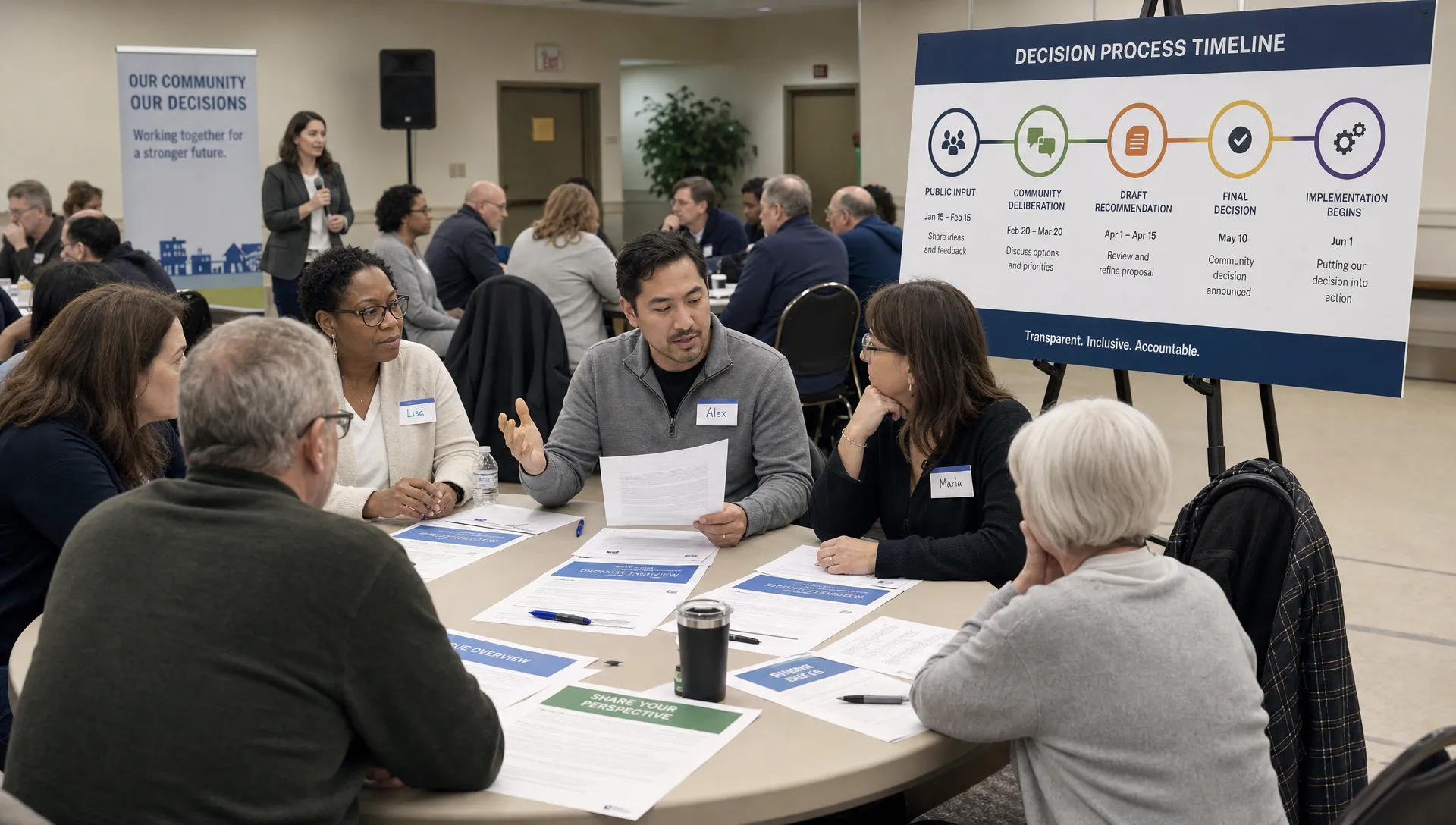
JustSocial has written about this as a need for participation that includes a real decision link, meaning citizens should know who decides, when the decision will be made, what rule will be used and how public input will be answered. Without that link, participation becomes decoration. With it, participation becomes accountability.
Discursive democracy catches drift early
Discursive democracy focuses on public reasoning, open speech and the formation of shared meaning before formal decisions are locked in. It matters because many bureaucratic failures begin at the level of problem definition.
If a transport agency defines the problem as low bus efficiency, it may cut stops. If riders define the problem as unreliable access to work, the same data may point toward different scheduling, better shelters or changes in routes. If a school system defines the problem as test performance, it may add more standardized preparation. If students, parents and teachers define the problem as disengagement, the answer may involve project based learning, counseling and a more holistic school day.
This connects directly to the JustSocial manifesto, which criticizes inherited industrial structures in education and public administration. The claim is not only that old systems are inefficient. It is that they carry old assumptions about citizens, workers and students as units to be processed rather than people who can think, speak, organize and help shape the institutions around them.
Discursive democracy slows the rush from administrative category to administrative solution. It asks: Who named the problem? Who was left out? Which experiences are missing from the official memo? Which words hide the real cost?
That kind of public speech is not a luxury. It is an early warning system.
Deliberative democracy forces trade-offs into the open
Discursive democracy helps citizens frame the problem. Deliberative democracy helps them reason through choices. It is not the same as a comment box or a poll. A deliberative process gives participants access to evidence, exposes them to competing arguments and asks them to weigh consequences together.
This is one of the best safeguards against both bureaucratic drift and shallow populism. Bureaucracies often hide behind complexity. Populist politics often pretends complexity does not exist. Deliberation takes a better path: it brings complexity into public view, then asks citizens to work through it.
A city budget is a good example. If officials ask residents whether they want better parks, faster permits, lower taxes, more shelters and cleaner streets, most people will say yes to all of it. That is not useful. If residents deliberate with real budget numbers, service constraints and legal obligations, they can begin to rank priorities, identify waste and understand what each choice costs.
The result is not perfect consensus. It is better disagreement. Citizens can see why a decision was hard, officials can see which values the public prioritized and the final decision can be judged against a clearer democratic record.
Continuous civic participation closes the loop
The strongest check on bureaucratic drift combines discursive democracy, deliberative democracy and continuous participation. Citizens should be able to speak, reason and return. A one time consultation is too easy to manage. A permanent participation layer changes the incentives.
JustSocial has described this broader idea through the proposal for a People’s Branch, a participation layer where public input is structured, ongoing and accountable. The crucial point is that citizens are not merely invited to react after decisions are designed. They become a standing democratic presence that institutions must account for.
That presence can check drift in small ways before failures become large. A digital service that excludes elderly users can be flagged early. A committee that stops publishing useful records can be challenged. A procurement process that ignores community needs can be questioned before a contract is final. A school reform that looks efficient from the ministry can be tested against teachers, parents and students before it hardens into policy.
What the JustSocial manifesto adds to the argument
The JustSocial manifesto frames bureaucratic drift as part of a larger historical problem: public systems built for an earlier industrial age are still governing societies transformed by digital technology, networked communication, remote work, artificial intelligence and real time data.
Its answer is not to abolish the state or romanticize disorder. It asks whether the state can be compelled to become closer to the individual, more transparent, more technologically capable and more open to continuous democratic input.
Several ideas in the manifesto are especially relevant here.
First, the manifesto argues that citizens should not be reduced to voters, taxpayers and consumers. Bureaucratic drift thrives when people are treated this way because the public becomes passive between transactions. Civic participation restores a fourth role: co-governor.
Second, the manifesto proposes that public opinion should be measured more consistently, but not obeyed blindly. This distinction matters. A mature democratic system should hear the people continuously while still protecting rights, law, evidence and institutional independence.
Third, the manifesto emphasizes transparency in committees, documents, recordings and public decision data. Drift becomes easier when decisions disappear into closed rooms. Publishing records does not solve everything, but it gives citizens, journalists, academics and representatives something to inspect.
Fourth, the manifesto places education at the center of democratic renewal. A public that is expected to participate needs civic knowledge, critical thinking, emotional maturity and practice in collective decision making. Civic participation is not only a government feature. It is a cultural habit.
How participation checks drift in practice
Civic participation works best when it is designed as a repeatable public control system, not as a mood. The goal is to create pressure that is informed, visible and hard to dismiss.
| Bureaucratic failure | Civic participation response | What success looks like |
|---|---|---|
| A policy continues after it stops working | Citizens submit evidence from daily experience | The agency reviews the policy against public outcomes |
| A service excludes certain groups | Affected users describe barriers before redesign | Accessibility changes are documented and tested |
| Officials use vague language | Public forums require plain language explanations | Citizens can understand the decision and contest it |
| Hearings become symbolic | Participation is tied to a decision owner and deadline | Officials must answer input before final approval |
| Agencies optimize for internal metrics | Public dashboards include citizen reported outcomes | Performance is measured by lived results, not only compliance |
This is why participation must be designed with receipts. A citizen should not have to wonder whether their input vanished. The system should show what was received, what themes emerged, what evidence was used, which official responded and what changed or did not change.
A government that cannot explain how it handled public input is asking for trust without proof.
Design principles for participation that resists drift
Not every participation process helps. Some are built to absorb anger without changing anything. Others attract only the already powerful, the already organized or the already angry. To check bureaucratic drift, participation needs discipline.
The strongest systems share a few basic principles:
- Decision linkage: Every participation process should connect to a named decision, office, timeline and response duty.
- Plain language: Citizens should not need legal or administrative training to understand what is being decided.
- Inclusion by design: Participation must account for time, disability, language, age, digital access and fear of retaliation.
- Evidence and deliberation: Public input should include lived experience and expert knowledge, with space to test both.
- Public receipts: Institutions should publish what they heard, how they weighed it and why they chose a final path.
These principles turn civic participation from a symbolic exercise into a check on power. They also protect civil servants. When public input is structured, officials receive clearer priorities and better evidence. The relationship becomes less about complaint and defense, more about shared problem solving.
The role of a political movement
A political movement is needed because bureaucratic drift is not only technical. It is political. Institutions rarely give up comfort on their own. Officials may support participation in theory but resist it when it changes timelines, exposes weak reasoning or gives citizens leverage over budgets and priorities.
That is why civic participation has to be demanded, organized and normalized. A movement can do what isolated citizens cannot do easily: build shared language, create prototypes, recruit volunteers, pressure representatives, educate the public and insist that participation be written into the routines of government.
This is where JustSocial’s project of continuous direct democracy becomes practical rather than abstract. The goal is not a single app, petition or campaign. The goal is a culture in which public institutions expect to be observed, questioned and improved by citizens as part of normal democratic life.
Bureaucratic drift feeds on distance. A political movement reduces that distance by making public participation persistent, organized and technologically capable.
The hard limits and why they matter
Civic participation is not magic. It can be captured by organized interests. It can become performative. It can overwhelm agencies if poorly designed. Digital democracy tools can create privacy, security and manipulation risks. A serious movement should admit these risks rather than wave them away.
The answer is not less participation. The answer is better architecture.
Anonymous or privacy preserving participation can protect citizens while still allowing useful demographic and geographic analysis. Public deliberation can reduce manipulation by requiring reasons, not only reactions. Academic review can help evaluate whether participation processes are fair. Transparent records can make it easier to detect when an agency listens only to convenient voices.
The JustSocial manifesto points toward this balance by arguing for stronger public technology, more transparency and an independent role for academia. That combination matters because continuous participation without safeguards could become chaos, but bureaucracy without participation becomes drift.
The democratic task is to build institutions that can listen without surrendering judgment, act without hiding and use expertise without silencing the people affected by it.
Frequently Asked Questions
What is bureaucratic drift? Bureaucratic drift is the gradual movement of public institutions away from their public mission and toward internal convenience, risk avoidance, procedural self-protection or detached professional judgment.
How does civic participation prevent bureaucratic drift? Civic participation creates ongoing feedback, public scrutiny and decision accountability. It helps citizens identify problems early, challenge official assumptions and require institutions to explain how public input affected outcomes.
What is the difference between deliberative democracy and discursive democracy? Discursive democracy focuses on open public reasoning and how society defines problems. Deliberative democracy focuses on structured discussion of options, evidence and trade-offs before decisions are made.
Can continuous civic participation replace elected representatives? Not necessarily. In the JustSocial vision, continuous participation surrounds and informs representative government. Representatives still make decisions, but they do so with a clearer, more measurable understanding of public opinion and public reasoning.
What makes civic participation meaningful rather than symbolic? Meaningful participation is tied to a real decision, a named decision maker, a timeline, transparent evidence and a public response. Without those elements, participation can become a ritual that absorbs public energy without changing power.
From drift to democratic correction
Bureaucracy will always tend to drift unless something pulls it back toward public purpose. Elections pull occasionally. Scandals pull too late. Protests pull unevenly. Civic participation can pull continuously.
That is the deeper promise of continuous direct democracy: not constant voting on everything, but constant democratic presence. Citizens should be able to speak into the state, reason with one another, inspect public decisions and see how their input is treated.
If the public sector is going to meet the demands of the current technological age, it cannot remain a closed industrial machine with a digital front door. It has to become a living democratic system. That change will not come from bureaucracy alone. It will come from citizens organized enough to demand it and from a political movement willing to build the tools, habits and institutions that make participation real.