
Libraries, parks, plazas, community rooms and school-adjacent public spaces are where democracy becomes physical. Civic participation in library and public space decisions matters because these places shape who can gather, learn, rest, organize, protest, study, connect with public services and feel that the state is something they belong to rather than something done to them.
Why Civic Participation Belongs in Libraries and Public Spaces
A library is not only a building with books. A public square is not only a paved area between roads. Both are civic infrastructure, which means their design, rules, budgets and programs influence public life.
The IFLA-UNESCO Public Library Manifesto describes the public library as a force for education, culture, inclusion and information. That makes library decisions political in the best sense of the word: they affect how people enter public life, how they access knowledge and how they meet others across class, age, religion, ethnicity and ideology.
This connects directly to the JustSocial manifesto's idea of moving from a distant, industrialized state toward a more intimate public culture, closer to the ancient Polis but scaled through modern technology. In that vision, people are not reduced to voters, taxpayers and consumers. They are participants in the daily life of the community.
When civic participation is taken seriously, a renovation of a library branch, a new park rule or the redesign of a town square becomes more than an administrative project. It becomes a small but real test of whether government can listen, explain and adapt.
What Decisions Should the Public Actually Influence?
Public input is often invited too late, after the real decision has already been made. A city presents a nearly finished design, asks residents to comment and then treats the public meeting as proof of legitimacy. That is consultation theater, not democracy.
For library and public space projects, civic participation should begin before the solution is locked. Residents should be able to influence the problem definition, the priorities, the tradeoffs and the final accountability measures.
| Decision area | What the public should see | What residents can help decide | Accountable outcome |
|---|---|---|---|
| Library hours | Usage data, staffing limits, budget options | Which hours matter most for students, workers, parents and seniors | Published schedule rationale |
| Building design | Floor plans, access constraints, cost ranges | Quiet zones, community rooms, youth areas, outdoor access | Updated design response |
| Public space rules | Existing complaints, safety data, legal limits | Rules for noise, events, vendors, pets and protests | Clear policy and review date |
| Programming | Attendance patterns, community needs, partner options | Workshops, language classes, civic forums, cultural events | Annual program plan |
| Budget priorities | Maintenance backlog, capital costs, grant limits | What to fund now, later or not at all | Public budget explanation |
This does not mean every decision becomes a referendum. It means officials must define where public judgment belongs and where professional, legal or safety constraints apply. The line should be visible, not hidden.
Discursive Democracy Comes Before Deliberative Democracy
Before a community can deliberate well, people need space to speak in their own language. This is where discursive democracy matters. It recognizes that democracy is not only voting or formal debate. It is also conversation, storytelling, disagreement, testimony and the exchange of lived experience.
In a library decision, a parent may describe why Saturday hours matter. A teenager may explain why there is nowhere safe to sit after school. A wheelchair user may identify an entrance problem that architects missed. A local business owner may worry about street access during construction.
These voices do not automatically produce a decision, but they reveal what the decision is really about. Civic participation fails when public agencies collect comments as isolated fragments and never show how they shaped the official understanding of the issue.
The JustSocial manifesto imagines technology that helps the state measure public opinion continuously, not only once every few years. Applied locally, that means a library board or city department should not treat public feedback as noise. It should treat it as structured civic knowledge.
From Open Mic Meetings to Deliberative Democracy
Open mic meetings are useful for visibility, but they are often bad at solving shared problems. The loudest voices dominate, technical information is uneven and officials can claim they listened without changing the decision.
Deliberative democracy adds structure. It gives residents balanced information, enough time to understand tradeoffs and a process for weighing competing values. For example, a community may need to choose between longer library hours, more staff support, better accessibility upgrades and new digital equipment. All may be worthy, but the budget may not cover everything this year.
A deliberative process should include people who use the space heavily, people who rarely use it, people who feel excluded from it and people who will be affected by nearby changes. In that setting, civic participation becomes less about winning a shouting match and more about forming public judgment.
This is especially important for libraries and public spaces because they must serve overlapping communities. A quiet reading room, a children's area, a homeless outreach desk, a public lecture and a youth gaming event may all belong in the same institution. The democratic question is how to make room for difference without letting one group capture the whole space.
A Practical Process for Library and Public Space Decisions
Good participation needs a process that residents can understand. It should not require insider knowledge, legal training or free time during weekday working hours.
Name the Decision, Owner and Window
Every participation process should begin with a simple public statement: what is being decided, who owns the decision, when the decision will be made and how public input will be used.
JustSocial has argued elsewhere that participation only matters when it is connected to a real decision point, which is the core idea behind civic participation that actually changes decisions. A library renovation should not ask for vague community dreams if the only open question is the furniture plan. Honesty builds trust.
Publish the Facts in Plain Language
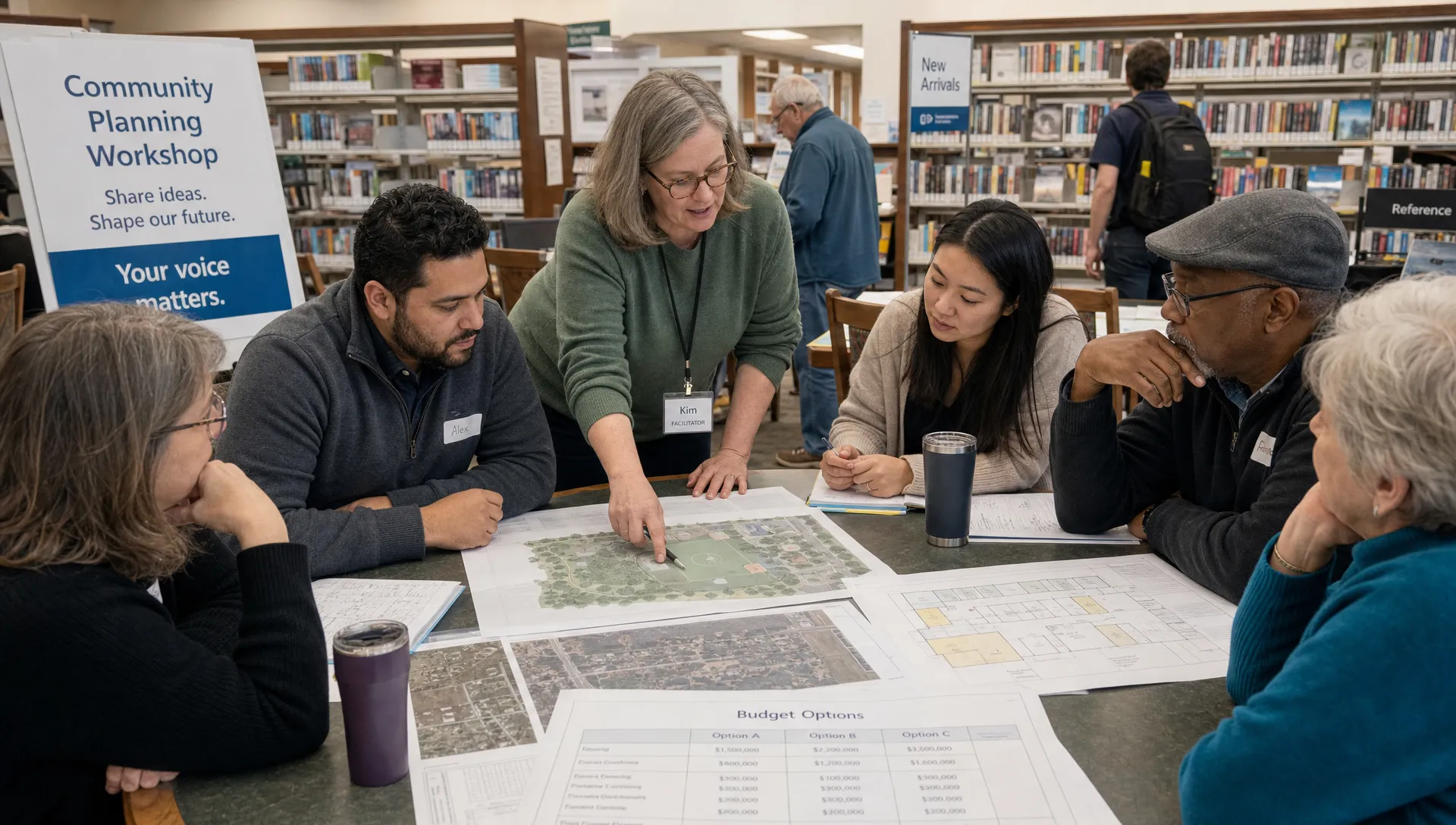
Residents need the same basic materials officials use: budgets, constraints, maps, schedules, usage data and legal limits. These should be published in plain language, with translations where needed and offline access for residents who are not digitally connected.
For civic participation to be fair, information cannot sit inside long PDF files that only professionals can decode. Libraries are well suited to host public information desks, printed summaries and facilitated explanation sessions.
Meet People Where They Already Are
A public meeting at city hall will miss many people. A library and public space process should include branch pop-ups, school events, senior centers, youth clubs, local markets, religious institutions and online channels.
The point is not to maximize comments for its own sake. The point is to hear from the people whose routines will be changed by the decision, including people who do not see themselves as political.
Deliberate Around Real Tradeoffs
The public should be invited to compare options, not merely react to a preferred plan. If a city can fund two of five upgrades this year, residents should see the costs, consequences and timelines of each option.
This is where deliberative democracy becomes practical. Residents can discuss whether safety lighting should come before a new event stage, whether a library needs more study rooms or longer hours and whether a plaza should prioritize markets, shade, seating, demonstrations or children's play.
Respond Publicly, Then Review Later
After the decision, officials should publish a response that says what changed, what did not change and why. Six or twelve months later, the public should be invited to review whether the decision worked.
This is close to the decision loop model described in JustSocial's article on better local decision loops. A public space decision should not end at ribbon cutting. It should continue through use, review and correction.
Technology Can Help, but Trust Comes First
Digital tools can make participation easier. Online surveys, public dashboards, livestreamed meetings, searchable archives and secure voting tools can widen access, especially for people who cannot attend meetings in person.
But technology does not make a process democratic by itself. A biased survey, a confusing platform or an unmoderated comment feed can deepen mistrust. In library and public space decisions, civic participation should use technology to clarify choices, protect privacy and show the path from public input to public decision.
The JustSocial manifesto discusses state-sanctioned public platforms, anonymous identification, analytics and secure digital participation as part of continuous direct democracy. For local projects, the same principle can be applied modestly: residents should be able to see the issue, understand the options, register their view and track the outcome.
Libraries can play a special role here because they already help people cross the digital divide. A participation platform is more legitimate when residents can use a library computer, ask staff how to access materials and submit input without owning the newest device.
Why Libraries Are Natural Homes for a Political Movement
A political movement that wants deeper democracy should care about libraries because libraries are one of the few public institutions that still welcome people without requiring them to buy something. They are also trusted spaces for learning, association and public information.
That does not mean turning libraries into partisan headquarters. It means recognizing that democratic capacity has to be built somewhere. People need places to learn how budgets work, how committees operate, how planning choices are made and how public testimony can be connected to action.
In the JustSocial manifesto, Yuval D. Vered argues for a future in which the state listens continuously and the people become a real branch of public life. The full JustSocial manifesto frames this as part of a move toward a Cosmopolis, a modern civic culture where technology and community strengthen one another.
Library and public space decisions are practical starting points for that larger political movement. They are local enough for residents to see results, but deep enough to reveal the habits of government: whether it hides information, whether it listens selectively, whether it explains tradeoffs and whether it returns after the decision to learn.
Common Failure Modes and Better Alternatives
Many participation processes fail for predictable reasons. They invite people too late, define the question too vaguely or ignore the people most affected by the outcome.
| Failure mode | What it looks like | Better alternative |
|---|---|---|
| Late consultation | The design is finished before residents see it | Invite input before options are narrowed |
| Performative listening | Officials collect comments with no response | Publish a response matrix and decision rationale |
| Digital exclusion | All input happens through online forms | Combine online tools with library access and in-person sessions |
| Unclear authority | Nobody knows who can change the decision | Name the decision owner from the start |
| One-time engagement | The public is dismissed after approval | Schedule post-implementation review |
The point is not to make every process perfect. It is to make participation visible, answerable and capable of changing something. Civic participation gains legitimacy when residents can trace a line from their time and testimony to a public decision, even when they do not get everything they wanted.
A Public Space Test for Continuous Democracy
If a city cannot explain how residents influence a library redesign, why should citizens trust it to handle larger decisions on education, housing, transportation or national policy? Local spaces are the training ground for bigger democratic reforms.
This is why civic infrastructure matters. A community that learns how to deliberate about library hours can learn how to deliberate about school priorities. A city that publishes committee documents for a park redesign can learn how to publish more government records. A public agency that responds clearly to residents in one project can build habits of transparency for the next.
For JustSocial, the deeper goal is continuous direct democracy: a society where public opinion is not trapped inside election cycles and where representatives become more accountable to the people they claim to serve. Library and public space decisions offer a concrete place to practice that culture now.
Frequently Asked Questions
Why should residents influence library decisions? Libraries are public institutions funded for public benefit. Residents can help identify access barriers, program needs, design priorities and rules that officials may miss without lived experience.
Is every public space decision suitable for voting? No. Some decisions involve law, safety, engineering or professional standards. The public should still be able to shape priorities, evaluate tradeoffs and receive a clear explanation of final choices.
How does deliberative democracy improve public meetings? Deliberative democracy gives residents balanced information, time to discuss tradeoffs and a structured way to form public judgment. It reduces the risk that only the loudest or most organized voices shape the outcome.
What is the role of discursive democracy in local planning? Discursive democracy makes room for stories, identity, disagreement and informal conversation. It helps officials understand what a library or public space means in daily life before narrowing choices into formal options.
How can technology support fair participation? Technology can publish materials, collect input, show decision timelines and track outcomes. It should be paired with offline access, privacy protections and clear accountability so it widens participation rather than replacing it.
Build Public Spaces That Listen
Library and public space decisions are not minor administrative details. They are everyday tests of whether democracy can become more continuous, transparent and human.
If you believe residents should have a real voice between elections, explore JustSocial's work on continuous direct democracy, read the manifesto and consider how your own city, school, library or neighborhood could turn public input into decisions people can actually see.





