
Community radio and local news are where democracy becomes personal. Discursive democracy gives these institutions a practical role beyond reporting what officials have already decided: helping residents reason together, test claims, hear one another and turn shared concerns into civic participation.
For JustSocial, this matters because continuous direct democracy cannot live only inside a voting app, a parliament livestream or a campaign slogan. It needs everyday public spaces where people learn how to speak, listen, disagree and form judgment. Local media can become one of those spaces, especially when it treats conversation as civic infrastructure rather than background noise.
Why discursive democracy belongs in community media
National politics often turns public life into a spectacle. Local news and community radio operate differently. They sit closer to the school board, the clinic, the bus route, the neighborhood park, the small business corridor and the family trying to understand a new public policy.
That closeness gives local media a democratic advantage. It can ask questions that are too specific for national outlets but deeply important to residents: Which crossing is dangerous? Why did the water bill rise? Who benefits from a zoning change? What do teachers, parents, students and officials each see that the others miss?
In this setting, discursive democracy means designing journalism so public discussion becomes visible, structured and useful. It does not ask reporters to become activists or replace elected officials. It asks them to build a better public record of reasons, evidence, tradeoffs and community priorities.
JustSocial’s manifesto argues that citizens should not be reduced to voters, taxpayers and consumers. Community media can help break that reduction by making citizens audible between elections.
From broadcast to civic loop
Traditional journalism often follows a linear model: something happens, a reporter covers it, audiences react privately or on social media, then the news cycle moves on. Community radio and local news can do more by creating a civic loop.
| Traditional coverage | Discursive local coverage |
|---|---|
| Reports an issue after it becomes news | Frames the issue before decisions harden |
| Quotes officials and a few affected residents | Maps the range of public reasons and lived experiences |
| Measures reach, clicks or call-ins | Tracks questions, proposals, objections and unresolved facts |
| Ends with publication or broadcast | Sends a structured public record back to institutions |
| Treats audience response as engagement | Treats response as civic participation |
A civic loop is not a referendum. It is a repeatable process that helps a community understand itself. It gives public officials better signals, gives residents a clearer path into civic life and gives journalists a stronger public-service mission.
This is close to what JustSocial calls the politics of listening. In a continuous democracy, listening is not a soft virtue. It is an operating system for public life, and local media can be one of its most trusted interfaces.
What discursive democracy sounds like on air and online
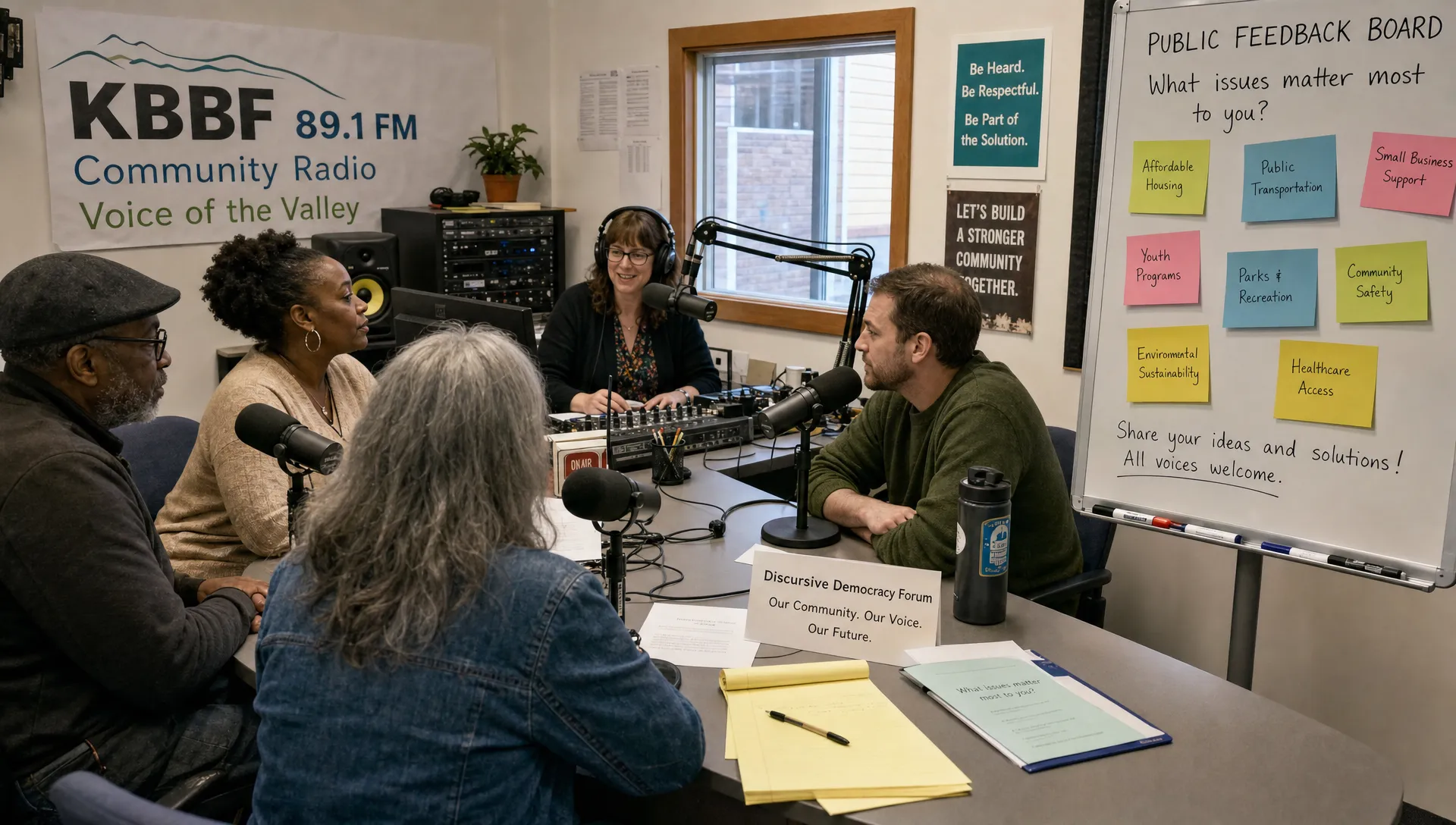
A community radio station practicing discursive democracy would not simply open the phone lines and hope for wisdom. Open calls can be valuable, but they often reward speed, confidence and anger. A discursive format gives conversation a shape.
A host might begin with a short evidence brief: what is known, what is disputed, what decision is coming and who has authority over it. A reporter could then bring in different affected groups, not as combatants but as witnesses to different parts of the issue. Listeners could send questions by voice note, text, email or an accessible web form.
The producer’s job would be to group contributions by substance. Some comments are about cost. Others are about safety, fairness, history, accessibility or trust. By the end of the program, the community has not merely “talked.” It has produced a map of public reasoning.
Local newsrooms can publish the same map beside the story: key facts, strongest arguments, unanswered questions, official responses and next steps. That turns a news item into a civic document.
The newsroom as convener, not ruler
There is a legitimate fear that “dialogue journalism” can become manipulation if the newsroom decides which voices matter. That is why the process must be transparent.
Editors should explain how topics are chosen, how comments are moderated, how sources are verified and how public input is summarized. They should separate reporting from opinion and make clear when a conversation is meant to inform a decision rather than decide it.
This distinction protects journalism. Local media should not pretend to be a parliament, a court or a city council. Its democratic power comes from convening public reasoning in a way institutions can read and residents can trust.
JustSocial’s writing on discursive democracy as a politics of listening is useful here because it shifts the focus from noise to response. A democratic conversation is incomplete unless someone responsible hears it, answers it and explains what happens next.
Inclusion is the test of the model
Any local media project that claims to serve democracy must ask who is missing. Some residents do not call radio shows because they fear public speaking. Others face language barriers, speech differences, disability, limited literacy, distrust of institutions or lack of internet access.
This is where community radio has a special role. Voice can be warmer than a comment box. A local host can slow down, repeat, translate, summarize and make room for people who would never attend a formal public hearing.
Communication access is not a side issue. If the goal is citizen empowerment, communities need practices that include people with different communication needs, including children, older adults, people recovering from neurological injury and people who use therapy or support to build confidence. Local stations and civic groups can learn from the broader work of speech and language support providers, especially when designing forums where every resident deserves a meaningful way to participate.
A practical workflow for local newsrooms
The best way to make discursive democracy useful is to turn it into a newsroom routine. It should not depend on heroic effort every time a controversy appears.
Start with issue intake
Invite residents to submit local problems before they become crises. A station might ask, “What decision is affecting your daily life that no one has explained well?” A newsroom can gather submissions from calls, WhatsApp groups, library drop boxes, community meetings and local organizations.
The intake process should tag each issue by place, institution, affected group, urgency and decision timeline. This gives editors a way to see patterns rather than chase only the loudest complaint.
Build a public evidence brief
Before hosting a discussion, publish or broadcast a plain-language brief. It should include the decision at stake, the responsible authority, the timeline, the budget if known, the legal constraints and the main unanswered questions.
This protects the conversation from becoming a rumor exchange. It also respects residents enough to give them the facts they need to participate intelligently.
Host structured dialogue
A good local forum should include disagreement without rewarding humiliation. The host can ask each participant to name the value behind their position: safety, affordability, dignity, stability, freedom, opportunity or trust.
When people explain values, not only preferences, the public can see where compromise may be possible and where the conflict is real.
Publish the civic record
After the broadcast or article, summarize the conversation in a public record. This does not need to be complicated. It should include the strongest arguments, common concerns, minority views, corrections, open questions and official commitments.
For communities looking for a broader implementation model, JustSocial’s practical guide for communities offers a wider framework for turning public reasoning into auditable local decisions.
Community radio can reach where platforms cannot
Digital platforms are powerful, but they are not neutral public squares. Algorithms reward emotion, identity conflict and constant reaction. Local radio, especially when paired with a local website or newsletter, can slow the pace.
Radio also has a memory function. A weekly segment can return to the same public issue until there is an answer. Did the municipality respond? Did the school board publish the data? Did the transit agency explain the route change? Did the promised repair happen?
This is where discursive democracy becomes accountability. Conversation is not enough. The public record must follow power.
Community radio can also bridge generations. Older residents may trust call-in shows. Younger residents may prefer clips, polls, group chats or short explainers. A local newsroom can connect these modes without forcing everyone into the same platform.
Local news as a school for citizenship
The JustSocial manifesto links democracy with education, arguing that people must be prepared to take part in public life rather than be managed by distant systems. Local media can become a civic classroom without becoming patronizing.
A good explainer on property taxes, public procurement or school budgets teaches residents how power works. A well-moderated public conversation teaches democratic habits: listening, asking for evidence, changing one’s mind, noticing who is absent and distinguishing a personal frustration from a public problem.
This educational role matters because many people meet government only through bureaucracy, crisis or elections. Local journalism can make public life more legible. Community radio can make it more human.
How discursive democracy connects to the JustSocial manifesto
JustSocial’s manifesto imagines a modern democracy where citizens have a daily role in shaping public affairs. It speaks of a “people” branch of government, public technology, transparent committees, civic analytics and a renewed version of the Polis, scaled through modern tools.
Community radio and local news are not substitutes for those tools, but they are cultural preparation for them. People will not suddenly practice continuous direct democracy well if public conversation remains chaotic, cynical and performative. They need trusted spaces where democratic speech becomes ordinary.
The manifesto’s idea of the Cosmopolis depends on more than software. It depends on citizens who can move from complaint to proposal, from identity to shared problem, from outrage to accountable action. Local media can train those muscles every week.
That makes this article’s angle intentionally local. The future of democracy may require platforms, voting systems and transparent public data, but it also requires a familiar voice on the radio asking the right question and a local reporter turning scattered frustration into a public map.
Risks local media must manage
Discursive formats can fail if they become partisan theater, donor branding or unmoderated grievance sessions. Local newsrooms should set clear rules before launching them.
A useful format needs viewpoint diversity, factual correction, moderation standards, privacy protections and a visible response path. If officials are invited, they should not be allowed to use the forum as a campaign stage. If citizens participate, they should know whether their names, recordings or comments will be published.
Local media should also avoid pretending that every issue has a middle ground. Some public problems involve rights, safety or corruption. In those cases, the discursive task is not to manufacture consensus. It is to clarify evidence, expose power and give the community a truthful record of the conflict.
A starter format for one local issue
A newsroom or station can begin small. Choose one issue with a real decision timeline, such as a school closure, transit change, housing development, hospital service reduction or public safety concern.
Create a three-part format:
- Before the conversation: Publish a short brief explaining the decision, timeline, authority, known facts and unanswered questions.
- During the conversation: Host residents, officials and affected groups with clear moderation and a focus on reasons rather than slogans.
- After the conversation: Publish a civic record and send it to the relevant institution, then report back on the response.
This is simple enough for a small newsroom but serious enough to change the relationship between media, residents and government.
Frequently Asked Questions
What is discursive democracy in local news? Discursive democracy in local news is a model where journalism helps residents reason together about public problems, not merely consume information. It structures public input, evidence, disagreement and institutional response.
How is this different from a normal call-in show? A call-in show collects voices. A discursive format organizes those voices into a public record of reasons, questions, proposals and official responses. The goal is not only expression but civic usefulness.
Can community radio stay neutral while hosting public dialogue? Yes, if it is transparent about topic selection, moderation, evidence standards and summaries. Neutrality should not mean passivity. A newsroom can actively structure fair dialogue without endorsing a policy outcome.
Does this replace voting or representative democracy? No. It strengthens democracy between elections by giving citizens more continuous ways to be heard. JustSocial’s vision treats public participation as a daily civic practice, while formal institutions still carry legal authority.
What should a small newsroom do first? Start with one local issue, one evidence brief, one moderated conversation and one published civic record. Build trust through repetition before expanding into larger civic participation projects.
Build the local habits of modern democracy
If democracy is going to become more continuous, transparent and participatory, people need places to practice it. Community radio and local news already have the proximity, trust and storytelling skills to help.
JustSocial is working toward a political culture where citizens are heard more than once every few years. Explore the JustSocial manifesto and consider how your newsroom, station or community group can help turn local conversation into democratic power.





