
Discursive democracy depends on people being able to challenge one another’s claims without turning every disagreement into a contest of endurance. That becomes difficult when someone repeatedly dodges questions, distorts an opponent’s position or demands evidence they will never consider. But accusing someone of “bad faith” can also become a shortcut for dismissing uncomfortable criticism.
The practical goal is not to prove what another person secretly intends. It is to establish whether their argument can be examined fairly, give them a clear opportunity to engage and protect everyone else’s ability to participate if they refuse.
What Bad Faith Means in Discursive Democracy
A bad-faith argument uses the appearance of discussion while evading its basic obligations. A participant might demand accountability from others while refusing it themselves, repeat a corrected claim without addressing the correction or keep changing what would count as an adequate answer.
An incorrect claim is not automatically a bad-faith argument. Neither are anger, distrust, limited vocabulary or refusal to compromise on a fundamental right. Someone can be mistaken and sincere. Someone else can be calm, articulate and evasive.
Because motives are difficult to establish, focus on observable conduct:
| Pattern | What you can observe | A fair initial response |
|---|---|---|
| Moving the goalposts | An agreed standard changes after it is met | Ask whether the original standard has been satisfied |
| Straw-manning | A position is replaced with a stronger or different claim | Restate the actual proposal and request a response to it |
| Whataboutism | Another controversy replaces the question under discussion | Explain its relevance or return to the current question |
| Evidence flooding | Numerous claims arrive faster than anyone can check them | Ask the speaker to select the strongest relevant claim |
| Repetition without engagement | A claim returns after a substantive answer | Ask what remains unanswered in that response |
Each pattern can occur accidentally. The more useful warning sign is continued evasion after a clear explanation and a reasonable opportunity to respond.
Separate Dishonesty From Missing Context
Before setting a boundary, check whether the person understands the question, the institution involved and the terms being used. Public discussions often bring together people with very different levels of knowledge.
Imagine a consultation about multilingual signs at a Japanese transit hub. Residents, commuters and visitors who rely on local travel and navigation assistance in Japan may experience the same station differently. A visitor’s basic questions about transport arrangements do not establish dishonesty, just as a resident’s familiarity does not make every assumption correct.
The same principle applies to school funding, housing policy or committee procedures. Explain unfamiliar terms and ask the person to restate the issue in their own words. If they cannot access the document being discussed, provide an accessible summary before demanding a response.
Distrust also deserves examination rather than automatic dismissal. Someone whose neighborhood has repeatedly received unfulfilled promises may reasonably question another consultation. Ask what happened and what accountability would make the present process credible.
Discursive democracy loses its value when fluency becomes a substitute for sincerity. Test whether a participant will engage with a clear explanation, not whether they already speak like a policy professional.
Test the Argument Before Judging the Person
Three questions can reveal whether a disagreement is workable. They are diagnostic tools, not a demand that everyone abandon their convictions.
What exactly are you claiming?
Narrow broad accusations into something assessable.
“Officials always waste money” might become “The proposed evening bus route costs more than the published budget allows.” The second claim can be checked. The first combines a factual allegation, frustration and a sweeping judgment.
Ask for one claim at a time. A person should not have to answer every criticism of an institution before discussing one proposal.
What supports that factual claim?
Request the source, relevant passage or direct experience behind the assertion. Apply the same standard to claims you favor.
Different claims need different support. A budget figure calls for a budget document. A resident describing a missed bus is reporting an experience, not necessarily estimating the citywide frequency of missed buses.
Distinguishing these prevents both unsupported generalizations and unfair demands that people produce a research report before describing a problem.
What would resolve the factual disagreement?
For an empirical claim, ask what evidence would lead the participant to revise their assessment. A useful answer might identify a document, measurement or independent review.
For a value judgment, ask a different question: “How should that principle shape the proposal?” Someone need not surrender a commitment to equal access or minority rights to participate honestly.
Discursive democracy can accommodate enduring moral disagreement. What it cannot sustain is a process where factual assertions are treated as immune to examination.
Response Scripts for Common Bad-Faith Tactics
Keep responses short enough that the original issue remains visible. The purpose is to restore a shared question, not deliver a lecture about fallacies.
When someone misrepresents your position
Try: “My proposal is an evening-route pilot, not the removal of daytime service. Do you object to the pilot as described?”
Correct the distortion once and point to the actual proposal. If the altered version returns, name the discrepancy rather than repeatedly defending a position you never held.
A useful record might say: “The objection addresses removing daytime service, which is not part of this proposal.” That lets other participants follow the disagreement without having to infer anyone’s motives.
When the standard keeps changing
Try: “You asked for the published cost estimate, and it is now available. Does it answer that question? If you have a separate concern about ridership, let’s identify it separately.”
New questions are legitimate. The problem is pretending that an answered question was never answered. Separate the completed inquiry from the new one so the discussion can accumulate progress.
When another controversy takes over
Try: “That comparison could matter if it changes how we assess this proposal. What connection are you asking us to consider?”
Not every comparison is whataboutism. Evidence of inconsistent treatment can be relevant. If no connection is offered, return to the agreed scope and provide a separate route for raising the other issue.
When someone overwhelms the discussion with claims
Try: “We cannot check all twelve claims in this session. Please choose the one that most directly affects the decision and provide its strongest support.”
Do not accept an unlimited burden to disprove everything. The person making a claim has a responsibility to explain and support it. Other participants should not lose their speaking time because one speaker can generate allegations quickly.
In discursive democracy, patience should make inquiry possible, not reward the participant who consumes the most attention.
Set a Stopping Rule Without Silencing Dissent
A fair stopping rule should be announced, proportionate and tied to conduct. “We dislike your conclusion” is not a defensible reason to end someone’s contribution. “You have repeated the same allegation without addressing the requested evidence” identifies a process problem.
For ordinary evasion, use a sequence: clarify the question, identify the unanswered point and offer one final opportunity to address it. Then pause that line of argument if the pattern continues.
A boundary can be direct: “This point will remain recorded as an unsupported allegation. We are moving on unless you can provide new evidence or address the response already given.”
That is different from deleting every trace of dissent. Preserve the objection accurately, including any valid concern within it. Allow re-entry when the person supplies relevant evidence or engages with the actual question.
Threats, targeted harassment and exposure of private information require faster intervention. People subjected to abuse should not be required to debate their harasser before receiving protection.
JustSocial’s discussion of free speech and process boundaries addresses the broader distinction. Here, the operational question is narrower: what conduct is preventing this discussion from examining its agreed issue?
Discursive democracy needs consistent procedure, but consistency does not mean giving unsupported claims the same credibility as well-supported ones.
Keep the Burden Fair Across Political Sides
A political movement undermines its own public reasoning when it recognizes evasive tactics only in its opponents. Apply the same tests to a popular organizer, a public official and a skeptical resident.
Facilitators also need to be answerable. If they rule a comparison irrelevant, they should explain why. If they misunderstand a contribution, they should correct the record. A participant’s challenge to the facilitator is not automatically disruption.
Be especially careful when a dispute concerns institutional power. A demand for documents that officials control is not equivalent to a demand that a resident prove every aspect of their lived experience. Responsibilities depend partly on who possesses the relevant information.
A healthy process can accept criticism of its own design while declining endless repetition. Provide a way to challenge a procedural ruling without allowing that challenge to consume the entire meeting.
The aim is neither automatic agreement nor enforced politeness. It is an environment where claims can be tested and people can criticize those with authority without losing their opportunity to be heard.
Turn the Disagreement Into a Decision Record
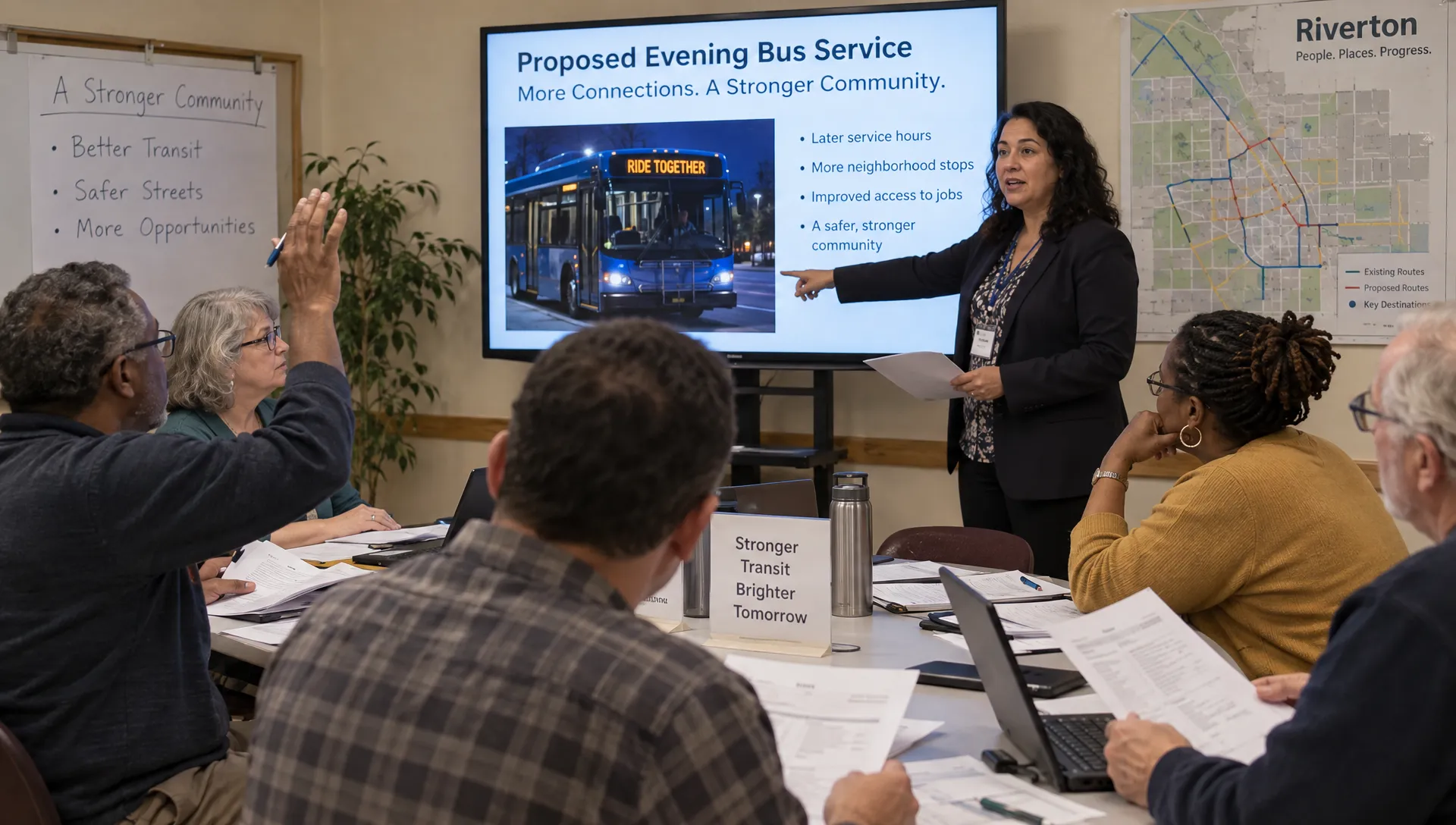
Consider an illustrative consultation on an evening bus-route pilot. A participant claims the route will cost twice the amount stated in the proposal. The facilitator asks for the calculation. A budget document resolves one cost question, but the participant then says the route will be useless regardless of its price.
Do not combine those objections into one endless argument. Record what happened:
- Cost claim: The participant has not yet supplied evidence for the higher estimate.
- Service concern: Whether the route serves the intended riders remains a legitimate question.
- Next step: Review ridership assumptions and identify what the pilot would measure.
This preserves a potentially valuable concern without treating the unsupported cost claim as established fact. It also avoids presenting agreement where none exists.
A decision record should distinguish verified facts, unresolved questions and value disagreements. JustSocial’s case for public receipts that connect discussion to decisions offers a useful foundation for this accountability.
For discursive democracy to matter, participants need to see not only who spoke but what officials did with the arguments.
How This Connects to JustSocial’s Manifesto
The JustSocial manifesto’s proposal for continuous citizen input argues that people should be heard between elections. It also makes an important distinction: public opinion should inform representatives without automatically becoming a binding referendum or removing institutional independence.
Handling bad-faith arguments is part of making that proposal workable. Continuous civic participation would offer little improvement if the loudest repetition became the strongest signal, or if officials could dismiss difficult criticism merely by labeling it dishonest.
The manifesto describes concepts for participation platforms and public-opinion analytics. Those aspirations create design questions, not guarantees that technology has already solved them. Systems would need to distinguish an unresolved objection from a repeated slogan and a factual correction from a popularity contest.
Any collection of political views also requires careful privacy protection. Bad-faith assessment should concern behavior within the discussion, not inferred political identity, faction or personal profile.
The connection to deliberative democracy is practical: wider participation needs opportunities for people to examine reasons, receive answers and understand decisions. More input alone does not produce better judgment.
Frequently Asked Questions
How can I tell whether someone is arguing in bad faith? You usually cannot establish their private motives. Look for repeated, observable evasion after a clear question, explanation and reasonable opportunity to respond. Treat the conclusion as a basis for a procedural boundary, not a definitive judgment about their character.
Should I call out a bad-faith argument directly? Usually, name the conduct first: “That changes the standard we agreed on” or “That is not the proposal under discussion.” Specific descriptions are easier to examine and less likely to turn the conversation into a dispute over intentions.
What if someone refuses to change their mind? Refusing to abandon a value or political position is not itself bad faith. Ask whether they will address evidence, represent others’ views accurately and accept shared procedures. Agreement is not the admission price for participation.
When should I stop responding? Stop when the same issue has received a substantive answer and the participant neither addresses it nor adds relevant evidence. State what remains unresolved, explain the boundary and leave a clear route for constructive re-entry.
Put One Fair Test Into Your Next Discussion
At your next community meeting or political movement discussion, begin with a manageable commitment: one claim at a time, a clear standard of support and an explicit stopping rule. Record legitimate disagreement even when you pause an evasive exchange.
That protects both sides of public reasoning: the freedom to challenge a proposal and the opportunity for everyone else to examine it.





