
When a public agency uses an algorithm to rank applications, flag cases or allocate services, residents need more than a comment box. They need to understand the choices being made, challenge the evidence behind them and see what changes follow. Discursive democracy makes public reasoning central to that process, rather than treating participation as a final approval step. A useful consultation should happen while the agency can still change the system, including deciding not to automate the decision at all.
This guide sets out a practical approach to public comment on algorithms, from initial disclosure to ongoing review.
What discursive democracy adds to algorithm consultation
Discursive democracy emphasizes the exchange and examination of reasons. For algorithm oversight, that means asking people to discuss more than whether they support a proposed technology. They should be able to question its purpose, assumptions, consequences and alternatives.
An algorithm does not have to involve artificial intelligence. A fixed scoring formula can shape access to public services just as significantly as a machine-learning model. Both deserve scrutiny when their outputs affect people’s opportunities or treatment.
Public comment is not automatically a binding vote. It is also not a representative survey: a thousand submissions from organized participants cannot establish what the whole population believes. Its value lies in surfacing evidence, exposing overlooked harms and testing institutional justifications.
This distinction fits Yuval David Vered’s JustSocial manifesto, which proposes continuous participation alongside institutions that remain independent. The manifesto calls for public opinion to be heard throughout a government’s term. Algorithm consultation can give that ambition a concrete form, provided officials explain how they considered the input.
Publish an algorithm consultation dossier before asking for comments
People cannot meaningfully assess a system described only as an “efficiency improvement.” Before consultation opens, publish a plain-language dossier identifying the decision, the responsible authority and the options still available.
The UK’s Algorithmic Transparency Recording Standard offers a useful reference for documenting algorithmic tools. Transparency records support scrutiny, but publishing a record alone does not create a deliberative process.
A consultation dossier should address these questions:
| Topic | What the public needs to know |
|---|---|
| Purpose | What problem is being addressed, and why is automation being considered? |
| Decision role | Does the system advise staff, prioritize cases or determine an outcome? |
| Inputs | Which data are used, where do they come from and what is excluded? |
| Decision rules | Which factors, thresholds or objectives influence the output? |
| Evidence | What testing has been completed, and what limitations remain? |
| Accountability | Who can change the system, review an outcome or suspend its use? |
| Alternatives | What would a manual process, a simpler rule or no intervention look like? |
Include worked examples using synthetic records, not identifiable residents’ information. Explain what happens when data are missing or contradictory.
Discursive democracy requires enough disclosure to challenge the reasoning, not necessarily unrestricted publication of source code. Where security or legitimate confidentiality limits disclosure, identify the withheld material, explain why and provide an appropriate independent review route.
Ask the public to challenge specific choices
Separate policy judgments from technical performance
A system can predict accurately and still pursue an unacceptable objective. For example, predicting which applicants are most likely to complete a process is different from deciding who most needs support.
Consultation questions should therefore distinguish policy choices from implementation questions. Residents might challenge whether speed should outweigh equal access, while technical reviewers examine whether the chosen data actually support the stated objective.
Ask questions that leave room for disagreement: “Should missing documents lower an applicant’s priority?” is more useful than “How can we improve our automated prioritization?” The second question assumes the central decision has already been settled.
For discursive democracy to influence design, the agency must name which decisions remain open. If a contract or legal requirement constrains the options, disclose that constraint instead of inviting changes officials cannot deliver.
Accept lived experience as evidence
Residents should not need to understand statistical modeling to contribute. Someone who explains that an address record excludes temporary accommodation may identify a consequential flaw without knowing anything about training data.
Offer a short submission template, while allowing free-form comments:
- Concern: Which rule, input or outcome are you questioning?
- Example: What experience, document or hypothetical case illustrates the problem?
- Consequence: Who could be affected, and how?
- Alternative: What change or safeguard would you suggest?
- Follow-up: What evidence or explanation would help resolve your concern?
Do not make every field mandatory. A resident may understand the harm without knowing how to fix it. Institutional responsibility includes investigating credible concerns, not transferring the entire burden of system design to participants.
Provide phone, paper and facilitated discussion routes alongside online submissions. Otherwise, a consultation about exclusion may reproduce the same exclusion in its participation process.
A worked example: community transport prioritization
Consider a hypothetical council proposal to prioritize community transport requests using appointment urgency, distance and previous booking history. The system would recommend which requests staff review first when capacity is limited.
A dossier could reveal that incomplete booking information lowers a request’s score. Residents might explain that some appointments are arranged by phone, changed at short notice or managed by a caregiver. Missing information would then reflect an administrative barrier, not necessarily lower need.
The consultation should also examine the journey beyond the booking itself. Someone arranging an appointment with Toorak Village Dental Care, for example, may still need help reaching the practice. Public booking and contact information cannot establish whether transport is accessible. The hypothetical algorithm being examined belongs to the transport program, not the clinic.
Discursive democracy would turn those observations into questions for the council: Does the scoring rule disadvantage people who need assistance completing forms? Can staff correct missing information before ranking requests? Should essential journeys receive a protected review pathway?
Possible responses include removing the missing-information penalty, offering assisted applications or testing a simpler prioritization rule. None should be presented as proven improvements until evaluated against the program’s actual needs and constraints.
Turn comments into tests and accountable decisions
Register issues without ranking people
Assign each substantive issue a public reference number and connect it to the relevant system component. Record the concern, supporting evidence and requested change. Remove identifying details before publication unless disclosure is appropriate and the participant has agreed.
Group genuinely similar submissions, but preserve differences in reasoning. Two people may oppose the same threshold for different reasons, and those reasons may require different responses.
Do not rank concerns solely by likes, repetition or the professional status of the author. Discursive democracy evaluates reasons; a single well-supported report can expose a failure that hundreds of general endorsements miss.
Publish how duplicates, abusive content and coordinated submissions are handled. Moderation should protect participation without quietly deleting criticism of the agency or its supplier.
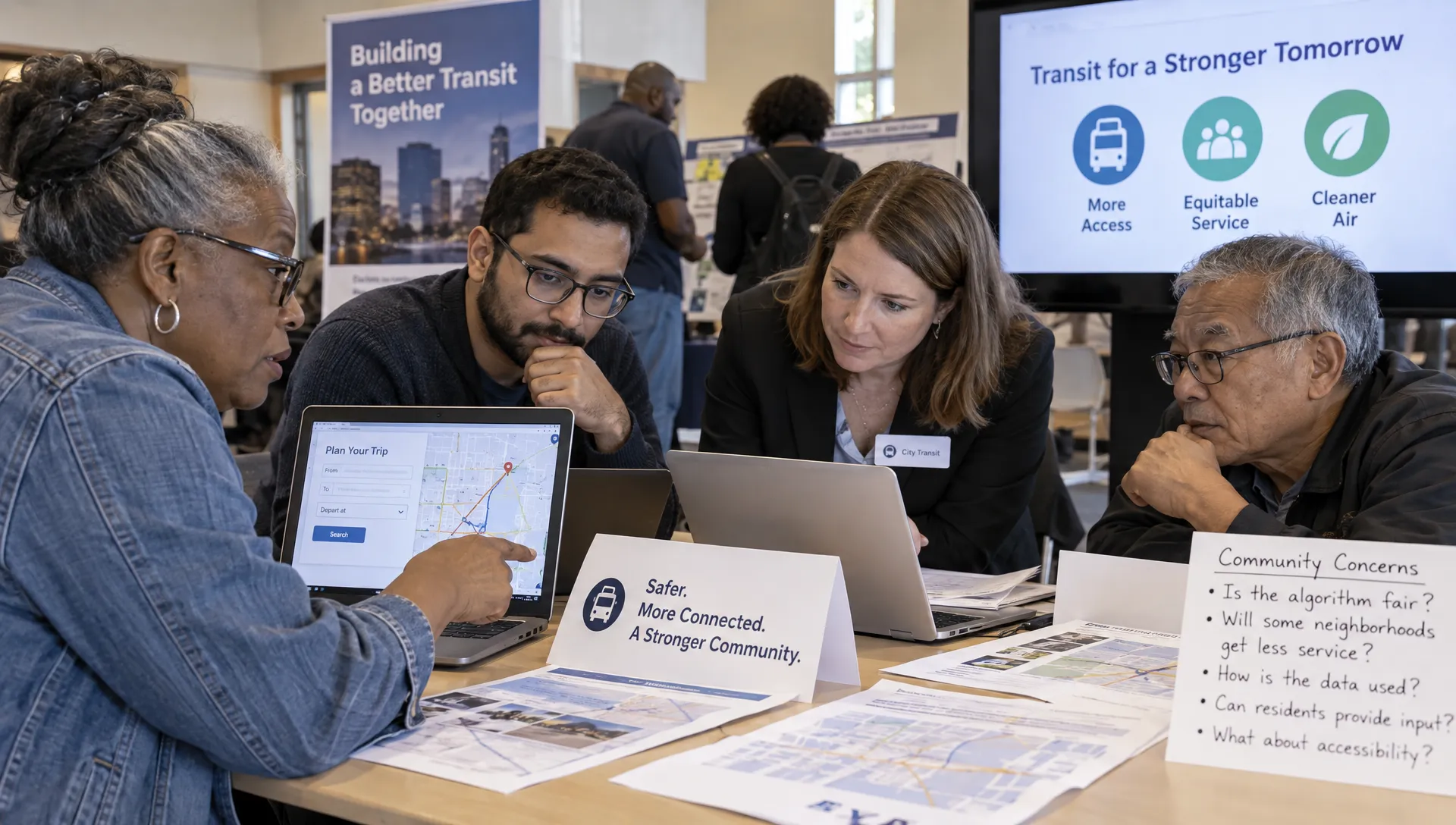
Test the concern, then explain the decision
Each credible concern should lead to an appropriate investigation. That might involve checking data quality, comparing outcomes across relevant groups, examining staff overrides or running synthetic edge cases through the proposed rules.
The NIST AI Risk Management Framework provides a useful reference for AI systems because it addresses risks in their wider context. It is not a substitute for public reasoning or a universal consultation procedure.
Publish an issue-by-issue response register. The following entries illustrate how a response could work; they are not findings from a real deployment.
| Public concern | Investigation | Possible documented response |
|---|---|---|
| Missing information reduces priority | Compare cases with equivalent need but different documentation | Remove the penalty or justify it with evidence and an assistance pathway |
| Distance outweighs appointment urgency | Test alternative weights and review difficult cases | Revise the weights or explain the capacity trade-off |
| Staff cannot challenge recommendations | Examine permissions and operational procedures | Add a documented override and escalation route |
Responses should distinguish acceptance, partial acceptance, rejection and unresolved questions. “Noted” is not an explanation.
Where officials reject a proposed change, they should identify the evidence and constraints behind that decision. Where uncertainty remains material, postponing deployment or narrowing the system’s role may be more defensible than promising to fix it later.
Protect privacy without concealing system failures
Public consultation can expose sensitive information about disability, finances, housing or family circumstances. Participants should have ways to submit evidence confidentially, contribute publicly under a pseudonym or discuss a synthetic example instead of their own case.
Keep identity verification separate from public comment wherever feasible. Collect only what the process needs, specify retention periods and explain who can access submissions. Never require residents to publish personal records to make their concerns credible.
Discursive democracy also needs protection against misleading summaries. If AI helps classify or summarize comments, disclose that use, check summaries against original submissions and let contributors report distortions. An automated summary must not become an unchallengeable account of what the public said.
JustSocial’s discussion of the ethics of civic analytics is relevant here: measuring participation should support public reasoning, not create unnecessary surveillance.
Publish aggregate findings carefully. Small groups can become identifiable even without names, and apparent differences may be unreliable when participation is sparse. Acknowledge those limits rather than presenting consultation data as a precise map of public opinion.
Make consultation a continuing duty
A consultation closes, but an algorithm can keep changing. New data sources, revised thresholds, different objectives or expansion into another service may alter the original justification.
Define review triggers before deployment. Material changes should prompt a proportionate opportunity for renewed scrutiny, while urgent safety changes may require immediate action followed by explanation and review. Routine maintenance does not always need a full consultation, but agencies should explain how they distinguish maintenance from consequential redesign.
Discursive democracy makes participation continuous without requiring everyone to comment on everything. Publish version histories, unresolved issues and the next review point so residents can engage when a change affects them.
Individual review must remain available separately from public consultation. Someone facing an adverse outcome needs a usable route to question their case; contributing to a general policy debate cannot replace that route.
For a political movement advocating ongoing civic participation, this is a practical reform demand: require a named decision owner, an accessible comment process and a public response register. Participation becomes consequential when institutions must account for their choices, not merely count submissions.
Frequently asked questions
Is public comment on an algorithm the same as voting on it? No. Public comment gathers reasons, experiences and evidence. A vote establishes a preference under specified rules. Unless a process explicitly has lawful decision-making authority, comments inform the responsible institution rather than automatically determining the outcome.
How does this relate to deliberative democracy? The approaches overlap. Discursive democracy emphasizes public reasoning across civic discussion, while deliberative democracy often highlights structured opportunities to consider evidence and weigh alternatives. A facilitated panel can complement an open comment period, but neither should erase dissent.
Does an agency have to release the source code? Requirements depend on the jurisdiction and system. Meaningful scrutiny may need more than code, including objectives, data descriptions, testing and decision rules. Conversely, a plain-language summary may be insufficient if consequential technical claims cannot be independently examined.
What if most comments support an algorithm but a minority identifies serious harm? Support does not resolve the harm. The agency should investigate the evidence, examine legal and rights-related obligations and explain its response. Popularity is not a substitute for evaluating whether a system treats people acceptably.
Can consultation happen after deployment? Yes, but it should not be the only opportunity. Early scrutiny can influence procurement and design, while later participation can identify real-world failures. Legal requirements vary, so this workflow supplements rather than replaces applicable obligations.
Start with one decision people can influence
Choose one proposed algorithm, disclose its role and invite challenges before the design is fixed. Assign an accountable owner and commit to publishing reasoned responses, including decisions to pause or change course.
If you want to connect that work with a political movement advocating continuous civic participation, explore JustSocial’s approach. The immediate test is straightforward: can a resident’s well-founded objection change what the institution does?





