Most local governments do not lack public input. They lack a reliable way to turn public input into better decisions.
Residents speak at council meetings, sign petitions, answer surveys, post in neighborhood groups, and organize around schools, parks, roads, policing, zoning, budgets, and local services. Yet too often, those signals enter a fog. People do not know who heard them, what changed, why a decision was made, or whether the outcome will ever be reviewed.
That is why civic participation needs better local decision loops.
A decision loop is the path from public experience to public action, then back to public review. It is not a one-time consultation. It is a repeatable civic habit: identify the issue, deliberate on tradeoffs, make the decision, implement it, publish the reasoning, measure what happened, and revise when reality proves the plan wrong.
This idea fits naturally with JustSocial’s broader argument for continuous direct democracy. In the JustSocial manifesto, Yuval D. Vered argues that modern public institutions still operate with industrial-era structures while citizens already live in a connected, digital, participatory society. Local decision loops are one practical bridge between those two worlds.
A local decision loop is more than a meeting
A public meeting is an event. A decision loop is a system.
In the old model, a city announces a meeting, residents speak for two minutes, officials thank everyone, and then the actual decision happens somewhere else. Sometimes the public comments matter. Sometimes they do not. The problem is that citizens usually cannot see the connection.
A better loop makes that connection visible.
| Loop stage | Core question | Citizen contribution | Public institution responsibility |
|---|---|---|---|
| Signal | What problem needs attention? | Lived experience, complaints, data, stories, petitions | Log the issue and define the decision path |
| Deliberate | What tradeoffs must be weighed? | Arguments, preferences, local knowledge, competing values | Provide facts, constraints, and options |
| Decide | What action will be taken? | Ranked priorities, testimony, support or opposition | Make a decision and publish the rationale |
| Implement | Did the promised action happen? | Monitoring, reporting, community feedback | Show timelines, costs, and progress |
| Review | Did it work? | Outcome feedback and new evidence | Adjust, continue, or reverse the policy |
This is different from asking people for vague input. It gives participation a civic destination. JustSocial has explored this problem from another angle in its essay on civic participation that actually changes decisions, which argues that participation must be tied to a real decision owner, decision window, decision rule, and duty to respond.
Decision loops build on that principle. They do not stop at the moment of decision. They ask what happens after the vote, after the budget line, after the policy announcement, and after the first signs of success or failure.
Why deliberative and discursive democracy both matter
Local democracy works best when two democratic habits reinforce each other: deliberation and discourse.
Deliberative democracy is structured public reasoning. It asks residents to consider evidence, listen to competing views, understand constraints, and weigh tradeoffs before forming a judgment. It is especially useful when a local issue is complex, such as school redistricting, public safety, housing density, climate adaptation, or budget allocation.
The OECD has documented the rise of representative deliberative processes, including citizens’ assemblies, juries, and panels, as governments look for more trusted ways to involve the public in hard decisions. The lesson for local communities is not that every town needs a formal citizens’ assembly. The lesson is that better participation requires time, information, structure, and a fair chance for people to hear each other.
Discursive democracy is the wider public conversation that surrounds formal decisions. It happens in community centers, local newspapers, WhatsApp groups, neighborhood forums, school parent groups, faith communities, unions, business associations, and social media. It is messy, emotional, informal, and often incomplete. But it is where people form political meaning.
A healthy local decision loop needs both.
Deliberation without discourse becomes sterile. A small group may reason carefully, but the wider public may feel excluded. Discourse without deliberation becomes noise. Everyone talks, but no shared understanding forms and no decision improves.
The JustSocial vision of continuous direct democracy points toward a synthesis: citizens should be able to weigh in continuously, while public officials remain responsible for making decisions transparently and taking public opinion seriously. That is not mob rule. It is not government by comment section. It is a demand that public institutions stop treating citizens as occasional voters and start treating them as continuous participants in civic life.
The practical problem: local governments lose civic memory
One reason local trust collapses is that every issue seems to start from zero.
A dangerous intersection gets complaints for years. A school policy frustrates families every semester. A park renovation triggers the same accessibility concerns raised during the last project. A neighborhood says public transit is unreliable, then has to prove the same point again when budgets return.
Without decision loops, local governments lose civic memory. Residents repeat themselves. Staff rotate. Elected officials change. Public comments sit in PDFs. Survey results get summarized once, then disappear. The community learns that participation is not cumulative.
A local decision loop fixes this by making each round of participation part of an ongoing record. The question is no longer, did people speak? The question becomes, what did the public say last time, what did the institution do, what happened afterward, and what should change now?
That is a more mature form of civic participation. It respects public time. It also helps officials, because a transparent loop can reduce suspicion, clarify tradeoffs, and show why not every demand can be met at once.
What better local decision loops look like in practice
Consider a city trying to improve street safety near a school.
In a weak participation model, residents complain after near-misses, the city holds a hearing, a few people attend, and officials either approve or reject a traffic change. Those who disagree assume the process was biased or pointless.
In a stronger loop, the process looks different.
- Residents submit mapped reports of dangerous crossings, speeding patterns, and visibility problems.
- The city publishes the legal, budgetary, and engineering constraints before asking for preferences.
- Parents, students, drivers, nearby businesses, accessibility advocates, and traffic staff deliberate on tradeoffs.
- Officials publish the chosen intervention, such as a crossing guard, speed cushion, signal change, curb extension, or enforcement plan, with a plain-language rationale.
- The city reports back after a defined period with accident data, travel-time impact, complaints, and observed behavior.
- Residents can request adjustment if the intervention fails or creates new problems.
The same loop can apply to school schedules, library hours, public park priorities, local housing plans, participatory budgeting, sanitation services, neighborhood policing, and climate resilience.
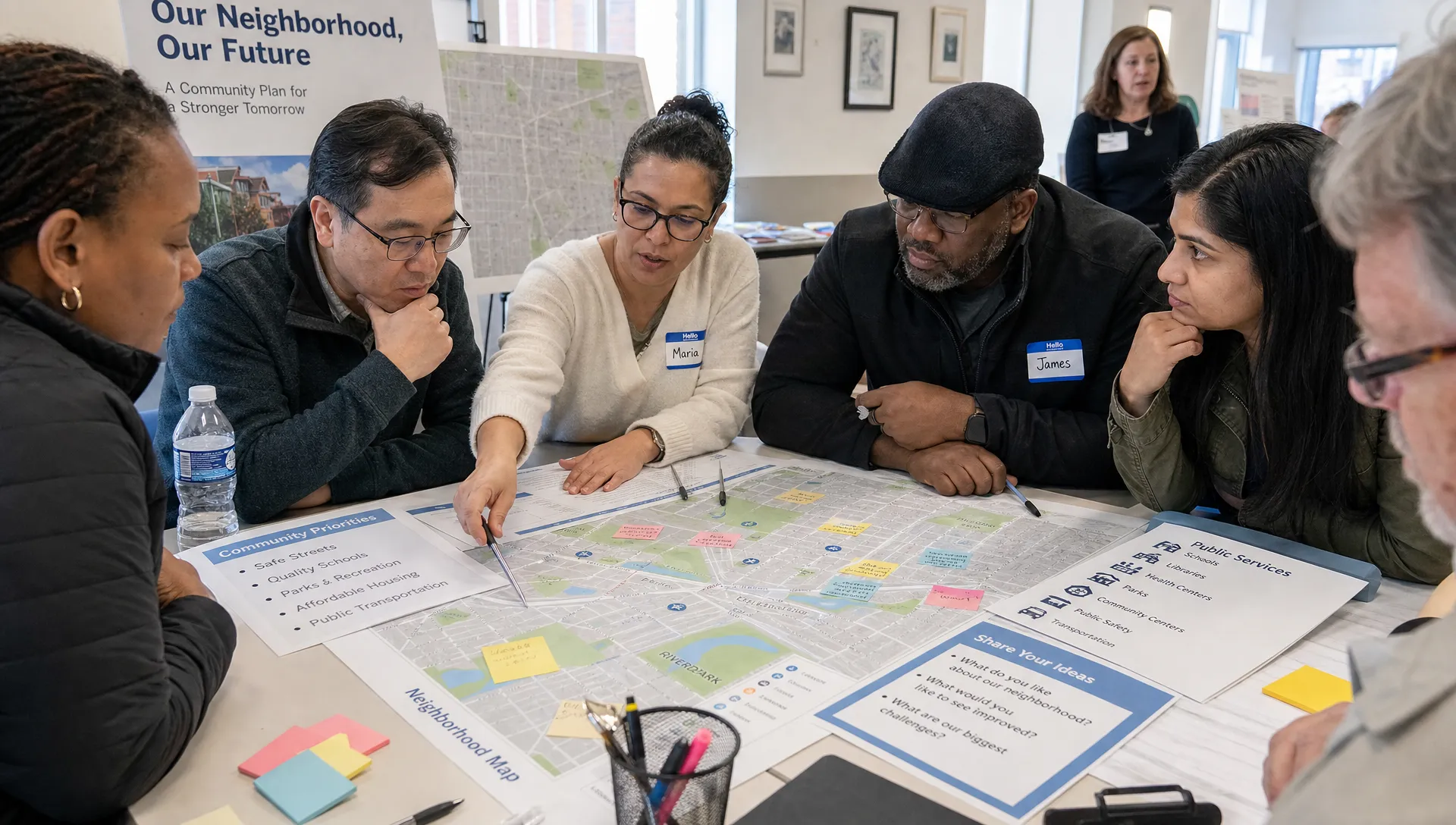
The important shift is simple: participation is not treated as a performance before power. It becomes part of the operating system of local governance.
Technology can shorten the distance, but trust must come first
Digital tools can make local decision loops faster, broader, and easier to audit. Online voting platforms, public dashboards, community forums, document repositories, and decision-making software can help residents participate without needing to attend a meeting at 7 p.m. on a weekday.
But technology alone does not create democratic legitimacy.
The JustSocial manifesto argues that the technology already exists: social platforms, analytics, cloud storage, AI language models, and possibly blockchain-based tools for confidentiality and security. The deeper challenge is institutional. Local governments must be willing to use technology to listen, explain, and share power, not merely to collect data.
A trustworthy digital participation system should follow several basic principles:
- Privacy with accountability: Residents should be able to participate safely, while institutions still protect the process from manipulation.
- Accessibility across digital divides: Online participation should expand access, not replace in-person options for residents who lack devices, time, language access, or comfort with technology.
- Transparent moderation: If comments are removed, merged, summarized, or categorized, the rules should be public.
- Auditable records: Citizens should be able to trace how input was gathered, summarized, and considered.
- Clear limits: Officials should state whether public input is advisory, binding, prioritizing, or exploratory.
AI can help summarize large volumes of public input, translate comments, identify recurring themes, and make long documents easier to understand. Yet AI should not become the decision maker. In a democratic loop, technology helps people reason together. It does not replace public judgment, elected responsibility, or institutional accountability.
This is where civic technology and political culture must develop together. A tool that collects opinions but hides the decision path will deepen cynicism. A tool that shows the loop can strengthen trust.
Metrics that show whether the loop is working
Local decision loops should be measured. Otherwise, participation becomes a slogan rather than a civic discipline.
The goal is not to reduce democracy to numbers. The goal is to make participation visible enough that citizens and officials can improve it over time.
| Metric | What to watch | Why it matters |
|---|---|---|
| Participation diversity | Who participates compared with who is affected | Prevents a loud minority from being mistaken for the whole community |
| Response time | How long it takes officials to acknowledge and answer input | Shows whether public input is treated as operationally important |
| Decision traceability | Whether residents can see how input affected the final decision | Builds trust even when people disagree with the outcome |
| Implementation follow-through | Whether promised actions actually happen | Connects democratic voice to public delivery |
| Review frequency | Whether decisions are revisited after evidence appears | Keeps local government adaptive rather than defensive |
| Public understanding | Whether residents can explain the tradeoffs after the process | Indicates whether deliberation improved civic knowledge |
These measures are especially important because local issues are rarely solved permanently. A school policy that works one year may fail when enrollment changes. A traffic fix may shift congestion elsewhere. A budget priority may become outdated after an emergency. A good loop does not pretend to achieve perfect decisions. It creates a way to learn in public.
How a political movement can build loops from the bottom up
A political movement for civic participation should not only campaign for better leaders. It should also campaign for better decision habits.
That means asking local institutions to adopt repeatable standards: publish the decision being made, explain who owns it, open structured participation before the decision closes, respond publicly, and review implementation after the fact. These standards can be pushed by residents, parent groups, neighborhood associations, civic organizations, local journalists, and reform-minded public servants.
This is a practical path because local government is close enough for citizens to observe. People know whether a road is safer, whether a school policy is working, whether a park is maintained, whether a service is responsive. Local communities are where democratic feedback can become concrete.
For groups that want a step-by-step structure, JustSocial’s civic engagement playbook for local communities offers a useful foundation. But the deeper cultural shift is this: do not let civic participation end when the microphone turns off. Follow the decision until it becomes action, then follow the action until it becomes evidence.
The manifesto’s discussion of the Polis is relevant here. The ancient Polis gave citizens a more immediate sense of belonging to public life, but it could not scale with the technology of its time. Modern communities have the opposite problem. We have the technology to scale participation, but our institutions often lack the culture and structure to use it democratically.
Local decision loops are one way to rebuild that missing intimacy. They make the state less remote. They turn public policy from something done to people into something people can continuously inspect, influence, and improve.
Start with one decision and one public promise
No city has to redesign democracy overnight.
A local decision loop can begin with one issue and one public promise: if residents participate, the institution will show how their input was considered and what happened next.
Start with a decision that is active, specific, and visible. A school board policy change. A neighborhood traffic plan. A park budget. A zoning update. A public safety priority. A library service change. The decision should have a timeline, an owner, and a real possibility of being influenced.
Then build the loop around it. Invite input early. Provide facts before asking for opinions. Make room for deliberation, not just reaction. Publish the rationale. Track implementation. Return to the public with results.
That one loop may seem small, but it teaches a powerful democratic lesson: citizens are not merely voters, taxpayers, and consumers. They are co-authors of local public life.
Frequently Asked Questions
What is a local decision loop? A local decision loop is a repeatable process that connects public input to a decision, implementation, feedback, and review. It helps citizens see not only that they were heard, but what happened after they participated.
How is civic participation different from public comment? Public comment is usually a single opportunity to speak. Civic participation is broader and more continuous. It can include deliberation, surveys, petitions, public data, online voting, community meetings, monitoring, and follow-up after decisions are made.
Does continuous direct democracy mean every local issue becomes a referendum? No. Continuous direct democracy can include advisory input, public sentiment, deliberative panels, participatory budgeting, and transparent feedback loops. Representatives may still decide, but they should do so with a clear understanding of public opinion and a duty to explain their reasoning.
Where do deliberative democracy and discursive democracy fit into local decisions? Deliberative democracy helps residents weigh evidence and tradeoffs in a structured way. Discursive democracy captures the broader public conversation where people form opinions and values. Better local decision loops need both.
Can communities build decision loops without official technology? Yes. A shared document, public meeting notes, printed summaries, clear timelines, and a commitment to publish responses can start a loop. Technology helps scale the process, but the essential ingredient is accountability.
Help build a more continuous local democracy
If civic participation is going to matter, it must become continuous, traceable, and connected to real public decisions. That is the future JustSocial is working toward: a political movement for direct democratic influence, public transparency, and citizen empowerment through technology.
Explore JustSocial.io and read the manifesto to see how local decision loops fit into a larger vision of modern democracy built by the people, for the people, and with the people participating every day.