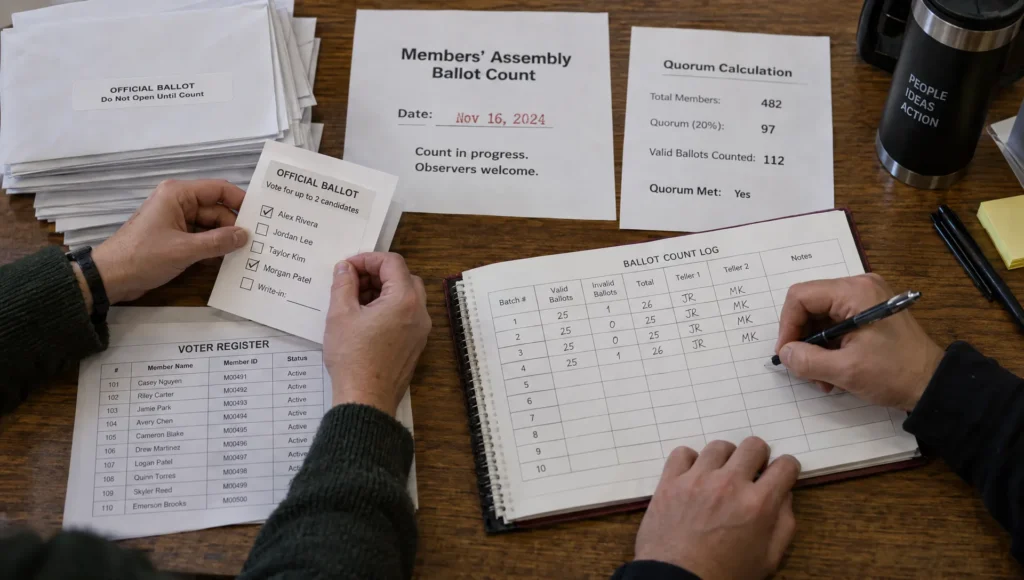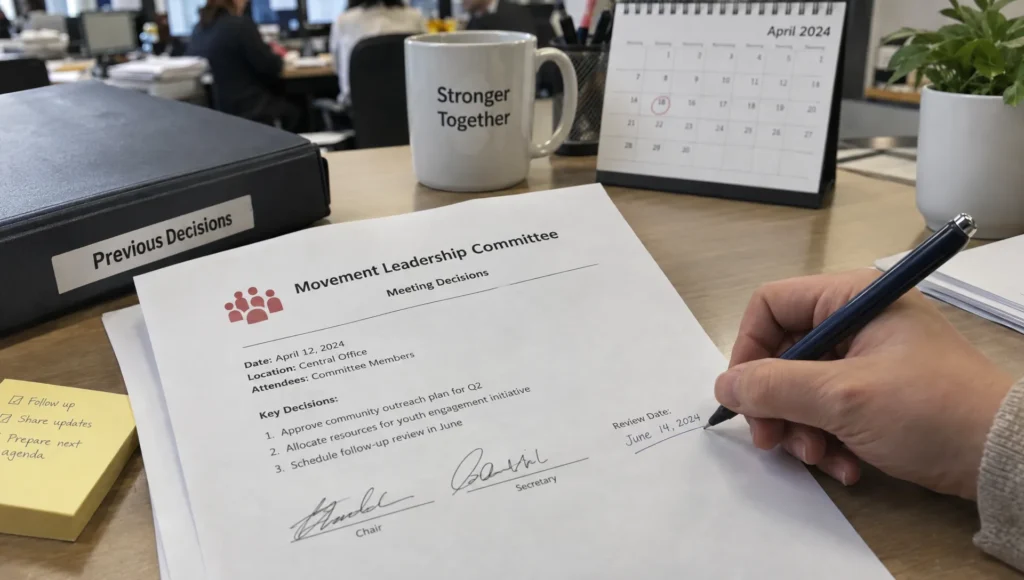
Most people who try civic participation eventually hit the same wall: you show up, you comment, you sign, you volunteer, and then the decision happens somewhere else.
That gap is not just frustrating, it is structurally predictable. If a participation channel is not designed to bind itself to a real decision point, it will drift into what citizens increasingly recognize as “engagement theater”: input is collected, legitimacy is borrowed, and outcomes remain unchanged.
JustSocial exists because that pattern is not inevitable. In The Face of Democracy, Yuval D. Vered argues that modern societies have the technology to upgrade democracy from a once-every-few-years ritual into a continuous civic capability, with institutions that must measure, publish, and respond to public judgment.
This article explains what “participation that changes decisions” actually requires, how deliberative democracy and discursive democracy make public input more legitimate and usable, and how a political movement can turn participation into durable power without slipping into manipulation or chaos.
What it means for civic participation to “change decisions”
Civic participation changes decisions when it reliably produces one of these outcomes:
- A decision-maker adopts a proposal (or a modified version) and explains why.
- A decision-maker rejects a proposal and explains why.
- A decision-maker changes the agenda, timeline, budget, implementation plan, or oversight method because of public input.
The key word is explain. Without public reasoning and traceable follow-through, citizens cannot tell the difference between influence and coincidence.
The four prerequisites (the “Decision Link”)
If you want civic participation to be consequential, your process needs a visible link between public activity and official action.
| Prerequisite | What it is | What citizens should be able to point to publicly |
| Decision owner | Who can actually decide | A named office, committee, agency lead, or delegated authority |
| Decision window | When the decision can still move | Dates for deliberation, drafting, vote/approval, and implementation start |
| Decision rule | How input will be used | Advisory vs binding, thresholds, eligibility, and what counts as “evidence” |
| Duty to respond | The “receipt” requirement | A published rationale that cites the inputs considered and what changed |
This is the backbone of JustSocial’s manifesto argument that democracy should work more like infrastructure: continuous, auditable, and designed to produce accountable outputs, not vibes.
Why most civic participation fails (even when people are sincere)
Participation fails most often for design reasons, not motivation.
1) It is disconnected from the real decision workflow
Many institutions run participation like a marketing layer placed on top of governance. You get a town hall, a comment form, maybe a survey, but there is no shared “case file” that travels into the decision room.
In the manifesto’s language, that is what it feels like to be reduced to a periodic voter and a background taxpayer, with no day-to-day standing in the system.
2) It substitutes noise for judgment
When participation is optimized for volume, it rewards the loudest, fastest, or most organized participants. That is not the same as public judgment. A consequential system needs ways to translate lived experience into decision-grade claims, tradeoffs, and options.
3) It does not publish reasons, so trust cannot accumulate
If citizens cannot see:
- what information mattered,
- which constraints applied,
- what tradeoffs were chosen,
then every cycle starts from zero. The institution might be “transparent” in a shallow sense (posting outcomes), while remaining opaque in the only way that matters (why the outcome is legitimate).
The upgrade: treat civic participation as an end-to-end system
The practical shift is simple to describe: participation must run as a loop, not an event.
JustSocial’s manifesto imagines a “People’s Branch” that continuously captures public judgment and a complementary “Academic Branch” that strengthens civic education and evidence quality. Whether or not a jurisdiction adopts that exact structure, the design implication is broadly useful: build participation so it produces inspectable artifacts at every stage.

Minimum viable artifacts that make participation consequential
You do not need a massive platform to start. You need public “receipts” that force clarity.
| Artifact | Purpose | What it prevents |
| Issue brief (problem, scope, constraints) | Aligns everyone on what is being decided | Endless debate about the wrong question |
| Evidence bundle (sources, lived experience, data) | Makes claims testable | “My feed says…” policymaking |
| Options memo (2 to 4 real choices) | Turns conflict into structured tradeoffs | False binaries and symbolic proposals |
| Decision rationale (what changed, why) | Converts input into accountable reasoning | Participation theater |
| Implementation tracker (milestones, status) | Keeps power accountable after the vote | “We approved it” without delivery |
This connects directly to the manifesto’s central frustration with industrial-era governance: decisions happen inside bureaucratic inertia, while citizens are left outside the loop.
Where deliberative democracy fits (and why it often outperforms raw polling)
Deliberative democracy is not “more talking” as a moral preference. It is an engineering choice: for complex issues, you want considered judgment, not first impressions.
A large body of real-world practice supports that premise. The OECD’s report Innovative Citizen Participation and New Democratic Institutions (2020) documents hundreds of deliberative processes across countries, noting that well-designed deliberation can improve legitimacy and the quality of recommendations, especially where trust is low.
When deliberative democracy is the right tool
Use deliberation when:
- The issue has unavoidable tradeoffs (cost, safety, rights, time).
- The public is polarized or exposed to misinformation.
- Decision-makers need “permission” to choose a difficult compromise.
- The topic is technical but value-laden (housing, policing, climate adaptation, education reform).
A practical deliberative design that actually links to decisions
Deliberation becomes consequential when it is paired with the Decision Link above. A minimal, decision-connected process looks like this:
- Publish the decision owner, window, rule, and duty to respond.
- Provide balanced learning materials (and publish them).
- Use facilitated small-group discussion, not a single microphone line.
- Produce a written recommendation with explicit tradeoffs and minority views.
- Require a formal response that references the recommendation line-by-line.
This is where JustSocial’s vision of continuous participation becomes more than idealism: deliberation is a method for producing decision-grade outputs repeatedly, not just during crises.
Discursive democracy: legitimacy comes from public reasons, not just results
If deliberative democracy focuses on how people reason together, discursive democracy focuses on what must be made public for a decision to be legitimate.
In discursive terms, a decision is stronger when citizens can inspect the argument structure:
- What claims were made?
- What evidence supported them?
- What counterarguments were considered?
- Which values were prioritized?
This is also where many digital-era failures become obvious. Social platforms are optimized for reach and reaction, not for accountable reasoning. The manifesto calls out this mismatch implicitly when it argues we should redirect the energy currently spent on “free hate in our smartphones” into structured civic power inside systems that must listen.
Make discourse usable: require “reason-giving” formats
A discursive process does not need to be academic. It needs to be structured enough that reasoning can survive scale.
| Discursive requirement | What it looks like in practice | What it changes |
| Claims must be legible | Short proposal summaries with a clear “because” | Less slogan substitution |
| Evidence must be attachable | Links, documents, and lived experience logs | Less rumor dominance |
| Counterarguments must be captured | “Best objection” field or facilitated synthesis | Less straw-manning |
| Reasons must be published | Decision rationale that cites inputs | Trust can accumulate over time |
Discursive democracy is also the bridge between citizen participation and institutional memory. When reasons are published, future citizens do not have to re-fight the same battles from scratch.
Political movement strategy: convert participation into durable influence
A political movement succeeds when it can do two things at once:
- Create participation that people can sustain.
- Convert that participation into decisions, staffing, budgets, and oversight.
The manifesto is unusually explicit about the friction point: power rarely gives itself away. Continuous civic participation threatens the monopoly that parties, gatekeepers, and incumbents have over agenda-setting.
So movements need an operating model, not just a message.
The movement play: build “participation capacity,” not just turnout
High-impact movements treat civic participation like a capability that compounds.
- Train members to identify decision owners and windows.
- Standardize artifacts (issue briefs, evidence bundles, options memos).
- Publish your own rationales and trackers, even when government does not.
- Recruit experts who can translate between public values and policy constraints.
This is also where relationship-building matters. Many movements fail because they only speak outward (broadcast), instead of building two-way channels with volunteers, stakeholders, journalists, and local officials.
If you are building outreach capacity for a movement and want structured, individualized follow-up at scale, tools built for relationship-based messaging can help. For example, AI-driven LinkedIn conversations can support consistent, personalized outreach while keeping the interaction conversational rather than spammy.
Align movement tactics with deliberative and discursive standards
Movements often hesitate to use deliberation because it feels slower than mobilization. The better approach is sequencing:
- Use mobilization to surface issues and recruit participants.
- Use deliberative democracy to turn conflict into decision-grade recommendations.
- Use discursive democracy to publish reasons and hold institutions to the duty to respond.
That combination is how civic participation stops being a protest-only instrument and becomes a governance instrument.
What JustSocial adds to this picture (without pretending tech is magic)
The manifesto’s “Technology” section is blunt: most of what we need already exists (modern web platforms, security techniques, analytics, cloud, and emerging AI). The hard part is institutional adoption and governance design.
JustSocial’s contribution is the insistence that democracy needs:
- Continuous participation channels that are connected to real decisions.
- Public transparency that includes reasons, not just outcomes.
- Civic tools that support deliberation and discourse, not rage and virality.
The manifesto even sketches practical product directions (like TakeAction!, rParliament, and rConsensus) that map to the participation loop: agenda intake, inspectable deliberation, recorded judgment, and ongoing oversight.
The standard to demand in 2026: “Show me the receipt”
If you want civic participation that actually changes decisions, ask one question that cuts through the noise:
Where is the published rationale that shows how public input shaped the outcome?
When institutions cannot answer, the next step is not “participate harder.” The next step is to redesign the process so that participation produces auditable artifacts and a duty to respond.
If that resonates, start by reading The Face of Democracy and treat it as an institutional prompt: what would it take for your community to run one full, transparent participation loop on one real decision, from issue framing to implementation tracking?