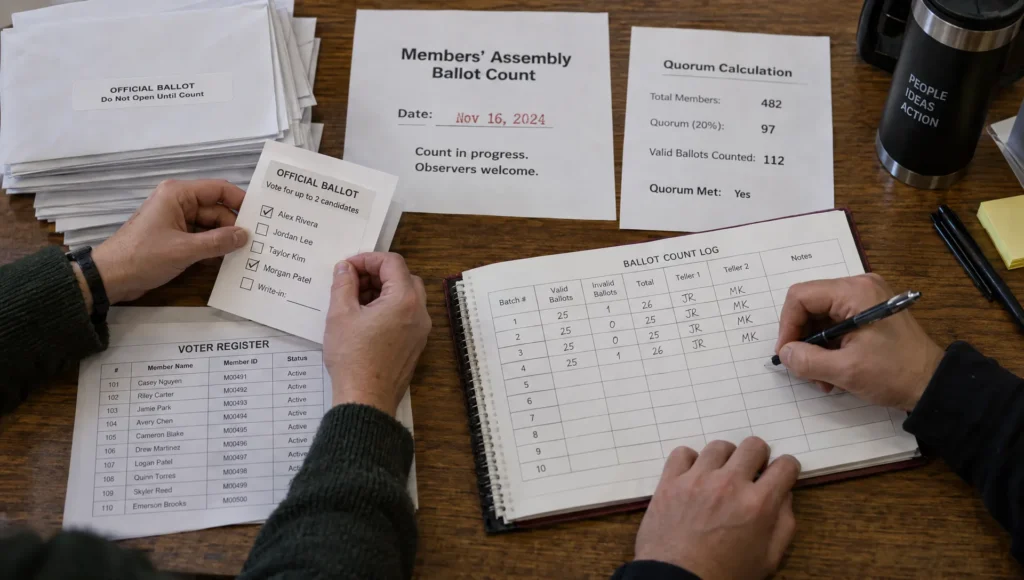
Public technology is now one of the main places where democracy either becomes real or collapses into paperwork. When a resident applies for public services, follows a city council vote, signs a petition, checks why a contract was awarded, or uses an online voting platform, they are not only using software. They are interacting with the state.
That is why public tech reform cannot be reduced to better procurement, cleaner interfaces, or faster portals. Those things matter, but they come after a more basic question: Who gets to define the problem the technology is meant to solve?
Deliberative democracy answers that question by bringing citizens into the reasoning process before key choices are locked in. It asks people not only to vote, react, or complain, but to examine evidence, hear tradeoffs, question experts, and form public judgments that officials can answer. For a political movement like JustSocial, which argues for continuous direct democracy powered by modern tools, deliberation is not an optional feature. It is the civic operating system that makes digital democracy responsible.
Public tech is policy in code
Public tech determines how people experience rights, obligations, benefits, representation, and accountability. A badly designed service can make a legal right hard to use. A closed procurement process can hide priorities from the people funding it. A public dashboard can inform citizens, or it can create a false sense of transparency while leaving the real decision-making process untouched.
The JustSocial manifesto frames many current institutions as relics of the Industrial Revolution: education systems, public offices, representative politics, and bureaucratic structures built for a slower age. The point is not simply that government should “use more technology.” The deeper point is that technology should help the state listen, explain, learn, and respond continuously.
That requires more than a new app. It requires democratic governance around the app.
A public platform for voting, petitions, committee records, service requests, law repositories, or civic analytics can either empower citizens or centralize power in a new technical layer. The difference depends on whether citizens are involved only after launch, when they are treated as users, or before launch, when they are treated as co-governors.
What deliberative democracy adds to public tech reform
Deliberative democracy is a model of public decision-making where citizens receive balanced information, question experts, discuss tradeoffs, and produce considered recommendations. It is especially useful when the issue is technical, value-laden, and difficult to reduce to a yes-or-no vote.
Public tech reform fits that description perfectly. Every major technology decision contains political choices:
- What data should the state collect, and what should it never collect?
- Which public decisions should be visible by default?
- How should citizens verify that online voting or consultation is secure?
- Who is excluded when participation moves online?
- When should algorithmic tools be used, and when should human judgment remain central?
These are not questions for engineers alone. They are questions for citizens, civil servants, academics, civic organizations, technologists, and elected officials together.
The OECD has documented the rise of representative deliberative processes, including citizens’ assemblies and citizens’ juries, as a way to involve people in complex public decisions. Public tech reform should learn from that tradition. It should not ask citizens to approve a finished system. It should invite them to shape the values, constraints, and accountability mechanisms that guide the system from the beginning.
Deliberation is slower than a poll, but it is often faster than launching a failed system, losing public trust, and rebuilding under pressure.
The missing layer: discursive democracy
Deliberative democracy cannot live inside a closed workshop. It needs a public conversation around it. This is where discursive democracy matters.
Discursive democracy is the broader democratic layer of public talk: media debates, community conversations, civic forums, social networks, workplace discussions, expert commentary, and citizen storytelling. It shapes the language people use before they enter a formal process. It also gives the wider public a way to inspect and challenge the reasoning of any smaller deliberative body.
For public tech reform, the relationship is simple:
| Democratic layer | Role in public tech reform | Failure mode if missing |
|---|---|---|
| Discursive democracy | Opens the public conversation, surfaces concerns, and makes tradeoffs visible | Reform becomes technical jargon controlled by insiders |
| Deliberative democracy | Creates structured citizen judgment after evidence and discussion | Public debate stays noisy without a decision pathway |
| Civic participation | Turns public judgment into petitions, votes, feedback, oversight, and organizing | Recommendations remain symbolic and fade away |
| Political movement | Sustains pressure until institutions change | Reform depends on temporary goodwill from officials |
This is why public tech reform needs all four. Public talk identifies problems. Deliberation turns talk into reasoned recommendations. Civic participation keeps people involved during implementation. A political movement makes sure institutions cannot ignore the result.
For a wider argument on the relationship between democratic infrastructure and modern tools, JustSocial has explored whether deliberative democracy can scale with modern technology. The key lesson is that scale should not mean reducing citizens to clicks. It should mean giving many more people access to structured, meaningful influence.
A practical reform cycle for democratic public tech
Public tech reform should follow a civic cycle, not a procurement-only cycle. Procurement asks, “What system should we buy?” Deliberative democracy asks, “What public problem are we solving, under what values, with what safeguards, and with whose consent?”
| Reform phase | Democratic question | Public tech method | Public output |
|---|---|---|---|
| Problem definition | What is failing, and for whom? | Public intake, service data, community testimony | A shared problem statement |
| Evidence opening | What do we know, and what remains uncertain? | Public evidence record, expert briefs, legal and budget summaries | An inspectable evidence base |
| Citizen deliberation | What tradeoffs are acceptable? | Citizens’ panel, facilitated forums, stakeholder hearings | Recommendations with reasons |
| Prototype review | Does the proposed tool match public values? | Usability testing, accessibility review, privacy review | Design changes before launch |
| Official decision | What will government do with the recommendations? | Public response from officials and agencies | Accept, modify, or reject with reasons |
| Continuous oversight | Is the system working as promised? | Public dashboards, audits, appeals, recurring deliberation | Ongoing accountability |
This cycle matters because public technology is never finished. A service evolves. A voting platform needs constant trust. A transparency portal must be maintained. An AI tool needs review as conditions change. Continuous democracy is not endless voting on every detail. It is an ongoing relationship between citizens and institutions.
From Polis to Cosmopolis
In the JustSocial manifesto, the idea of the Polis is used to describe a form of political life where citizens do not experience the state as distant machinery. They experience it as a shared civic life. The manifesto then points toward a “Cosmopolis,” a modern culture where technology helps scale that sense of belonging, influence, and public responsibility.
That bridge from Polis to Cosmopolis is where deliberative public tech reform belongs.
The manifesto’s proposed concepts, such as tools for civic action, public committee records, community voting, public analytics, open legal repositories, and classroom-oriented AI, share a common theme: public systems should become more visible, participatory, and responsive. But visibility without deliberation can become spectacle. Participation without evidence can become noise. Analytics without accountability can become surveillance. Digital democracy needs a democratic conscience.
Deliberative democracy supplies that conscience by asking citizens to reason together before systems are normalized.

Design principles for deliberative public tech
Make evidence public before opinions harden
People deliberate better when they can inspect the facts, assumptions, and constraints behind a decision. For public tech, that means publishing plain-language summaries of budgets, procurement options, privacy risks, accessibility requirements, cybersecurity considerations, legal limits, and expected public benefits.
This aligns with the case for a stronger public evidence layer in democracy. As JustSocial argues in its article on deliberative democracy and public evidence, citizens should not be asked to trust conclusions they cannot examine.
Build for inclusion, not just participation counts
A digital consultation that receives thousands of responses can still be undemocratic if the same groups are always missing. Public tech reform must include people with disabilities, people with low digital confidence, linguistic minorities, rural residents, older citizens, young people, and workers who cannot attend meetings during standard office hours.
That means online tools should be paired with offline access, community facilitation, clear language, assistive design, and public education. Civic participation is not measured only by the number of clicks. It is measured by whether the people affected by a system can realistically shape it.
Separate public opinion signals from binding authority
One of the most important distinctions in the JustSocial manifesto is that continuous public input does not have to mean every social vote becomes a binding referendum. Public opinion can be measured, clustered, and presented to representatives, journalists, agencies, and citizens as a democratic signal.
That distinction protects society from shallow click democracy while still making the public visible between elections. Some decisions may require formal votes. Others require deliberative recommendations. Others require ongoing public feedback. A healthy digital democracy knows the difference.
Treat privacy and cybersecurity as democratic foundations
If citizens fear exposure, manipulation, or retaliation, they will not participate freely. If a voting or consultation system cannot be trusted, its results will not carry legitimacy. Privacy, authentication, anonymity where appropriate, auditability, and data minimization are not technical extras. They are conditions of democratic freedom.
Public tech reform should therefore ask privacy and security questions at the deliberative stage, not after development. Citizens should understand the tradeoffs between identity verification, anonymous participation, fraud prevention, open data, and personal safety.
Require an official response
Deliberation without an official response becomes consultation theater. If citizens invest time in learning, discussing, and recommending, the state must answer them clearly.
That answer does not have to be automatic agreement. Representatives and agencies may reject a recommendation for legal, budgetary, ethical, or operational reasons. But they should publish those reasons. The democratic minimum is not that citizens always win. The minimum is that citizens are heard, answered, and able to challenge the answer.
What reform could look like in practice
Imagine a city wants to build a new public transparency platform. In a conventional process, officials might define requirements internally, hire a vendor, launch the platform, and invite feedback afterward.
A deliberative process would look different. First, the city would publish the problem: residents cannot easily follow committee decisions, contracts, budgets, or implementation timelines. Then it would open the evidence: existing records, legal limits, cost ranges, examples from other cities, accessibility issues, and privacy concerns.
Next, a representative citizens’ panel would deliberate. Participants might ask whether committee videos should be searchable, whether contract data should be downloadable, how redactions should be justified, which languages should be supported, and how residents can appeal missing information. Journalists, civil society groups, public servants, technologists, and academics could provide testimony.
The result would not be a vague request for “more transparency.” It would be a public design mandate: what must be visible, what must be protected, how records should be organized, how the system should be audited, and how officials must respond when information is missing.
Only then should procurement begin.
This is better for citizens, but it is also better for public agencies and technology providers. It reduces guesswork. It exposes political risks early. It clarifies success criteria. It creates a public record that explains why the system exists.
The danger of reform without deliberation
Public tech reform can fail in two opposite ways. It can be too timid, using new tools to preserve old bureaucracy. Or it can be too reckless, using technology to automate decisions that deserve human judgment.
Deliberative democracy helps avoid both failures. It asks whether a service should be digitized at all, what should remain human, what should be automated, what must be transparent, and who is accountable when harm occurs.
This is especially important as governments experiment with AI, analytics, online voting platforms, digital identity, and automated service delivery. The question is not whether these tools are modern. The question is whether they make people more free, more informed, more capable, and more connected to public life.
A democracy does not become modern because it digitizes paperwork. It becomes modern when citizens gain meaningful influence over the systems that govern them.
Why a political movement is necessary
Public tech reform will not happen through better software alone. Many institutions benefit from opacity, slow procedures, and limited participation. Even well-intentioned officials face procurement rules, budget limits, legal caution, political pressure, and organizational inertia.
That is why a political movement is needed. A movement can translate deliberative democracy into public demands: open committee records, civic technology standards, public evidence requirements, citizen panels for major digital systems, transparent implementation dashboards, and continuous civic participation between elections.
The JustSocial manifesto identifies apathy and concentrated political power as major sources of friction. Deliberative democracy responds to both. It gives citizens a serious role, and it gives institutions a practical way to listen without surrendering to chaos.
The goal is not to abolish representative democracy overnight. The goal is to surround representation with better public intelligence, better civic participation, and better accountability, so elected officials become more like channels for public judgment than owners of public power.
Frequently Asked Questions
Is deliberative democracy the same as online voting? No. Online voting collects a decision or preference. Deliberative democracy creates the conditions for informed judgment before decisions are made. It can use digital tools, but it depends on evidence, discussion, facilitation, and public reasoning.
Why does public tech reform need citizen deliberation? Public tech shapes access to services, transparency, privacy, voting, data, and accountability. These are democratic questions, not just technical ones. Citizens should help define the values and safeguards before systems are built.
How does discursive democracy fit into public tech reform? Discursive democracy is the wider public conversation that surrounds formal decisions. It helps surface concerns, language, stories, and objections. Deliberative democracy then turns that public conversation into structured recommendations.
Can citizens deliberate on technical issues they do not fully understand? Yes, if the process is designed well. Citizens do not need to become engineers. They need balanced evidence, access to experts, clear explanations, and time to weigh tradeoffs from the public’s point of view.
Does deliberative democracy replace representatives? Not necessarily. In public tech reform, it can guide representatives and agencies by giving them a clearer, more legitimate account of public judgment. Officials may still decide, but they should answer citizen recommendations openly.
Build public tech that listens
Public tech should make citizens more than users of government systems. It should make them participants in shaping those systems.
If you believe democracy must move beyond occasional elections and toward continuous civic participation, explore the JustSocial vision, read the manifesto, and consider how you can support a political movement for direct, deliberative, and technology-enabled democracy at JustSocial.io.