Public spending is often treated as a technical exercise: revenues, line items, forecasts, procurement rules, and votes. Yet every budget is also a moral and democratic choice. It decides which problems deserve urgency, which communities wait, which risks are tolerated, and which future the public is asked to fund.
That is why smarter public spending cannot come only from better accounting software or tighter procurement rules. Those matter, but they are not enough. A government can balance a spreadsheet and still waste public money on projects people do not need, services they cannot access, or reforms that collapse because the public was never meaningfully involved.
Deliberative democracy offers a better path. It creates structured conditions for citizens to study evidence, question experts, weigh tradeoffs, and recommend spending priorities that are more legitimate, more realistic, and more aligned with lived experience.
For JustSocial, this connects directly to a core claim in the JustSocial manifesto: the public sector is still operating with industrial-era structures while society already has the technology, knowledge, and civic capacity to govern differently. Smarter public spending begins when citizens stop being treated only as voters, taxpayers, and consumers, and start being treated as continuous participants in public judgment.
Why public spending fails when citizens enter too late
Most people encounter public budgets after the important choices have already been framed. Officials publish a budget document, hold a hearing, invite public comment, and then proceed through a process that is technically open but practically hard to influence.
This creates a familiar democratic frustration. Residents may be asked whether they support or oppose a spending plan, but not whether the plan is asking the right questions. They may react to a school construction proposal, but not deliberate on whether the deeper problem is overcrowding, outdated learning models, transportation, teacher retention, or digital infrastructure. They may complain about a costly technology project, but only after the procurement assumptions have already been locked in.
That is not meaningful civic participation. It is public reaction after institutional momentum has already formed.
The result is not only distrust. It is also bad spending. Governments miss local knowledge, underestimate implementation barriers, ignore distributional effects, and overvalue projects that look efficient on paper but fail in daily life.
A smarter system brings citizens in before money becomes politically committed.
What deliberative democracy adds to fiscal discipline
Deliberative democracy is not a town hall with louder microphones. It is a designed process where a representative group of citizens receives balanced information, hears competing perspectives, asks questions, discusses tradeoffs, and produces considered recommendations.
In public spending, that matters because budgets are full of real constraints. Money spent on one priority is not available for another. Long-term maintenance may matter more than a flashy launch. A cheap option may become expensive if it increases risk, exclusion, or administrative burden.
Deliberation improves fiscal discipline by making those tensions visible. Instead of reducing budgeting to political bargaining, it forces a public conversation around evidence, consequences, and values.
This is why deliberative democracy belongs beside financial review, procurement law, audit institutions, and elected oversight. It does not replace professional expertise. It gives expertise a democratic setting where assumptions can be tested by the people affected.
If you want a broader explanation of how this works in budget contexts, JustSocial has also outlined a practical model for deliberative democracy in budget decisions. The focus here is narrower: how deliberation can make spending smarter, not just more participatory.
Smarter spending starts with better public questions
Governments often ask, “Should we fund this program?” Deliberative democracy pushes the public to ask earlier, more useful questions: What problem are we solving? What outcome matters? What alternatives exist? What evidence would prove success? What happens if we do nothing?
That shift is powerful. Bad spending often begins with a poorly framed problem. A city may fund more policing when residents want safer streets, but the actual causes involve lighting, youth services, transit access, addiction treatment, or slow emergency response. A ministry may buy a digital platform when the true issue is fragmented data governance and outdated workflows. A school district may invest in standardized testing tools when parents and teachers need more flexible, project-based learning support.
Deliberation does not guarantee perfect answers. It improves the quality of the question before the public pays for the answer.
| Spending stage | Weak question | Smarter deliberative question |
|---|---|---|
| Problem definition | What proposal is on the table? | What public problem are we actually trying to solve? |
| Option design | Which department gets funding? | Which options produce the best public value over time? |
| Evidence review | What does the agency recommend? | What evidence supports each option, and what is uncertain? |
| Equity review | Who supports or opposes it? | Who benefits, who pays, and who may be overlooked? |
| Accountability | Was the money spent legally? | Did the spending achieve the promised outcome? |
This is not anti-government. It is pro-competence. It treats public spending as an ongoing civic responsibility rather than a periodic contest between parties.
The five public value questions every spending process should answer
A deliberative spending process should not drown citizens in accounting details. Instead, it should organize complex information around a small number of public value questions.
What outcome are we buying? Public money should be connected to a measurable public result, not just an activity. A road project is not merely “transportation spending.” It may be buying shorter commutes, fewer accidents, better access to jobs, or lower maintenance costs. If the outcome is unclear, the spending is not ready.
What tradeoff are we accepting? Every budget decision has an opportunity cost. Deliberation helps citizens compare options honestly instead of pretending every popular demand can be fully funded at once.
Who experiences the benefit or burden? A project can be efficient overall and still unfair in distribution. Citizens should see whether benefits reach underserved communities, whether costs fall on vulnerable groups, and whether the spending widens or narrows civic trust.
What does the full lifecycle cost? Public officials often face incentives to fund visible launches while underfunding maintenance, staffing, training, cybersecurity, inspection, or evaluation. Deliberative review should include long-term operating costs, not just upfront price tags.
How will the public know if it worked? Smarter public spending requires feedback loops. Citizens should know what indicators will be tracked, when results will be published, and how programs will be revised if they fail.
These questions transform residents from passive critics into civic co-evaluators. They also help elected officials justify difficult decisions with more than party discipline or vague appeals to fiscal responsibility.
Where deliberative democracy can improve spending most
Deliberative democracy is useful wherever public spending involves uncertainty, tradeoffs, and long-term consequences. That describes almost every major budget area, but three sectors are especially important.
Education spending
Education budgets often lock communities into old assumptions. More money may be directed toward testing, fragmented subject structures, or administrative compliance without asking whether the model still fits modern learning.
JustSocial’s manifesto argues that education should move beyond industrial-line schooling and toward more holistic models, including project-based learning, personalized learning, and better use of AI and digital tools. Whether one agrees with every specific proposal or not, the spending lesson is clear: education budgets should not be built only around legacy categories. Parents, teachers, students, academics, and citizens should deliberate on what learning outcomes matter and which investments actually support them.
This is especially important when technology enters the classroom. A deliberative process can ask whether a tool strengthens teacher-student relationships, supports curiosity, protects student privacy, and improves access, rather than simply asking whether it is new.
Public technology spending
Digital government can make participation easier, services faster, and institutions more transparent. It can also waste enormous sums if agencies buy platforms without clear public goals, interoperability, privacy protections, or citizen trust.
This is why public tech reform should be treated as a democratic spending issue. Citizens do not need to write software requirements, but they should help define the public problem, the rights at stake, the accessibility standards, and the accountability expectations.
JustSocial’s vision of direct democracy tools, online voting platforms, public transparency initiatives, and prototype access points toward a future where public technology is not only purchased for citizens, but shaped with citizens. For a deeper look at this connection, see JustSocial’s article on deliberative democracy for public tech reform.
Infrastructure and public services
Infrastructure spending is where citizen experience and technical expertise must meet. Residents know where roads feel unsafe, where public transport fails, where public buildings are inaccessible, and where maintenance is overdue. Engineers, inspectors, planners, and service providers know what is feasible, safe, durable, and cost-effective.
The point is not to make citizens substitute for experts. The point is to let public priorities and technical realities inform each other before procurement hardens into a contract. For example, safety-critical projects may benefit from early consultation with technical partners experienced in smart engineering solutions so that citizens deliberate not only on what they want, but on what can be built, maintained, inspected, and improved responsibly.
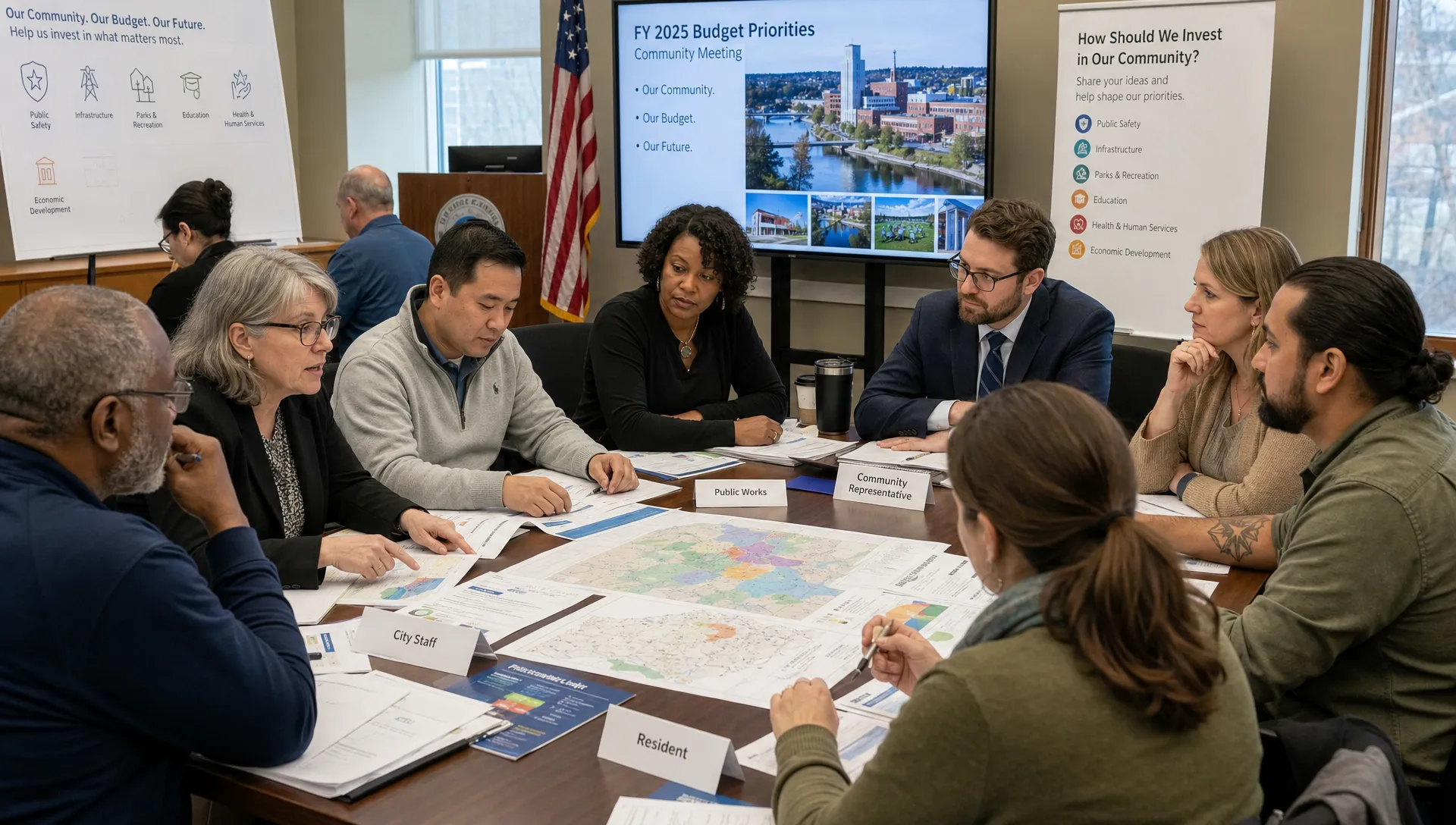
A deliberative cycle for smarter public spending
A public spending process should be easy enough to understand, serious enough to influence decisions, and structured enough to resist manipulation. One practical cycle can work at the city, district, agency, or national level.
| Phase | What happens | Why it improves spending |
|---|---|---|
| Public problem map | The institution publishes a plain-language map of the problem, budget constraints, prior spending, and known evidence. | Citizens begin from shared facts rather than rumors or slogans. |
| Representative citizen panel | A diverse group is selected, with support for participation barriers such as time, language, disability, and childcare. | The process hears more than the loudest or most organized voices. |
| Expert and stakeholder hearings | Citizens question officials, technical experts, frontline workers, affected communities, and watchdogs. | Assumptions are tested before money is committed. |
| Option comparison | The panel compares multiple spending paths, including doing nothing, scaling pilots, or reallocating funds. | Public debate shifts from wish lists to tradeoffs. |
| Recommendation and minority report | Citizens publish a recommendation, reasoning, evidence, and any serious disagreement. | Decision-makers receive public judgment, not just raw opinion. |
| Formal government response | Officials accept, modify, or reject recommendations with written reasons and timelines. | Public input becomes accountable, not symbolic. |
| Outcome review | Results are reported after implementation, with space for revision. | Spending becomes a learning system rather than a one-time promise. |
This cycle also strengthens budget transparency. Posting documents is not enough if only specialists can understand them. Real transparency means the public can interpret, question, and contest spending choices. JustSocial has explored that principle in its article on civic participation for public budget transparency.
Why deliberation reduces waste differently than austerity
Public debate often treats waste reduction as a call for cuts. Deliberative democracy offers a better distinction: waste is not simply spending too much. Waste is spending without public value.
A program can be expensive and worthwhile if it solves an important problem fairly and effectively. A program can be cheap and wasteful if it fails, excludes people, or creates hidden downstream costs. Deliberation helps citizens examine this difference.
It can reduce waste in several ways without defaulting to austerity:
- It identifies programs that no longer match public needs.
- It exposes hidden implementation costs before launch.
- It challenges politically attractive projects with weak evidence.
- It brings frontline experience into spending design.
- It creates public criteria for success before money is spent.
This matters because democratic legitimacy is not built by saying “no” to everything. It is built by showing why some priorities deserve investment and why others should wait, shrink, merge, or end.
Technology can scale the Polis, but it must serve judgment
The JustSocial manifesto draws inspiration from the Greek Polis, where political life was immediate and citizens experienced themselves as members of a shared civic world. The ancient Polis could not scale to modern nation-states. Today, digital tools make broader participation possible, but scale alone is not enough.
A comment box is not deliberation. A like button is not public reason. A viral post is not a budget mandate.
Technology should help citizens learn, compare, deliberate, and track outcomes. It should make public documents searchable, committee work visible, expert testimony accessible, and spending data understandable. It should also protect privacy, prevent manipulation, and preserve space for minority views.
This is where JustSocial’s idea of continuous direct democracy becomes important. The goal is not to turn every spending decision into a chaotic national referendum. The goal is to create ongoing channels through which public opinion, civic identity, expertise, and institutional responsibility can interact.
In that sense, deliberative democracy is a bridge between representative institutions and direct citizen empowerment. It gives the public a serious role without pretending that every complex decision can be settled by instant majority vote.
Guardrails that keep deliberative spending credible
A deliberative process can be poorly designed. If the agenda is manipulated, evidence is biased, participants are unrepresentative, or officials ignore the outcome, the process may become a public relations exercise. Credibility requires safeguards.
| Guardrail | What it prevents | What it requires |
|---|---|---|
| Balanced evidence | One-sided persuasion | Independent briefing materials and competing expert views |
| Representative selection | Capture by organized groups | Sortition or structured recruitment with demographic diversity |
| Skilled facilitation | Domination by confident speakers | Trained moderators and equal speaking opportunities |
| Plain-language budgets | Exclusion through complexity | Clear summaries, visual maps, and accessible formats |
| Public reasoning | Symbolic participation | Published recommendations with evidence and tradeoffs |
| Formal response | Institutional indifference | Written government replies and implementation tracking |
These guardrails make deliberation useful to citizens and officials alike. Citizens gain confidence that the process is real. Officials gain a defensible public record for difficult decisions.
How elected officials should use citizen recommendations
Deliberative democracy does not require elected officials to surrender judgment. In most cases, citizen recommendations should guide decisions rather than automatically bind them. But if officials reject a recommendation, they should explain why.
This fits a healthier understanding of representation. Elected officials should not be rulers who disappear between elections. Nor should they be passive poll-readers. They should become responsive stewards of public judgment, translating citizen priorities into lawful, feasible, and accountable policy.
The JustSocial manifesto describes representatives as pipelines for gathering consensus and implementing public policy. Applied to spending, that means elected officials should treat deliberative recommendations as a serious democratic input, especially when those recommendations come from informed citizens who have studied constraints and tradeoffs.
Committees can play a central role here. A budget committee, education committee, infrastructure committee, or technology committee can receive citizen panel recommendations, hold public hearings in response, and publish a decision record. This would make spending debates more transparent and less dependent on closed negotiations.
Public spending as a renewed social contract
The deepest argument for deliberative democracy is not efficiency. It is dignity.
In the old social contract, citizens pay taxes, follow laws, consume services, and vote every few years for representatives they may not trust. In a renewed social contract, citizens are invited to help define public problems, weigh tradeoffs, and evaluate whether their shared money is building the society they want.
That does not make governance simple. It makes it more honest.
Smarter public spending means public money is not treated as the property of ministries, parties, agencies, or political insiders. It is treated as a shared civic resource. The public should see how it is used, understand why priorities were chosen, and have structured ways to challenge, improve, and monitor those choices.
This is the practical promise of deliberative democracy for public spending: not endless meetings, not performative consultation, and not mob rule, but a more intelligent relationship between citizens and the state.
A society that can deliberate well can spend well. A society that spends well can build trust. And a society that builds trust can finally move beyond political inertia toward the modern democracy JustSocial calls the Cosmopolis.
Frequently Asked Questions
What is deliberative democracy in public spending? Deliberative democracy in public spending is a structured process where citizens review evidence, question experts, discuss tradeoffs, and make informed recommendations about how public money should be used.
Is deliberative democracy the same as participatory budgeting? Not exactly. Participatory budgeting often lets residents propose and vote on specific projects. Deliberative democracy focuses more on informed discussion, evidence, tradeoffs, and reasoned recommendations. The two can work together.
Can ordinary citizens understand complex budgets? Yes, if budgets are translated into plain language, visual summaries, clear options, and outcome-based questions. Citizens do not need to become accountants. They need enough balanced information to make sound public judgments.
Does deliberative democracy slow down spending decisions? It can add time at the beginning, but that may save time later by reducing public resistance, implementation failures, legal disputes, and poorly designed projects. The goal is slower commitment and faster learning.
Should citizen recommendations be binding? Sometimes they may be, especially in local or clearly defined participatory processes. In many cases, they should be advisory but require a formal government response, so officials must explain whether and how they will act on them.
Help build a smarter democracy
JustSocial exists to promote continuous direct democracy, citizen empowerment, public transparency, and technology-driven participation. If you believe public money should be guided by informed citizens, not only by closed institutional routines, explore the movement, read the manifesto, and consider how you can contribute your skills, voice, or local initiative.