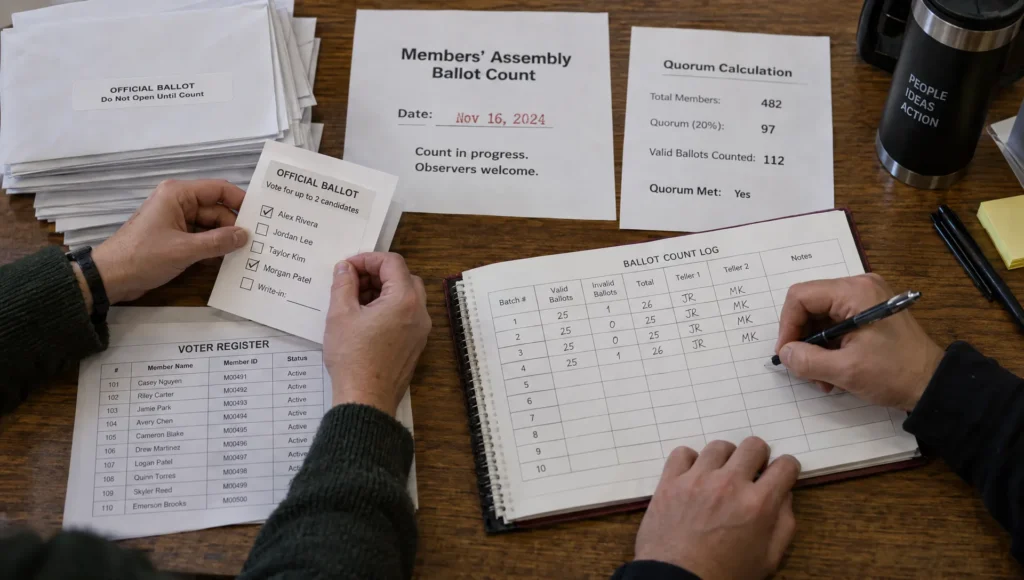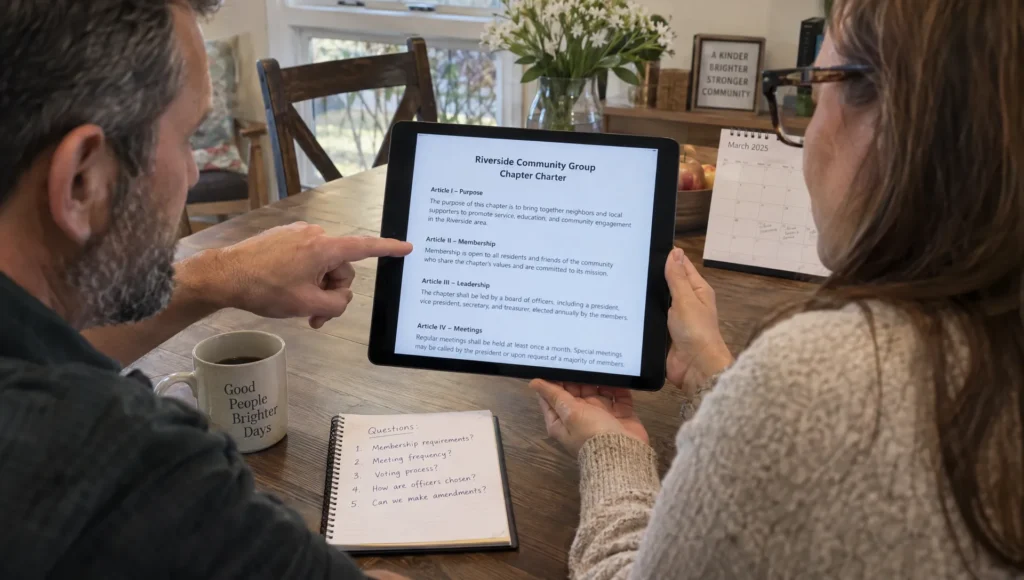
Most public oversight is designed to arrive after the damage is done. A committee votes, a budget is allocated, a permit is approved, a contract is signed, and only then do citizens discover what happened. By that point, participation becomes protest, litigation, or resignation.
Discursive democracy starts from a different premise: public speech should not merely be tolerated after decisions are made. It should be organized into a living civic record while decisions are still forming. Real-time public oversight is not about turning government into a comment section. It is about making the path from proposal to decision visible, contestable, and accountable before power hardens into policy.
That distinction matters in 2026 because trust in institutions is fragile, civic attention is fragmented, and political algorithms often reward outrage more than understanding. Freedom House continues to document pressure on political rights and civil liberties worldwide, which makes the design of democratic participation more than a technical issue. It is a survival issue for open societies.
What Discursive Democracy Adds to Public Oversight
Discursive democracy is democracy built around structured public reasoning. It treats arguments, evidence, objections, identities, and institutional responses as part of the democratic process, not as background noise.
In a traditional representative system, the citizen is usually invited to act as a voter every few years, a taxpayer every day, and a spectator the rest of the time. In discursive democracy, the citizen becomes a continuous participant in public meaning-making. The goal is not that every citizen votes on every issue. The goal is that every public decision can be examined through a transparent chain of claims, evidence, counterclaims, tradeoffs, and official explanations.
This is closely connected to the vision laid out in JustSocial’s manifesto: a continuous direct democracy where citizens are not reduced to occasional ballots, but are heard through technology-enabled civic participation. The manifesto’s idea of the people as a branch of government is especially relevant here. Oversight becomes a public function, not merely a watchdog function performed by journalists, courts, or opposition parties after the fact.
Why Real-Time Oversight Is Different From Post-Fact Accountability
Post-fact accountability asks, who made the mistake? Real-time oversight asks, how can the public see the decision before the mistake becomes irreversible?
That does not mean every choice must wait forever while the public debates. It means public institutions should expose the relevant stages of decision-making early enough for civic participation to matter. A city budget, school curriculum change, housing plan, national procurement contract, or emergency regulation should not appear as a finished product wrapped in bureaucratic language. It should be visible as a developing choice.
| Oversight model | What citizens usually see | What institutions are required to do | Democratic effect |
|---|---|---|---|
| After-the-fact oversight | Final votes, press releases, scandals, lawsuits | Explain or defend decisions after they are made | Citizens react late |
| Periodic electoral oversight | Campaign promises and party platforms | Seek approval every election cycle | Citizens judge broad performance |
| Real-time discursive oversight | Proposals, evidence, objections, revisions, votes, implementation data | Show the reasoning trail while action is still possible | Citizens influence earlier |
The key difference is timing. A public comment submitted after the real decision was made is not participation. It is documentation of exclusion. A public comment attached to a visible proposal, categorized by issue, answered by officials, and preserved in public memory is oversight.
The Oversight Gap in Modern Government
Many governments already publish information. The problem is that publication is not the same as oversight.
A 300-page PDF uploaded the night before a hearing does not empower citizens. A livestream with no agenda markers, searchable transcript, or official response mechanism does not create democratic transparency. A public hearing where residents speak for two minutes while officials silently wait for the clock to expire does not create meaningful civic participation.
Common oversight failures include:
- Late disclosure of documents, agendas, and proposed amendments.
- Public hearings that collect emotion but do not require official response.
- Committee livestreams that are difficult to search, clip, cite, or connect to votes.
- Procurement and budgeting processes that hide tradeoffs behind technical language.
- Political media cycles that reward scandal after decisions rather than attention before them.
Discursive democracy does not solve these failures by demanding more noise. It solves them by designing better civic infrastructure.
The Four Layers of Real-Time Public Oversight
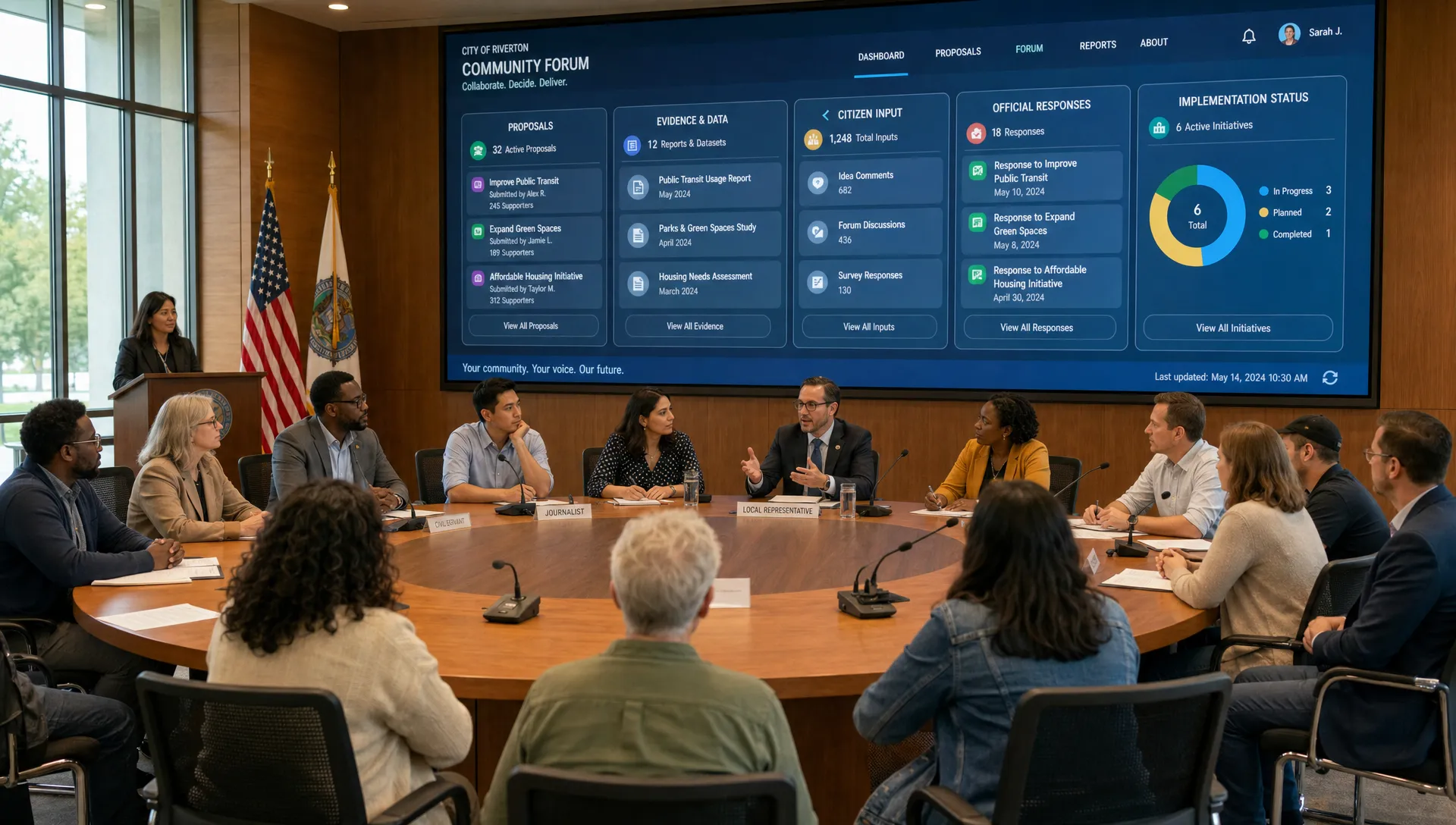
A real-time oversight system needs more than open comments. It needs a structured civic stack that can turn public input into legible public knowledge.
Decision visibility means citizens can see what is being considered, who is responsible, which legal authority is involved, and when the next step will happen. Every proposal should have a public decision page, not scattered references across PDFs, press statements, and meeting recordings.
Evidence visibility means the documents behind the decision are accessible, summarized, searchable, and linked to the specific claims they support. Citizens should be able to understand what evidence officials relied on and what evidence was ignored or contested.
Participation visibility means public contributions are not buried in inboxes. They are categorized into themes, objections, support statements, questions, and alternative proposals. This is where discursive democracy differs from raw social media. The point is not to count likes. The point is to map the public conversation.
Response visibility means institutions must answer. Not every citizen gets the policy outcome they want, but every major argument deserves a visible institutional response. Officials should be able to say: we heard this claim, we evaluated this evidence, we accepted this concern, we rejected this proposal for these reasons.
From the Polis to the Cosmopolis
The JustSocial manifesto returns to the ancient idea of the Polis, where political life was immediate, concrete, and inseparable from communal life. The modern state is too large to recreate the ancient city-state physically, but digital democracy can recreate part of its intimacy.
That is the promise of the Cosmopolis: not nostalgia for ancient assemblies, but a scalable culture of civic presence. In such a culture, public oversight is not an occasional confrontation between citizens and government. It is a continuous relationship.
This is where tools like public committee platforms, community voting systems, civic analytics, and open legal repositories become politically important. A platform like the manifesto’s rParliament concept would not simply broadcast committees. It would connect recordings, documents, clips, votes, citizen comments, and official responses into one civic memory. JustSocial has explored this direction further in its writing on discursive democracy for public committee livestreams, where the question is how to turn passive broadcasts into structured public spaces.
The same logic applies beyond parliament. School boards, municipal planning offices, regulatory agencies, and public procurement bodies all make decisions that shape daily life. If the people are to become a democratic branch, they need access to the working papers of power, not only its ceremonies.
Discursive Democracy Is Not Mob Rule
The strongest objection to real-time public oversight is predictable: what if the public is angry, misinformed, manipulated, or simply wrong?
The answer is that the public already participates, but often through worse channels. People argue on social platforms, react to headlines, join protests, withdraw from politics, or vote years later based on accumulated frustration. Discursive democracy does not pretend citizens are always wise. It gives public disagreement a structure that can be challenged, corrected, and learned from.
Real-time oversight should not replace courts, elected officials, civil service expertise, or constitutional rights. It should pressure them to become more transparent. In the manifesto’s language, elected officials should become pipelines for gathering consensus and implementing public policy, not owners of public will.
This also explains the difference between deliberative democracy and discursive democracy. Deliberative democracy often emphasizes smaller, structured forums where citizens weigh evidence and reason together. Discursive democracy can include those forums, but it also addresses the broader public sphere: hearings, livestreams, social platforms, civic dashboards, journalism, public records, and everyday civic participation.
The question is not whether the people should directly command every state action. The question is whether public institutions should be required to continuously hear, measure, answer, and remember the people.
Where Real-Time Oversight Should Begin
The best place to start is not the most abstract constitutional question. It is the decision points where citizens already feel excluded.
Public committees and hearings
Every committee meeting should have a public agenda, linked evidence, speaker registration, timestamped transcript, decision log, and response tracker. Citizens should be able to see not only who spoke, but what claims were made and whether officials addressed them.
Public hearings need the same redesign. A hearing should not be an emotional outlet with no consequence. It should be a structured civic event that feeds into the decision record.
Budgets, procurement, and infrastructure
Public money is where oversight becomes concrete. Citizens should be able to track why a project was proposed, who benefits, which vendors or partners are involved, what alternatives were considered, and how performance will be measured.
This is especially important in local development and public works. Residents understand that physical projects depend on sequenced milestones, permits, materials, budgets, and inspections. The same end-to-end mindset used by turn-key builders coordinating structures from foundation to finishes should be expected of public authorities: show the stage, the evidence, the tradeoffs, and the responsible office before money and land use are locked in.
Education policy
The manifesto argues that industrial-age education structures are badly outdated. Real-time oversight can help here too. Parents, teachers, students, researchers, and local communities should be able to see proposed curriculum changes, budget shifts, technology pilots, and assessment reforms before they become imposed systems.
Education is also where civic habits are learned. If students experience democratic choice only as student council theater, they learn politics as symbolism. If they see their class, school, or district using structured public reasoning, they learn democracy as a daily practice.
Safeguards for a Discursive Oversight System
A civic platform that gathers public input can empower citizens, but it can also be abused. Real-time oversight must be designed with safeguards from the beginning.
| Risk | Why it matters | Discursive safeguard |
|---|---|---|
| Harassment | Citizens and officials may avoid participation if debate becomes abusive | Clear moderation rules, identity protections, and enforceable conduct standards |
| Manipulation | Coordinated campaigns can distort visible public sentiment | Bot detection, provenance signals, rate limits, and transparent participation metrics |
| Privacy harm | Civic identity data can expose vulnerable groups | Minimal data collection, anonymity where appropriate, and strict public-interest limits |
| Information overload | Too much input can become unreadable | Topic clustering, summaries, minority reports, and searchable records |
| Performative response | Officials may acknowledge input without changing anything | Mandatory response logs and revision histories tied to final decisions |
The most important safeguard is institutional humility. Public input should not be treated as sacred merely because it is public, but official expertise should not be treated as sacred merely because it is official. Discursive democracy requires both sides to show their reasoning.
A Minimum Viable Oversight Protocol
Governments do not need a perfect platform to begin. They can start with a simple protocol for major decisions.
- Publish a public decision page at the proposal stage.
- Attach the legal authority, budget impact, evidence packet, timeline, and responsible officials.
- Allow structured public input through claims, questions, objections, and alternatives.
- Summarize recurring themes without erasing minority positions.
- Require officials to answer the main public arguments before voting.
- Preserve all revisions, votes, and implementation updates in a searchable archive.
This is not futuristic. Most of the underlying technology already exists. The missing ingredient is political will, which is exactly why a political movement for continuous direct democracy matters.
The Cultural Shift: From Spectators to Co-Governors
Real-time public oversight is ultimately a cultural change. It asks citizens to stop seeing politics as something done by distant representatives and start seeing it as a shared public practice. It also asks institutions to stop treating public participation as a procedural hurdle.
The manifesto’s social contract section captures the deeper transformation: the citizen should no longer be reduced to a voter, taxpayer, and consumer. A modern democracy should empower people to take a stake in public policy and public ventures.
Discursive democracy is one path toward that future. It does not require blind faith in technology. It requires technology to be subordinated to democratic purpose: visibility, accountability, education, transparency, and human dignity.
Frequently Asked Questions
Is discursive democracy the same as direct democracy? No. Direct democracy usually refers to citizens voting directly on laws or decisions. Discursive democracy focuses on the public reasoning process around decisions. It can support direct democracy, representative democracy, and deliberative democracy by making public input visible and answerable.
Does real-time public oversight mean every decision becomes a referendum? No. Real-time oversight means citizens can see, question, and influence decisions while they are developing. Representatives and institutions may still make final decisions, but they must show how public arguments and evidence were considered.
How can ordinary citizens participate without becoming full-time activists? Good civic systems should let people follow issues by location, topic, institution, or personal relevance. Citizens should be able to contribute when they care, receive clear summaries, and see whether their concerns entered the public record.
What role should experts play in discursive democracy? Experts should help clarify evidence, uncertainty, tradeoffs, and likely consequences. Their role is not to silence citizens, but to improve the quality of public reasoning. This fits JustSocial’s idea that academia can act as an independent democratic force.
Why is real-time oversight important for trust? Trust grows when people can see how decisions are made, not merely what decisions are announced. Even when citizens disagree with an outcome, a transparent reasoning trail makes power less arbitrary and more accountable.
Help Build the Infrastructure of Continuous Democracy
Discursive democracy for real-time public oversight is not only a theory. It is a practical direction for civic participation, government transparency, and citizen empowerment.
If this vision resonates with you, explore JustSocial and take part in building a political movement for continuous direct democracy. The future of public oversight should not belong only to officials, lobbyists, and insiders. It should belong to the people, in real time, with structure, memory, and responsibility.