Public health priority setting often looks like a technical exercise. Health departments review disease burden, budget limits, workforce capacity, hospital data and expert advice, then publish plans that shape real lives for years.
But public health priorities are never only technical. A city that puts more money into diabetes prevention may have less available for emergency response. A national ministry that expands digital surveillance may improve outbreak detection, but it must also answer questions about privacy and trust. A school district that prioritizes mental health support may need to reduce spending elsewhere.
Those choices involve evidence, but they also involve values. Who should be protected first? Which risks are acceptable? How should limited public money be divided between prevention, treatment and emergency readiness? These questions are too consequential to be left to closed committees, yet too complex to be reduced to social media outrage or a one-time survey.
That is where deliberative democracy becomes practical. It gives citizens a structured way to learn, question, discuss and recommend priorities before public health decisions are finalized. Done well, it can turn civic participation from noise at the margins into a disciplined part of public decision-making.
Why public health priorities cannot be set by data alone
Public health officials need scientific evidence. Without epidemiology, clinical expertise and budget analysis, health systems drift toward slogans. Yet even the best evidence cannot decide every public question by itself.
Data can show that two programs are effective. It cannot automatically decide which one should be funded first when money is limited. Data can estimate the risk of an infectious disease outbreak. It cannot fully answer how much disruption citizens should accept in schools, workplaces or religious life. Data can identify disparities in health outcomes. It cannot, by itself, determine what level of redistribution a community considers just.
The World Health Organization handbook on social participation for universal health coverage frames voice, agency and empowerment as part of making health systems more responsive. That matters because public health depends on public cooperation. People are more likely to accept hard choices when they can see the evidence, question assumptions and understand why one priority was chosen over another.
When citizens are excluded, public health can become brittle. People may comply when trust is high, but distrust grows quickly when decisions feel imposed. When citizens are invited only after the plan is finished, public consultation becomes a performance. Deliberative democracy creates a better sequence: involve the public while priorities are still open.
What deliberative democracy changes
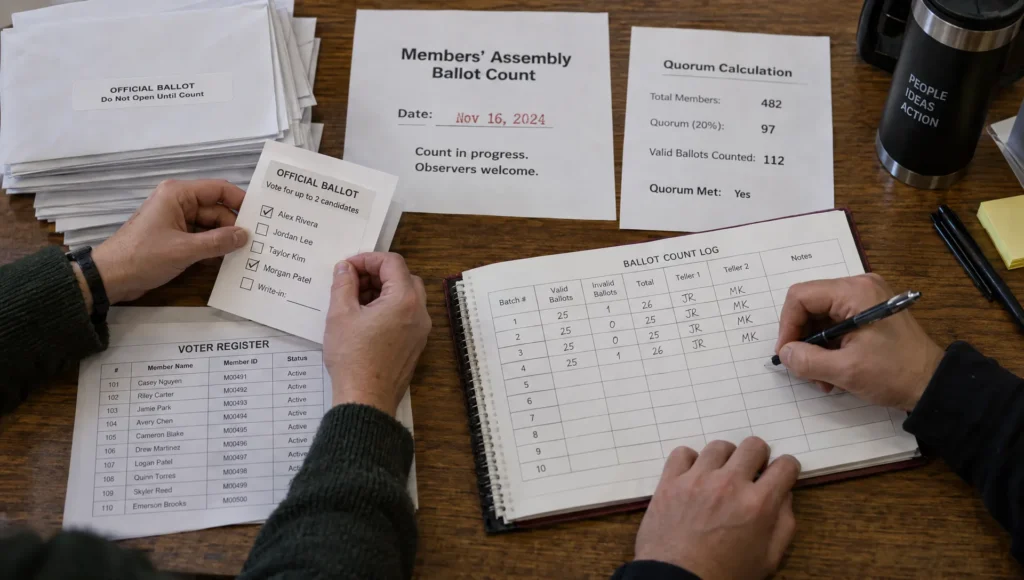
Deliberative democracy is not a town hall where the loudest person wins. It is not a poll that captures a reaction before people have learned the facts. It is a structured process where a representative group of citizens receives balanced information, hears from experts and affected communities, discusses trade-offs with trained facilitation and produces recommendations.
The broader case for how deliberative democracy improves public decisions applies strongly to health because health policy sits at the intersection of science, daily life and scarce resources. Citizens do not replace doctors, nurses, epidemiologists or economists. They help clarify public judgment where expert evidence meets social values.
The OECD report Catching the Deliberative Wave documents the growing use of representative deliberative processes in public decision-making. Health priority setting is a natural fit for this approach because the public already pays for, depends on and is affected by health systems.
A useful deliberative process asks citizens to do more than express preference. It asks them to weigh consequences. A participant may begin by demanding more hospital beds, then change position after hearing how early intervention programs reduce avoidable admissions. Another may support a digital health tool, then ask for stronger privacy rules after hearing from civil rights advocates. This is not indecision. It is democratic learning.
The role of discursive democracy around health decisions
Deliberation works best when the wider public conversation is healthier too. This is where discursive democracy matters. Discursive democracy focuses on the norms of public debate: how claims are made, challenged, corrected and connected to action.
Public health debates often collapse because people mix personal fear, political identity, institutional distrust and partial evidence into one argument. That does not mean citizens are incapable of reason. It means the public sphere is poorly designed. Viral content rewards certainty, anger and tribal performance. Public health needs a culture that rewards clarity, correction and good-faith disagreement.
JustSocial has argued for practical rules for healthier public debate because public conversation is the soil from which formal civic participation grows. Before a citizen assembly meets, the public should have access to plain-language evidence, open questions and visible disagreements. After it reports, the wider public should be able to scrutinize its recommendations without turning every disagreement into a loyalty test.
Discursive democracy keeps the door open. Deliberative democracy structures the room.
Which public health priorities should citizens deliberate?
Not every health decision requires the same kind of public process. A clinical protocol for surgery should be led by medical expertise. An emergency evacuation order cannot wait for weeks of public discussion. But many public health priorities are exactly the kind of choices citizens should help shape.
| Priority area | Evidence citizens need | Value question at stake |
|---|---|---|
| Prevention vs treatment | Disease burden, program effectiveness, long-term costs | How much should we invest now to prevent harm later? |
| Mental health | Service gaps, wait times, school and workplace needs | Which forms of suffering remain invisible in current budgets? |
| Emergency preparedness | Risk scenarios, supply needs, response capacity | What level of readiness is worth funding during calm periods? |
| Digital health data | Benefits, privacy risks, cybersecurity safeguards | How should safety be balanced with personal autonomy? |
| Health equity | Access gaps, outcomes by community, barriers to care | Which inequalities should be corrected first? |
| Environmental health | Pollution exposure, housing data, local health outcomes | Who bears the burden of economic convenience? |
These are not abstract questions. They determine whether a child gets school-based counseling, whether an elderly person can reach a clinic, whether a neighborhood breathes polluted air and whether a government earns enough trust to act during a crisis.
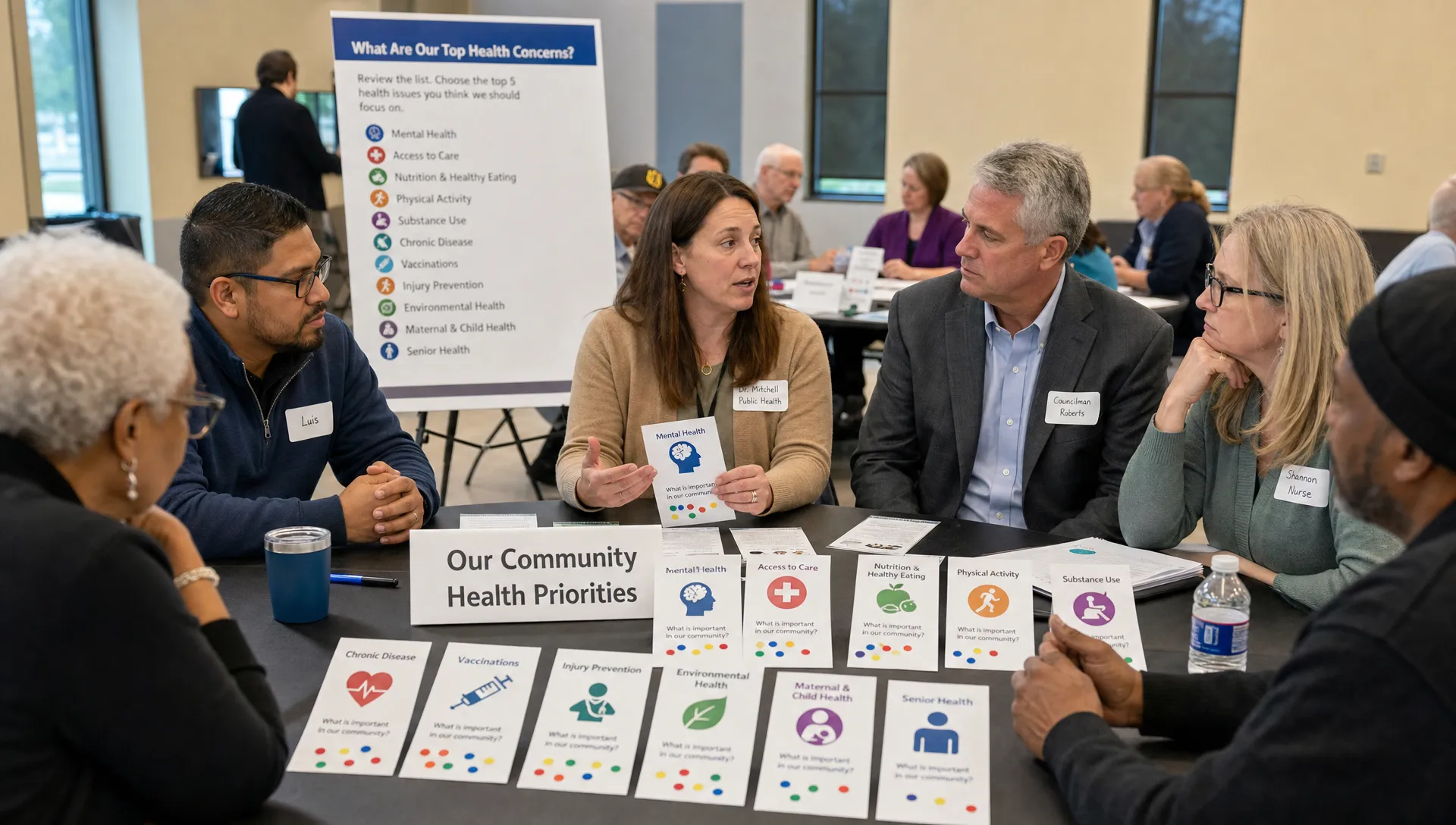
A practical cycle for health priority deliberation
A strong process begins with a real decision, not a vague invitation to talk. Public agencies should state what is being decided, what budget or legal constraints exist, which options are currently on the table and how citizen recommendations will be used.
| Stage | What happens | Legitimacy test |
|---|---|---|
| Define the decision | Officials name the priority question and constraints | Citizens know what is still open to influence |
| Build the evidence brief | Experts summarize options, uncertainty and trade-offs | Materials are balanced, readable and public |
| Recruit participants | A representative mini-public is selected | The group reflects affected communities, not only activists |
| Deliberate | Participants question experts and discuss options | Facilitation protects minority views and avoids domination |
| Publish recommendations | Citizens explain priorities and reasons | Officials must respond publicly and specifically |
The official response is essential. If a health department accepts a recommendation, it should say how and when it will implement it. If it rejects or modifies a recommendation, it should explain why. A process that collects public judgment and then disappears will deepen cynicism.
This is also why public health deliberation should not happen once every four years. Health needs change continuously. New evidence appears. Budgets shift. Emergencies expose weaknesses. A continuous model of civic participation, supported by public technology and transparent reporting, makes health governance more responsive without turning every issue into a referendum.
Guardrails that keep deliberation legitimate
Public health deliberation can fail if it is designed carelessly. The aim is not to create a symbolic focus group. The aim is to build a process that citizens, professionals and officials can trust.
Key guardrails include:
- Balanced evidence, including uncertainty and disagreement between credible sources
- Independent facilitation that prevents officials, experts or organized groups from dominating
- Inclusion of affected communities, especially people with direct experience of the health issue
- Clear privacy rules when discussing personal health stories or community-level data
- Public documentation of evidence, recommendations and government responses
- Ongoing review so priorities can change when outcomes or conditions change
There should also be a boundary between public judgment and professional standards. Citizens can deliberate whether to prioritize maternal health, addiction treatment or air quality. They should not vote on whether a medicine works if the clinical evidence says it does not. Deliberative democracy is strongest when it respects expertise while making value choices public.
How this connects to the JustSocial manifesto
The JustSocial manifesto argues that modern citizens are too often reduced to voter, taxpayer and consumer. Public health makes that reduction painfully visible. People pay into health systems, rely on them in moments of fear and illness, then often have little meaningful influence over the priorities those systems pursue.
The manifesto also argues that the public sector has lagged behind the technological revolution. In health, this gap is obvious. Governments can collect vast amounts of administrative data, but many still struggle to translate public experience into policy. Citizens can complain online all day, but their input rarely becomes structured knowledge that officials must answer.
A deliberative model for health priorities points toward the manifesto’s larger idea of a state that listens continuously, not only during elections. It also fits the proposal for a stronger role for academia. Universities, public health schools and independent researchers could help prepare evidence briefs, audit the fairness of deliberative processes and track whether adopted priorities actually improve outcomes.
The goal is not to romanticize public opinion. The manifesto is clear that public input should be measured, safeguarded and taken seriously, not treated as a raw command that overrides every institution. In public health, that distinction matters. Citizens should have real influence over priorities, but the process must be protected by evidence, ethics and professional responsibility.
A simple example: choosing a local mental health priority
Imagine a city has funding for one major mental health initiative this year. Officials propose three options: school counseling, crisis response teams or community clinics with evening hours. Each option has evidence behind it. Each helps a different population first.
A deliberative process would begin by publishing the costs, expected benefits, service gaps and limits of each option. Students, parents, emergency responders, clinicians, people who have used mental health services and residents from underserved neighborhoods would all be heard. A representative citizen panel would then deliberate the trade-offs.
The final recommendation might prioritize school counseling, but with a condition that crisis response data be reviewed within twelve months. Or citizens might choose evening clinics because access is the biggest barrier. The value is not only the final choice. The value is that the public can see the reasoning, the trade-offs and the human experiences behind it.
That is how civic participation becomes more than protest. It becomes governance.
Frequently Asked Questions
Is deliberative democracy the same as a public survey? No. A survey captures opinions at a point in time, often before people have reviewed evidence. Deliberative democracy gives citizens time, information and discussion before they form recommendations.
Can citizens understand complex public health evidence? Yes, if the process is designed well. Citizens need plain-language evidence, access to experts, time to ask questions and facilitators who help the group compare trade-offs without pretending everyone is a specialist.
Would deliberation slow urgent health decisions? It should not be used for immediate emergency commands that require fast action. It is better suited for preparedness, budget priorities, recovery plans and after-action reviews that shape future policy.
How does discursive democracy support public health? Discursive democracy improves the wider debate by encouraging clearer claims, better disagreement and more responsible public communication. That makes formal deliberation more productive.
Why should a political movement care about public health priorities? Public health is one of the clearest tests of whether a state listens to its people. A political movement committed to real civic participation should help citizens shape the priorities that affect their bodies, families and communities.
Toward health systems that listen
Public health will always need expertise. It will also always need trust. Deliberative democracy can help build that trust by giving citizens a serious role in setting priorities before decisions harden into policy.
For JustSocial, this is part of a larger political movement for continuous democratic influence. If health systems are funded by the public, depend on public cooperation and shape public life, then the public should not be an afterthought. Citizens should be heard early, informed honestly and answered clearly.