In politics, dissent is often treated as a problem to be managed after decisions are made. A crowd protests, a minority objects, a community refuses to accept the official explanation and the system asks how to restore order. Deliberative democracy starts from a different premise: dissent is not a malfunction of democracy. It is one of the ways democracy learns what it has ignored.
A political system that wants civic participation without dissent is asking for applause, not citizenship. People do not become politically meaningful only when they agree. They become politically meaningful when their reasons, fears, objections and lived experience can enter public judgment before power hardens into policy.
That is why the right to dissent belongs at the center of deliberative democracy. It protects minorities from being erased by majorities. It protects majorities from shallow consensus. It protects the future from the inertia of institutions that confuse silence with legitimacy.
Why dissent is a democratic resource, not a democratic threat
Deliberative democracy is built on the idea that public decisions should be shaped through reason-giving, listening, evidence and fair participation. It is not just a slower version of voting. It asks citizens and institutions to test proposals against the people who will live with the consequences.
Dissent is essential to that process because it reveals what consensus may hide. A policy can look popular because the affected minority was absent. A reform can look efficient because the human cost was not measured. A security measure can look necessary because the people most vulnerable to abuse were afraid to speak.
The right to dissent helps correct those failures. It says that disagreement is not merely permitted, but politically useful. In a deliberative system, the dissenter is not automatically the enemy of the public will. The dissenter may be the person exposing an incomplete public will.
This is especially important in societies where citizens already feel reduced to voters, taxpayers and consumers. The JustSocial manifesto argues that modern representative systems often ask people to participate only every few years, then expect them to accept decisions made at a distance. Deliberative democracy challenges that distance by making public reasoning continuous, structured and visible.
The legal and moral foundation of dissent
The right to dissent is not always named as one single right in law. It is usually protected through a cluster of rights: freedom of expression, freedom of peaceful assembly, freedom of association and the right to participate in public affairs. The International Covenant on Civil and Political Rights protects these principles through Articles 19, 21, 22 and 25.
But the moral foundation is older and broader than any treaty. A citizen must be able to say, “This decision does not speak for me,” without being cast outside the political community. If democracy means rule by the people, then the people must be allowed to disagree about what the people want.
Deliberative democracy does not turn dissent into a veto. It does something more demanding. It asks institutions to hear dissent, test it, answer it and preserve it in the public record. That last part matters. When dissent disappears from the record, later generations inherit only the official story.
Dissent is not the same as disruption
A healthy democracy must distinguish between dissent and behavior that destroys the conditions for participation. Dissent challenges a decision, a process, a policy, a law or a public narrative. It can be angry. It can be uncomfortable. It can be disruptive in the ordinary political sense of interrupting complacency.
But intimidation, threats, targeted harassment and deliberate deception are not democratic dissent simply because they use political language. A deliberative process has to protect disagreement without allowing bad-faith actors to silence everyone else.
| Civic expression | What it contributes | How deliberative democracy should respond |
|---|---|---|
| Disagreement | Offers competing reasons or priorities | Give it time, information and a fair hearing |
| Dissent | Challenges legitimacy, exclusion or harm | Record it, answer it and let it influence revision |
| Protest | Signals that normal channels may have failed | Protect assembly and create a path into formal deliberation |
| Minority report | Preserves unresolved objections after a decision | Publish it with the final recommendation or law |
| Intimidation or deception | Blocks others from participating freely | Moderate conduct while protecting lawful expression |
This distinction matters because authoritarians often label dissent as chaos, while cynical actors sometimes label chaos as dissent. Deliberative democracy needs a clearer standard: protect speech that adds reasons to public life, restrain conduct that prevents others from speaking.
Discursive democracy is where dissent often begins
Not all dissent starts inside a formal citizens’ assembly, public consultation or committee hearing. Much of it begins in conversation: on streets, in classrooms, in religious communities, in activist networks, in comment sections, in independent media and around family tables.
This is where discursive democracy becomes important. Discursive democracy focuses on the wider public sphere where people contest language, identity, narratives and the meaning of public problems. Deliberative democracy is more structured and decision-oriented. Discursive democracy is broader, messier and often more emotionally charged.
A society needs both. Discursive democracy lets dissent surface before institutions know how to categorize it. Deliberative democracy gives that dissent a route into decisions. For a deeper distinction, JustSocial has already explained how discursive democracy and deliberative democracy work together without becoming the same thing.
This relationship is crucial for protest movements. A protest can expose pain, anger or exclusion, but if the system has no deliberative channel, the protest may remain symbolic. A deliberative channel can translate protest into questions that institutions must answer: What was ignored? Who was excluded? What evidence is contested? What remedy is being demanded? What tradeoffs are citizens willing to accept?
From periodic consent to continuous objection
Traditional representative democracy often treats elections as the main moment of public consent. Citizens vote, representatives govern and dissent is pushed into the spaces between elections. That model may have made more sense when communication was slow and large-scale participation was technically difficult.
It is no longer the only option.
Digital democracy tools can make civic participation more continuous. Citizens can respond to proposals, rank priorities, deliberate in smaller groups, submit objections, review evidence, monitor representatives and participate in local or national decision-making processes more regularly than once every election cycle.
The danger is that continuous input becomes a dashboard of majority moods. If institutions only count clicks, likes or quick votes, they may reproduce the worst habits of social media. Deliberative democracy needs a richer form of input. It must ask not only what people support, but why they support it, what they fear, what would change their minds and which minority concerns remain unresolved.
This is why the question of deliberative democracy for continuous public input matters. A continuous democracy without dissent protections can become continuous pressure. A continuous democracy with dissent protections can become continuous public learning.
How to design deliberation that protects dissent
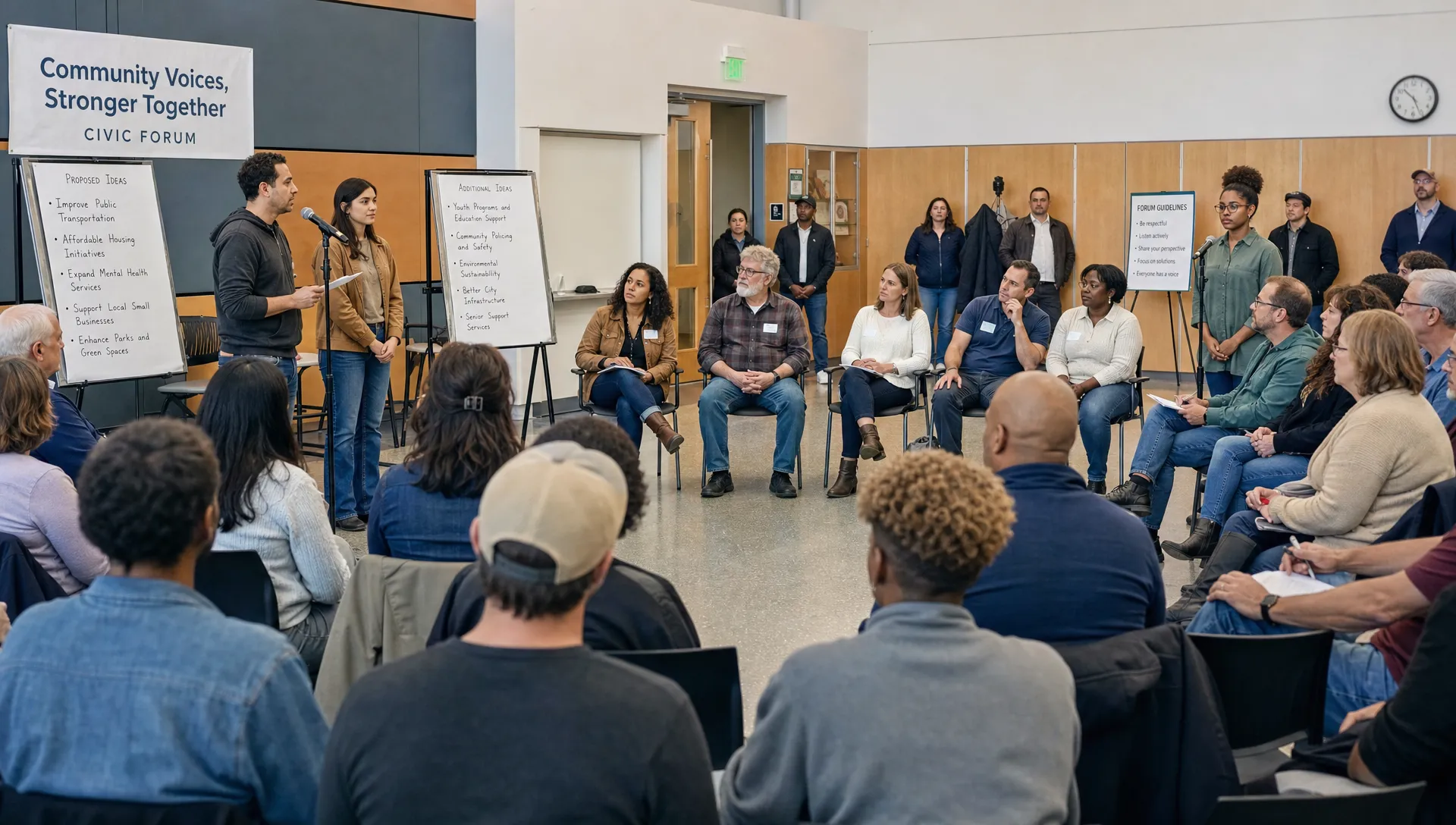
The right to dissent should not depend on the goodwill of whoever controls the meeting. It has to be built into the design of democratic processes. Otherwise, dissent will be tolerated only when it is convenient.
A serious deliberative process should include several safeguards:
- Agenda access so citizens can raise issues rather than only react to official proposals.
- Balanced briefing materials so dissenters are not forced to argue against selective evidence.
- Facilitation rules that protect equal speaking time and prevent domination by status, wealth or confidence.
- Minority reports so unresolved objections are published alongside final recommendations.
- Transparency records so citizens can see how dissent affected the final decision.
- Privacy protections so people can participate without fear of retaliation when the topic is sensitive.
- Revision windows so decisions can be reconsidered when strong objections expose new facts or harms.
These are not procedural luxuries. They are what make public reasoning credible. If a government invites citizens to deliberate, then ignores every dissenting view without explanation, the process becomes performance. If a political movement asks people to join, then punishes internal disagreement, it reproduces the same power habits it claims to oppose.
Technology can either protect dissent or bury it
JustSocial’s broader vision connects direct democracy, civic engagement and government transparency with modern technology. That connection is necessary, but it must be handled carefully. Digital systems can make participation easier. They can also make conformity easier.
An online voting platform can count preferences quickly, but speed is not the same as legitimacy. A civic platform can display public opinion, but visibility is not the same as understanding. An analytics system can cluster viewpoints, but clustering must not flatten dissent into a statistical footnote.
If democracy tools are built for deliberation, they should help citizens and officials see the structure of disagreement. What are the main objections? Which groups raise them? Are the objections factual, moral, economic, constitutional or procedural? Which objections were answered? Which remain open?
Government transparency also changes meaning in this context. Transparency is not only publishing final votes. It is publishing the path from public input to public decision. A citizen should be able to trace how a concern moved through the system, where it was considered, why it was accepted or rejected and whether it will be reviewed later.
This is one of the strongest connections between deliberative democracy and the JustSocial idea of continuous direct democracy. If citizens are to be heard regularly, their dissent must not disappear into a black box. It needs institutional memory.
The right to dissent inside a political movement
A political movement that promotes democracy has to practice it internally. This is hard because movements often feel pressure to simplify the message, protect leadership and avoid public disagreement. Some discipline is necessary. A movement with no shared direction becomes a conversation club. But a movement with no room for dissent becomes a miniature version of the system it criticizes.
For a movement built around citizen empowerment, internal dissent should be treated as a source of correction. Members should be able to question strategy, challenge priorities, criticize messaging and propose alternatives without being framed as disloyal. The question should not be, “Does this person agree with us?” The better question is, “Does this objection help us become more honest, more democratic or more effective?”
The JustSocial manifesto repeatedly returns to the idea that no single person has all the answers, but the people collectively may. That claim has consequences. If collective intelligence is real, then dissent is not an embarrassment to the movement. It is part of the method.
What institutions should do with dissent
Dissent should not be left as a symbolic gesture. Institutions need a repeatable way to handle it. A practical deliberative cycle can look like this:
- Receive dissent publicly: Give citizens a legitimate channel to object, explain and organize.
- Translate objections into deliberative questions: Turn anger or refusal into issues that can be examined.
- Bring in evidence and affected voices: Let facts, expertise and lived experience meet in the same process.
- Deliberate under fair rules: Protect speaking time, relevance and access to information.
- Publish majority conclusions and minority objections: Show both the decision and the unresolved dissent.
- Explain the final decision: Make institutions answer the strongest objections, not the weakest ones.
- Create review points: Let dissent reopen decisions when consequences prove different from promises.
This cycle does not guarantee agreement. It does something more realistic: it gives disagreement a civic form. It allows people to lose a vote without being erased from the community.
The democratic maturity test
Every regime claims to represent the people. The test is how it treats the people who say no.
If dissenters are mocked as ignorant, the system is afraid of its citizens. If dissenters are heard only when they are numerous enough to threaten stability, the system rewards escalation. If dissenters are invited into deliberation, answered in public and preserved in the record, the system becomes more capable of learning.
Deliberative democracy does not ask society to love disagreement for its own sake. It asks society to recognize that public judgment improves when disagreement is handled fairly. Civic participation becomes meaningful only when citizens can do more than endorse a prewritten agenda. They must be able to object, persuade, revise and sometimes remain unconvinced.
That is not a weakness in democracy. That is democracy becoming honest about what it is.
Frequently Asked Questions
Is deliberative democracy the same as giving every dissenter a veto? No. Deliberative democracy protects the right to be heard, answered and recorded. It does not mean every objection must block a decision. It means decisions gain legitimacy by seriously engaging with objections before power is used.
Why is dissent different from polarization? Dissent can clarify values, expose harm and improve decisions. Polarization hardens identity groups against one another and often makes listening feel like betrayal. Deliberative design tries to keep dissent reasoned, visible and connected to public problem-solving.
Can online voting platforms protect dissent? They can, but only if they are designed for more than counting votes. A democratic platform should capture reasons, publish minority views, protect privacy, show how input influenced decisions and prevent harassment or manipulation.
How does discursive democracy support the right to dissent? Discursive democracy protects the wider public conversation where dissent first appears. It allows citizens to challenge narratives, language and assumptions before formal deliberation turns those conflicts into decision-ready questions.
What role should a political movement play in protecting dissent? A democratic political movement should model the behavior it demands from the state. That means allowing internal criticism, recording minority positions and treating disagreement as a way to improve strategy rather than as disloyalty.
From dissent to democratic power
The right to dissent is not a side issue for deliberative democracy. It is the condition that makes deliberation real. Without dissent, civic participation becomes managed approval. With dissent, it can become public intelligence.
JustSocial’s vision of continuous direct democracy depends on citizens who are not passive recipients of policy, but active participants in shaping it. That includes the citizen who agrees, the citizen who doubts and the citizen who refuses to accept that the current system is the best we can build.
If this argument resonates, read the manifesto, share the idea, volunteer your skills or begin a local initiative with the same democratic spirit. A political movement for citizen empowerment should not ask people to be quiet supporters. It should invite them to become thinking, speaking and dissenting co-builders of public life.