
Whistleblowers can reveal wrongdoing that ordinary public debate never reaches: concealed safety failures, manipulated procurement or retaliation against employees who raise concerns. But disclosure carries risks that an invitation to speak cannot solve. Discursive democracy needs whistleblower protections because participation is not genuinely free when telling the truth can cost someone their livelihood.
The challenge is to connect confidential reporting with public accountability without turning an allegation into a spectacle. Citizens should be able to question an institution’s response, examine its reasoning and influence reforms. They should not vote on a whistleblower’s credibility or demand access to identifying evidence.
How discursive democracy strengthens whistleblower protections
Discursive democracy treats public reasoning as part of legitimate decision-making. Institutions must engage with evidence, answer objections and explain their choices rather than merely count expressions of support.
For whistleblower protections, this creates two distinct responsibilities. First, institutions need a protected process for receiving and investigating disclosures. Second, they need a public process for explaining what they learned and what they will change, subject to lawful confidentiality limits.
These responsibilities reinforce each other but cannot be merged. A confidential investigator may need documents that would expose a source if published. A public forum may need an explanation of a procurement failure without needing the original documents or the employee’s name.
The democratic objective is accountable handling of wrongdoing, not public adjudication of individual cases. A majority cannot determine whether someone deserves statutory protection. Nor should popularity determine whether an allegation receives an independent assessment.
This distinction matters for deliberative democracy as well. A carefully facilitated citizens’ panel can examine proposed reporting safeguards, but it should not replace qualified investigators, courts or other legally authorized decision-makers.
Start with legal rights, not a participation platform
Whistleblower protection is a legal framework as well as an institutional practice. Coverage depends on jurisdiction, employment status, subject matter and the route used to report. A policy that sounds protective may leave someone outside the relevant law.
The EU Whistleblower Directive establishes protections for reporting breaches in specified areas of EU law. Among its conditions, reporting persons must have reasonable grounds to believe the information was true when reported and fell within the directive’s scope. It addresses confidential reporting channels, follow-up and retaliation, while national implementing laws determine how those protections operate locally.
In the United States, protection is divided among different federal and state laws. OSHA’s Whistleblower Protection Program administers retaliation provisions under multiple statutes, each with its own coverage and filing deadline. It is not a universal channel for every workplace complaint.
An institution should explain available internal and external reporting routes rather than assume that reporting to management is always required. Public disclosure may receive protection only under particular legal conditions, so posting allegations online is not automatically equivalent to making a protected report.
For anyone considering a disclosure, qualified legal advice can clarify reporting routes, deadlines and document-handling restrictions. This article presents governance principles, not advice for an individual case.
Keep confidential investigation separate from public discussion
JustSocial’s manifesto for continuous public participation proposes that citizens should be heard throughout a representative’s term, not only at elections. It also distinguishes public opinion from binding referendums and preserves institutional independence.
Applied to whistleblower protections, that distinction supports a practical boundary: people can scrutinize the system without controlling an individual investigation. The manifesto’s demand for accessible public records must also be implemented alongside privacy, due process and lawful restrictions on disclosure.
The confidential reporting process
A protected reporting process should identify who receives disclosures, who can access evidence and how conflicts of interest are handled. If the allegation concerns senior leadership, routing it solely through that leadership defeats the purpose.
Confidentiality and anonymity are different. In a confidential report, authorized recipients may know the reporting person’s identity but must restrict disclosure. In an anonymous report, the recipient may not know it. Neither label guarantees safety: document metadata, job responsibilities or distinctive details can reveal a source.
Policy should therefore address identity exposure, not merely promise that a name will be hidden. It should also provide a way to report suspected retaliation separately from the underlying allegation.
An investigation must distinguish substantiated, unsubstantiated and unresolved claims. A report that cannot be substantiated is not automatically a knowingly false report. People should not have to prove an entire case before asking an authorized body to investigate it.
The public discussion process
Public discussion should concern institutional performance and policy choices: whether reporting channels are independent, whether corrective action is adequate and whether employees can raise concerns safely.
Publish redacted findings and reasoned responses when legally permissible, with an explanation of what has been withheld and why. A useful public record can describe the issue, the review method, the conclusion and the corrective action without exposing witnesses.
JustSocial’s approach to rules for healthier public debate is relevant here. Discussion rules should keep attention on evidence and institutional responsibilities while preventing attempts to identify sources, harass witnesses or present unresolved allegations as established facts.
Discursive democracy becomes protective when it makes officials answerable for their response without making vulnerable people answerable to a crowd.
Build a visible path from disclosure to remedy
A reporting system can accept submissions while doing little to address them. Democratic oversight should examine the entire path from receipt to corrective action, including what happens when the institution fails to follow its own procedure.
The following is a proposed governance model, not a statement of universal legal requirements:
| Stage | Protected responsibility | Public accountability mechanism |
|---|---|---|
| Receipt | Acknowledge reports through an appropriate channel | Publish the reporting procedure and responsible office |
| Initial assessment | Assess scope, urgency and conflicts of interest | Explain assessment criteria without exposing case details |
| Investigation | Preserve evidence and protect procedural fairness | Publish review standards and oversight arrangements |
| Retaliation response | Assess reported threats or adverse treatment | Report aggregated outcomes where disclosure is safe |
| Resolution | Communicate findings within applicable legal limits | Release lawful, redacted conclusions and reasons |
| Corrective action | Assign responsibility for implementing remedies | Track commitments, completion and unresolved issues |
Timeliness should be measurable, but speed alone is a poor measure of success. Closing a difficult case quickly can conceal inadequate investigation. Institutions should explain delays through appropriate channels and provide independent escalation routes where available.
A municipal procurement example
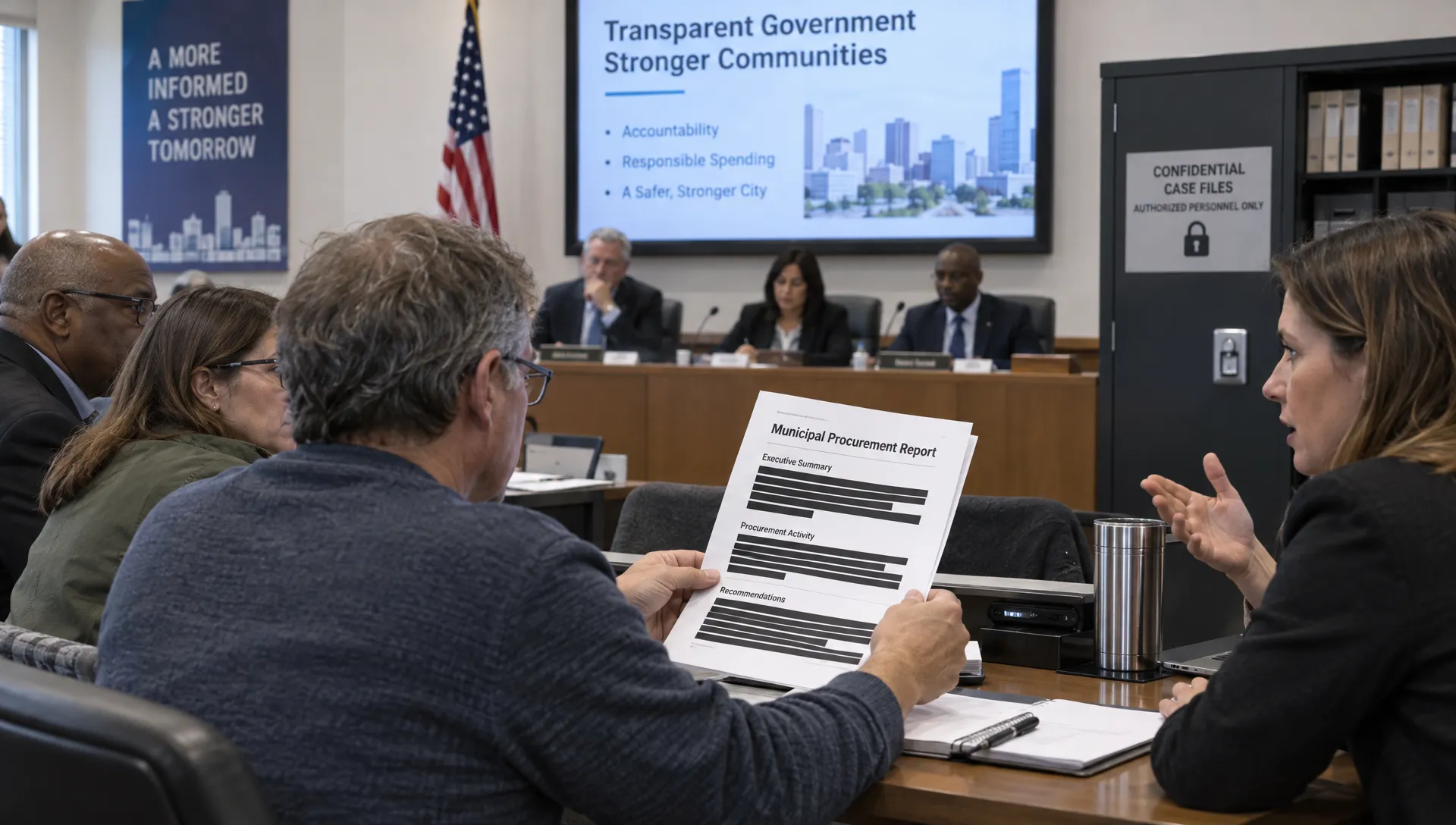
Imagine a municipal employee reports that a contract evaluation was altered to favor a particular bidder. This hypothetical case requires a confidential evidence review, conflict checks and protection against retaliation.
Residents do not need the employee’s identity to examine the institutional response. Once disclosure is legally permissible, they can scrutinize the procurement rules, the redacted findings and the proposed safeguards against future manipulation.
A public discussion might compare independent review panels, stronger conflict declarations or clearer records of evaluation changes. The municipality should then explain which reforms it accepts, which it rejects and why.
That is civic participation with a defined purpose. It influences the rules and tests the adequacy of the remedy without asking residents to decide guilt. It also extends JustSocial’s case for public accountability in real time into the period after an investigation, when promised reforms can otherwise disappear from view.
Make software promises testable
A reporting portal can undermine an otherwise sound policy. Excessive access permissions, identifying analytics or revealing notification messages can expose information the institution promised to protect.
Translate policy into testable requirements. For example, specify which roles may access identifying information, which actions must be logged and what information may appear in notifications. Separate public participation data from confidential case material rather than treating everything as one community database.
Tools for continuous software correctness audits, such as Proof, can help trace approved requirements to code and check implementations through verification, coverage analysis and runnable findings. For a reporting system, this approach can support checking whether specific software behavior matches documented commitments across releases.
That is a limited assurance layer, not a guarantee of whistleblower safety. Software correctness checks do not by themselves establish cybersecurity, legal compliance or protection from retaliation. Independent security assessment, careful operations and accountable institutional leadership remain necessary.
Public metrics also need privacy review. A count of reports from a tiny department may identify a source even without names. Discursive democracy should make institutional performance visible, not make every underlying data point public.
A political movement must protect dissent within itself
Whistleblower protections test a political movement’s principles where they are least comfortable: allegations about its own leaders, supporters or partners.
A movement cannot credibly demand public accountability while treating internal criticism as disloyalty. It should distinguish disagreement over strategy from reports of suspected wrongdoing, provide proportionate reporting routes and prevent implicated people from controlling the response.
JustSocial’s manifesto proposes independent branches of government and a role for academia in examining public decisions. Applied here, the relevant principle is independent scrutiny. Technical specialists can assess system claims, legal professionals can clarify obligations and appropriate oversight bodies can review institutional handling. None should be assumed impartial merely because of their title or affiliation.
The manifesto also treats education as a foundation for meaningful participation. Whistleblower literacy belongs within that agenda: people need to understand reporting routes, confidentiality limits, retaliation and the difference between evidence and allegation.
For discursive democracy to support dissent, those principles must survive political inconvenience. The same process should apply whether a disclosure challenges an opponent, an ally or the movement itself. These are proposed standards consistent with JustSocial’s stated values, not claims that it currently operates a protected reporting service.
Evaluate protection, not just participation
A pilot program should start with a defined institutional scope, appropriate independent oversight and an explanation of what its reporting channel can and cannot do. Invite affected workers and relevant specialists to examine the design without asking anyone to disclose a live case publicly.
Useful evaluation questions include:
- Can a reporting person bypass an implicated manager through an appropriate route?
- Are confidentiality limits and access responsibilities clearly explained?
- Can suspected retaliation be reported and assessed separately?
- Are corrective actions assigned, tracked and independently checked?
- Can the public question institutional decisions without identifying a source?
Submission volume and public engagement are insufficient measures. More reports may reflect greater trust, more wrongdoing or both. Fewer reports may reflect improvement or fear. Evaluation should combine carefully protected feedback, process review and evidence that corrective commitments were implemented.
The aim is not to maximize disclosure. It is to make legitimate reporting safer and institutional responses more accountable.
Frequently asked questions
Can discursive democracy replace whistleblower laws? No. Public reasoning can strengthen oversight and improve policy, but enforceable rights, lawful investigations and access to remedies remain essential. A participation platform cannot create statutory protection by itself.
Should whistleblower allegations be discussed publicly? Not automatically. Public disclosure can expose sources, prejudice proceedings or breach legal restrictions. Public discussion should usually focus on lawful, redacted findings and institutional reforms rather than confidential evidence.
Does an anonymous reporting option prevent retaliation? Not necessarily. Circumstances or document details may reveal a source. Effective protection also requires restricted access, independent handling and a credible response to suspected retaliation.
What can citizens influence without investigating individual cases? Citizens can examine reporting policies, question the independence of oversight, debate proposed remedies and track institutional commitments. Individual findings and legal entitlements belong with appropriately authorized bodies.
Turn participation into enforceable responsibility
JustSocial’s vision asks institutions to listen continuously. Whistleblower protections add a necessary condition: people must be able to raise uncomfortable evidence without being sacrificed to the process.
Explore the manifesto with that test in mind. Advocate for confidential reporting, independent review and public explanations of corrective action. A credible political movement should welcome scrutiny and make clear who is responsible when protection fails.





