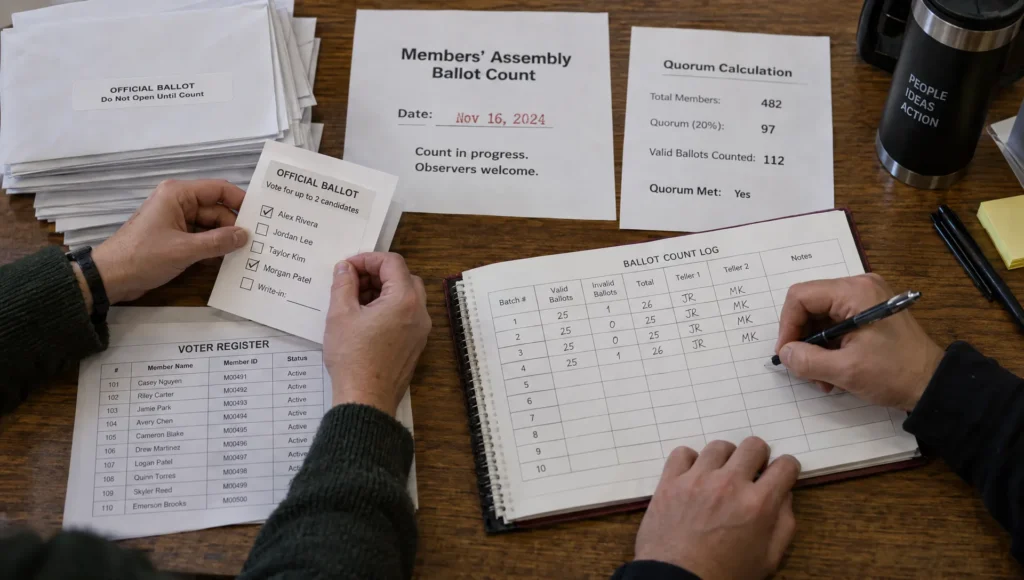
Turnout is the most familiar civic scorecard because it’s easy to count. But it is also a blunt instrument: it tells you how many people showed up, not whether civic participation produced legitimate, informed, and decision-relevant public judgment.
If your goal is healthier public decisions, you need to measure what happens between “people showed up” and “a decision was made.” That gap is exactly where discursive democracy (the quality of public talk) and deliberative democracy (the quality of public reasoning toward options) either strengthen legitimacy or quietly fail.
This is also where many reform efforts die: they optimize for attention rather than outcomes, then call the result “engagement.” In the language of the JustSocial manifesto, it becomes participation theater instead of a durable civic institution that treats citizens as more than occasional voters.
Below is a practical metrics framework you can use as a community group, a city team, or a political movement that wants to build real civic capacity.
Why turnout fails as a standalone metric
Turnout is useful, but it only answers one question: how many people participated in one moment? It does not tell you:
- Whether participation was inclusive, accessible, and safe.
- Whether people understood tradeoffs, changed their mind, or learned.
- Whether the process produced decision-grade outputs (options, reasons, evidence).
- Whether decision-makers responded in a way participants can audit.
A turnout-only strategy also creates perverse incentives. If “bigger is better,” organizers may optimize for virality, outrage, and low-friction clicks, which tend to degrade discursive quality and undermine deliberative work.
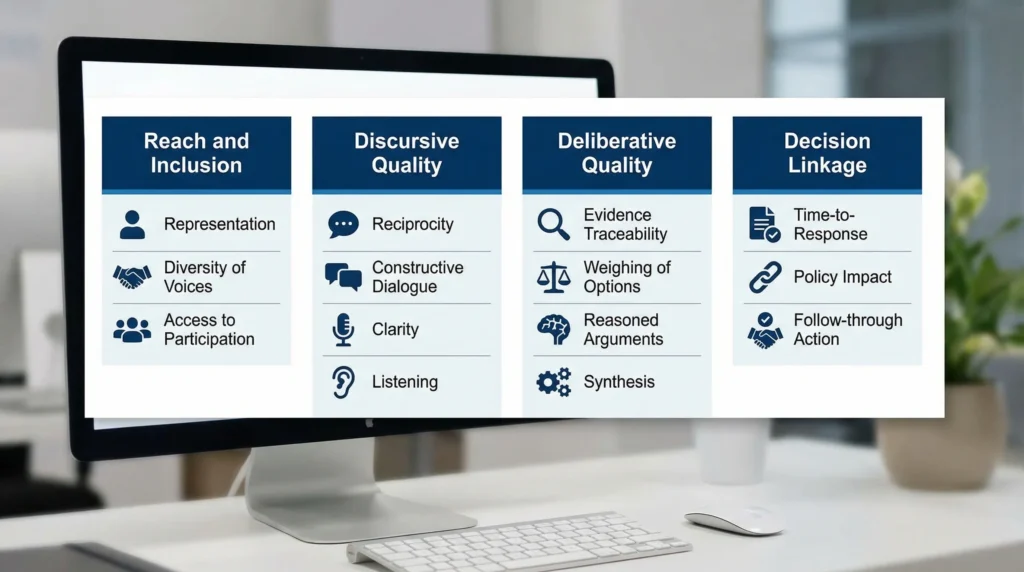
A 4-layer measurement model for civic participation
Think of civic participation as an end-to-end system. Each layer has different metrics and different failure modes.
- Reach and inclusion (who had a real chance to participate)
- Discursive quality (how people talked in the public sphere)
- Deliberative quality (how people reasoned toward options)
- Decision linkage and follow-through (what institutions did with the input)
This model aligns with the manifesto’s core demand: participation should be continuous and consequential, supported by “receipts” (public artifacts people can inspect), not just slogans.
Layer 1: Reach and inclusion metrics (beyond raw turnout)
Raw counts hide who is missing. Inclusion metrics answer: Did the process represent the public affected by the decision?
Track these core inclusion metrics
| Metric | What it tells you | How to measure it (practical) | Common gaming risk | Anti-gaming guardrail |
| Eligible reach | Whether affected people even heard about the process | Estimate eligible population reached by channel (mail, SMS, community partners, in-person) | Inflated “impressions” | Count verifiable touches (deliveries, RSVPs, partner distribution logs) |
| Participation rate by group | Whether groups participated at similar rates | Compare participation share vs population share (by neighborhood, age band, language) | Over-collecting personal data | Use privacy-preserving, voluntary, minimal demographic sampling |
| Barrier rate | Where people got stuck | Drop-off at steps (sign-up, identity check, submission, meeting attendance) | Hiding friction by removing safeguards | Report friction and fix it, do not erase it |
| Multi-channel balance | Whether offline residents could participate | % of contributions via in-person, phone, paper, assisted digital | “Digital only” looks efficient | Publish a channel access promise and resource it |
One metric that often changes behavior fast: repeat participation
Repeat participation rate (how many people come back next month or next issue) is a better indicator of civic health than one-time turnout.
- High turnout + low repeat participation often signals spectacle.
- Moderate turnout + high repeat participation can signal an emerging civic institution.
Layer 2: Discursive democracy metrics (quality of public talk)
Discursive democracy is about the public sphere: framing, agenda-setting, and who gets heard. Your metrics should reward clarity, reciprocity, and truth-seeking behavior, not volume.
A workable “discursive quality” scorecard
You do not need perfect NLP or surveillance. Start with lightweight coding (human sampling), clear rules, and public norms.
| Metric | Definition (plain English) | How to track without creepiness |
| Reciprocity rate | % of contributions that respond to another contribution (not just broadcast) | Sample 200 comments/posts, code as “reply,” “builds on,” or “broadcast” |
| Claim-to-evidence ratio | Are people providing sources, lived experience details, or verifiable claims? | Require a “What makes you think this?” field, then sample quality |
| Civility and procedural compliance | Are people following debate rules that protect participation? | Track moderator actions by category (not viewpoint) and publish counts |
| Cross-group contact | Are people encountering different perspectives? | Track attendance in mixed forums and structured pairings (opt-in) |
Why this matters for a political movement
A political movement can generate massive attention while still weakening democracy if it normalizes dehumanizing discourse. Discursive metrics help movements prove they are building civic capacity, not just winning the feed.
In the manifesto’s terms, this is part of breaking the cycle where citizens dump rage into phones but gain no durable influence. Discursive quality is the bridge from noise to civic power.
Layer 3: Deliberative democracy metrics (did reasoning improve decisions?)
Deliberative democracy is where groups move from “what we feel” to “what we recommend,” under conditions that support learning, tradeoffs, and fair hearing.
Deliberation should produce decision-grade outputs. If it doesn’t, institutions will ignore it, and participants will conclude participation is fake.
Measure deliberation by its artifacts
A strong, low-drama way to measure deliberative democracy is to measure what it produces.
| Metric | What “good” looks like | What to publish as the receipt |
| Issue pack completeness | Clear scope, constraints, timeline, what is in-bounds/out-of-bounds | A short Issue Pack PDF/page with version history |
| Evidence commons quality | Multiple perspectives, disagreement made legible, sources accessible | Evidence index with citations and “what we still don’t know” |
| Option diversity | More than binary choices, includes hybrid and staged options | Options memo that lists 3 to 6 viable paths |
| Tradeoff clarity | Costs, benefits, risks, and who bears them | A one-page tradeoff table per option |
| Minority views preserved | Dissent is recorded, not erased | Minority report(s) attached to the final output |
| Deliberation-to-output cycle time | Not rushed, not endless | Published timeline with meeting dates and deadlines |
If you want a research-informed foundation for why deliberation design matters (and how it can be institutionalized), the OECD has documented how deliberative processes can improve legitimacy when they are connected to real decision pathways (see OECD work on deliberative democracy).
A simple metric that catches “fake deliberation” early
Track Option Adoption Rate:
- Of the options produced by the deliberative group, how many made it into the decision-maker’s official consideration set?
If that number is near zero repeatedly, your deliberation is likely being treated as a PR exercise.
Layer 4: Decision linkage and follow-through metrics (the missing half)
Most civic participation collapses here.
People give time, stories, and ideas. Institutions often respond with vague gratitude. The gap creates cynicism.
The manifesto calls for civic systems where the public can see how input shaped outcomes. That requires measuring linkage and publishing receipts.
The essential decision-link metrics
| Metric | Why it matters | How to measure it |
| Duty-to-respond coverage | Whether decision owners actually answered | % of issues with an official response by deadline |
| Time-to-response | Whether the system respects participants’ time | Days from close of input to published response |
| Rationale specificity | Whether reasons are inspectable | Score responses: “generic,” “partly specific,” “fully specific with references” |
| Input traceability | Whether people can find where their ideas went | % of major themes linked to evidence and addressed in the rationale |
| Implementation tracker coverage | Whether promises become trackable work | % of approved actions with milestones and status updates |
| Outcome delta | Whether change happened in the real world | Define 1 to 3 outcome indicators per project (service levels, costs, equity) |
This layer overlaps heavily with transparency practice. If you want a deeper implementation approach, JustSocial’s framing on measurable public receipts is a strong complement (see the manifesto: The Face of Democracy).
A practical “Civic Participation Metrics” starter dashboard (30 days)
If you only track a handful of things at first, track what makes participation sustainable and auditable.
Week 1: Inclusion baseline
Pick one live issue and publish:
- Eligible population (rough estimate)
- Outreach channels you used
- Participation by channel (online, in-person, assisted)
- Barrier log (top 5 points where people dropped off)
Week 2: Discursive rules and compliance
Publish your discourse rules (procedural, not ideological), then track:
- Reciprocity rate (sampled)
- Moderation actions by category (harassment, spam, off-topic, doxxing)
- Claim-to-evidence ratio (sampled)
Week 3: Deliberative outputs
Run at least one structured deliberation session (even small), then publish:
- Issue Pack
- Evidence index
- Options memo
- Minority note (if present)
Week 4: Linkage receipts
Publish:
- Decision owner and decision date
- Official response
- Rationale with references to themes/options
- Implementation tracker (even if it is a simple table)
This is how a political movement, or a local institution, proves it is serious: not by louder messaging, but by a visible civic operating loop.
What to learn from outside politics: the “diagnose, fix root cause, teach prevention” model
Healthy civic systems resemble good maintenance systems.
A useful analogy comes from local service businesses that win trust by making their work legible: diagnose transparently, fix the root cause, and teach prevention. For example, TapTech’s approach to home plumbing and drains emphasizes modern diagnostics and homeowner education as part of the service (expert plumbing and drain cleaning services).
Civic participation works the same way:
- Diagnose the public problem (shared facts, clear scope).
- Fix the root cause (options that address mechanisms, not only symptoms).
- Teach prevention (civic learning, clear rules, repeatable processes).
If your metrics only count “calls received” (turnout), you miss whether the system actually solved the problem and reduced future failures.
Common metric traps (and how to avoid them)
Trap 1: Measuring volume instead of judgment
High comment counts can correlate with conflict, not wisdom. Counterbalance with deliberative artifact metrics (option quality, tradeoff clarity, minority reports).
Trap 2: Incentivizing polarization
If you reward shares, you often reward outrage. Replace engagement KPIs with reciprocity and claim-to-evidence measures.
Trap 3: Over-surveillance
Participation systems can easily become extractive if they collect too much identity or behavioral data. Use:
- Data minimization
- Voluntary sampling
- Aggregated reporting
- Clear retention limits
Trap 4: “We listened” with no receipts
A vague summary is not accountability. Publish the chain: issue framing, evidence, options, reasons, and implementation status.
The bottom line
Turnout is a starting point, not a verdict.
If you want civic participation that builds legitimacy and power (rather than exhaustion), measure the whole system:
- Inclusion (who could participate)
- Discursive democracy (how the public sphere behaves)
- Deliberative democracy (whether reasoning produces decision-grade outputs)
- Decision linkage (whether institutions respond with auditable receipts)
That is how a political movement earns trust at scale: not by claiming to represent the public, but by building participation infrastructure that the public can inspect.