Every public budget contains a moral argument. It says what must be protected, what can wait, who carries the burden, and which future a community is willing to fund.
That is why budget decisions create so much distrust. A city can publish a balanced spreadsheet and still leave residents feeling ignored. A ministry can announce efficiency cuts and still fail to explain whose services will shrink. A school district can ask for patience, then lose legitimacy because parents never saw the real tradeoffs.
Deliberative democracy is not a magic way to make scarcity disappear. Its value is more practical and more important: it helps people trust the process by which painful budget choices are made. When citizens see the evidence, weigh alternatives, hear one another, and receive a public explanation of how their input shaped the final decision, budget tradeoffs become inspectable rather than mysterious.
This is exactly the kind of democratic upgrade JustSocial argues for in its manifesto: people should not be reduced to voters, taxpayers, and consumers. Budgeting is where that principle becomes concrete, because taxes and public services are the daily meeting point between the citizen and the state.
Why budget tradeoffs break public trust
Budget debates are difficult because every option has a cost. More funding for mental health support may mean fewer road repairs. Lower taxes may mean longer waiting times. A new public safety program may delay investment in parks, libraries, or housing.
The problem is not only that people disagree. The deeper problem is that the disagreement is usually processed through institutions that the public cannot inspect. Residents see speeches, headlines, campaign promises, and final votes. They rarely see the internal tradeoff map: what was legally fixed, what was discretionary, what evidence mattered, who was consulted, what alternatives were rejected, and why.
The OECD Survey on Drivers of Trust in Public Institutions emphasizes that trust is closely connected to whether people believe government is responsive, reliable, and open to public input. Budgeting touches all three. If people cannot see how a budget choice was made, they often assume the worst: corruption, ideology, favoritism, incompetence, or bureaucratic inertia.
That suspicion is not irrational. In many places, public participation is still designed like a performance. Officials invite comments after the main choices have already been narrowed. Citizens speak for two minutes at a microphone. A report says the public was consulted. Then the budget moves forward with little visible connection between public input and public action.
A trustworthy budget process must do more than invite opinions. It must make the tradeoffs public, comparable, and answerable.
What deliberative democracy adds to budgeting
Deliberative democracy is a model of civic participation where legitimacy comes from fair, informed, structured public reasoning, not only from voting or public comment volume. It asks citizens to learn about a real decision, question evidence, hear different perspectives, weigh values, and produce reasoned recommendations.
The OECD report on deliberative processes describes a growing international wave of citizens' assemblies, juries, and panels used to address complex policy issues. Budgets fit this model because they are complex, value-laden, and full of unavoidable tradeoffs.
Deliberation does not replace elections. It does not mean every line item is decided by a mass vote. It creates a civic layer between private frustration and official decision-making, a place where public judgment becomes more informed, more representative, and more useful.
| Democratic layer | Role in budget tradeoffs | What it contributes to trust |
|---|---|---|
| Discursive democracy | Opens public conversation about needs, fears, priorities, and lived experience | Makes the range of public concerns visible before options are narrowed |
| Deliberative democracy | Brings a diverse group into structured learning and option-building | Produces reasoned recommendations that weigh evidence and values |
| Participatory democracy | Lets broader communities vote, rank, comment, or join oversight | Expands civic participation beyond a small deliberative group |
| Transparency infrastructure | Publishes evidence, rationales, responses, and implementation status | Lets outsiders verify whether the process mattered |
This layered approach matters because budget trust is not built by one tool. An online voting platform can collect preferences, but it cannot by itself explain tradeoffs. A public hearing can surface anger, but it rarely turns that anger into options. A spreadsheet can show numbers, but it cannot show public reasoning.
A trustworthy budget process needs all of these functions connected in a loop.
The budget tradeoff loop people can inspect
A deliberative budget process should begin before officials have already decided the answer. The public must be invited into the real decision window, not the communication phase after the decision is effectively done.
Publish the real fiscal question
The first act of trust is clarity. A budget process should start with a plain-language question such as: How should the city close a projected budget gap while protecting core services? Or: Which new investments should receive priority if only a limited amount of discretionary funding is available?
A vague question invites vague participation. A real question names the decision owner, the amount of money at stake, the timeline, the constraints, and what kind of public input can influence the outcome.
This is where many processes fail. They ask residents what they want, but not what they would give up. They ask for priorities, but hide constraints. They ask for comments, but do not say who must respond.
Build a public budget tradeoff pack
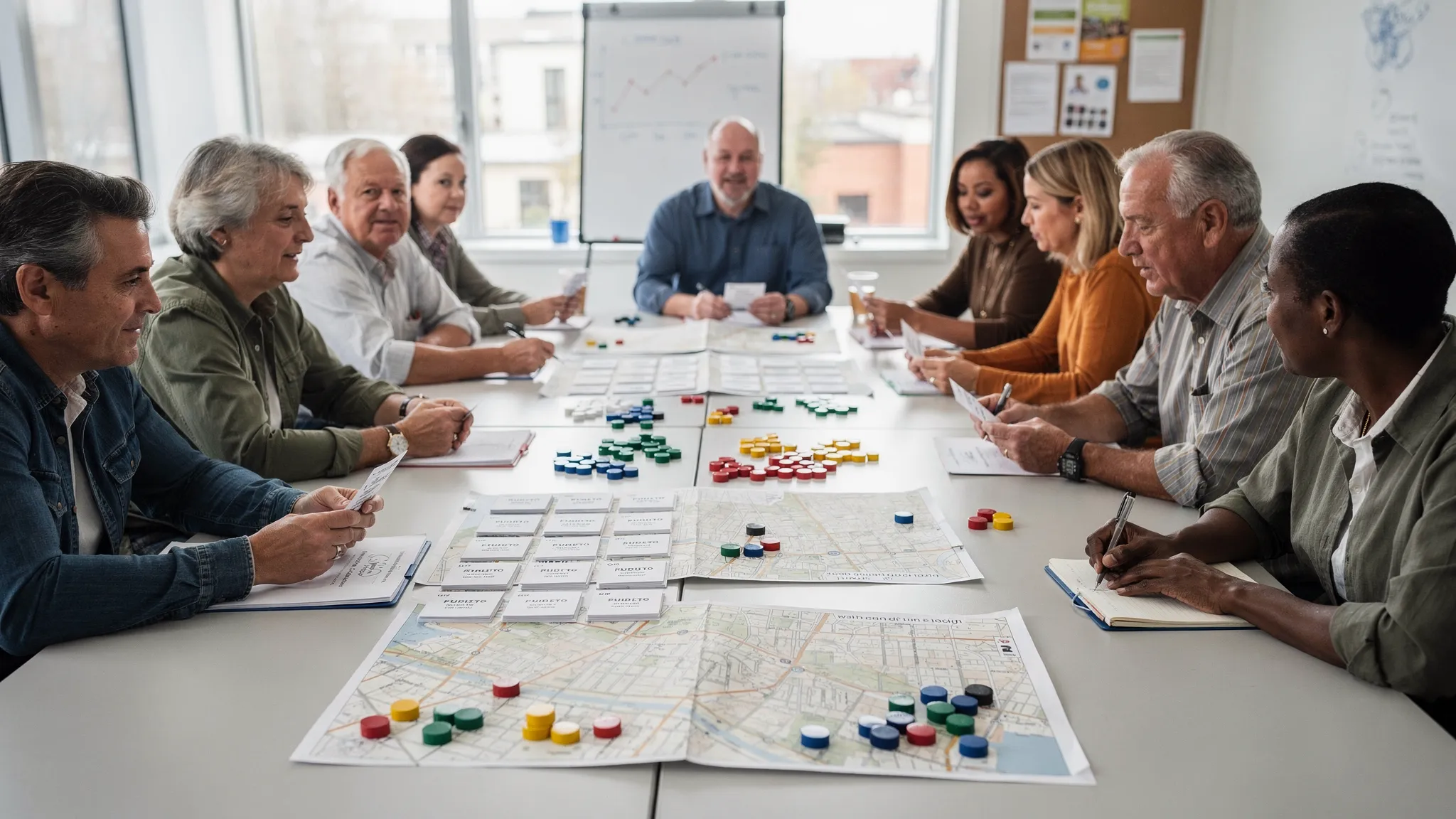
People cannot deliberate seriously without shared information. A Budget Tradeoff Pack should translate the financial reality into materials that ordinary residents can use without becoming accountants.
| Artifact | What it answers | Why it builds trust |
|---|---|---|
| Baseline budget | What are we spending now, and on what? | Prevents false claims about easy savings |
| Constraint map | Which funds are legally restricted, contracted, mandated, or time-limited? | Shows what is actually negotiable |
| Option cards | What would each cut, tax change, delay, or investment cost and produce? | Makes alternatives comparable |
| Distribution note | Who benefits, who pays, and who may be harmed? | Protects minority communities and vulnerable groups |
| Evidence index | What sources, assumptions, and uncertainties support each claim? | Lets citizens challenge weak evidence |
| Response memo | What did officials accept, reject, or modify, and why? | Creates a duty to answer public reasoning |
| Implementation tracker | What happened after the vote? | Turns trust into memory and follow-through |
For a broader operational model, JustSocial has also published a practical guide to deliberative democracy for budget decisions. The key point here is narrower: budget trust depends on whether people can inspect the tradeoffs, not merely whether they were invited to speak.
Open a discursive intake before deliberation
Before a smaller deliberative group begins, the wider public should have a structured way to surface concerns. This is the discursive democracy layer.
Instead of an open comment box that rewards outrage and repetition, ask residents to submit claims in a simple format: what budget choice concerns you, who is affected, what evidence or lived experience supports your claim, and what tradeoff you think decision-makers should consider.
This does not require every comment to be perfect. It does require public input to be legible. A resident's story about losing bus access, a teacher's warning about classroom staffing, a business owner's concern about fees, and a youth worker's evidence about prevention programs can all enter the same civic record.
The purpose is not to count which side shouted louder. It is to map the public problem before deliberators begin weighing options.
Convene a diverse deliberative group
A budget deliberation group should be diverse enough to hear tradeoffs from multiple positions in society. Recruitment can combine random selection, targeted outreach to underrepresented communities, and open applications with transparent selection rules.
The group should not be stacked with insiders. It should also not be left alone with raw complexity. Participants need time, facilitation, accessible materials, expert Q&A, and the ability to request additional information.
This is where JustSocial's manifesto idea of an independent Academic Branch becomes useful. Expertise should support public judgment without replacing it. Academics, auditors, service providers, and community experts can prepare evidence and uncertainty statements, but citizens must still weigh values.
In budget terms, the expert can say what a service costs, what evidence exists, and what uncertainty remains. The public must still decide what level of risk, burden, and priority is acceptable.
Turn values into comparable options
Budget deliberation should not produce a wish list. It should produce decision-ready options.
For example, imagine a city facing a hypothetical $10 million gap. A weak process asks residents which services they like. Unsurprisingly, most services are popular. A better process asks participants to compare packages:
| Option package | Main choice | Likely benefit | Likely cost or risk |
|---|---|---|---|
| Protect services, raise revenue | Smaller service cuts with targeted fee or tax increases | Preserves frontline programs | Higher burden on some residents or businesses |
| Delay capital projects | Postpone selected infrastructure upgrades | Avoids immediate service cuts | May increase future repair costs |
| Reduce service levels | Shorter hours, fewer programs, slower response times | Avoids revenue increases | Direct impact on residents who rely on services |
| Use reserves temporarily | Cover part of the gap with savings | Buys time for transition | Reduces resilience for future shocks |
| Mixed package | Smaller changes across revenue, reserves, delays, and efficiencies | Spreads burden | Harder to explain and manage |
The deliberative question becomes: Which package is most legitimate, given the evidence, the distribution of harm, long-term risk, and community values?
This is more honest than asking people whether they support good things in isolation. Trust grows when public reasoning confronts scarcity directly.
What makes a painful budget choice legitimate?
People do not need to agree with every outcome to trust a process. They need to believe the process was fair, informed, and consequential.
A budget tradeoff becomes more legitimate when four conditions are met.
First, the process must be truthful about constraints. If legal mandates, debt obligations, grant restrictions, or labor contracts limit the decision, those limits must be public. Hidden constraints create fake participation.
Second, it must be fair about burdens. A budget cut that looks neutral on paper can harm one neighborhood, age group, profession, or minority community more than others. Distributional analysis is not optional. It is how a democracy sees people instead of just totals.
Third, it must be contestable. Citizens should be able to challenge assumptions, request missing data, publish dissenting views, and see minority reports. A clean final recommendation is not as trustworthy as an honest record of disagreement.
Fourth, it must be linked to power. Officials can reject a deliberative recommendation, but they should not be able to ignore it silently. A public response memo should explain what was accepted, rejected, or changed.
This connects directly to JustSocial's argument for continuous direct democracy. In the manifesto, Yuval D. Vered argues that the people should become a continuous civic force, not a passive audience between elections. In budgeting, that means citizens should be able to follow a decision from public concern to deliberation, from deliberation to official action, and from official action to measurable implementation.
Technology helps only if it serves the process
Digital democracy tools can make budget deliberation more accessible and transparent. They can host evidence packs, collect structured input, publish meeting records, verify eligibility, support anonymous or pseudonymous participation where appropriate, and maintain implementation trackers.
But technology can also damage legitimacy if it is used as a shortcut. A poll without shared evidence is not deliberation. A dashboard without a duty to respond is not accountability. AI summaries without human review can flatten minority concerns or hide contested assumptions.
The JustSocial manifesto proposes concepts such as TakeAction!, rParliament, rConcensus, public analytics, and better civic technology for continuous participation. For budget tradeoffs, the same direction applies: tools should make public reasoning more visible, not merely collect more clicks.
A useful civic platform should help residents answer practical questions:
- What decision is being made?
- What options are on the table?
- What evidence supports each option?
- Who participated, under what rules?
- What did officials do with the recommendation?
- What changed after the budget was approved?
If the platform cannot answer those questions, it may be engagement technology, but it is not yet democratic infrastructure.
For governments evaluating civic technology, JustSocial's guide to citizen participation platform features and its work on transparency metrics offer useful next steps.
A trust scorecard for budget deliberation
Before launching a budget process, governments, civic groups, and political movements can test whether the process is likely to build trust.
| Trust test | Good sign | Warning sign |
|---|---|---|
| Decision clarity | The process names the decision owner, amount, timeline, and authority | The public is asked for ideas with no decision link |
| Evidence quality | Budget materials are plain-language, sourced, and challengeable | Only officials and consultants can understand the numbers |
| Inclusion | Outreach includes affected and underrepresented groups | Participation is dominated by organized insiders |
| Tradeoff honesty | Options show costs, risks, and distributional effects | Proposals are presented as all benefit, no sacrifice |
| Facilitation integrity | Rules prevent domination and require reason-giving | Loudness, status, or mobilized blocs control the room |
| Official response | Decision-makers must publish a response memo | Officials say they listened but provide no reasoning |
| Follow-through | Implementation is tracked publicly | The process ends when the vote ends |
This scorecard reflects a simple democratic principle: trust should not depend on personality. It should depend on inspectable process.
How a political movement can start before government agrees
A political movement does not need to wait for full institutional reform to practice deliberative democracy. It can model the standard it wants the state to adopt.
Start with one visible budget issue: a school district's staffing plan, a city service cut, a neighborhood infrastructure delay, or a grant allocation. Publish a participation promise. Build a small evidence pack. Invite structured public input. Convene a balanced deliberation group. Produce an options memo. Send it to the relevant decision owner. Publish the response, or publish the absence of one.
This is not a substitute for legal authority. It is movement infrastructure. It trains citizens, creates public memory, and shows officials that civic participation can be serious, disciplined, and useful.
It also matches the deeper spirit of JustSocial's People's Branch idea. A People’s Branch does not begin as a slogan. It begins as repeated civic practice: public questions, shared evidence, structured reasoning, visible decisions, and follow-through.
Budget tradeoffs are one of the best places to begin because they are concrete. Everyone understands that money is limited. Everyone can see whether promises were kept. And every budget cycle creates a new chance to improve the process.
Frequently Asked Questions
Is deliberative democracy the same as participatory budgeting? No. Participatory budgeting usually lets residents propose and vote on how to spend a defined pool of money. Deliberative democracy focuses on informed public reasoning about tradeoffs, which can support participatory budgeting but can also apply to cuts, taxes, long-term plans, and full budget priorities.
Can ordinary citizens understand complex budgets? Yes, if the process is designed well. Citizens do not need to become accountants. They need accessible materials, honest constraints, expert support, time for questions, and comparable options. Complexity is a design challenge, not an excuse for exclusion.
Does deliberation replace elected officials? It should not replace lawful authority. It should improve the quality and legitimacy of decisions. Elected officials can still decide, but they should publicly explain how they used or rejected deliberative recommendations.
How do you prevent organized groups from capturing the process? Use transparent recruitment, balanced information, facilitation rules, disclosure of interests, structured input formats, minority reports, and public records. Separate broad mobilization from the smaller deliberative phase so volume does not overpower judgment.
Can online tools be trusted for budget deliberation? They can help, but only with strong governance. Online tools need accessibility, privacy protection, identity rules appropriate to the stakes, moderation transparency, audit trails, and human oversight. The process must be trustworthy before the software can amplify it.
Build budget decisions people can trust
Budgeting will always involve disagreement. The goal is not to eliminate conflict. The goal is to make conflict productive, visible, and accountable.
Deliberative democracy gives communities a way to move from suspicion to shared reasoning. It helps citizens see the real constraints, compare real options, protect affected groups, and demand public explanations from decision-makers.
That is the democratic future JustSocial is working toward: continuous civic participation supported by transparent institutions and responsible technology. Read the JustSocial manifesto, explore the practical model for budget deliberation, and consider how your community could run one budget tradeoff process that people can actually inspect.