Deliberative democracy begins with a simple but demanding claim: citizens should not merely be counted after campaigns persuade them. They should be equipped to reason together before public decisions are made.
That raises an unavoidable question. If citizens are asked to deliberate on climate policy, education reform, housing, taxation, public health, artificial intelligence, or constitutional design, where does reliable knowledge come from? A public meeting without evidence becomes noise. A vote without understanding becomes a reflex. But a process ruled by experts becomes something else entirely, closer to technocracy than democracy.
This is where academia matters. Not as a priesthood of credentialed decision-makers, and not as a class above the people, but as public reasoning infrastructure. Academia can help societies distinguish evidence from propaganda, uncertainty from ignorance, expertise from authority, and values from facts. In the vision developed in the JustSocial manifesto, academia is even imagined as an independent branch of government, one that educates the public, holds representatives to higher standards, and helps regulate the quality of democratic decision-making.
The challenge is to give academia enough power to improve deliberation without giving it the power to replace the people.
Deliberative democracy needs more than opinions
Democracy often treats public opinion as something already formed. Pollsters measure it. Campaigners manipulate it. Parties claim to represent it. Media outlets package it. Governments respond to it when it becomes loud enough to threaten them.
Deliberative democracy starts from a different premise. Public opinion is not only measured, it can be improved. When people receive balanced information, question experts, hear affected communities, consider trade-offs, and speak under fair conditions, they often form judgments that are more stable, more nuanced, and more legitimate.
This is why deliberative democracy is different from a standard town hall, online comment section, or election campaign. It does not assume that louder voices are better voices. It creates conditions where citizens can think together.
The OECD has documented the rise of citizens’ assemblies, citizens’ juries, and other deliberative processes in its work on the deliberative wave. Ireland’s deliberative processes, including work connected to constitutional questions through the Citizens’ Assembly, are often cited because they show how structured citizen deliberation can influence serious national debates.
But every such process depends on information design. Who decides what evidence citizens see? Who explains competing views? Who checks whether claims are misleading? Who translates technical knowledge into public language without stripping away complexity?
If deliberative democracy is the public table, academia should help prepare the evidence placed on that table.
What academia can contribute
Academia’s democratic value is not that academics are always right. They are not. Academic fields can be biased, slow, captured by fashions, shaped by funding incentives, and disconnected from ordinary life. The value of academia lies in its methods: peer criticism, evidence standards, disciplinary memory, reproducibility, citation, methodological transparency, and long-term inquiry.
Those methods are imperfect, but they are far better than a public sphere governed only by virality, partisan messaging, and private platform incentives.
In a deliberative system, academia can contribute in five essential ways:
- Evidence synthesis: Academics can summarize what is known, what is disputed, and what remains uncertain.
- Methodological review: They can test whether statistics, models, surveys, and policy claims are being used honestly.
- Scenario building: They can help citizens understand likely consequences of different choices.
- Civic education: They can teach the public how to evaluate arguments, not just what conclusions to accept.
- Institutional memory: They can preserve lessons from past reforms so every generation does not restart from zero.
A companion JustSocial article explores how expertise should be publicly checkable and contestable. That point is crucial. Academia’s role is not to end disagreement. It is to make disagreement more honest.
Academia as a branch, not a throne
The JustSocial manifesto proposes a government structure with five branches: the executive, parliament, judiciary, the people, and academia. The point is not to crown professors as rulers. The point is to stop treating knowledge as an optional accessory to politics.
Today, academic expertise often enters government through temporary committees, consultancy reports, lobbying channels, expert hearings, or crisis task forces. That makes knowledge episodic and often dependent on whoever already holds power. A minister can commission a report, ignore it, distort it, or bury it. A parliamentary committee can invite experts and then reduce their testimony to partisan ammunition.
A democratic academic branch would make knowledge a standing public function. It would not vote instead of citizens. It would not govern instead of elected officials. It would ensure that citizens, representatives, journalists, courts, and public agencies have access to structured, transparent, challengeable evidence.
| Democratic function | Academic contribution | Democratic safeguard |
|---|---|---|
| Public deliberation | Plain-language evidence briefs and expert testimony | Competing views, citizen questions, and minority reports |
| Legislation | Review of evidence, assumptions, and expected impacts | Public publication of methods and conflicts of interest |
| Education | Civic reasoning, media literacy, and lifelong learning | Curriculum transparency and community input |
| Government accountability | Evaluation of policy outcomes and administrative claims | Open data where privacy and security allow |
| Public communication | Clarification of uncertainty and misinformation | No final authority over values or political choices |
This structure matters because modern public problems are too complex for slogan-based politics, yet too value-laden for expert rule. Housing policy is not just a matter of economics. It is also a question of community, property, generational justice, infrastructure, and ecology. Public health is not just epidemiology. It is also liberty, trust, risk, care, and social solidarity.
Academia can clarify the consequences of choices. It cannot decide what a people should value most.
The danger of technocracy
Every argument for expertise in democracy must face the same danger: expertise can become domination.
Citizens have good reasons to distrust expert institutions when they appear arrogant, inaccessible, politically selective, or captured by money. A democracy that tells people to simply defer to experts is not deliberative. It is paternalistic. Worse, it feeds the resentment that demagogues exploit.
Deliberative democracy requires a different posture from academia. The academic does not enter the room as a ruler with answers. The academic enters as a witness, translator, critic, and servant of public reasoning.
That means academic input should follow several rules. Evidence should be published before deliberation begins. Experts should disclose conflicts of interest. Uncertainty should be stated clearly. Dissenting academic views should be included when they meet serious standards. Citizens should be able to question experts directly. Policy options should separate factual assumptions from moral choices.
For example, an academic panel may explain that a certain tax reform is likely to increase revenue, reduce one form of inequality, and create pressure in a specific sector. But whether that trade-off is acceptable is a democratic question. Citizens must decide whether the gain is worth the cost.
The phrase follow the science can be useful in emergencies, but it is insufficient as a democratic philosophy. Science can inform the map. It cannot choose the destination.
What academia should do before citizens deliberate
A strong deliberative process begins before citizens enter the room. If the evidence is biased, incomplete, or incomprehensible, the process is already distorted.
Before deliberation, academic institutions can help build a public evidence package. This package should not be a single official truth. It should be a structured field of knowledge that citizens can inspect and challenge.
A useful evidence package would include the decision to be made, the realistic policy options, the strongest arguments for each option, known risks, affected groups, historical context, budget implications, legal constraints, and areas of uncertainty. It should also include a glossary, because public language matters. If citizens cannot understand the terms, they cannot exercise power.
This connects directly to the manifesto’s criticism of industrial-age public systems. Many institutions still treat citizens as passive recipients of decisions made elsewhere. Deliberative democracy reverses that relationship. The state must prepare citizens to participate, and academia can help make that preparation serious.
What academia should do during deliberation
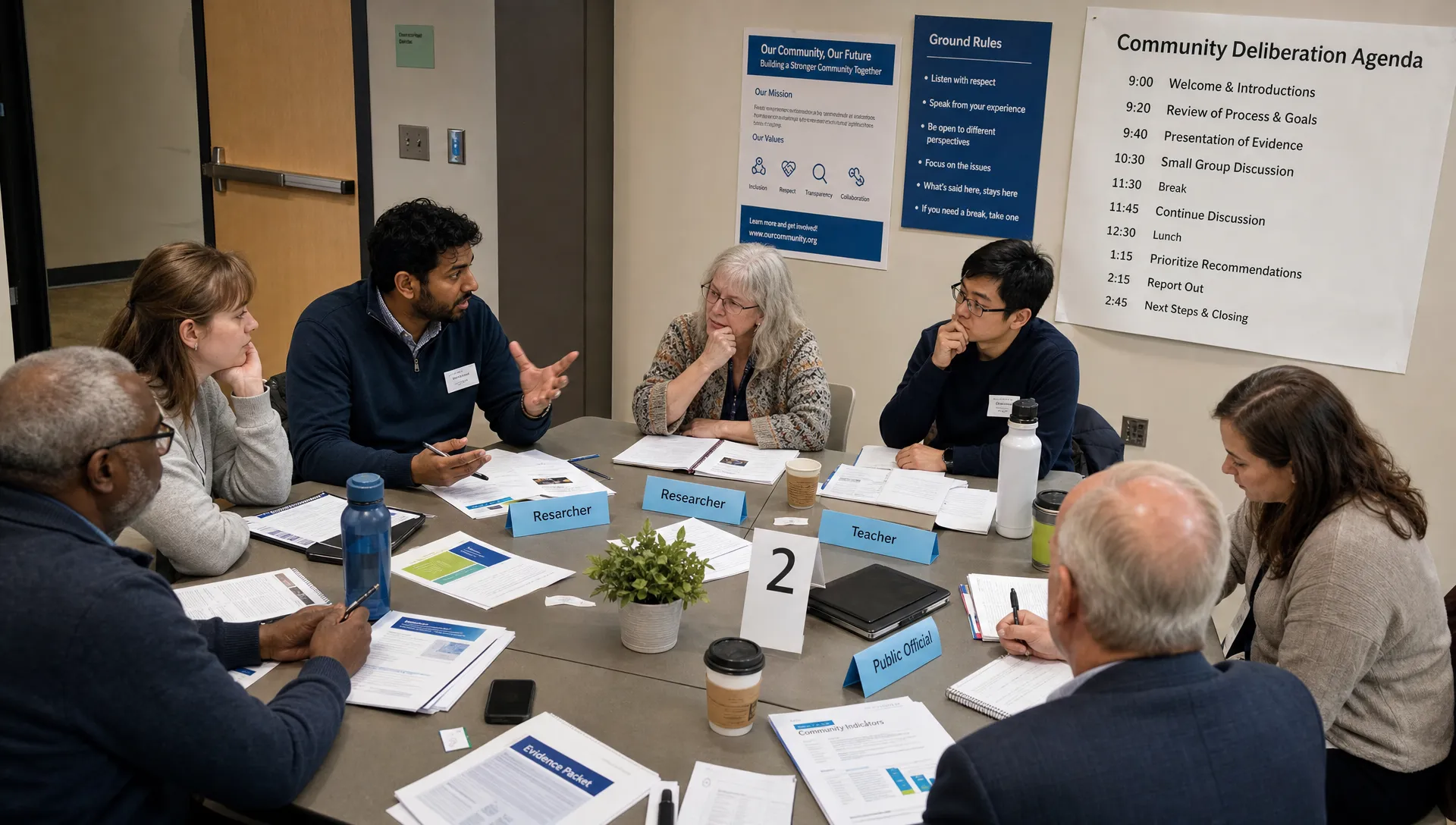
During deliberation, academics should be available but not dominant. They should answer questions, correct factual errors, explain uncertainty, and help facilitators distinguish evidence disputes from value disputes.
This requires humility. A citizen may not know the technical vocabulary of a field, but they may understand the lived consequences of a policy better than the expert. A parent can illuminate education reform in ways that a policy analyst cannot. A nurse can explain hospital capacity in ways that a model misses. A student can reveal classroom realities that never appear in national reports.
The best deliberative processes combine academic expertise with lived experience. One without the other is incomplete.
This also expands the role of civic media. Public reasoning does not happen only in universities or official assemblies. It happens through teachers, local organizers, podcasters, journalists, creators, and community leaders. If civic educators use platforms like YouTube to explain policy and deliberation, they also need sustainable and transparent funding models. A creator may use a sponsorship database for YouTube channels to identify potential partners, but democratic credibility requires clear disclosure so financial support never quietly shapes public evidence.
Technology can scale academia’s public role
The manifesto argues that modern society still relies on public structures inherited from the Industrial Revolution while living inside a technological revolution. That criticism is especially relevant to academia and democracy.
Academic knowledge is often locked behind paywalls, written in inaccessible language, scattered across institutions, and disconnected from public decision cycles. Meanwhile, citizens receive political information through algorithmic feeds optimized for attention rather than understanding.
Digital democracy should change that. Public evidence libraries, searchable legislative repositories, open committee records, deliberation platforms, online voting systems, public analytics, AI-assisted summaries, and secure civic identity tools can all help bring knowledge closer to citizens. JustSocial’s broader discussion of scaling deliberation with modern tech fits this exact challenge.
But technology must be governed as democratic infrastructure, not treated as a shortcut. AI can summarize testimony, but citizens should know what sources were used. Analytics can reveal opinion patterns, but they should not reduce citizens to behavioral data. Online voting can widen participation, but voting without deliberation can amplify impulse. Blockchain or other security tools may protect records, but technical security does not automatically create political legitimacy.
The correct formula is not academia over citizens or technology over institutions. It is citizens supported by academia, protected by institutions, and empowered by technology.
Education is the foundation of deliberative democracy
The manifesto’s education reform argument is not a side issue. It is central. A society cannot ask people to participate continuously in democracy while educating them for passivity.
Industrial schooling often rewards memorization, compliance, and standardized performance. Deliberative democracy needs different habits: listening, questioning, collaborative problem-solving, evidence evaluation, disagreement without dehumanization, and comfort with uncertainty.
Academia can help redesign civic education around these habits. Universities and schools should not only prepare people for the labor market. They should prepare people for self-government.
That includes lifelong learning. Citizens should be able to return to public education throughout life, especially when major policy decisions require new knowledge. Climate adaptation, AI governance, biotechnology, constitutional reform, migration, and war powers are not issues people can understand once at age 17 and then ignore forever.
If the people are to become a real democratic branch, education must become continuous too.
From the Polis to the Cosmopolis
One of the manifesto’s most important images is the movement from the ancient Polis to a future Cosmopolis. The Polis represented intimate political life, where citizens felt the state as something immediate rather than remote. It was not scalable in the ancient world. Modern republics solved the scale problem by representation, but at the cost of distance. Citizens became voters, taxpayers, and consumers, while politics became a profession practiced elsewhere.
Deliberative democracy, supported by academia and technology, offers another path. It can recover some of the immediacy of the Polis without pretending that a modern nation is a small city-state. The goal is not nostalgia. It is a new social contract in which citizens are heard continuously and seriously.
Academia’s role in that Cosmopolis is not to govern the people. It is to help the people govern themselves at a higher level of clarity.
FAQ
Does giving academia a formal role make democracy less democratic? Not if academia advises, educates, audits, and explains while citizens and legitimate public institutions retain decision-making power. The danger begins when expertise becomes command rather than service.
How is deliberative democracy different from simply asking experts for policy recommendations? Expert recommendations usually move from specialists to officials. Deliberative democracy brings citizens into the reasoning process, allowing them to question evidence, weigh values, and make or influence decisions after structured discussion.
Can ordinary citizens deliberate on highly technical issues? Yes, if the process is designed well. Citizens do not need to become specialists. They need balanced information, access to competing experts, plain-language materials, enough time, and fair facilitation.
What prevents academic institutions from becoming politically biased? No institution can be made perfectly neutral. The safeguard is transparency: published methods, competing perspectives, conflict disclosures, open questioning, minority reports, and the ability of citizens to challenge claims.
Why connect academia to civic participation? Civic participation without knowledge can become reactive. Academic knowledge without civic participation can become detached. Deliberative democracy needs both: informed citizens and accountable expertise.
Help build a democracy that can think
If democracy is reduced to elections every few years, public anger will keep flowing into streets, comment sections, and campaign cycles without becoming real power. If democracy becomes expert administration, citizens will be managed rather than represented.
The better path is continuous deliberative democracy: citizens empowered by technology, supported by academia, and connected through a political movement committed to transparency, education, and public participation.
JustSocial exists to push that future forward. Read the ideas, challenge them, share them, and help build the civic infrastructure a modern democracy deserves. Visit JustSocial.io to take part.