Anger is often treated as a threat to democracy. It can be. Anger can become hatred, conspiracy, violence, or permanent contempt for anyone outside the tribe. But anger can also be a democratic alarm bell. It tells us that people feel unheard, institutions feel distant, and public life has become too thin to carry the weight of real human frustration.
The question is not whether citizens will be angry. They will be, especially when housing feels impossible, schools feel outdated, public services feel slow, politics feels corrupt, and elected officials seem to listen only once every election cycle. The real question is whether a political movement can convert that anger into civic participation, deliberative democracy, and practical reform.
That conversion is the heart of democratic renewal. A movement that only amplifies outrage becomes another media engine. A movement that disciplines anger into action becomes civic infrastructure.
Anger is a signal, not a strategy
Political anger usually begins with a breach of trust. People were promised representation, fairness, opportunity, security, dignity, or voice, and they believe the promise has been broken. That feeling should not be dismissed as irrational. Around the world, democratic trust has been under pressure for years. Freedom House reported that global freedom declined for the 18th consecutive year in 2023, a reminder that democratic systems do not maintain themselves automatically.
Still, anger alone rarely builds anything durable. It is excellent at identifying pain, but poor at designing institutions. It can gather a crowd, but it cannot by itself write a policy, compare tradeoffs, audit a budget, or sustain civic work after the news cycle moves on.
This is where a serious political movement must be different from a protest brand or online outrage page. Its task is to turn the sentence I am furious into the sentence here is the public decision we need to influence, here is the evidence, here are the options, and here is what citizens can do next.
In the JustSocial manifesto, Yuval D. Vered argues that the modern citizen has been reduced too often to three roles: voter, taxpayer, and private consumer. That diagnosis matters because it explains why anger accumulates. When people are asked to fund the state, obey the law, and live with public decisions, but are given only occasional, blunt instruments of influence, frustration becomes predictable.
A healthier democratic culture gives citizens more than a ballot every few years. It gives them meaningful ways to speak, learn, deliberate, organize, and be heard continuously.
The anger-to-action conversion
A movement turns anger into action by building a path between emotion and public consequence. That path should be simple enough for new participants to understand, but structured enough to prevent chaos.
| Stage | What anger becomes | Democratic practice | Practical output |
|---|---|---|---|
| Expression | Testimony and shared language | Discursive democracy | Public issue maps, citizen stories, recurring concerns |
| Understanding | Competing explanations | Civic education | Evidence briefs, expert input, community context |
| Judgment | Weighed choices | Deliberative democracy | Ranked options, tradeoff analysis, recommendations |
| Action | Organized participation | Civic participation | Petitions, meetings, proposals, campaigns, public comments |
| Accountability | Visible follow-through | Transparency | Decision logs, representative responses, progress tracking |
Without this path, anger stays circular. People post, react, argue, and burn out. With this path, anger becomes a renewable source of democratic energy.
Start with discursive democracy: let people name the injury
Before citizens can deliberate, they need a place to speak in a way that is more serious than a comment section. Discursive democracy is not just people talking. It is public reasoning through language, testimony, disagreement, and mutual recognition.
This step matters because many political arguments begin with a translation problem. One group says taxes are too high. Another says services are collapsing. One group says schools are failing discipline. Another says schools are failing curiosity. One group says the government is corrupt. Another says it is simply outdated, understaffed, or captured by bad incentives.
A movement should not flatten these claims into slogans too quickly. It should collect them, compare them, and help citizens see the structure beneath their anger.
Useful discursive practices include:
- Public listening sessions where citizens describe concrete experiences, not only ideological positions.
- Issue mapping that groups complaints by policy area, institution, location, and affected community.
- Moderated online forums where participants must state the problem, the impacted group, and the decision-maker involved.
- Minority reports that preserve dissenting views instead of pretending consensus exists before it does.
- Citizen language summaries that translate technical policy into plain public questions.
This is not soft work. It is foundational work. A movement that cannot listen carefully will eventually organize badly.
Then use deliberative democracy: turn accusations into choices
Anger often points at a villain. Deliberation asks a harder question: what should actually be done?
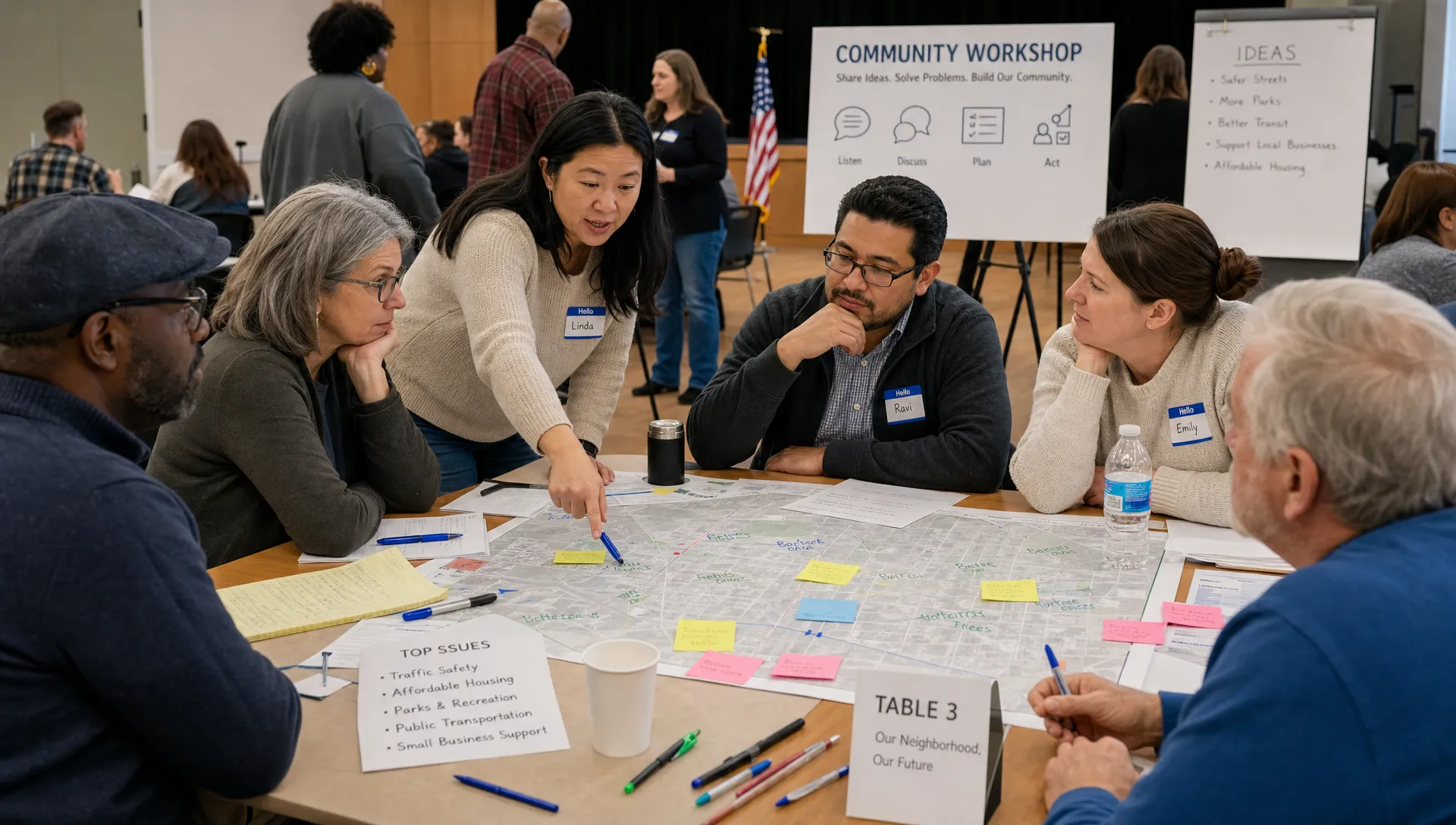
Deliberative democracy creates conditions where citizens can weigh evidence, hear competing perspectives, consider tradeoffs, and form more stable judgments. It does not require everyone to agree. It requires people to move from reaction to reasoning.
For example, anger about education might begin as schools are broken. A deliberative process turns that into public choices: Should schools reduce standardized testing? Should project-based learning receive more support? Should AI tools assist teachers? Should class schedules change? What evidence supports each proposal? What would it cost? Who might be harmed if implementation is rushed?
This connects directly to JustSocial’s broader argument that industrial-era institutions need reform. The manifesto criticizes education systems that treat learning like a factory line and proposes more holistic models, including project-based learning, stronger emotional guidance, and responsible use of technology. Whether one agrees with every detail or not, the democratic method is clear: citizens should be able to examine such proposals publicly, improve them, challenge them, and help decide what deserves support.
A mature political movement does not ask people to replace one dogma with another. It asks them to participate in disciplined public judgment.
Build participation ladders, not outrage funnels
Many movements are good at getting people angry enough to show up once. Fewer are good at helping them stay involved in ways that fit real life. Parents, workers, students, caregivers, retirees, immigrants, and small business owners do not all have the same time, confidence, or political knowledge.
A political movement should create participation ladders. The first step should be easy. The next step should be meaningful. The highest steps should develop citizens into organizers, policy contributors, candidates, watchdogs, or civic educators.
| Time available | Useful action | What it achieves |
|---|---|---|
| 10 minutes | Vote on a local issue prompt or submit a short testimony | Converts private frustration into public signal |
| 30 minutes | Send a decision-ready message to a representative | Shows officials a specific demand, not vague anger |
| 1 hour | Join a moderated discussion or local meeting | Builds shared understanding across citizens |
| 1 evening | Help summarize evidence, minutes, or public records | Makes civic knowledge easier for others to use |
| 1 weekend | Organize a neighborhood deliberation or issue campaign | Turns concern into visible collective action |
| Ongoing | Volunteer for research, outreach, product, legal, or community work | Builds the movement’s long-term capacity |
For citizens who want immediate examples, JustSocial has outlined practical political engagement examples citizens can do today, ranging from small actions to deeper civic commitments.
The key is to respect different levels of readiness. Not every supporter needs to become a full-time activist. A movement grows when it makes small civic actions feel legitimate, connected, and cumulative.
Make follow-through visible or anger will return
Citizens become cynical when they speak and nothing happens. Sometimes nothing happens because officials ignore them. Sometimes nothing happens because the process is unclear. Sometimes something does happen, but nobody communicates it back.
Transparency is the bridge between participation and trust. A movement should show what was heard, what was prioritized, who is responsible, what was sent to decision-makers, and what response came back.
This does not require a perfect technological system from day one. It can begin with public records, shared documents, open meeting notes, transparent funding disclosures, and clear decision logs. Over time, software can make this easier. The important principle is that every public action should leave a public trace.
A useful transparency system answers five questions:
- What issue are we working on?
- Who contributed to the discussion?
- What evidence was considered?
- What decision or recommendation was made?
- What happened after citizens acted?
This is why democratic technology should be judged less by how impressive it looks and more by whether it makes participation accountable. JustSocial’s writing on political movement tools for transparent growth develops this idea in greater detail: growth should make decisions more visible, not more hidden.
Treat technology as civic infrastructure, not a magic cure
Technology can help a political movement scale participation, but it cannot substitute for democratic ethics. Online voting platforms, civic forums, public transparency tools, analytics, AI summaries, and secure identity systems can all support digital democracy. They can also be abused if they are designed without privacy, consent, auditability, and public oversight.
The JustSocial manifesto is ambitious about technology. It imagines civic platforms for petitions, representative accountability, community voting, public analytics, legal repositories, and education. But the deeper point is not that every problem needs an app. The deeper point is that public institutions should stop lagging behind the tools citizens already use in private life.
At the same time, continuous participation must not become mob rule or surveillance. A responsible system should distinguish between public opinion as an input and binding law as an institutional output. Citizens should be heard continuously, but courts, rights, minority protections, evidence standards, and constitutional limits still matter.
In other words, the future of civic participation is not simply more clicks. It is better channels between citizens, knowledge, representatives, and public decisions.
Move from protest to institutions without losing the street
Protest is sometimes necessary. It can break silence, show urgency, and reveal that a problem is not isolated. But protest is an alarm, not a full operating system for democracy.
If anger remains only in the street, institutions can wait it out. If anger moves into public comments, city councils, school boards, party lists, civic assemblies, budget processes, legal reform campaigns, watchdog groups, and technology projects, it becomes much harder to ignore.
This is one of the most important shifts a political movement can make: it must help people move from expression to leverage. That means knowing where decisions are made, when they are made, who influences them, and what form of citizen input can alter the outcome.
The manifesto uses strong language about taking power back through building technology, organizing, entering party lists, starting parties, caucusing, and demanding reform. The practical lesson is that democratic anger needs institutional destinations. Otherwise, it becomes a ritual of disappointment.
A 30-day anger-to-action sprint
A movement does not need to solve the entire democratic crisis in one month. It does need repeatable rhythms. A 30-day sprint can turn a burst of public frustration into organized civic work.
| Days | Movement focus | Citizen-facing output |
|---|---|---|
| 1 to 3 | Listen and collect testimony | A public issue page with citizen stories and recurring concerns |
| 4 to 7 | Define the decision | A plain-language explanation of who can change what |
| 8 to 14 | Gather evidence and options | A short brief comparing possible solutions and tradeoffs |
| 15 to 20 | Deliberate | A moderated assembly, online forum, or local workshop |
| 21 to 25 | Act | Representative letters, petitions, meeting requests, public comments, or campaign materials |
| 26 to 30 | Report back | A public update showing participation numbers, responses, next steps, and unresolved questions |
This rhythm matters because it teaches citizens that politics is not only identity and outrage. It is a craft. People can learn it, practice it, and improve together.
Guardrails: the difference between civic anger and destructive anger
Not all anger should be treated as equally democratic. A movement has a responsibility to channel moral urgency without feeding dehumanization.
| Risk | What it looks like | Democratic safeguard |
|---|---|---|
| Scapegoating | Blaming a whole group for a complex problem | Moderation rules, evidence standards, and minority protections |
| Disinformation | Viral claims with no reliable source | Source requirements and correction practices |
| Burnout | Constant urgency with no achievable next step | Participation ladders and realistic campaign cycles |
| Leader capture | One personality becomes the movement | Transparent governance and distributed roles |
| Performative action | People feel active but influence nothing | Clear targets, decision logs, and follow-up reports |
The goal is not to make politics emotionless. That would be impossible and undesirable. The goal is to make emotion answerable to truth, responsibility, and the common good.
The deeper promise: citizens as members, not subjects
The JustSocial manifesto returns repeatedly to the idea of the Polis, the ancient Greek model in which civic life was immediate, participatory, and central to human meaning. We cannot simply recreate the Polis in modern nation-states. Scale, pluralism, rights, security, and complexity make that impossible.
But we can recover one crucial idea: citizens should feel like members of public life, not distant subjects of a machine they fund but cannot meaningfully shape.
That is why the phrase turn anger into action is not just a communications tactic. It is a democratic philosophy. Anger becomes action when citizens are invited to speak, learn, deliberate, decide, build, monitor, and return again. A political movement worthy of the name does not ask people to stay furious forever. It helps them become powerful enough not to need permanent fury.
Frequently Asked Questions
Can anger be good for democracy? Yes, when it identifies real injustice and motivates civic participation. It becomes dangerous when it turns into hatred, misinformation, or a refusal to deliberate with others.
What is the difference between discursive democracy and deliberative democracy? Discursive democracy focuses on public expression, dialogue, and the formation of shared meaning. Deliberative democracy focuses on weighing evidence, comparing options, and making reasoned public judgments.
Does a political movement need to win elections to create change? Elections matter, but they are not the only path. Movements can influence public agendas, local decisions, institutional norms, civic education, transparency standards, and the behavior of representatives before and after elections.
How can technology support civic participation without becoming surveillance? Civic technology should use consent, privacy protection, transparent rules, independent audits, and limited data collection. The goal should be to hear citizens better, not to monitor them unnecessarily.
What can one person do this week? Choose one public issue, identify the decision-maker, write a clear demand, share evidence with others, and invite a small group to discuss the next step. Small actions become powerful when they are connected.
From frustration to democratic work
A political movement can turn anger into action only if it respects anger without worshiping it. The work is to build channels where citizens can transform frustration into speech, speech into deliberation, deliberation into civic participation, and participation into visible public consequence.
That is the democratic challenge JustSocial is taking on: continuous participation, public transparency, citizen empowerment, and a political culture where people are more than voters and consumers. If that direction resonates with you, read the manifesto, share the ideas, volunteer your skills, support the work, or start a local initiative that carries the same democratic spirit into your own community.