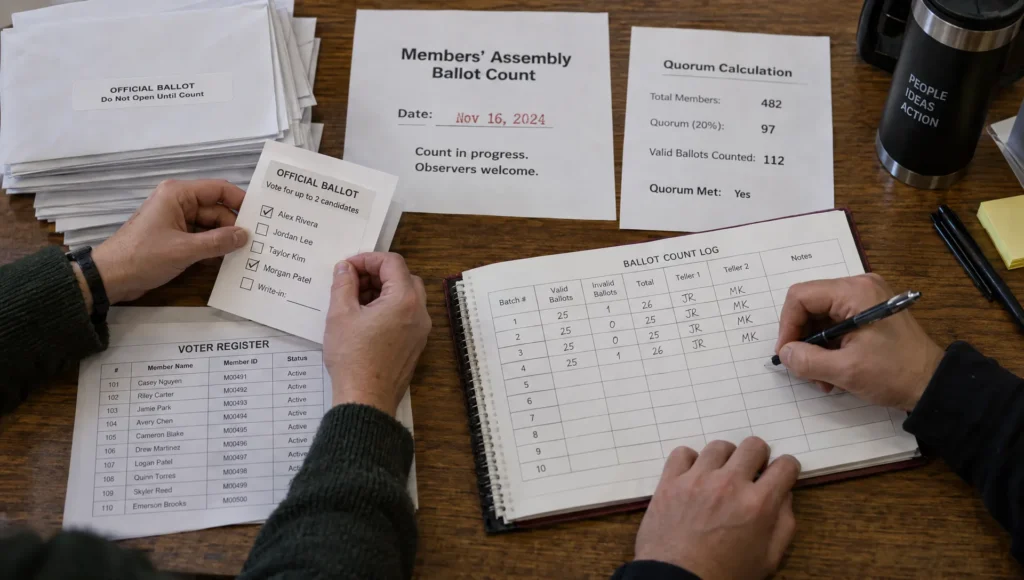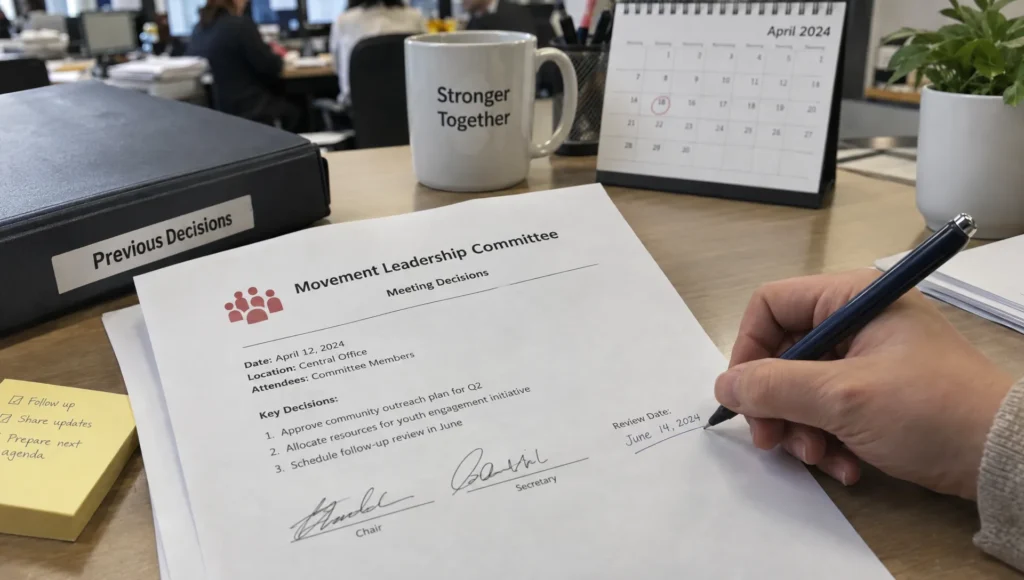
Public committee records are often treated as administrative leftovers: minutes, attachments, attendance lists, vote tallies, and recordings stored somewhere for legal compliance. But in a society serious about discursive democracy, committee records should do something far more important. They should preserve the public reasoning of government in a form citizens can inspect, challenge, learn from, and use.
Committees are where public decisions are usually shaped before they become visible to the broader public. Budgets are narrowed. Testimony is weighed. Amendments are drafted. Experts are invited. Objections are dismissed or absorbed. By the time a bill, regulation, or municipal decision reaches a final vote, the most meaningful democratic work may already be over.
That is why public committee records matter. If citizens cannot see how reasoning developed, who influenced it, what evidence was considered, and which alternatives were rejected, then civic participation becomes reactive rather than formative. People are left protesting final decisions instead of participating in the process that produced them.
Discursive democracy offers a practical answer: make the committee record a living map of public reasoning, not just a static archive of proceedings.
Why Committee Records Are Democratic Infrastructure
A public committee record is not merely a document. It is part of the democratic operating system.
In representative systems, committees perform the detailed work that full legislatures, councils, and agencies cannot handle at scale. They hear evidence, negotiate tradeoffs, scrutinize executive action, and prepare decisions for broader approval. Yet their records are often difficult to search, hard to understand, or disconnected from the final decision.
JustSocial’s political vision argues that modern technology should allow citizens to be heard consistently, not only once every election cycle. The JustSocial manifesto connects this idea to continuous direct democracy, public transparency, state-sanctioned civic platforms, and even a searchable repository of state laws. Public committee records are one of the most concrete places to begin building that future.
If the public record is weak, participation is weak. If the public record is structured, accessible, and responsive, citizens gain a real path into the policy process.
This is not only a technological concern. It is a cultural one. A political movement for deeper democracy must ask what kind of public memory the state creates. Does it remember only outcomes, or does it remember the reasoning, conflict, evidence, and civic input that shaped those outcomes?
What Traditional Committee Records Usually Miss
Many public bodies already publish some committee materials. Agendas may appear before meetings. Minutes may be released afterward. A video may be uploaded. A PDF packet may include staff reports, expert submissions, or proposed amendments.
Those practices are useful, but they are incomplete. They often fail to answer the questions citizens actually need answered:
- What decision was the committee truly preparing to make?
- Which claims were made, and what evidence supported them?
- Which objections were raised by citizens, experts, or minority members?
- Which alternatives were considered and rejected?
- Did public testimony change anything?
- Who is responsible for the next step?
- How does this committee discussion connect to the final law, budget, rule, or policy?
A video recording may technically be public, but a three-hour recording without indexing, transcripts, issue tags, or official responses is not meaningful transparency. It asks citizens to do the state’s documentation work for themselves.
That is the gap discursive democracy tries to close. It does not treat public speech as noise around a decision. It treats speech, evidence, and disagreement as part of the decision-making record.
From Administrative Records to Discursive Records
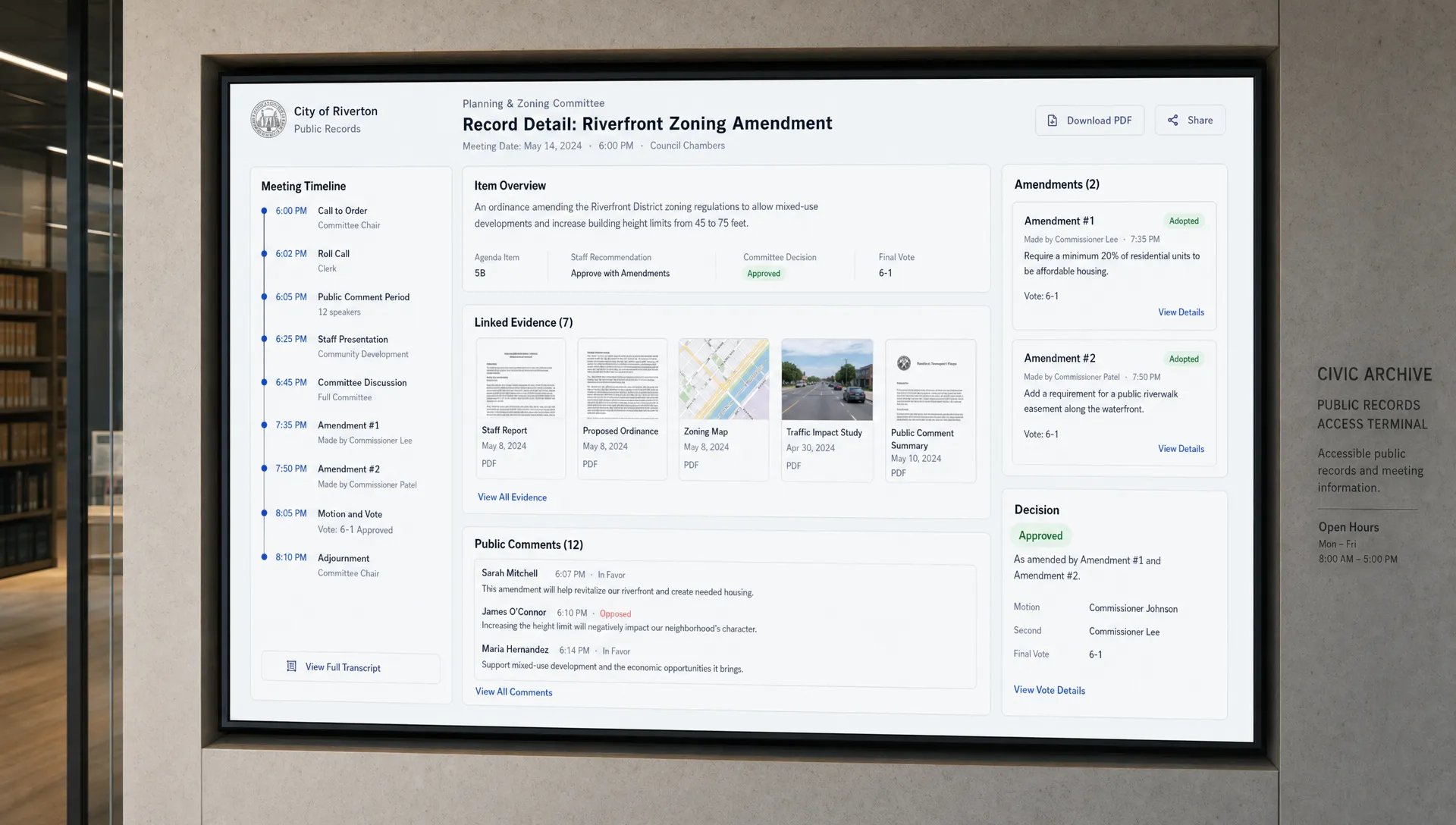
A discursive committee record should show how public reasoning moved from problem to evidence to disagreement to decision. It should not replace official minutes, legal records, or archival duties. It should add a democratic layer that makes those records understandable and usable.
| Record element | Traditional committee record | Discursive democracy record |
|---|---|---|
| Agenda | Lists topics and times | States the decision question, options, and expected outputs |
| Minutes | Summarizes attendance and actions | Captures claims, evidence, objections, amendments, and reasoning |
| Public testimony | Stored as comments or video | Linked to the issue, response, and decision pathway |
| Evidence | Attached as PDFs | Indexed by source, relevance, date, and contested points |
| Vote record | Shows who voted yes or no | Explains what each vote resolved and what alternatives remained |
| Follow-up | Often unclear | Assigns responsibility, deadline, and public status tracking |
The goal is not to overload citizens with more documents. The goal is to organize public information around democratic meaning.
For example, if a city committee debates a housing policy, the record should not merely say that speakers discussed affordability, zoning, and infrastructure. It should show which affordability claims were made, which data was cited, whether the planning department accepted or disputed that data, which amendments responded to the concern, and what remains unresolved.
That is the difference between publishing information and creating public understanding.
The Discursive Democracy Standard for Committee Records
A strong committee record should meet five basic standards.
It should be decision-centered
Every record should begin with the real decision at stake. Citizens should not have to infer whether the meeting is exploratory, advisory, procedural, or decisive. A committee record should make clear what question is being answered and what authority the committee has.
This also makes public participation more honest. If a committee is only recommending policy, the public should know. If the committee is effectively determining the outcome before a formal vote elsewhere, that should be visible too.
It should be evidence-linked
Claims should be connected to sources wherever possible. A public official may cite a budget projection. A citizen may cite lived experience. An expert may cite a peer-reviewed study. A civil society group may submit a report.
Not all evidence is the same type, but all relevant evidence should be traceable. The Open Government Partnership has long emphasized that transparency, participation, and accountability work best when public information is accessible and actionable. Committee records should apply that principle at the point where decisions are formed.
It should be disagreement-aware
A democratic record should not flatten conflict into bland consensus. Disagreement is valuable when it is structured. Citizens need to know which points were contested, which concerns were answered, and which were ignored.
This is where discursive democracy differs from simple transparency. The record does not merely expose what happened. It preserves the argument so future citizens, journalists, courts, researchers, and representatives can evaluate whether power reasoned honestly.
It should be citizen-readable
Legal and procedural precision matters, but public records should also include plain-language summaries. A resident should be able to understand the decision pathway without needing to decode parliamentary procedure or bureaucratic shorthand.
This does not mean simplifying away complexity. It means building records with multiple layers: official text, plain-language summaries, searchable transcripts, linked evidence, and structured issue maps.
It should be reusable
Public records should be searchable, downloadable, and linkable. They should use stable identifiers for meetings, agenda items, speakers, documents, motions, amendments, and votes. When records are reusable, civic groups can build tools, journalists can investigate patterns, educators can teach democratic processes, and citizens can follow issues over time.
A Practical Model for Better Public Committee Records
Discursive democracy does not require a perfect system on day one. Public bodies can begin with a practical record workflow that improves participation before, during, and after committee meetings.
Before the meeting: publish the decision context
The public should know what is at stake before the meeting begins. A useful pre-meeting record includes the decision question, agenda item IDs, staff recommendations, relevant documents, known alternatives, public submission rules, and deadlines.
This stage is where civic participation becomes possible. If citizens only learn about a decision after the committee has already narrowed the options, participation becomes symbolic. If they can see the decision context early, they can bring evidence, experience, and organized feedback into the process.
During the meeting: capture structured public reasoning
A committee meeting should produce more than a video. It should produce a structured record of claims, questions, amendments, commitments, and unresolved points. This can be done through human clerks, trained moderators, transcription tools, and carefully reviewed AI assistance.
The committee does not need to agree with every citizen. But it should show that public speech entered the official reasoning environment. That principle is closely related to JustSocial’s argument for public receipts, short records that show how civic input travels from speech to evidence, synthesis, decision, and implementation.
After the meeting: publish the reasoning trail
The post-meeting record should not be limited to minutes. It should include a decision summary, vote record, issue map, evidence index, response to major public concerns, next steps, deadlines, and the responsible office or committee.
This is especially important for trust. Citizens may accept losing an argument if they can see that the argument was heard, weighed, and answered. What creates cynicism is not disagreement itself. It is the sense that public participation disappears into a void.
A minimum viable public committee record could include:
- A clear decision question for each agenda item
- A list of documents and evidence considered
- A speaker and submission register by role, not necessarily by sensitive personal details
- A summary of major claims, objections, and official responses
- A record of motions, amendments, votes, and rationales
- A follow-up tracker showing deadlines, owners, and status
- Searchable transcripts and downloadable open formats
This model also strengthens the connection between committee transparency and broader civic life. For a deeper look at why committees are central to public trust, JustSocial has explored civic participation for committee transparency as a necessary step toward meaningful public oversight.
Technology Can Help, But Governance Must Lead
The technology required for better committee records already exists. Transcription, cloud storage, structured databases, searchable video, digital identity, analytics, and open-source repositories are not futuristic concepts. They are standard tools in much of the private sector.
The harder question is institutional will.
JustSocial’s manifesto argues that public institutions have lagged behind the technological revolution. Committee records are a clear example. A private company can usually search meetings, tag tasks, track decisions, and connect documents across teams. A citizen trying to understand a public committee may still face scattered PDFs, unindexed recordings, and vague minutes.
A discursive record system could use:
- Stable public URLs for every meeting, agenda item, document, amendment, and vote
- Transcripts with timestamps and speaker roles
- Issue tags that connect testimony, evidence, and decisions
- Version history for proposals and amendments
- Plain-language summaries reviewed by accountable staff
- Open data exports for researchers, journalists, and civic technologists
AI may help summarize long meetings or cluster repeated public concerns, but it must not become an unaccountable layer between citizens and government. AI-generated summaries should be labeled, reviewed, corrected, and linked to source material. The public must always be able to trace a summary back to the original record.
Blockchain or tamper-evident logs may also be useful in some contexts, especially where record integrity is contested. But technology should serve the democratic standard, not distract from it. The core question remains simple: can citizens see how public reasoning became public action?
Discursive Democracy, Deliberative Democracy, and the Role of Records
Discursive democracy and deliberative democracy are closely related, but they emphasize different parts of the democratic process.
Deliberative democracy focuses on reasoned discussion, balanced information, mutual respect, and thoughtful judgment. It asks how people should deliberate before reaching a decision. This matters greatly inside committees, where structured discussion can reduce performative politics and improve policy quality.
Discursive democracy focuses on the public life of arguments over time. It asks whether claims, evidence, disagreements, and responses remain visible across institutions. In this sense, records are not clerical byproducts. They are the infrastructure that allows public discourse to accumulate into public memory.
The OECD’s work on deliberative democracy has shown growing interest in citizen assemblies, representative deliberation, and more thoughtful public input. But even the best deliberative processes lose power if their reasoning disappears after the event. Committee records are where deliberation can become durable.
That durability is essential for continuous civic participation. Citizens cannot participate every day if the state forgets yesterday’s arguments.
Risks and Safeguards
A more detailed public record can create risks if it is built carelessly. Privacy, harassment, selective editing, information overload, and political manipulation all need serious attention.
Some public participants may need anonymity or limited disclosure, especially in sensitive areas such as housing insecurity, immigration, health, education, policing, or workplace retaliation. Discursive records should preserve the substance of civic input without unnecessarily exposing vulnerable people.
Moderation rules must also be transparent. If comments are removed, merged, or summarized, the reason should be documented. Public bodies should distinguish between abusive speech, irrelevant submissions, duplicate campaigns, and legitimate dissent.
There is also a risk that officials use structured records to create the appearance of listening without changing anything. That is why the record must include official responses. A committee can reject public input, but it should explain why. It can prefer one source of evidence over another, but the preference should be visible.
Accountability begins when the public can compare what was said, what was promised, what was decided, and what was implemented.
Building a Political Movement Around Public Memory
A political movement for modern democracy cannot focus only on elections. Elections matter, but they are too infrequent to carry the full weight of public life. The deeper question is whether citizens can meaningfully influence the state between elections.
Public committee records are a practical place to organize that demand. They are specific enough to reform, but important enough to change the relationship between citizens and government.
Imagine if every committee record showed the full path of a public issue: the original proposal, the evidence, the public objections, the expert disagreements, the amendments, the vote, the implementation plan, and the later results. Citizens would not need to rely only on trust, slogans, or partisan interpretation. They could inspect the democratic record themselves.
That is the spirit of discursive democracy. It does not assume that citizens will agree. It assumes they deserve to see the reasoning of power and to have their own reasoning preserved within the public process.
In JustSocial’s broader vision, citizens are not reduced to voters, taxpayers, and consumers. They become active participants in the public reasoning of the state. Better committee records will not create that future alone, but they can become one of its foundations.
Frequently Asked Questions
What is discursive democracy in public committee records? Discursive democracy means public committee records should preserve the reasoning behind decisions, including claims, evidence, disagreements, public input, official responses, amendments, and follow-up actions.
How is this different from publishing meeting minutes? Traditional minutes usually record attendance, motions, and votes. Discursive records explain how the committee moved from information to judgment, making the decision pathway easier for citizens to inspect.
Do public committee records need an online voting platform? Not always. Online voting can support some forms of civic participation, but committee records first need clear decision questions, searchable evidence, structured public input, and transparent official responses.
Can AI summarize public committee meetings safely? AI can help with transcription, tagging, and summaries, but only with human review, clear labeling, source links, correction processes, and public access to the original record.
Why should a political movement care about committee records? Because committees shape policy before final votes happen. A movement for civic participation and continuous democracy must make those early decision points visible, understandable, and open to public influence.
Help Build a More Transparent Democratic Record
Discursive democracy begins with a simple demand: public decisions should leave a public reasoning trail.
JustSocial is working toward a future where citizens can participate more continuously, public institutions use modern technology more responsibly, and government transparency becomes part of everyday democratic life. If that vision speaks to you, explore the movement at JustSocial.io, read the manifesto, and consider how your skills, community, or local institution can help turn public records into public power.