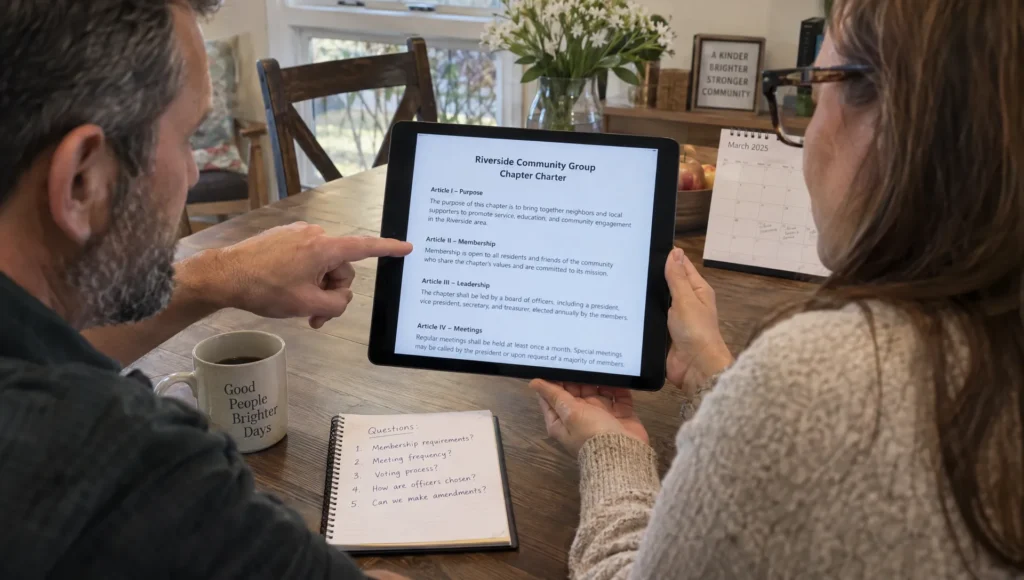
Most political movements know how to publish, protest, fundraise, recruit, and react. Far fewer know how to help the public learn together.
That gap matters. A movement can win attention without building understanding. It can mobilize anger without clarifying tradeoffs. It can gather supporters without creating a shared civic memory. When that happens, the movement may grow, but the public does not become more capable of self-government.
Political movement infrastructure for public learning is the missing layer between civic participation and democratic reform. It is the set of tools, habits, records, forums, and institutional pathways that help citizens move from scattered opinion to informed judgment, from private frustration to public reasoning, and from isolated action to accountable follow-through.
This is especially urgent in a political climate where many citizens feel reduced to voters, taxpayers, and consumers. The JustSocial manifesto frames this as a failure of the modern social contract: public institutions ask people to obey, pay, and vote occasionally, but rarely give them a meaningful daily role in shaping common life. Public learning infrastructure is one way a political movement can begin to repair that contract.
Why public learning is movement infrastructure, not messaging
Messaging asks, “How do we persuade people?” Public learning asks, “How do we help people understand, question, decide, and revise together?”
That distinction is fundamental. A political movement built only around messaging treats the public as an audience. A movement built around public learning treats the public as a civic intelligence system.
Democracy is not sustained by participation alone. People can participate in shallow ways, by liking slogans, joining outrage cycles, or voting against a disliked opponent. These actions may matter, but they do not necessarily produce collective judgment. A healthier model connects civic participation to structured learning.
The need is not theoretical. Freedom House reported in 2024 that global freedom declined for the 18th consecutive year. The crisis is not only institutional. It is educational, cultural, and informational. Citizens are surrounded by content, but not always by trustworthy processes that help them compare evidence, hear opposing views, and influence policy.
A political movement that wants more than short-term mobilization must therefore build learning capacity. It must make public questions easier to understand, public disagreement easier to navigate, and public decisions easier to track.
What public learning means in democratic practice
Public learning is not a lecture delivered by experts to citizens. It is not propaganda. It is not a civics class detached from real decisions.
Public learning is the repeated process through which a community can:
- Identify a public problem clearly.
- Gather evidence from lived experience, institutions, journalism, and research.
- Debate values, priorities, risks, and tradeoffs.
- Deliberate before decisions are made.
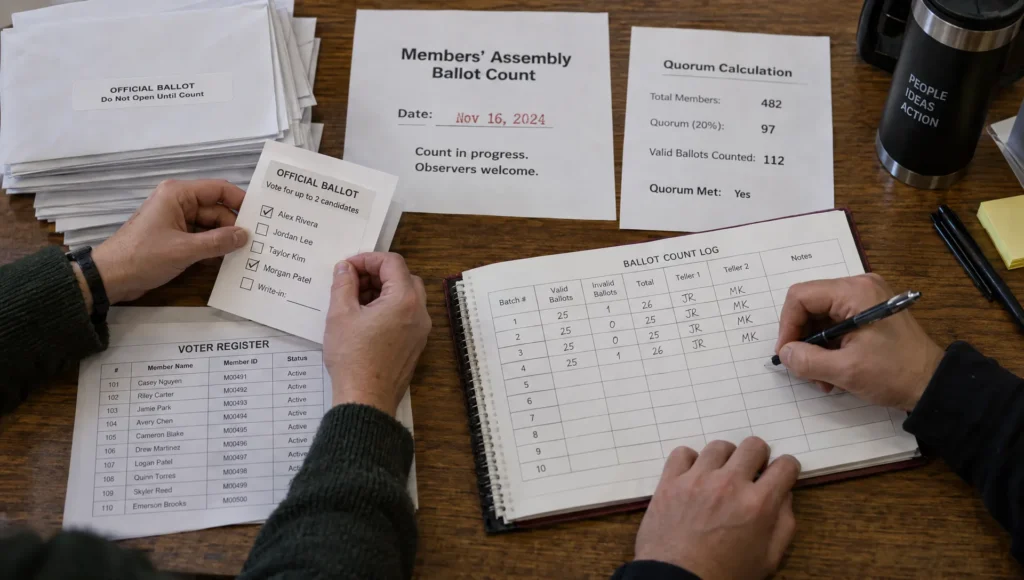
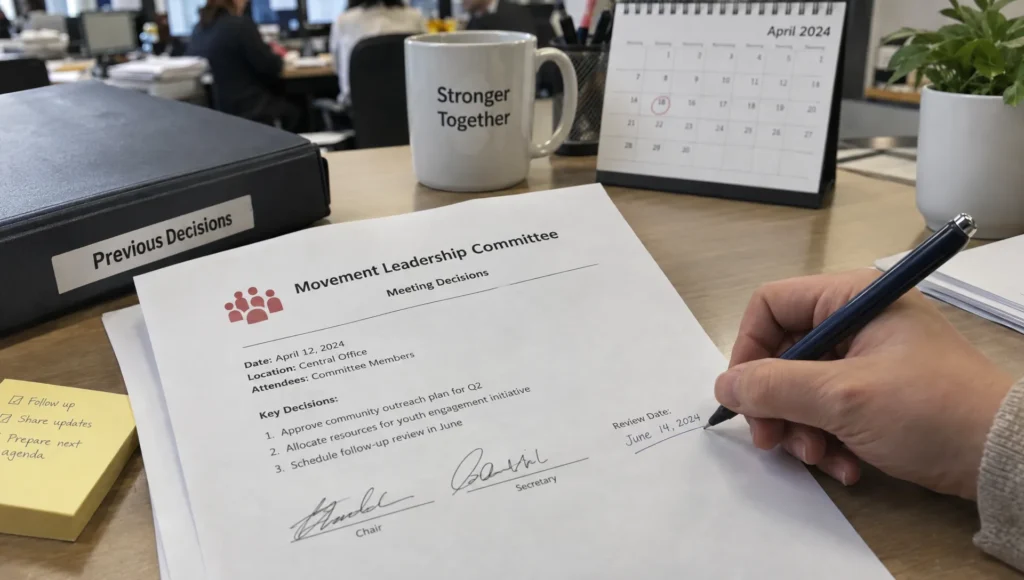
- Record what was promised, what was decided, and what happened afterward.
- Update future choices based on results.
This is where discursive democracy and deliberative democracy become practical. Discursive democracy gives people a public space to argue, question, explain, and contest meaning. Deliberative democracy gives people structured processes for weighing options before collective decisions. Civic participation connects both to real action.
| Democratic mode | What it helps people learn | Infrastructure needed |
|---|---|---|
| Civic participation | What citizens care about, experience, and demand | Accessible participation channels, petitions, local forums, volunteering pathways |
| Discursive democracy | How arguments form, clash, and evolve in public | Moderated discussion spaces, transparent content records, issue tagging, public replies |
| Deliberative democracy | Which choices survive evidence, tradeoffs, and reflection | Citizen assemblies, structured panels, briefing materials, facilitation, published recommendations |
| Accountability practice | Whether public decisions produced promised results | Decision logs, follow-up reports, public dashboards, open archives |
The point is not to replace representative institutions overnight. The point is to surround them with a more intelligent public environment, one where citizens are continuously heard and public officials can no longer pretend that elections every few years are enough.
The manifesto connection: from industrial politics to a learning society
The JustSocial manifesto argues that many public systems still operate as relics of the Industrial Revolution. Education is organized like a production line. Government is often slow to adopt modern tools. Political participation is compressed into periodic elections, while daily public opinion is scattered across social media platforms that were not designed for democratic responsibility.
Public learning infrastructure answers that critique directly.
If industrial politics treats citizens as units to be processed, a learning democracy treats them as contributors to shared intelligence. If industrial schooling divides knowledge into fragmented sprints, public learning connects knowledge to real public life. If traditional politics asks people to choose leaders and then wait, public learning asks people to keep observing, discussing, measuring, and shaping policy throughout the term.
The manifesto’s idea of the “people” as a branch of government is especially relevant here. Such a branch cannot be only a mass voting mechanism. It must also be a learning branch. If citizens are to influence public policy continuously, they need more than opinion tools. They need issue maps, evidence libraries, deliberation formats, civic education, transparent records, and ways to see whether participation changed anything.
The manifesto also proposes academia as a separate public force capable of advising, educating, and holding representatives to higher standards. Public learning infrastructure is the bridge between academic knowledge and democratic life. It helps expertise inform citizens without replacing citizen judgment.
The core layers of public learning infrastructure
A political movement does not become a learning movement by publishing longer posts. It needs a system. That system can start small, but it should be designed with durable layers.
1. A public evidence commons
Every serious public question needs a place where people can see the basic materials: laws, budgets, official reports, timelines, proposals, datasets, expert explainers, citizen testimonies, and counterarguments.
Without an evidence commons, public debate becomes dependent on whoever controls the loudest narrative. With an evidence commons, disagreement does not disappear, but it becomes more inspectable. Citizens can ask, “What is this claim based on?” and “What evidence would change our mind?”
For a political movement, this can begin as a simple issue library. Each issue page should clarify the problem, the stakeholders, the known facts, the disputed facts, the policy options, and the decision points ahead.
2. A discursive layer
People need spaces to speak before they are asked to decide. This is the role of discursive democracy. It allows citizens to test language, express anger, share experience, challenge elites, question experts, and discover that a public issue looks different from another neighborhood, profession, age group, or identity.
But discourse needs structure. Otherwise, it becomes a feed, and feeds reward speed, outrage, and performance. A movement can improve the quality of discourse by organizing discussion around issues rather than personalities, making claims traceable, separating testimony from evidence, and preserving minority arguments instead of burying them.
This connects with JustSocial’s broader argument that a political movement should build the civic systems it wants to see. The article on how a movement can build durable systems before chasing scale makes the same strategic point: without infrastructure, growth becomes noise.
3. A deliberative layer
Discourse opens the question. Deliberation disciplines it.
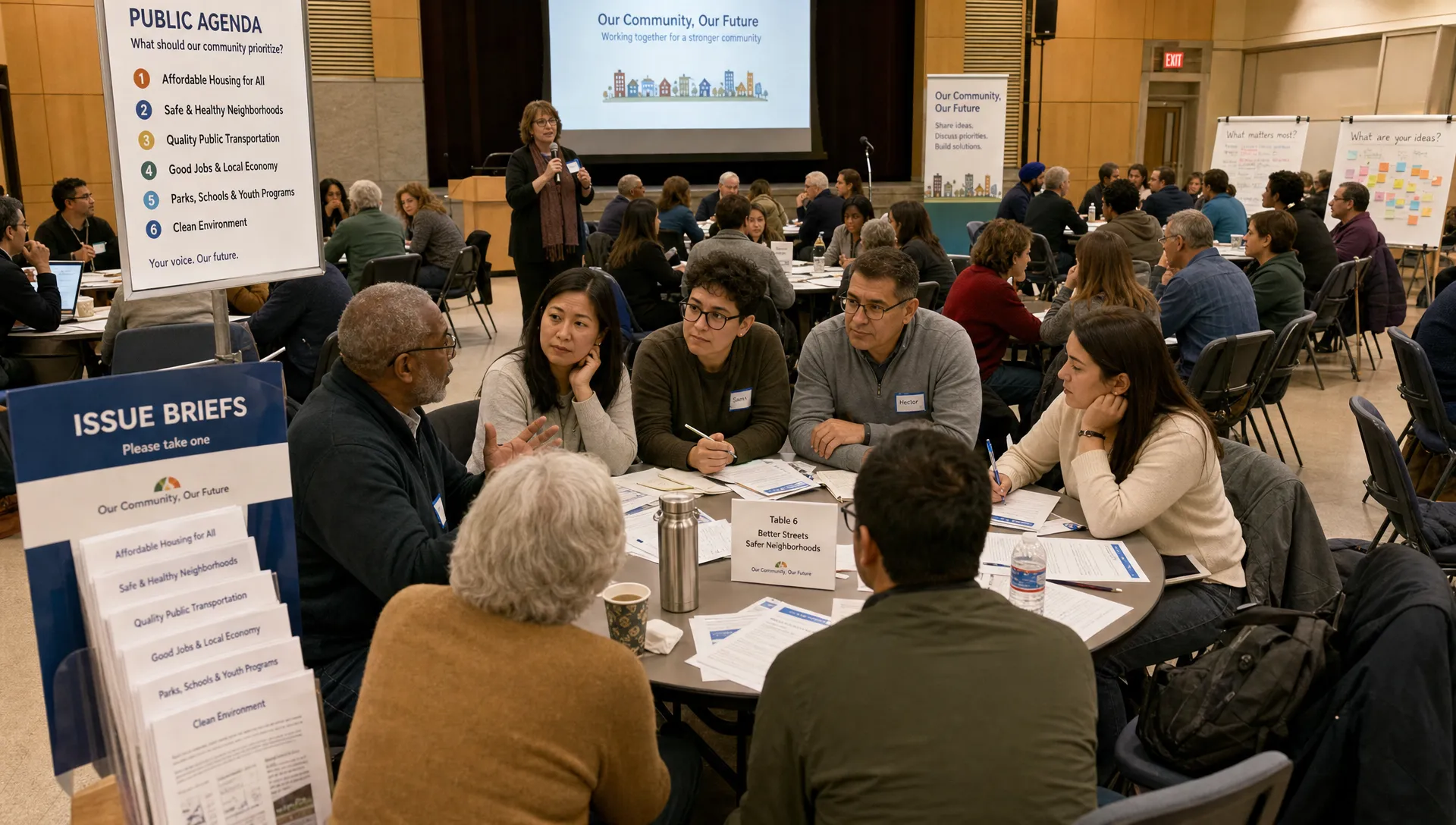
Deliberative democracy is most useful when a community must weigh competing goods: liberty and safety, cost and quality, speed and legitimacy, local preference and national standards. A deliberative process should not be a comment section. It should include balanced briefing materials, facilitated discussion, time to question experts, and a written output that decision-makers must answer.
The OECD’s work on deliberative processes documented hundreds of representative citizen deliberations across countries and policy areas. One lesson is clear: people can handle complexity when the process respects their time, gives them information, and asks them to reason together rather than simply react.
4. A civic memory layer
Movements often forget. Institutions often benefit from that forgetting.
A public learning movement must keep civic memory. What was promised? Who supported it? What evidence was used? What objections were ignored? What changed after implementation? What should be revised?
Civic memory prevents participation from becoming theater. It also protects movements from repeating the same arguments forever. When a debate returns, citizens should not have to start from zero. They should inherit the previous cycle of learning.
5. A pathway into action
Learning without action becomes civic education in a vacuum. Action without learning becomes mobilization without wisdom. A political movement needs both.
This means every issue should have visible next steps: attend a meeting, join a working group, submit testimony, support a proposal, volunteer technical skills, help translate materials, brief local communities, or track implementation.
The manifesto’s proposed tools, such as action-oriented news aggregation, parliamentary transparency, community voting, and public analytics, all point toward this principle. Information should not end in passive awareness. It should become civic participation.
A practical public learning loop
A movement can start with a simple repeatable loop. The loop matters because public learning is not a one-time event. It is a civic habit.
| Stage | Public question | Movement responsibility |
|---|---|---|
| Signal | What problem are people raising? | Collect citizen concerns and identify recurring issues |
| Frame | What exactly is being decided? | Define the issue, scope, stakeholders, and timeline |
| Inform | What must people know? | Publish evidence, explainers, testimonies, and competing claims |
| Discuss | How do people interpret the issue? | Host open discourse with moderation and issue tagging |
| Deliberate | What tradeoffs should guide judgment? | Convene structured sessions with balanced materials |
| Decide | What action or recommendation follows? | Record outcomes, votes, proposals, and dissenting views |
| Review | What happened after action? | Track implementation, results, failures, and revisions |
This loop turns a political movement into more than a campaign. It becomes a civic learning institution.
Why the Greek polis still matters, and where it must evolve
The manifesto draws on Charles Wayper’s description of the Greek polis as an intense form of civic life where politics was not remote. Citizens experienced the polis as part of themselves. Public life was not an occasional obligation, but a source of meaning.
Modern societies cannot simply copy the polis. The ancient model was small, exclusionary, and impossible to scale in its original form. But the civic intensity is worth recovering. A modern political movement can learn from the polis while rejecting its exclusions.
The relevant lesson is that citizenship should be practiced, not merely held as a legal status. Public learning infrastructure makes that possible at scale. Digital tools can help large communities organize discourse, deliberate across distance, preserve records, and connect public judgment to institutions.
JustSocial has explored this connection more directly in its essay on recovering the civic intensity of the Greek polis. The public learning angle adds another layer: the polis was not only a decision space. It was also an educational environment. People learned citizenship by doing citizenship.
That is the cultural shift a democratic political movement should aim for.
Design principles for learning without manipulation
Public learning infrastructure can be abused if it becomes a tool for surveillance, propaganda, or manufactured consensus. A movement that promotes civic participation must therefore build safeguards from the beginning.
First, transparency should apply to processes, not unnecessary exposure of private citizens. People should understand how topics are selected, how evidence is reviewed, how comments are moderated, how deliberative groups are formed, and how outputs reach decision-makers. At the same time, participants need privacy protections, especially when discussing sensitive issues.
Second, disagreement should be preserved. A learning democracy does not erase minority views after a majority forms. Minority reports, dissent summaries, and unresolved questions are signs of intellectual honesty. They help future participants understand what was contested.
Third, expertise should inform without ruling. Experts can clarify constraints, evidence, and likely consequences. Citizens still have the democratic role of weighing values and priorities. Public learning fails when experts are treated either as unquestionable authorities or as enemies of the people.
Fourth, access must be designed, not assumed. If participation requires free time, high literacy, insider vocabulary, or comfort with digital tools, the movement will reproduce inequality. Public learning needs translation, plain-language summaries, offline options, accessible formats, and community facilitators.
Fifth, the movement must publish its own uncertainty. When evidence is incomplete, say so. When a proposal has risks, name them. When a decision fails, record why. Trust grows when people can see that a movement is capable of correction.
The role of education in political movement infrastructure
The manifesto’s educational reform section argues for a more holistic model of learning, one that values curiosity, social-emotional development, project-based learning, and the intelligent use of technology. That vision should not be limited to schools.
A political movement also educates. It teaches by what it rewards, what it records, how it handles disagreement, and whether it treats supporters as thinkers or as amplifiers.
If a movement rewards only loyalty, it teaches obedience. If it rewards only outrage, it teaches escalation. If it rewards public reasoning, careful evidence, and courageous revision, it teaches democratic citizenship.
This is why movement training should go beyond canvassing scripts and social media tactics. It should include civic literacy, facilitation, conflict navigation, evidence evaluation, local government processes, budgeting basics, and ethical technology use.
A public learning movement needs many civic roles, not only leaders and followers.
| Role | Contribution to public learning |
|---|---|
| Issue steward | Maintains an issue page, timeline, and evidence record |
| Community facilitator | Hosts discussion and keeps disagreement productive |
| Evidence reviewer | Checks sources, summarizes research, and flags uncertainty |
| Participation organizer | Helps residents move from concern to concrete action |
| Deliberation designer | Structures forums where tradeoffs can be weighed fairly |
| Accountability tracker | Follows decisions after they are made and reports outcomes |
These roles are practical, but they also carry a cultural message: democracy is work shared by many, not performance delivered by a few.
How a movement knows the public is learning
Public learning should be measured carefully. The goal is not to reduce democratic life to analytics, but to notice whether participation is becoming more informed, inclusive, and consequential.
A movement can track learning through both qualitative and quantitative signals.
| Signal | What it may indicate |
|---|---|
| More issue-specific participation | Citizens are engaging with concrete public questions, not only broad identity conflict |
| Better questions over time | Participants understand tradeoffs and institutional constraints more clearly |
| Diverse testimony | The movement is hearing from affected communities, not only habitual activists |
| Revisions to proposals | Public input is changing ideas before decisions are finalized |
| Published dissent | The movement is preserving disagreement rather than forcing false unity |
| Follow-up after decisions | Participation is tied to accountability, not symbolic consultation |
The strongest sign of success is not universal agreement. It is a public that becomes harder to manipulate because it has practiced learning together.
Public learning as a path beyond protest and election cycles
Protests can reveal urgency. Elections can transfer power. Neither is enough by itself.
Between protests and elections is the daily work of democratic formation: learning the issue, hearing the neighbor, challenging the official, revising the proposal, tracking the budget, questioning the result, and trying again. This is the space where a political movement can become a lasting civic institution.
That does not make elections irrelevant. It makes them less lonely. When a vote comes after years of public learning, it is not a sudden emotional snapshot. It is part of a larger democratic memory.
This also changes what leadership means. In a learning movement, leaders are not the sole source of vision. They are stewards of process. Their job is to help the public become more capable of seeing itself, educating itself, and governing itself.
That idea is deeply aligned with the manifesto’s claim that elected officials should become pipelines for gathering consensus and implementing public policy. A pipeline, however, needs structure. Public learning is that structure.
Frequently Asked Questions
What is political movement infrastructure for public learning? It is the combination of tools, processes, records, forums, and civic roles that help citizens learn about public issues together and connect that learning to action and accountability.
How is public learning different from political messaging? Messaging tries to persuade an audience. Public learning helps citizens examine evidence, discuss disagreement, deliberate on tradeoffs, and update their views through a transparent process.
Where do deliberative democracy and discursive democracy fit? Discursive democracy supports open public reasoning and contestation. Deliberative democracy structures deeper decision-oriented discussion. A strong political movement uses both, then connects them to civic participation.
Can public learning infrastructure start locally? Yes. A neighborhood, school community, city group, or issue campaign can begin with a simple evidence page, public discussion format, deliberation session, decision record, and follow-up report.
Why does JustSocial connect public learning to democratic reform? JustSocial argues that citizens should have a continuous role in public life, not only a periodic vote. Public learning helps make that role informed, transparent, and accountable.
Build the learning layer of democracy
A political movement that wants to change society must do more than gather attention. It must help the public become more capable of self-government.
That means building spaces where citizens can learn in public, disagree without disappearing into chaos, deliberate before decisions are made, and remember what happened afterward.
If this vision resonates with you, start with the JustSocial manifesto. Share it, challenge it, build from it, or volunteer your skills toward the civic tools and public learning systems that a modern democracy now requires.