A political movement that wants to renew democracy should not study the Greek polis as a museum object. It should study it as a warning and a challenge. The polis was intimate, demanding, participatory, and deeply imperfect. It made public life feel immediate, but it also excluded most people from full citizenship.
That tension is exactly why it matters now.
Modern citizens often experience the state as distant: agencies, forms, party lists, media cycles, and elections that arrive every few years. The Greek polis suggests a different democratic feeling: politics as a living part of ordinary identity. JustSocial's manifesto, The Face of Democracy, connects this ancient memory to a modern ambition: building a scalable civic culture where people are not reduced to voters, taxpayers, and consumers, but become continuous participants in public life.
The lesson is not to copy Athens. The lesson is to recover the civic intensity of the polis while correcting its exclusions through modern institutions, discursive democracy, deliberative democracy, and technology designed for civic participation.
Why the Greek Polis Still Matters
The word "politics" comes from the polis, the Greek city-state. As Encyclopaedia Britannica explains, the polis was not simply a city in the modern administrative sense. It was a political community, a shared structure of belonging, law, worship, defense, and public decision-making.
In the JustSocial manifesto, Yuval D. Vered quotes Charles Wayper's description of the polis as something far more intimate than the modern state. The Greek citizen did not merely live under public authority. He experienced public life as part of his own identity. Wayper's phrase, "The Polis teaches the man," captures a core insight: democracy is not only a procedure. It is an education in belonging, responsibility, argument, and shared consequence.
Today, many democracies have the opposite problem. Citizens are legally sovereign but practically remote. They vote, pay taxes, complain, post, and wait. A modern political movement should ask: how can public life become vivid again without shrinking society back into small city-states or excluding anyone?
That is the bridge from polis to Cosmopolis, from small-scale civic intimacy to large-scale democratic infrastructure.
Lesson 1: Citizenship Must Be a Practice, Not a Label
In the polis, citizenship was active. It meant attending assemblies, serving in offices, judging disputes, funding public goods, defending the community, and participating in common life. Again, the model was exclusionary by modern standards, but the intensity of participation is worth noticing.
Modern citizenship often becomes passive because institutions treat people as occasional inputs. A political movement can reverse that by making civic participation routine, visible, and consequential.
This does not mean asking every person to become a full-time activist. It means creating many levels of civic agency: a 10-minute contribution, a local working group, a public hearing, an evidence review, a deliberative panel, a budget vote, or an oversight role. The important shift is from identity to practice.
A supporter is not only someone who agrees with a movement's slogan. A citizen-participant is someone who helps produce the movement's public reasoning, priorities, and accountability.
Lesson 2: Make Public Life Concrete Again
One of the most powerful parts of the polis was concreteness. Public obligations were close enough to see. A wealthy citizen might fund a public performance or a ship. A citizen might speak in an assembly and later live with the consequences of the vote. Public life was not an abstraction hidden behind layers of bureaucracy.
Modern government often separates input from outcome. People submit comments and never learn what happened. They vote for representatives and cannot trace decisions. They pay taxes and struggle to see how funds became services, contracts, or failures.
For a political movement, the answer is not just better messaging. It is better civic architecture.
| Polis insight | Modern political movement application | Failure to avoid |
|---|---|---|
| Public life felt immediate | Connect participation to named decisions, timelines, and responsible institutions | Symbolic engagement with no decision link |
| Citizens learned through participation | Turn supporters into civic teams that research, discuss, propose, and follow up | Treating citizens as an audience |
| Common obligations were visible | Publish receipts, agendas, evidence, rationales, and implementation trackers | Asking people to trust invisible process |
| Belonging was civic, not only private | Build local chapters, online forums, and community rituals around shared public work | Reducing movements to social media identity |
| Debate preceded action | Use structured discursive democracy before decisions are made | Letting outrage substitute for reasoning |
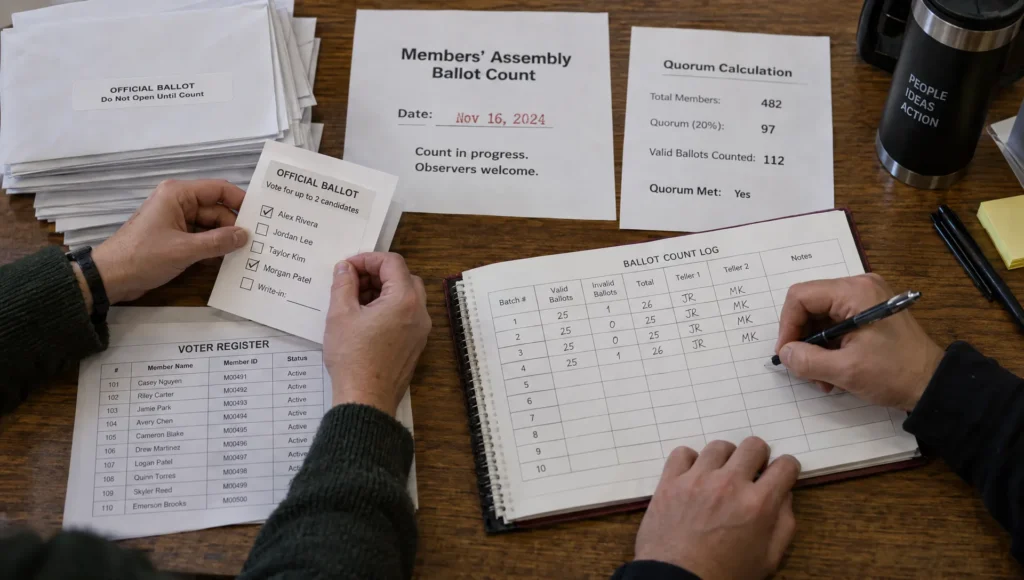
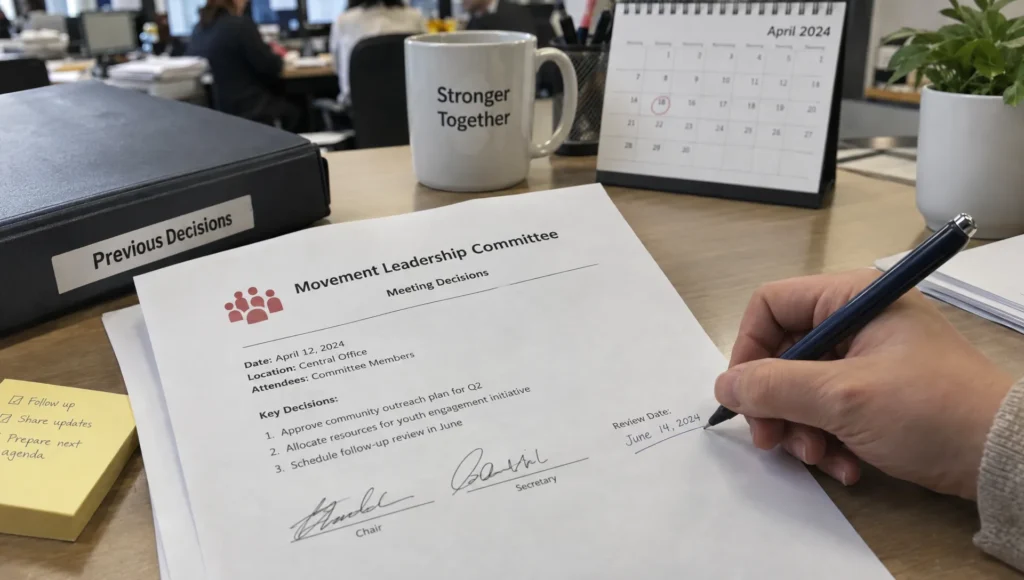
The modern version of polis concreteness is the public receipt: a document, tracker, decision note, response memo, or record that lets citizens see what happened and why. Without receipts, participation becomes performance. With receipts, it becomes memory.
Lesson 3: Discursive Democracy Comes Before Power
The agora, the assembly, the theater, and the public rituals of the polis all remind us that political power begins in speech. People must be able to name problems, challenge assumptions, frame shared concerns, and hear opposing claims before a decision becomes legitimate.
That is the domain of discursive democracy.
Discursive democracy is not simply free expression in the widest sense. It is public conversation organized so that claims, reasons, evidence, identities, and disagreements become legible. It asks: can people understand what is being argued, what evidence is being used, who is affected, and what decision is being requested?
A political movement that skips this stage risks becoming a brand, a tribe, or a pressure machine. It may mobilize anger, but it will not build public judgment.
A polis-inspired movement should therefore create spaces where supporters and critics can do several things well: define the issue, state claims clearly, mark uncertainty, disclose interests, cite evidence, and separate disagreement from dehumanization. This is especially important in digital spaces, where speed, outrage, and algorithmic incentives often reward the loudest voice rather than the clearest argument.
Discursive democracy gives a movement its public mind. Deliberative democracy gives it a process for turning that public mind into usable options.
Lesson 4: Deliberative Democracy Turns Voice Into Judgment
Ancient Greek assemblies did not simply gather feelings. They made decisions. Modern movements should be careful here. Mass participation without structure can become chaotic, while expert-only decision-making can become detached and illegitimate.
Deliberative democracy offers a middle path. It creates structured conditions for people to learn, compare tradeoffs, listen across difference, and produce decision-ready recommendations.
For a modern political movement, this means every major issue should move through a civic sequence:
- A clear public question tied to a real decision
- A shared evidence base that ordinary people can inspect
- A structured discussion format with facilitation rules
- A way to compare options and tradeoffs
- A published rationale explaining the recommendation
- A follow-up mechanism showing whether anyone acted on it
The key is not consensus at all costs. In many cases, honest disagreement is healthier than forced unity. The key is making disagreement usable. If a movement can publish majority reasoning, minority concerns, unresolved facts, and practical options, it becomes more than a protest voice. It becomes a civic institution in formation.
This is where JustSocial's People’s Branch idea connects strongly to the polis. The ancient polis made citizens part of public judgment because the scale allowed it. A modern People’s Branch would need to recreate that role through transparent processes, digital tools, eligibility rules, privacy safeguards, and continuous channels of participation.
Lesson 5: Scale the Intimacy, Not the Exclusion
The Greek polis cannot be romanticized. Its democracy was built on exclusion. Women, enslaved people, foreigners, and many laboring populations were denied full political standing. Any modern political movement that takes lessons from the polis must begin by rejecting that boundary.
The goal is not to restore ancient citizenship. The goal is to universalize civic dignity.
That means designing participation for people with different abilities, schedules, languages, risks, and levels of political confidence. Democracy cannot only belong to the highly educated, the loud, the online, the wealthy, or the already organized. It must be practiced in schools, workplaces, neighborhoods, care settings, youth programs, and local communities.
This is why civic culture must include more than formal politics. People learn agency in everyday environments where they work, study, play, and build trust. Inclusive community spaces, such as Ons Plekske's day activities for work, study, sport, and relaxation, show why belonging is practical before it is political: people need structured, supportive places where participation feels possible.
A serious democratic reform movement should treat accessibility and inclusion as constitutional principles, not optional kindness. If the polis teaches intensity, modern democracy must add universality.
Lesson 6: Civic Education Is the Hidden Constitution
The polis was not only a governing unit. It was an educational environment. Citizens learned public life by seeing it, speaking in it, serving it, and being judged by it.
JustSocial's manifesto makes a similar argument about education reform. It criticizes industrial-era schooling for treating students as products moving through standardized systems rather than as whole people preparing for meaningful participation. The manifesto's education vision, including project-based learning, democratic class choices, and AI-supported teaching, is not separate from democratic reform. It is part of it.
A political movement that wants deeper civic participation must therefore invest in civic learning for adults and young people alike. People cannot deliberate well if they have never been taught how to compare evidence, identify decision owners, ask process questions, or disagree without humiliation.
Civic education should not be a textbook unit people forget after graduation. It should be a living curriculum of public practice: how to read a budget, how to submit testimony, how to build an issue pack, how to evaluate a policy claim, how to request transparency, and how to track implementation.
The polis made public life educational because public life was near. Modern movements must make it near again.
Lesson 7: A Political Movement Must Become a Civic Culture
Many political movements fail because they remain reactive. They rise around anger, elections, personalities, or crises, then fade when attention moves elsewhere. The polis suggests a deeper standard: politics as culture.
A civic culture has habits. It has rituals. It has shared records. It has expectations for how people speak, decide, object, and follow through. It does not depend entirely on charismatic leaders because its practices are teachable and repeatable.
For JustSocial, this connects to the manifesto's broader Cosmopolis vision: a society where technology helps the people become an active branch of public life, not merely a market segment or voting bloc. In that model, a political movement is not only a campaign for reform. It is a prototype of the democracy it wants to build.
That is a demanding standard. A movement that calls for transparency must publish its own process. A movement that calls for participation must let its own supporters shape priorities. A movement that calls for better deliberation must practice better disagreement internally. A movement that calls for public accountability must show its own receipts.
A Polis-Inspired Checklist for Modern Movements
A modern political movement can translate the best lessons of the Greek polis into practical design principles:
- Build belonging before asking for sacrifice.
- Treat civic participation as a recurring practice, not a one-time mobilization.
- Create discursive spaces where claims, evidence, and disagreements are visible.
- Use deliberative democracy to turn public voice into decision-ready options.
- Publish public receipts so people can trace input, reasoning, decisions, and follow-through.
- Design for inclusion from the beginning, especially for people usually left outside public processes.
- Make civic education part of every campaign, meeting, platform, and local chapter.
- Use technology to scale human judgment, not to replace it.
The Greek polis was small enough for public life to feel personal. Modern democracy is too large to rely on face-to-face politics alone. But with the right institutions, digital tools, educational practices, and civic norms, we can scale participation without abandoning depth.
The task is not nostalgia. The task is reconstruction.
Frequently Asked Questions
Was the Greek polis really democratic? Some poleis, especially Athens during certain periods, developed democratic practices, but they were limited and exclusionary by modern standards. The useful lesson is not to copy ancient systems. It is to learn from their active civic culture while building universal, rights-protecting participation today.
What can a political movement learn from the polis? A movement can learn that democracy must be lived regularly, not only voted on occasionally. The polis shows the power of civic identity, public debate, visible obligation, and shared decision-making.
How does discursive democracy fit into this lesson? Discursive democracy organizes public conversation so people can understand claims, reasons, evidence, and disagreements. It is the modern equivalent of building a healthier public square before decisions are made.
How does deliberative democracy improve civic participation? Deliberative democracy gives participation structure. It helps citizens move from opinion to informed judgment by using evidence, facilitation, tradeoff analysis, and public reasoning.
How can modern democracy avoid the exclusions of the polis? By treating inclusion, accessibility, privacy, and minority protection as core design requirements. The modern goal is not ancient citizenship for a few, but meaningful civic agency for everyone.
Help Build the Modern Civic Culture
The Greek polis reminds us that democracy is strongest when people feel like members of public life, not spectators of it. JustSocial exists to help build that next democratic layer: continuous civic participation, transparent tools, and institutions that listen between elections.
If this vision resonates with you, read the manifesto, share it, contribute your skills, or help build the civic infrastructure that can turn a political movement into a living democratic culture.