Most governments are not failing because citizens have no opinions. They are failing because public institutions still treat public voice as an occasional interruption. A vote every few years, a public comment window, a town hall with three minutes at the microphone, and a PDF buried on a ministry website are not enough for a society that now communicates, learns, organizes, and solves problems continuously.
That is why civic participation should be understood as more than good democratic manners. It is a modernization strategy. When designed well, it can make government faster at sensing problems, better at weighing tradeoffs, more transparent in its reasoning, and more legitimate when it acts.
The JustSocial manifesto frames this challenge as a break from the relics of the Industrial Revolution. Our schools, workplaces, public agencies, and representative systems were shaped for a slower, more centralized age. Yet citizens now live in a networked society. The question is no longer whether people can be involved more often. The question is whether government will build institutions that can listen, deliberate, respond, and learn at the same pace as modern life.
Modernization starts by admitting the old model is exhausted
The standard model of representative government reduces most people to three public roles: voter, taxpayer, and private consumer. Citizens are asked to fund the state, obey the law, and periodically choose between political packages assembled by parties. Between elections, they are mostly expected to watch.
This structure made more sense when mass participation was technically difficult. It was expensive to gather opinion, slow to distribute information, and nearly impossible to maintain a structured conversation across large populations. But the constraints have changed. The private sector already uses digital systems to coordinate teams, measure feedback, automate workflows, and keep records. Civil society can organize campaigns in days. Communities can share knowledge instantly.
Government, however, often still behaves like communication is scarce. Public consultation happens late. Committee materials are difficult to search. Citizens rarely know whether their input affected a decision. Agencies collect data for administration, but not always for public learning. This is not only inefficient. It deepens mistrust.
Freedom House has warned in its Freedom in the World research that democratic rights and institutions have been under sustained pressure around the globe. One reason democratic systems become vulnerable is that people stop believing public institutions can hear them, represent them, or correct themselves. Civic participation is not a decorative fix for that crisis. It is one way to rebuild the state as a living system rather than a distant machine.
| Industrial-era government habit | Modern participatory alternative | Why it matters |
|---|---|---|
| Citizens vote, then wait years | Citizens contribute continuously | Public opinion becomes timely, not episodic |
| Decisions are explained after the fact | Reasoning is visible during the process | People can challenge assumptions before harm is done |
| Participation is symbolic | Participation is connected to decision rules | Input gains credibility because it has a defined path |
| Expertise sits behind institutional walls | Experts, citizens, and officials deliberate together | Policy becomes both informed and grounded |
| Public records are technically open but hard to use | Records are searchable, tagged, and contextual | Transparency becomes usable, not performative |
Civic participation turns citizens into public sensors
Every government has blind spots. Officials cannot see every pothole, school failure, housing pressure, hospital delay, or regulatory absurdity from inside the administrative system. Citizens encounter these realities first. Civic participation modernizes government by turning lived experience into a public intelligence layer.
This does not mean treating every complaint as policy. It means creating structured ways for people to report problems, define priorities, contribute evidence, and test whether policy is working. A parent can identify where education policy fails in practice. A small business owner can show where licensing procedures create needless friction. A nurse can explain how a budget line appears inside a real hospital shift. A student can reveal what an education reform feels like from inside the classroom.
In the JustSocial vision, this everyday knowledge should not disappear into social media anger or private frustration. It should be gathered through civic systems that governments are required to take seriously. That is where civic participation becomes a tool for modernization. It transforms the public from a crowd outside the building into a distributed source of observation, diagnosis, and accountability.
This is also why participation must be continuous. A person who does not vote today may vote tomorrow. A citizen who is silent on tax policy may have deep knowledge about public transit. A teenager who cannot yet vote may still understand the public school system better than many adults. Modern government needs channels flexible enough to recognize different forms of knowledge at different moments.
Deliberative democracy adds judgment, not just volume
A common fear is that more participation will mean louder politics, faster outrage, and less responsible decision-making. That fear is valid if civic participation is reduced to instant polling. Modern government does not need a permanent popularity contest. It needs better public judgment.
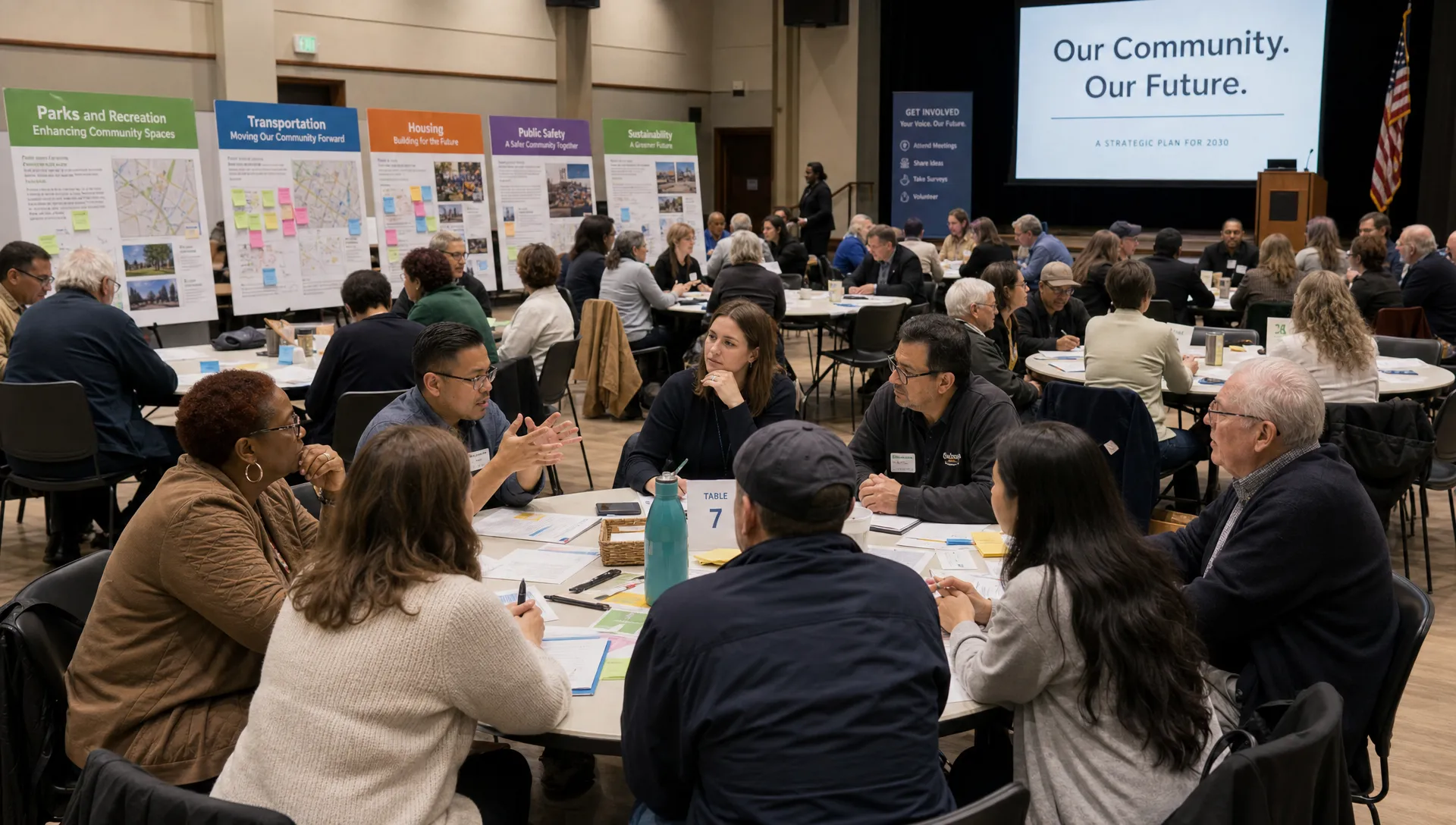
This is where deliberative democracy matters. Deliberative democracy creates spaces where citizens receive balanced information, hear from experts, discuss tradeoffs, question assumptions, and produce considered recommendations. It is slower than a like button, but often far more valuable.
The OECD has documented the growth of deliberative processes and citizens' assemblies as governments experiment with more thoughtful forms of public participation. These models are not perfect, but they point toward an important principle: citizens should not merely express preferences. They should be given the conditions to think politically with one another.
A modern government could use deliberative democracy for questions such as education reform, climate adaptation, local zoning, public health priorities, constitutional safeguards, and budget tradeoffs. Participants would not replace elected officials or professional administrators. Instead, they would give government a stronger public reasoning process before decisions are made.
The JustSocial manifesto argues for a future where the state and individual are more closely intertwined, not through control, but through meaningful influence. Deliberation is one of the safeguards that makes that influence responsible. It slows down reaction, introduces evidence, and forces participants to confront the fact that public policy is rarely a choice between good and evil. It is usually a choice between competing goods, limited resources, and uncertain outcomes.
Discursive democracy makes public reasoning visible
If deliberative democracy is about structured judgment, discursive democracy is about the wider public conversation that surrounds power. It asks a simple question: can citizens see, join, challenge, and improve the arguments that shape public decisions?
Most governments publish outcomes. Fewer publish reasoning in a way people can actually use. A bill may be available online, but without clear summaries, version history, committee context, expert testimony, public objections, fiscal implications, and links to the final vote, the public is technically informed but practically excluded.
Discursive democracy modernizes government by making the conversation itself part of the institution. Public hearings, committee meetings, draft laws, budget debates, citizen comments, expert reports, and media analysis should be connected. People should be able to trace an issue from the first proposal to the final decision and then to implementation.
This connects directly to JustSocial's call for public committees, recordings, documents, and representative activity to become accessible in modern formats. Livestreams alone are not enough. A three-hour video with no transcript, tags, clips, or issue map is transparency without usability. For a deeper look at this problem, JustSocial has argued that public committees and livestreams should become participation infrastructure, not just archives.
Discursive democracy also changes the role of media and civic influencers. Instead of acting only as commentators after decisions are made, they can help translate complex issues, compare arguments, expose missing evidence, and bring more people into the discussion. In a healthier system, public discourse becomes a civic utility.
A political movement is needed because institutions rarely modernize themselves
Technology alone will not modernize government. A dashboard can be ignored. A public platform can be underfunded. A consultation portal can become a graveyard of unread comments. Civic participation becomes powerful only when it is backed by institutional duties: a duty to publish, a duty to respond, a duty to explain, and a duty to measure public input honestly.
That is why a political movement matters. A political movement can name the failure, organize citizens around a shared demand, pressure representatives, recruit builders, and insist that public systems catch up with public life. JustSocial's role is not merely to imagine better civic tools. It is to push for a new expectation of government, one in which participation is continuous, structured, and connected to real public authority.
Private organizations already understand that complex coordination requires purpose-built systems. Event professionals, for example, do not want to manage clients, contracts, payments, teams, and schedules across disconnected tools when platforms such as Foundation Vibes can bring operations into one place. Government should learn from that operational logic without copying private-sector values blindly. Public institutions also need integrated workflows, but with democratic safeguards, open records, public accountability, and equal access.
A modern political movement can therefore focus on two fronts at once. It can demand legal reform so participation has standing, and it can help design the civic infrastructure that makes participation practical. Neither front is sufficient alone.
Civic participation can modernize the machinery of government
To make this concrete, civic participation can change several core functions of the state.
First, it can improve agenda setting. Instead of waiting for parties to decide which issues matter, governments can continuously identify public priorities across neighborhoods, age groups, professions, and communities. This does not mean the loudest group always wins. It means representatives start with a clearer map of public concern.
Second, it can improve lawmaking. Draft bills can be published in readable versions, annotated by experts, discussed by citizens, and revised before they harden into partisan positions. Public input should be attached to the legislative record so people can see what was accepted, rejected, or deferred.
Third, it can improve administration. Agencies can use civic participation to identify service failures, test digital forms, monitor procurement outcomes, and compare policy promises with lived results. This is especially important in areas like education, transportation, housing, healthcare, and local infrastructure.
Fourth, it can improve oversight. Citizens should not need investigative skills to understand what representatives did in their name. Votes, attendance, committee activity, conflicts of interest, budget decisions, and implementation progress should be visible and understandable.
Fifth, it can improve legitimacy. People are more likely to accept difficult decisions when they can see the process, understand the tradeoffs, and verify that their concerns were considered. Legitimacy does not require unanimous agreement. It requires a fair, intelligible, and accountable path to decision.
This is where the idea of a People’s Branch becomes relevant. JustSocial has described a People’s Branch as a permanent participation layer that would help citizens influence public priorities without collapsing government into constant referendums. That distinction is crucial. Modernization should make government more responsive, not chaotic.
The safeguards are as important as the tools
Civic participation can modernize government only if it is designed with constitutional seriousness. Bad participation systems can be captured, manipulated, or used to create the illusion of consent. A modern democracy must protect citizens from those risks.
Privacy matters. People should be able to participate without exposing every political belief to employers, hostile groups, or manipulative campaigns. Security matters. Voting, identity verification, and public data systems must be protected from fraud and coercion. Inclusion matters. Participation systems must work for people with disabilities, limited time, limited digital access, different languages, and lower institutional trust.
Minority rights also matter. Civic participation should inform and influence government, but it should not become a weapon for majorities to erase basic rights. The manifesto's own distinction is important here: continuous public opinion can be measured and taken seriously while courts, parliaments, executives, academia, and other branches remain independent. Public voice should guide the state, but constitutional protections should prevent the state from becoming a mob with software.
Modernization therefore requires both openness and restraint. The goal is not to let every online reaction become law. The goal is to build a government that can hear the people continuously, reason publicly, and act responsibly.
How governments can begin now
A full transformation will take law, funding, public trust, and a political movement strong enough to overcome institutional inertia. But governments do not need to wait for a perfect future to begin.
They can start with a few practical commitments:
- Publish every major decision question before the decision window closes.
- Give each participation process a named decision owner and a public response deadline.
- Use deliberative panels for complex tradeoffs instead of relying only on surveys.
- Make committee records searchable, summarized, tagged, and linked to votes.
- Report back after implementation so citizens can compare promises with outcomes.
These steps sound modest, but they would already mark a cultural shift. They would tell citizens that participation is not a performance. It is part of governing.
The deeper shift is philosophical. The ancient Polis gave citizens a sense that public life was immediate, meaningful, and tied to human flourishing. It could not scale with the tools of its time. The modern republic scaled representation, but often at the cost of intimacy and direct influence. The task now is to build something better: a modern civic order where scale and participation are no longer enemies.
That is the promise behind the Cosmopolis idea in the JustSocial vision. Not nostalgia for ancient city-states, and not blind faith in technology, but a society where public institutions are redesigned around the fact that people can participate, deliberate, learn, and govern together more continuously than ever before.
Frequently Asked Questions
What is civic participation in modern government? Civic participation is the ongoing involvement of citizens in public decisions, oversight, problem-solving, and community life. In modern government, it should include structured channels for input, deliberation, transparency, and feedback after decisions are made.
How is deliberative democracy different from ordinary public consultation? Deliberative democracy gives citizens time, information, facilitation, and access to different viewpoints before they make recommendations. Ordinary consultation often collects opinions quickly, while deliberation is designed to produce more informed public judgment.
What does discursive democracy add to civic participation? Discursive democracy focuses on the public conversation around decisions. It asks whether citizens can see the arguments, evidence, objections, and reasoning that shape policy, not only the final result.
Can civic participation replace elected representatives? Not necessarily. The stronger model is to make representatives more accountable and better informed by continuous public input. Civic participation can guide, challenge, and improve representative government without eliminating constitutional checks and professional administration.
Why does this require a political movement? Institutions rarely surrender power or redesign themselves without pressure. A political movement can organize citizens, demand legal duties for participation, and help build the culture needed for continuous democratic involvement.
Help build a government that listens continuously
Modern government should not treat citizens as background noise between elections. Civic participation can become the foundation of a more intelligent, transparent, and humane public system, but only if people organize around that demand.
JustSocial exists to advance that political movement. If you believe government should be shaped by citizens continuously, through deliberation, public reasoning, and accountable technology, now is the time to take part, share the idea, volunteer, build, organize, and help move democracy from periodic permission to everyday public power.