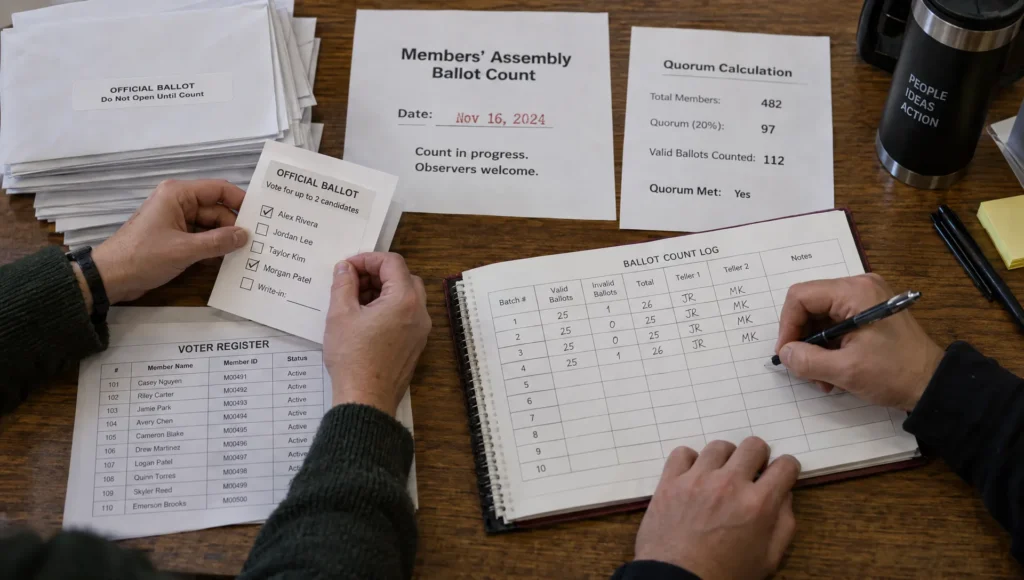
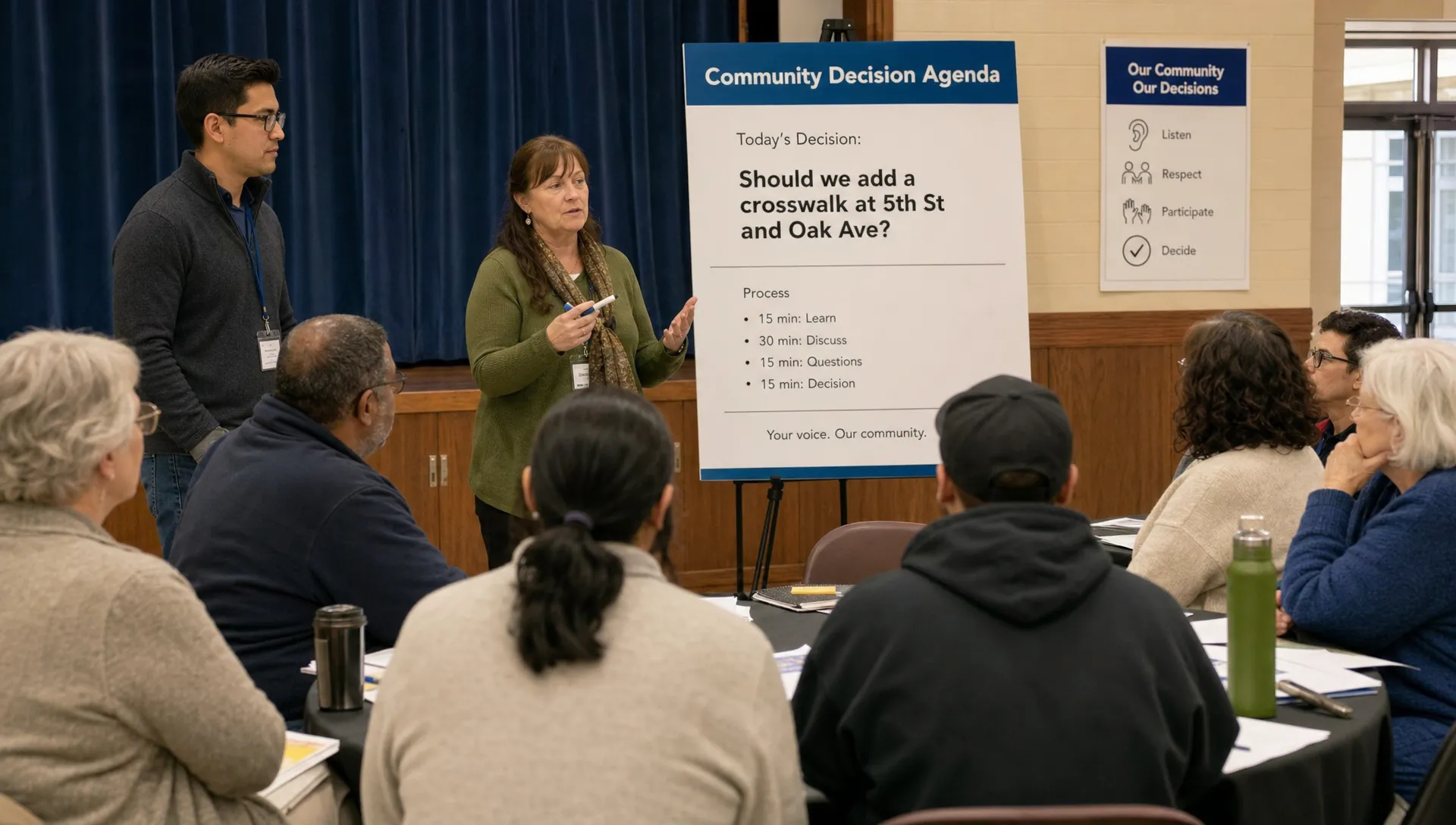
Civic participation becomes credible when it survives contact with a real public decision. It is easy for a government, party or civic group to say that people should be heard. It is harder to prove that public input can be gathered fairly, discussed seriously and connected to action.
That is why public pilot programs matter. A pilot gives civic participation a test environment: one decision, one community, one clear timeframe and one public record of what happened. It does not ask a nation to accept an entirely new political system overnight. It asks a simpler question: can we show, in practice, that people can participate in governing with more regularity and more consequence than a vote every few years?
The JustSocial manifesto makes this point through a broader critique of industrial-era institutions. Public life still runs on slow bureaucratic forms, fragmented public hearings and election cycles that reduce citizens to voters, taxpayers and consumers. The manifesto argues for a culture where technology helps the state listen continuously, where public committees are visible and where people become a civic branch of government rather than background noise. Public pilot programs are the bridge between that vision and institutional reality.
Why pilots belong at the center of civic participation
Large democratic reforms often fail before they begin because they are framed as total replacements for the existing system. Officials fear losing control. Citizens fear manipulation. Professionals fear that complex decisions will be reduced to slogans. Activists fear that participation will become symbolic, used to decorate decisions that were already made.
A public pilot program lowers the temperature. It says: let us try this with a school district policy, a municipal budget choice, a neighborhood mobility plan, a public committee archive or a local service redesign. Let us see who participates, what information they need, how disagreement is handled and whether the decision owner can respond in a serious way.
This is not a compromise with the old system. It is a way to build evidence against the old system’s strongest excuse, the claim that people cannot participate responsibly at scale. A good pilot does not need to prove that everyone agrees. It needs to prove that a public institution can open a structured channel, listen without chaos, protect minority voices and show exactly how participation affected the final decision.
For a political movement, pilots also create discipline. A movement can demand change, but a pilot forces it to define the change clearly enough to be tested. Who gets to participate? What counts as a valid contribution? What happens after people speak? What evidence is published? These design choices separate serious civic participation from vague democratic branding.
What a public pilot has to prove
The purpose of a pilot is not to stage a perfect miniature democracy. It is to test whether an institution can make participation meaningful under real constraints. Public decisions involve budgets, law, professional expertise, deadlines and conflicting values. Civic participation has to work inside that world, not in a fantasy version of it.
A useful pilot should answer a few practical questions before anyone argues about national scale.
| Pilot question | What success looks like | What it protects against |
|---|---|---|
| Can people understand the decision with fair briefing material? | Participants ask better questions and identify real tradeoffs | Technocratic gatekeeping |
| Can broad public discussion surface concerns early? | Recurring arguments, risks and local knowledge become visible | Decisions shaped only by insiders |
| Can deliberation improve public judgment? | Participants revise views after hearing evidence and other citizens | Instant polling treated as wisdom |
| Can the decision owner respond clearly? | Officials publish what they accepted, rejected and why | Participation without consequence |
| Can the process protect trust? | Privacy, moderation and records are handled transparently | Manipulation, intimidation or performative outrage |
This kind of proof matters because civic participation is often criticized in the abstract. The public is too polarized. Online spaces are too toxic. People do not have time. Officials cannot read every comment. Some of these concerns are real, but none of them justify abandoning participation. They justify designing it better and testing that design publicly.
From consultation to consequence
Most citizens have already experienced weak participation. They fill in a survey, attend a hearing or post a comment into a platform that never shows them what happened next. The process may be legal and technically open, but it trains people to believe that public input disappears.
A public pilot program should begin with a participation promise. The promise does not have to say that the public will decide everything. In many cases, elected officials or public professionals still hold legal responsibility. The promise should say what the public is being asked to influence, who owns the final decision, when the decision will be made, what materials will be available and how the institution will answer the public record.
That final answer is the hinge. Without it, civic participation becomes consultation theater. With it, even a rejected proposal can strengthen trust, because citizens can see the reasoning and contest it in the open. The manifesto’s demand that representatives become better pipelines for public consensus depends on this kind of visible chain from public voice to institutional response.
How deliberative democracy and discursive democracy work together
Public pilot programs should not rely on one participation format. Voting, commenting and discussion each do different jobs. A stronger model combines deliberative democracy and discursive democracy.
Deliberative democracy is useful when a public question requires informed judgment. A representative or balanced group of participants receives briefing material, hears from relevant voices, discusses tradeoffs and develops recommendations. Its strength is depth. People have time to move beyond first reactions and consider consequences.
Discursive democracy is broader. It focuses on the public conversation itself: arguments, stories, objections, questions, identities and values that circulate across a community. Its strength is reach. It can reveal concerns that a small deliberative group might miss, especially from people who cannot attend long sessions.
A pilot can combine both. Start with a discursive phase where the wider community submits experiences, questions and arguments. Then convene a deliberative group that works through the most important themes with evidence and facilitation. Finally, publish the recommendations alongside the wider public record so that everyone can see the relationship between open discussion and structured judgment.
For organizations looking for a more detailed format, JustSocial’s guide to an online deliberative democracy pilot offers a practical starting point for turning these principles into a bounded test.
The consumer internet set expectations government has not met
One reason public participation feels outdated is that citizens compare it to the rest of their digital lives. People can check sizes, new drops and reviews on an authentic sneaker marketplace in minutes, yet they may struggle to find the status of a public proposal that affects their school, street or tax money.
The point is not that government should copy e-commerce. Public authority has duties that consumer platforms do not: equality, legality, privacy, accessibility, due process and public accountability. The point is that the private sector has spent years making information searchable, actions trackable and user feedback measurable, while many public institutions still treat participation as a meeting notice and a PDF.
The JustSocial manifesto names this gap directly. Social platforms, cloud tools and analytics have changed private life, but public institutions have adopted them slowly or defensively. Public pilot programs offer a careful way forward. They let governments and civic groups test modern participation methods without pretending that every tool is ready for every public purpose.
A practical structure for the first public pilot
A pilot should be modest enough to complete and serious enough to matter. If the decision is too small, citizens will see it as a toy. If it is too broad, the process will collapse under its own ambition. The right starting point is a decision with real stakes, a known decision owner and room for public influence.
JustSocial has also explored how a political movement can build civic tech pilots from the ground up. The same logic applies to public institutions, civic coalitions and local organizers.
- Choose one decision: Select a concrete issue, such as a school program priority, a neighborhood safety plan, a committee transparency process or a small public budget allocation.
- Name the decision owner: Identify the official body, agency leader, board or committee that has the authority to respond.
- Publish the participation promise: Explain what the public can influence, what is outside scope, what the timeline is and how the final response will be written.
- Prepare fair briefing material: Present the budget, legal limits, tradeoffs and key facts in plain language, with room for competing interpretations.
- Run the discursive phase: Invite broad public input through accessible channels, then organize recurring themes without hiding disagreement.
- Run the deliberative phase: Bring a smaller group through structured discussion, evidence review and recommendation writing.
- Publish the full response: Show what changed, what did not change and why, using language ordinary citizens can understand.
- Evaluate before scaling: Review participation diversity, decision impact, cost, trust signals, moderation problems and accessibility gaps.
The evaluation step is where many pilots become politically useful. A failed pilot can still teach. Maybe the briefing was too complex. Maybe the timeline was too short. Maybe the community trusted local facilitators more than national figures. Maybe online comments surfaced strong concerns, but deliberation was needed to turn them into usable recommendations. The lesson should be public, not buried.
Guardrails that make pilots legitimate
Civic participation gains power only when people trust the process. That trust cannot be assumed, especially in polarized societies. A pilot needs guardrails before it launches, not after controversy arrives.
| Guardrail | Why it matters |
|---|---|
| Clear identity rules | Participants should know whether input is anonymous, verified, public or grouped by role |
| Privacy protection | Sensitive civic views should not expose people to retaliation or profiling |
| Accessible participation | Time, language, disability access and digital access shape who is heard |
| Transparent moderation | Rules against abuse should be visible and applied consistently |
| Minority reporting | Strong dissent should be recorded rather than flattened into majority language |
| No false referendum | If the pilot is advisory, it must not be marketed as binding public rule |
| Public archive | Materials, summaries, recommendations and official responses should remain available |
The manifesto’s idea of willing and anonymous civic identity points to a difficult but necessary design question: how can public systems know enough to understand participation patterns without turning civic life into surveillance? A pilot cannot solve that forever, but it can test privacy, verification and transparency in a limited setting.
This is also where academia, civil society and public professionals can play a constructive role. They can audit briefing materials, observe facilitation, identify participation gaps and help evaluate whether the process met its promise. In the manifesto’s language, civic participation should not be left to politicians alone. It should be held to public, educational and methodological standards.
Why this matters for a political movement
A political movement that supports deeper democracy has two tasks. It must inspire people, and it must make the future believable. Public pilot programs help with the second task.
Slogans can gather attention, but pilots gather proof. They show residents what it feels like to discuss a real decision before it is finalized. They show officials that public input can be structured rather than chaotic. They show journalists a public record instead of a press release. They show skeptics where the model works and where it still needs repair.
This is especially important for a movement built around civic participation, deliberative democracy and discursive democracy. Those ideas are not merely academic. They can be tested in a classroom choosing part of its learning agenda, a municipality opening committee materials to public tagging and response, a neighborhood shaping a local plan or a public agency redesigning a service with the people who use it.
Each pilot also trains democratic habits. Citizens learn how to read public materials, argue without reducing opponents to enemies, make tradeoffs and expect a response from power. Officials learn how to listen before decisions harden. Organizers learn how to move from protest energy to institutional design.
From pilot to public institution
The danger of pilots is that they become showcases. A government launches one impressive process, publishes a summary and then returns to normal. That is not enough.
A serious pilot program should create a path to repetition. If the first pilot works, the next question is which rule, budget line or administrative routine will change so participation becomes easier next time. If the pilot fails, the next question is whether the failure came from the concept, the design, the technology, the institution or the political will behind it.
The long-term goal is not endless experimentation. It is a public participation layer that becomes normal. Committee records should be easier to follow. Public input should be easier to trace. Civic identity should be protected. Deliberation should be available for hard tradeoffs. Discursive democracy should keep everyday public concerns visible between elections.
The JustSocial vision of a modern democracy, connected to the older ideal of the Polis and expanded toward a Cosmopolis, can sound ambitious. Public pilot programs make that ambition concrete. They do not ask citizens to wait for a perfect constitution, a perfect platform or a perfect leader. They ask communities to begin with one decision and prove that people can be more than spectators.
Frequently Asked Questions
What is a public pilot program for civic participation? A public pilot program is a limited, time-bound test that lets citizens participate in a real public decision. It should include a clear decision owner, accessible information, a defined participation process and a public response explaining how input was used.
How is a pilot different from a normal public consultation? A consultation often gathers comments without showing whether they changed anything. A pilot is designed to test a complete participation model, including public discussion, structured deliberation, official response and evaluation.
Where do deliberative democracy and discursive democracy fit? Discursive democracy helps gather broad public arguments, stories and concerns. Deliberative democracy helps a smaller group work through evidence and tradeoffs. A strong pilot can use both, with each format doing the job it is best suited for.
Can a pilot include online voting? Yes, but only when the legal, security and ethical conditions are clear. Many early pilots should treat voting as advisory input rather than a binding referendum, especially when the main goal is to test participation quality and institutional response.
Who should run a civic participation pilot? A city, agency, school district, university, nonprofit or political movement can run a pilot, but legitimacy improves when the decision owner is named, the process is transparent and independent observers can review the outcome.
Build the next public pilot
Civic participation will not become real because people praise it. It becomes real when communities test it, improve it and insist that public institutions respond.
For JustSocial, the case for public pilot programs is the case for democratic seriousness. Start with one decision. Make the promise clear. Let people speak broadly. Let a group deliberate deeply. Publish the response. Then do it again with better tools, better safeguards and a stronger public record.
A political movement earns trust when it can turn a manifesto into practice. Public pilot programs are where that work begins.