Climate adaptation used to sit inside technical reports, engineering departments and long-range planning documents. By 2026, it has become one of the most immediate democratic questions facing cities, regions and national governments. It decides whose street gets flood protection first, where trees and cooling centers are installed, when water restrictions begin, which homes can still be insured and whether public money goes to seawalls, drainage, relocation, schools or hospitals.
Those are not purely technical choices. They are choices about risk, sacrifice, fairness and time. Climate models can show likely hazards. Engineers can price infrastructure. Economists can estimate damage. Public health officials can map heat exposure. None of them can decide, alone, what a community should accept, protect or change.
That is where deliberative democracy matters. It gives governments a structured way to bring residents into difficult climate adaptation decisions before positions harden into slogans. Citizens receive balanced evidence, question specialists, deliberate with people outside their usual circles and produce recommendations that elected officials can use. The goal is not to replace expertise or representative institutions. The goal is to make public judgment part of the decision itself.
Why climate adaptation is a democratic stress test
Climate adaptation is different from many other policy areas because it is local, unequal and uncertain at the same time. A national climate target can sound abstract, but a stormwater fee, managed retreat plan or heat-resilient zoning code lands on specific households, neighborhoods and businesses.
Four tensions make adaptation especially hard for ordinary politics:
- Climate risk is local, so residents often know details that regional models miss.
- The burdens are unequal, since low-income neighborhoods, elderly residents, renters and outdoor workers often face higher exposure with fewer resources.
- The evidence is probabilistic, meaning leaders must act before certainty arrives.
- The costs are visible now, while many benefits arrive years or decades later.
The IPCC Sixth Assessment Synthesis Report makes clear that adaptation is already happening across sectors and regions, but gaps remain and poorly designed adaptation can deepen vulnerability. That warning has a democratic implication: bad adaptation is not only a planning failure. It can become a legitimacy failure.
Traditional public comment often arrives too late. A city presents a plan, angry residents line up for three minutes each, officials thank everyone and the core decision barely changes. A referendum can identify which side has more votes on a fixed question, but it rarely helps people understand tradeoffs. A social media debate can surface frustration, but it usually rewards speed, outrage and group loyalty.
JustSocial's manifesto argues that modern citizens should not be reduced to voters every few years, taxpayers and private consumers. Climate adaptation is a concrete case for that claim. If the state asks people to live with new risks, new costs and new rules, it should also build civic participation into the way those decisions are made.
From public comment to public judgment
A public hearing asks citizens to react. Deliberative democracy asks citizens to learn, weigh, revise and justify. That difference matters.
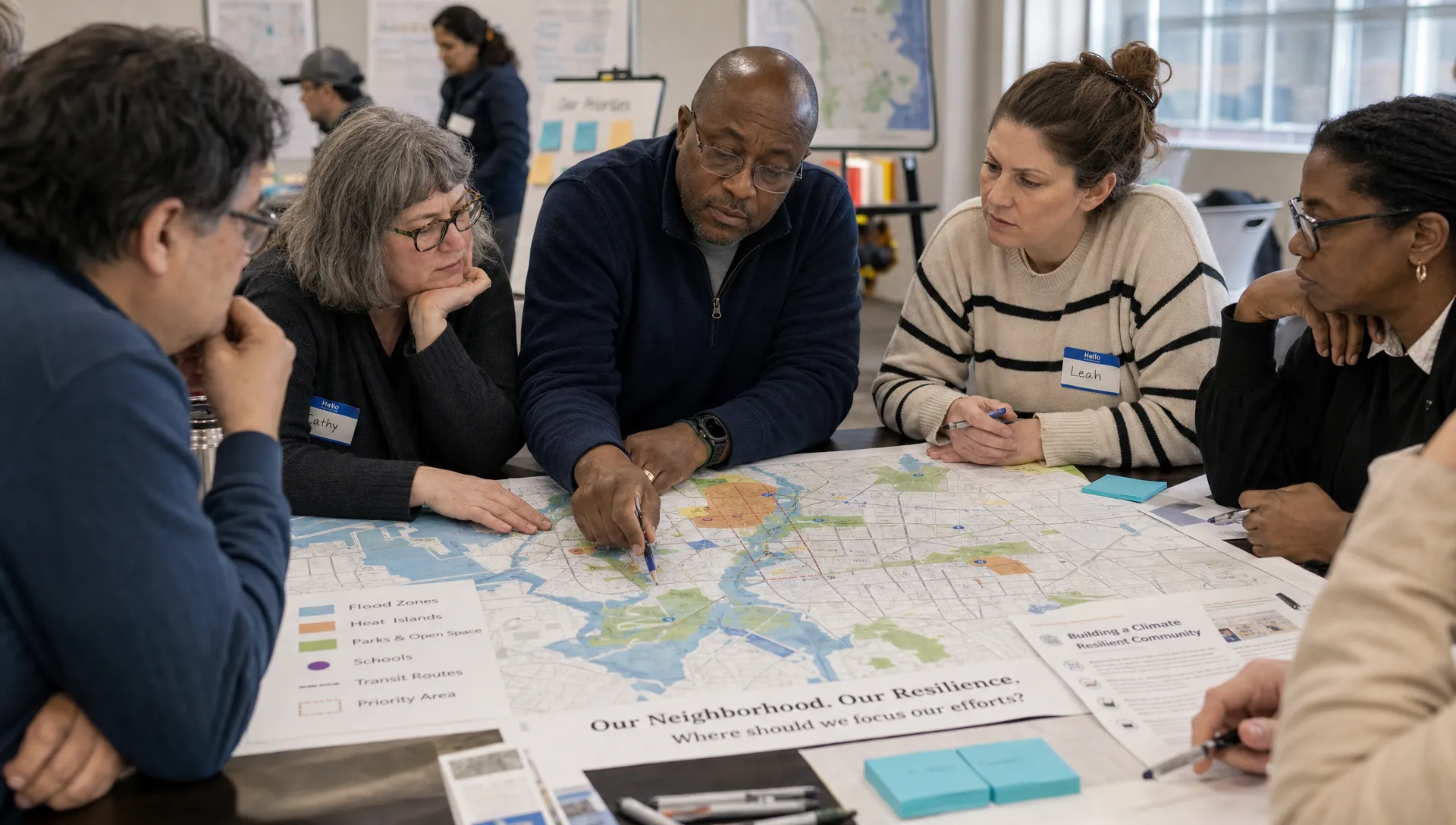
In a strong adaptation process, residents do not simply say whether they like a seawall, a floodplain buyout or a heat ordinance. They hear the expected benefits, costs, uncertainties and distributional impacts. They ask engineers why one option is cheaper now but riskier later. They ask health officials which residents are most exposed. They ask business owners how supply chains, insurance and employment would be affected. Then they deliberate in a setting designed for listening rather than performance.
The OECD has documented the growing use of representative deliberative processes, including citizens' assemblies, panels and juries, as tools for public decision-making. Climate adaptation should be one of their main fields of use because it forces society to compare real goods against one another: safety, affordability, continuity, property rights, ecological repair and fiscal responsibility.
A mini-public does not make elected officials irrelevant. It gives them a clearer view of what informed residents can support after studying the issue. That is very different from guessing public opinion from protests, partisan polling or the loudest comments in a council chamber.
The adaptation choices that benefit most from deliberation
Not every climate decision needs a full citizens' assembly. Emergency response still requires speed. Routine maintenance still belongs with public agencies. Deliberative democracy is most useful when the decision is high impact, contested and value-laden.
| Adaptation decision | The real tradeoff | What deliberation should produce |
|---|---|---|
| Flood protection | Protect the most assets, the most vulnerable people or the highest-risk areas first | A ranked investment framework with fairness criteria |
| Urban heat planning | Prioritize tree canopy, cooling centers, building codes or work rules | A heat action plan that reflects health risk and neighborhood needs |
| Water scarcity | Balance household limits, agricultural use, industry, pricing and conservation | Public principles for rationing, pricing and long-term resilience |
| Coastal retreat | Defend, elevate, buy out or relocate exposed communities | Conditions under which relocation is acceptable and how residents are protected |
| Land use reform | Restrict building in risk zones or allow growth with stronger standards | A zoning approach that connects housing needs with climate risk |
| Infrastructure budgets | Spend now on prevention or later on recovery | A transparent budget sequence with public justification |
Budget choices deserve special attention because adaptation is often blocked less by lack of ideas than by lack of agreement on priorities. The same discipline described in JustSocial's model for deliberative democracy for budget decisions applies here: define the decision, make tradeoffs visible, give citizens usable evidence and require a public response from decision-makers.
A practical model for climate adaptation deliberation
A useful climate adaptation process should be repeatable. Governments should not invent a new participation format every time a flood map or heat plan becomes politically difficult. A practical model can follow seven phases.
- Name the decision clearly: The public must know what is actually on the table. A vague question such as how should we adapt to climate change is too broad. A better question is which three neighborhoods should receive the first round of flood resilience investment under a fixed budget, and by what criteria.
- Publish a balanced evidence pack: The evidence pack should include climate projections, local hazard maps, budget limits, legal constraints, public health data, infrastructure options, expected maintenance costs and distributional impacts. It should also name what is uncertain, because false certainty damages trust.
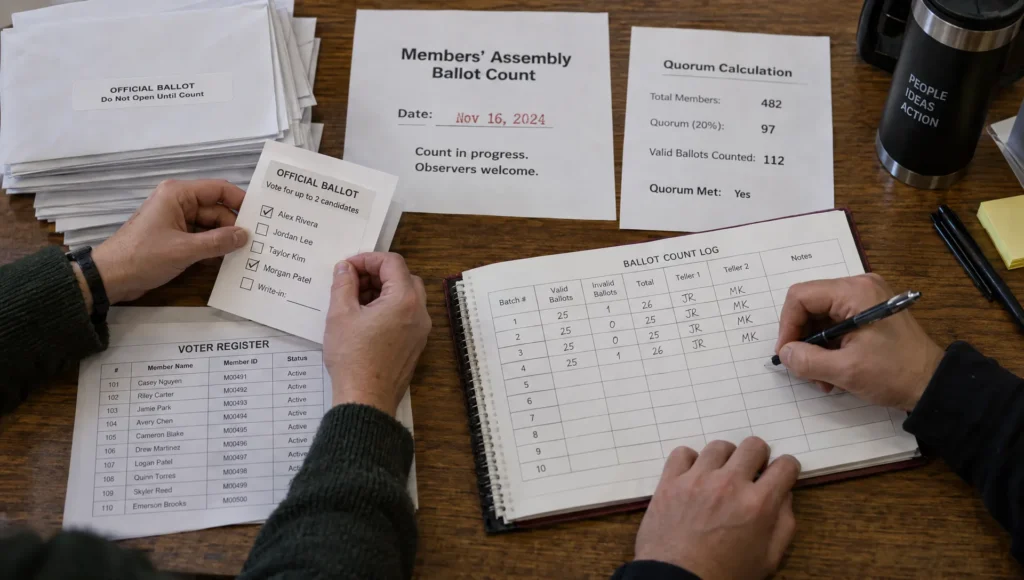
- Recruit a representative mini-public: Participants should reflect the affected population by age, geography, income, housing status and other relevant factors. Random selection with demographic balancing is often stronger than open signup alone, since open meetings tend to overrepresent people with time, confidence and existing political habits.
- Open a wider civic participation channel: The mini-public needs input from the wider community. Residents should be able to submit experiences, questions, photos, proposals and objections. This is where digital tools help, especially if participation is accessible by mobile phone, available in multiple languages and designed with privacy protections.
- Run facilitated deliberation: Citizens should question experts, deliberate in small groups, test scenarios and identify the values behind their preferences. Facilitators should protect minority voices and prevent the process from becoming a debate club for the most confident speakers.
- Produce recommendations with reasons: A useful output is not a wish list. It should include recommended actions, tradeoffs accepted by the group, unresolved disagreements, minority reports and the evidence that shaped the conclusions.
- Require an official response: Elected officials and agencies should respond publicly to each recommendation. They may accept, modify or reject it, but they should explain why. Without that response, participation becomes symbolic.
Cities, agencies and civic organizations that want to begin with a smaller digital process can adapt JustSocial's online deliberative democracy pilot template to a climate adaptation topic such as urban heat, stormwater fees or neighborhood resilience planning.
Designing civic participation without rewarding outrage
Climate adaptation often triggers fear because people hear loss inside the policy language. A floodplain update may sound like lower property value. A water restriction may sound like punishment. A zoning change may sound like government overreach. A relocation discussion may sound like erasure of home, memory and community.
That emotional reality should be acknowledged rather than dismissed. Good civic participation does not tell residents to calm down and trust the experts. It gives people a setting where anger can be translated into claims, claims can be tested against evidence and evidence can be connected to public choices.
This requires design. Meetings should not be scheduled only during working hours. Childcare, translation, disability access and compensation for mini-public participants can change who shows up. Community groups should be invited early, not used later as messengers for a decision they did not shape. Youth voices also matter, especially in climate adaptation, because today's infrastructure choices will define the conditions they inherit.
The process should also separate lived experience from misinformation. A resident who says a street floods every year may be providing crucial evidence. A resident who says climate risk is a hoax is making a claim that should be addressed with transparent data. Deliberation works when people are respected as citizens without treating every claim as equally supported.
Where discursive democracy fits
Deliberative democracy works best when it is surrounded by discursive democracy, meaning a healthier public conversation around the formal process. A citizens' panel can deliberate carefully, but if the broader public only hears rumors about what happened, trust will still break down.
The discursive layer should make the process visible. Evidence packs should be public. Expert testimony should be recorded when possible. Questions from residents should be answered in plain language. Journalists, schools, neighborhood associations, faith communities and civil society groups should be able to discuss the same materials as the mini-public.
The aim is not forced consensus. The aim is legible disagreement. A community can live with disagreement more easily when people can see what others value and why. One neighborhood may prioritize flood walls because relocation feels like cultural loss. Another may prefer buyouts because repeated flooding has become unbearable. Discursive democracy helps those positions become understandable rather than tribal.
Technology can strengthen this layer if it is used carefully. A public platform can collect questions, cluster recurring concerns, show where proposals came from and track official responses. But the platform must not become a surveillance tool or a popularity contest. JustSocial's broader vision of technology-enabled public participation is relevant here because adaptation needs continuous input, not one-off consultation after plans are already written.
Business, local economies and adaptation decisions
Climate adaptation is a public responsibility, but local economies are part of the adaptation system. Retail corridors, restaurants, logistics depots, farms, tourism operators, construction firms and care facilities all depend on infrastructure, water, energy and safe working conditions. If a heat plan ignores outdoor workers, it fails. If a flood plan ignores small businesses, it may protect buildings while destroying livelihoods.
Business voices should not dominate the process, but they should be included in a transparent way. A port city considering flood defenses needs to understand employment, supply chains and insurance. A district redesigning streets for stormwater absorption should hear from delivery operators and shop owners. A region planning water restrictions should understand how different industries use water and what conservation options are realistic.
The private sector also offers a useful lesson about decision discipline. A consumer brand considering cross-border growth, for example, can use an AI-powered market readiness scan to validate target countries, channel options and partner routes before committing resources; public adaptation planning needs the same habit of testing assumptions before spending public money. Evidence first, then prioritization, then execution.
This does not turn climate adaptation into a business exercise. It recognizes that public decisions shape economic resilience, and economic disruption can quickly become social disruption. A deliberative process should therefore include workers, small businesses, large employers and consumer representatives alongside residents, scientists and public agencies.
The JustSocial angle: from Polis to climate-ready Cosmopolis
The JustSocial manifesto draws on the idea of the Polis, where civic life felt immediate and citizens experienced political belonging as part of daily life. Ancient city-scale democracy could not scale with the technology of its time. Modern representative systems solved part of that scale problem, but they also created distance. Citizens often experience the state as something that taxes, regulates and announces, not something they actively help steer.
Climate adaptation exposes the cost of that distance. If a government announces a managed retreat zone without deep public legitimacy, residents may resist even when the science is strong. If officials impose water rules without explaining tradeoffs, people may see unfairness even when conservation is necessary. If agencies build expensive infrastructure without public prioritization, the next budget cycle becomes a fight over trust.
A climate-ready Cosmopolis would not mean every resident votes every day on every engineering detail. It would mean the state has permanent channels for public judgment, transparent evidence and accountable response. Citizens would be able to participate as informed members of the community rather than occasional spectators.
The manifesto's emphasis on academia as a stronger public branch is also relevant. Climate adaptation needs universities, scientists and technical experts, but not as distant authorities handing down conclusions. They can help maintain evidence packs, review claims, explain uncertainty and evaluate outcomes. In a deliberative system, expertise becomes more public, and public judgment becomes more informed.
Safeguards for legitimacy
Deliberative democracy is not automatically fair. Poor design can produce tokenism, capture or confusion. Climate adaptation processes need safeguards from the start.
| Risk | Safeguard | Why it matters |
|---|---|---|
| Tokenism | Require a formal public response to recommendations | Citizens need proof that participation can influence decisions |
| Elite capture | Use random selection and demographic balancing | Organized interests should not be the only voices in the room |
| Misinformation | Publish evidence sources and expert answers | Residents can challenge claims without relying on rumor |
| Short-termism | Include future impact scenarios | Adaptation requires decisions beyond the next election cycle |
| Privacy concerns | Collect only necessary data and explain how it is used | Digital participation must not become surveillance |
| Inequity | Pay participants and remove access barriers | Vulnerable residents are often most affected and least heard |
| Administrative drift | Track implementation publicly | Recommendations lose value if agencies quietly ignore them |
These safeguards turn participation from a public relations exercise into civic infrastructure. They also protect elected officials. When a controversial adaptation plan is backed by a transparent deliberative record, leaders can explain not only what they chose, but how the public helped shape the choice.
A 90-day pilot for a city or region
A government does not need to begin with a national assembly. A 90-day pilot can test the model on one urgent adaptation decision.
| Timeline | Main task | Output |
|---|---|---|
| Day 1 to 15 | Define the decision, scope and budget limits | Public mandate and decision question |
| Day 16 to 30 | Recruit participants and open public submissions | Representative mini-public and wider input channel |
| Day 31 to 45 | Prepare evidence pack and expert briefings | Plain-language materials and uncertainty notes |
| Day 46 to 70 | Run deliberation sessions | Draft recommendations, tradeoffs and minority views |
| Day 71 to 80 | Publish findings for public discussion | Discursive democracy review period |
| Day 81 to 90 | Agency and elected official response | Accepted actions, rejected items and implementation tracker |
A good pilot question is specific enough to matter and limited enough to decide. For example: Which heat adaptation measures should be funded first in three high-risk neighborhoods? How should a stormwater fee be structured to protect low-income households while funding urgent infrastructure? What principles should guide voluntary buyouts in a repeatedly flooded area?
The pilot should be evaluated publicly. Did participants change their views after hearing evidence? Did the wider public understand the recommendations? Did officials respond clearly? Did the process reach residents who rarely attend public meetings? These questions matter because the purpose is not one impressive event. The purpose is a repeatable democratic capacity.
What representatives should commit to before launch
Before convening citizens, elected officials should make a limited but real commitment. They do not need to promise automatic adoption of every recommendation. They should promise that the question is genuine, the evidence will be public, the process will be independent enough to be trusted and the final response will be specific.
They should also identify the decision pathway in advance. If a citizens' panel recommends a heat resilience fund, which agency can implement it? If residents recommend zoning changes, which committee hears them? If they recommend a budget shift, when is the next budget vote? Deliberation without a pathway creates frustration.
Finally, representatives should treat disagreement as useful information. If the mini-public splits, the split may reveal the real political issue: homeowners fear loss, renters fear displacement, workers fear unsafe conditions or young people fear being ignored. That insight is valuable even when consensus is incomplete.
Frequently Asked Questions
Is deliberative democracy too slow for climate adaptation? Not if it is used for the right decisions. Emergency response must stay fast, but major investments, zoning changes, water rules and relocation policies benefit from structured public judgment. A 60 to 90-day process can prevent years of backlash.
How is this different from a town hall? A town hall usually gathers whoever chooses to attend and gives each person a short time to speak. Deliberative democracy recruits a representative group, gives participants balanced evidence, supports structured discussion and produces reasoned recommendations.
Should citizen recommendations be binding? They do not have to be binding to matter. Many processes work best when officials must publicly accept, modify or reject each recommendation with reasons. That preserves representative responsibility while making public judgment harder to ignore.
Can online participation work for climate adaptation? Yes, if it is designed for access, privacy and seriousness. Online tools can collect local knowledge, questions and proposals, but they should support deliberation rather than reduce the process to quick polls or comment fights.
Where does discursive democracy fit in? Discursive democracy is the wider public conversation around the formal deliberation. It helps residents who are not in the mini-public understand the evidence, follow the debate and assess whether the final decision is legitimate.
Climate adaptation needs a democratic upgrade
Climate adaptation will either deepen distrust or rebuild civic capacity. If governments treat it as a technical project with occasional public comment, many residents will experience adaptation as something done to them. If governments use deliberative democracy, strong civic participation and a healthier discursive democracy layer, adaptation can become something communities decide together.
That is the larger political movement JustSocial is working toward: a public life where citizens are heard continuously, evidence is made visible and representatives act as channels for informed public judgment rather than distant managers of public frustration.
If your city, agency, campus or community is facing climate adaptation decisions, start with one real decision, one transparent process and one commitment to respond. Democracy becomes stronger when people are trusted with the tradeoffs that shape their own future.