
Cross-community dialogue is often treated as a public relations exercise: invite representatives from different groups, give everyone a few minutes to speak, publish a summary and hope tensions soften. That can be useful, but it rarely changes how decisions are made.
Discursive democracy asks for something more demanding. It treats public speech not as background noise around politics, but as a core democratic function. People give reasons, answer one another, revise claims, challenge assumptions and connect lived experience to public choices. When the topic crosses communities, that process matters even more because different groups may not share the same history, vocabulary, media diet or trust in institutions.
For JustSocial, this connects directly to the movement’s larger claim: citizens should not be reduced to voters, taxpayers and consumers. In the JustSocial manifesto, Yuval D. Vered argues for a continuous direct democracy where people are heard throughout the term, not only once every few years. Cross-community dialogue is one of the places where that vision becomes practical. If the people are to govern more continuously, the people must also learn how to speak across boundaries without dissolving into factional noise.
What discursive democracy adds to cross-community dialogue
Discursive democracy is a model of democratic life where legitimacy grows from open, reason-giving public discussion. A decision is not considered strong merely because it has votes behind it. It becomes stronger when affected people can see the claims, evidence, tradeoffs and disagreements that shaped it.
This is especially useful across communities because conflict often begins before policy details are even discussed. One group may experience a security policy as protection, while another experiences it as surveillance. One neighborhood may see new housing as economic growth, while another sees displacement. One religious, ethnic or political community may hear a proposal through decades of mistrust that outsiders barely recognize.
A discursive process does not pretend these differences vanish. It gives them a civic structure. Participants are asked to do more than express identity or grievance. They must also explain what they need, what evidence they rely on, what tradeoffs they accept and what would make an outcome feel procedurally fair even if they do not fully agree with it.
That is the bridge between civic participation and responsible governance. Participation without structure can become shouting. Structure without participation becomes bureaucracy. Discursive democracy tries to hold both together.
Cross-community dialogue is not the same as consensus building
Many civic processes fail because they make consensus the emotional goal too early. Participants sense that the room wants harmony, so they soften their claims, perform politeness or disengage. The result may look calm, but the underlying conflict remains.
Cross-community dialogue should aim first at intelligibility, not agreement. Can each community describe what the other is actually claiming? Can participants separate a factual dispute from a value dispute? Can they name which institution owns the decision? Can they identify which voices are missing?
This is why JustSocial’s emphasis on shared civic context matters. A public conversation cannot work if participants do not know what body has authority, what law applies, what budget exists or what data is credible. The JustSocial article on why discursive democracy needs shared civic context develops this point in depth: dialogue needs common reference points before it can become meaningful public reasoning.
In cross-community settings, shared context should not erase different experiences. It should create a common table on which those experiences can be compared, questioned and translated into public options.
Discursive democracy and deliberative democracy
Discursive democracy is closely related to deliberative democracy, but the two should not be collapsed into one term. Deliberative democracy usually focuses on structured consideration before a decision. Discursive democracy is broader: it includes the ongoing public speech, media interpretation, civic education and informal exchange that shape what citizens understand as politically possible.
The distinction matters because cross-community dialogue rarely begins inside a formal assembly. It begins in WhatsApp groups, local news, school meetings, faith communities, comment sections, protest signs, neighborhood rumors and family conversations. A democratic system that ignores these spaces will misunderstand the public long before any official vote is held.
| Model | Main question | Best use in cross-community dialogue |
|---|---|---|
| Deliberative democracy | How should a group reason together before choosing? | Citizen assemblies, policy panels, participatory budgeting and formal recommendations |
| Discursive democracy | How should public reasoning circulate across society? | Community dialogue, civic media, transparent debate, public feedback and continuous participation |
| Direct democracy | How should citizens express binding or advisory preferences? | Referendums, public ballots, online voting and community mandates |
| Representative democracy | How should elected officials act on behalf of citizens? | Legislation, oversight, negotiation and implementation |
The stronger democratic future is not one model replacing all the others. It is a better relationship between them. Discursive democracy can prepare the ground for deliberation. Deliberation can clarify options for direct democracy. Direct public input can guide representatives, who remain responsible for lawful, informed implementation.
Principles for cross-community discursive democracy
A cross-community process needs rules that protect both openness and seriousness. Without openness, marginalized communities are filtered out. Without seriousness, the loudest actors dominate and the process loses public value.
The following principles are a practical starting point:
- Equal civic standing: No participant enters as a guest in someone else’s democracy. Each community must be treated as part of the public, not as an interest group asking for favors.
- Reason-giving: Claims should be connected to reasons, evidence or lived experience. A person can speak from pain, but the process should help translate pain into civic language that others can respond to.
- Reciprocal listening: Participants should be expected to restate opposing claims accurately before rejecting them. This reduces symbolic disagreement and exposes real disagreement.
- Transparent boundaries: The process must clarify what can change, what cannot change, who decides and when the next decision point arrives.
- Protected dissent: A successful dialogue does not require unanimity. Minority reports, unresolved objections and principled dissent should be recorded rather than buried.
These principles also answer a common fear about digital democracy: that more participation simply means more chaos. The problem is not that citizens speak too much. The problem is that most public systems collect speech poorly, respond inconsistently and rarely show how participation affects outcomes.
A workflow for cross-community dialogue
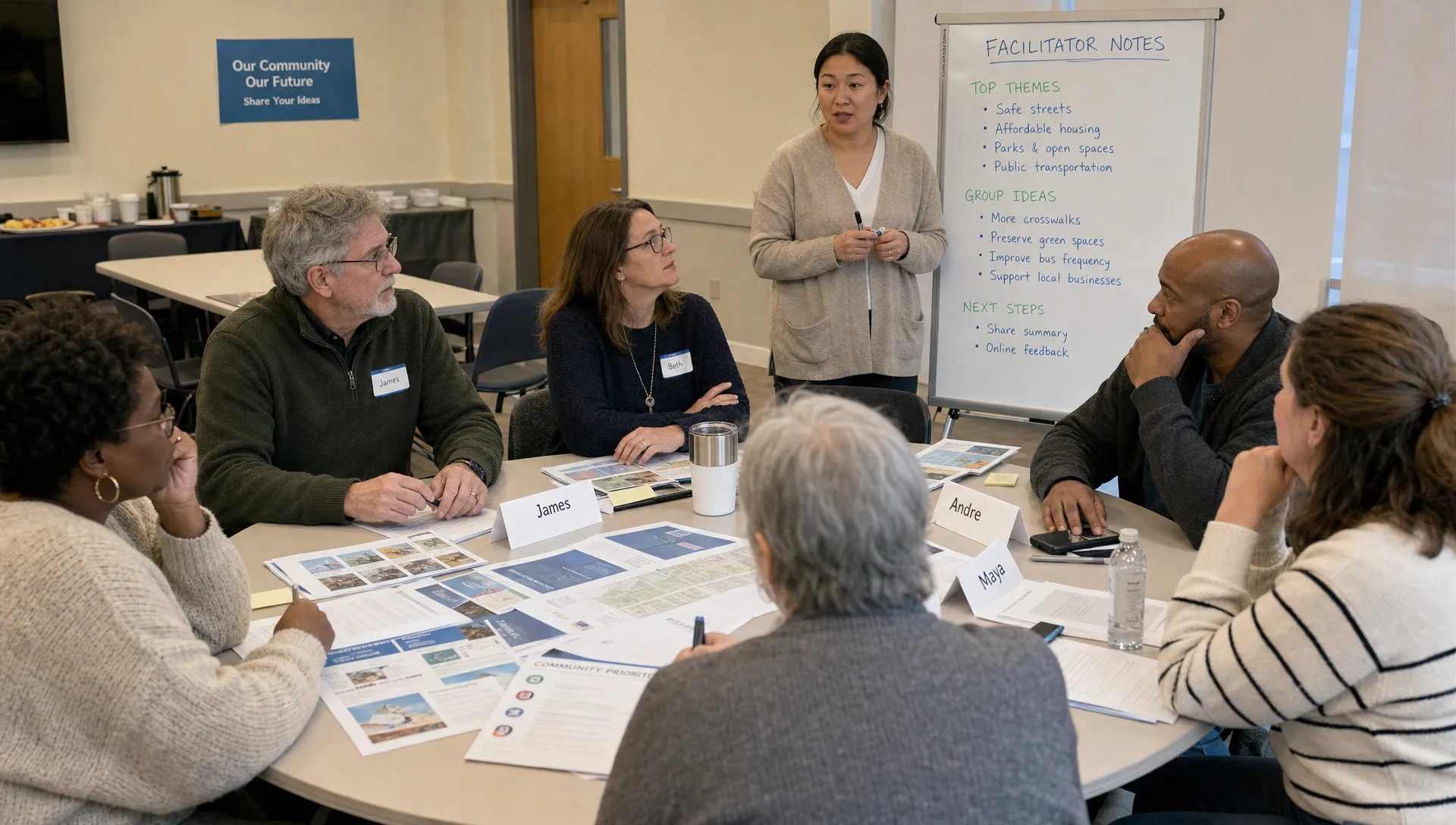
A useful discursive process should be simple enough for a city, school district, agency or civic movement to repeat. The workflow below can be adapted to local disputes, national reforms, interfaith initiatives, education policy or public technology projects.
- Map the communities and stakes: Begin by identifying who is affected, who has organized power, who is usually absent and who carries historical mistrust. Do not assume the loudest representatives cover the whole community.
- Create a shared civic brief: Publish a short, accessible document explaining the issue, legal context, decision owner, budget limits, timeline and known facts. Translate it where needed.
- Open with testimony before argument: Let participants describe how the issue affects their lives before forcing policy debate. This helps reveal harms and priorities that official documents often miss.
- Translate stories into claims: Facilitators should help convert testimony into public claims, such as requests, warnings, proposed principles or evidence gaps.
- Require response, not performance: Each community should answer the strongest version of other communities’ concerns. This shifts the process from identity performance to civic reasoning.
- Produce options with tradeoffs: The output should include more than a transcript. It should present policy options, expected benefits, risks, costs and objections.
- Return with an institutional answer: The responsible body must explain what it accepted, what it rejected and why. A dialogue without a return channel teaches citizens that participation is decorative.
This workflow is not meant to eliminate politics. It makes politics more legible. People can still disagree sharply, but they should be able to see where disagreement sits: facts, values, priorities, costs, institutional authority or trust.
The technology layer: from public conversation to public intelligence
The JustSocial manifesto argues that the technologies needed for more continuous democracy already exist: social platforms, analytics, cloud storage, AI language models and possibly blockchain for security and confidentiality. The challenge is not invention alone. It is civic design.
In cross-community dialogue, technology should serve four functions.
First, it should widen access. People who cannot attend a meeting because of work, disability, childcare, distance or fear of public exposure should still be able to participate. Digital channels can collect statements, questions, votes and feedback asynchronously.
Second, it should organize public reasoning. A well-designed platform can group claims by theme, show which communities raised them, connect them to documents and distinguish between emotional testimony, factual claims, legal constraints and policy proposals.
Third, it should protect identity where needed. The manifesto’s idea of willing and anonymous identification is important here. In some contexts, people need to be counted as part of a demographic, neighborhood or affected group without being personally exposed to retaliation.
Fourth, it should create accountability. Public officials, journalists, researchers and citizens should be able to trace how a topic moved from dialogue to options to decisions. This does not mean every comment becomes policy. It means the public can see whether institutions listened accurately.
This is where democracy tools become more than convenience. An online voting platform, public record system or civic analytics dashboard should not simply digitize old habits. It should help communities understand themselves and help governments respond with clarity.
How this connects to the Polis and the Cosmopolis
One of the most important passages in the JustSocial manifesto reflects on the Greek Polis through Charles Wayper’s writing. The Polis gave citizens a direct sense that public life belonged to them. Politics was not a remote professional class operating somewhere else. It was part of what it meant to live in common.
The modern state is far larger, more diverse and more complex than the ancient Polis. That is why nostalgia is not enough. The goal is not to copy an ancient city-state. The goal is to recover the intimacy of civic influence at modern scale.
The manifesto calls that horizon the Cosmopolis: a future culture where technology, public participation, education and government are reorganized around the people’s continuous role in public life. Cross-community dialogue is essential to that vision because a Cosmopolis cannot be built by one tribe, one party, one class or one identity bloc. It must be built through repeated contact between communities that learn how to reason together without becoming the same.
For communities already experiencing severe polarization, JustSocial has also explored how discursive democracy can turn conflict into structured public reasoning in polarized communities. Cross-community dialogue overlaps with that challenge, but it is broader. It includes not only hostile groups, but also communities that simply live in parallel and rarely share a civic language.
Common failure modes to avoid
Good intentions do not guarantee democratic value. Cross-community dialogue can reproduce inequality if it is designed carelessly.
| Failure mode | What it looks like | Better practice |
|---|---|---|
| Performative inclusion | Inviting symbolic representatives after decisions are mostly made | Involve affected communities before options are fixed |
| Story extraction | Asking people to share pain without giving them influence | Convert testimony into claims, options and institutional responses |
| Premature voting | Measuring preferences before participants understand tradeoffs | Use discussion, briefing and questions before any ballot |
| Platform capture | Letting organized factions dominate digital channels | Use transparent moderation, identity safeguards and participation audits |
| No feedback loop | Publishing a summary with no decision response | Require officials or organizers to answer the public record |
The deepest failure is treating dialogue as therapy rather than power. Healing may happen, but democracy cannot depend on emotional closure. It needs procedures that let people affect the systems governing their lives.
A 90 day pilot for civic organizations and local governments
A political movement, municipality, school district or civic coalition can test cross-community discursive democracy without waiting for national reform. A 90 day pilot is enough to learn whether the process can improve trust, surface better information and produce clearer decisions.
In the first month, choose one issue with real stakes but manageable scope. Examples include school zoning, public space rules, transportation changes, local safety practices or youth services. Build the shared civic brief and recruit participants from affected communities.
In the second month, run the dialogue across both in-person and digital channels. Keep the process focused on claims, evidence, values and options. Publish interim summaries so participants can correct misinterpretations before the final report.
In the third month, require an institutional answer. The decision owner should respond publicly to the main options, explain constraints and commit to next steps. If no formal authority is involved, the organizing coalition should still publish what actions it will take, what it cannot do and what support it needs.
This modest pilot reflects a larger democratic principle: participation becomes credible when it is continuous, structured and consequential.
Frequently Asked Questions
What is discursive democracy? Discursive democracy is a democratic model that emphasizes public reasoning, open dialogue and the exchange of reasons among citizens. It focuses on how opinions are formed and communicated, not only on how votes are counted.
How does discursive democracy help cross-community dialogue? It gives different communities a process for making claims, hearing responses, checking facts, naming values and linking discussion to decisions. This helps dialogue move beyond symbolic listening toward civic participation.
Is discursive democracy the same as deliberative democracy? No. Deliberative democracy usually refers to structured reasoning before a decision, often in formal settings. Discursive democracy includes the wider public conversation that shapes civic understanding across media, institutions and communities.
Can online voting replace cross-community dialogue? Online voting can measure preferences, but it cannot by itself build understanding. In a healthy digital democracy, voting should come after people have access to context, competing arguments and clear tradeoffs.
What role can a political movement play in this process? A political movement can build tools, set norms, recruit participants, pressure institutions and model better civic behavior. Its role is not only to win attention, but to help citizens gain meaningful influence over public life.
Build the habit of being heard together
Cross-community dialogue is not a soft alternative to politics. It is one of the disciplines politics needs if continuous direct democracy is going to work. Citizens cannot govern together if they only meet as opponents during elections, protests or crises.
JustSocial exists to advance that deeper democratic shift: technology-enabled civic participation, public transparency and a political culture where people are heard continuously. If this vision resonates, explore JustSocial.io, read the manifesto and consider how your community could begin practicing discursive democracy now.





