
Deliberative democracy works only when ordinary people can afford to take part. If a city, ministry, school district or parliament asks citizens to spend hours reviewing evidence, questioning experts and weighing tradeoffs, that is not casual feedback. It is public work. Participant pay recognizes that work and helps prevent deliberation from becoming another arena dominated by people who already have time, income, confidence and institutional access.
The case is not that every political conversation should be monetized. Democracy still depends on unpaid speech, protest, organizing, debate and mutual responsibility. The case is narrower and stronger: when the state or a public institution creates a structured deliberative process, selects citizens and asks them to help shape public decisions, those participants should be paid for their time.
The missing cost in deliberative democracy
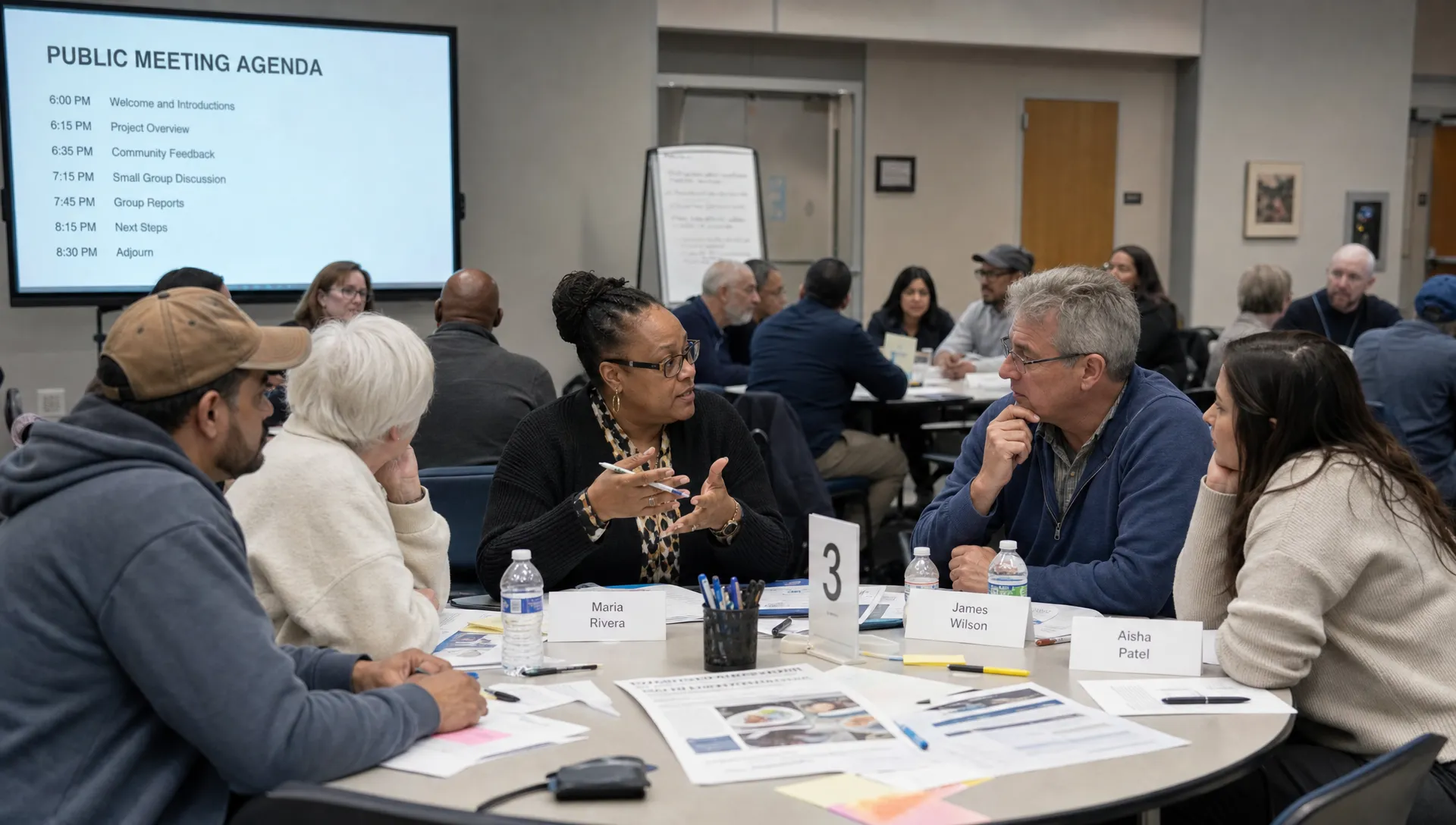
A deliberative process is not a poll. It is not a town hall where the loudest or most available people show up for two minutes at a microphone. In a serious citizens' assembly, citizens' jury or representative mini-public, participants receive balanced information, hear from affected groups, question specialists and deliberate before producing recommendations.
That structure is what makes deliberation valuable. It slows down reaction and creates a setting where people can revise their views after hearing evidence and one another. JustSocial has explored this difference in its comparison of deliberative democracy vs participatory democracy, where deliberation is treated as the deeper judgment layer inside a wider democratic ecosystem.
But depth has a cost. Someone must read the briefing materials. Someone must attend evening sessions or weekend meetings. Someone must travel, arrange childcare, take time away from paid work or spend scarce attention after an already exhausting week. If the process ignores those costs, it silently decides who can participate.
Unpaid deliberation often favors retirees, salaried professionals, students with flexible schedules, activists, policy hobbyists and people already comfortable around institutions. Their views may be sincere, but they are not enough. A process that claims to speak for the public cannot rely mainly on people who can afford unpaid public labor.
Participant pay is not buying opinions
The most common objection is simple: if citizens are paid, are their opinions being bought? The answer depends on what the payment is for.
Participant pay should never reward a particular conclusion, vote or recommendation. It should compensate attendance, preparation and the time required to do the work. The payment is for participation under fair rules, not for agreement with the government, the facilitator or the majority.
This distinction matters. Democracies already pay people for many public functions without assuming their judgment is corrupted. Judges, election workers, public defenders, teachers, civil servants and expert witnesses are paid because society needs their work performed with seriousness and accountability. Citizen deliberators are different from professionals, but the same basic principle applies: public service should not depend on private wealth.
Payment also protects independence. A low-income participant who misses hourly wages to attend a weekend assembly is under pressure before deliberation even starts. A caregiver who cannot afford childcare may decline the invitation. A participant with a disability may need transport or support. Paying participants reduces those pressures and makes consent to participate more meaningful.
Why participant pay strengthens legitimacy
Legitimacy in deliberative democracy is not created by a polished report at the end. It comes from the visible fairness of the process. Citizens need to see that participation was not reserved for a narrow slice of society.
Random selection and stratified recruitment can help create a group that reflects the broader public by age, gender, geography, income, education or other relevant factors. Yet recruitment only works if selected people can say yes. Compensation turns representativeness from a statistical aspiration into a practical possibility.
The benefit is not only fairness. It also improves the quality of deliberation. Participants who are not worrying about lost wages or the cost of transport can focus more fully on the issue. They are more likely to read materials, attend consistently, listen carefully and stay through difficult conversations.
Transparency matters too. If the public knows how participants were selected, what they were paid, which evidence they reviewed and how officials will respond, the process becomes easier to trust. That is why participant pay should sit alongside a strong evidence architecture, not replace it. JustSocial's argument for a public evidence layer is directly relevant here: paid participation is strongest when citizens and observers can inspect the information behind the process.
| Design question | Weak approach | Stronger approach |
|---|---|---|
| Who can afford to attend? | Only those with free time absorb the cost | Participants receive pay and support for real barriers |
| What is payment tied to? | Informal rewards or unclear incentives | Flat, transparent compensation for time and preparation |
| How is trust protected? | The final report is published alone | Recruitment, evidence, payments and official responses are public |
| Who benefits? | Institutions get legitimacy cheaply | Citizens receive recognition for public work |
From the Polis to the Cosmopolis: paying for civic time
The JustSocial manifesto draws on the ancient Polis as a model of political life where citizens were not merely subjects of a distant state. They were members of a shared public world. The point is not to romanticize ancient societies, which excluded many people from citizenship. The point is to recover the intensity of belonging and influence, then make it radically more inclusive with modern institutions and technology.
Participant pay belongs inside that shift. In the manifesto's language, the modern citizen has too often been reduced to a voter, taxpayer and private consumer. A continuous direct democracy asks for something more ambitious: citizens who can weigh in regularly, shape priorities and help public institutions understand lived experience in real time.
That vision cannot be built on unpaid civic extraction. If citizens are asked to help govern, their time must be treated as part of the new social contract. Payment is not the whole contract, but it is a concrete signal that the state is no longer asking people to donate labor so institutions can claim public legitimacy.
Technology can make this easier. Online scheduling, secure identification, transparent payment records, public documentation and accessible deliberation platforms can reduce friction. But technology does not remove inequality by itself. A video meeting still takes time. Reading policy materials still takes concentration. Speaking in a structured forum still requires emotional and civic labor.
A practical payment model for deliberative forums
A good participant pay model should be simple enough for citizens to understand and robust enough to withstand political attack. The amounts will vary by country, cost of living and the intensity of the process, but the design principles should be consistent.
A public body commissioning a deliberative forum should budget for compensation from the beginning, not treat it as a nice extra after facilitation, venue costs and consultants are paid. If participant pay is added only when money remains, the process already signals that citizen time is less valuable than professional time.
A practical model can include:
- A base stipend for each session or full day of participation
- Reimbursement for transport, meals and necessary communication costs
- Childcare, eldercare and disability access support where needed
- Compensation for preparation time when reading or homework is required
- Clear tax and benefits guidance so low-income participants are not harmed
- Published rules explaining who is paid, how much and for what purpose
The strongest models avoid hidden discretion. Participants should not have to plead for support or prove hardship in a humiliating way. A universal stipend combined with additional access support is usually cleaner, fairer and easier to administer.
Payment should also be high enough to matter. A token gift card may thank participants, but it does not solve the exclusion problem. If a process requires serious time, the compensation should reflect local wages and the actual burden of participation.
Where discursive democracy fits
Discursive democracy is the wider public conversation around political life: journalism, social media, neighborhood debate, classroom discussion, party organizing, protest, podcasts, public comments and everyday disagreement. It is messy, emotional and often unequal, but it is where many democratic ideas first appear.
Participant pay should not try to monetize all of that. If every post, argument or public comment became a paid act, democracy would become administratively absurd and morally thinner. The better model is layered.
Discursive democracy remains broad and mostly unpaid. Participatory democracy lets larger numbers of people propose, vote, comment or organize around public choices. Deliberative democracy creates smaller, representative spaces where selected citizens examine evidence and reach considered recommendations. In that final layer, participant pay is essential because the institution is asking citizens to perform structured public work.
This also helps avoid creating a professional class of permanent citizen participants. Paid deliberative roles should rotate. Selection should be time-limited. Repeat participation can be capped or disclosed. The goal is not to create a new civic elite, but to let more people participate when called.
This is also where broader civic participation and paid participation connect, but the deliberative case is especially strong because the work is structured, time-bound and institutionally useful.
Safeguards against capture, bias and performative process
Participant pay can improve deliberation, but it cannot rescue a bad process. A forum can pay citizens and still be manipulative if the mandate is vague, the evidence is biased, facilitators are partisan or officials ignore the recommendations afterward.
The OECD's work on representative deliberative processes has helped normalize standards such as clear purpose, representativeness, adequate time, transparency and a link to public decision-making. Those standards matter because deliberation is easy to stage and hard to do well.
A paid deliberative process should include clear safeguards: independent facilitation, balanced briefing materials, public recruitment criteria, conflict-of-interest rules for experts, accessible language, minority reporting where needed and a required public response from the authority that commissioned the process.
That last point is crucial. Citizens should not be paid to perform democratic theater. If a mayor, ministry, school board or parliament convenes a deliberative body, it should say in advance how the recommendations will be considered and when the public response will be delivered.
What a political movement should demand
For a political movement committed to continuous direct democracy, participant pay is a practical demand, not a side issue. It turns a principle into institutional design: citizens should have real influence, and access to that influence should not depend on free time or disposable income.
A serious reform platform could demand that every publicly commissioned deliberative body publish four things before recruitment begins: the decision it will influence, the participant pay model, the recruitment method and the official response process. After the forum ends, the institution should publish the participant demographics, final recommendations, evidence materials and a timeline for action.
This would make deliberative democracy more credible because citizens could see the full chain from invitation to impact. It would also make manipulation easier to detect. If officials want the legitimacy of public deliberation, they should accept the transparency and costs that come with it.
The deeper case is cultural. Paying participants says that democracy is not only a ritual performed every few years. It is a continuous civic function. It needs infrastructure, education, technology, trust and time. When institutions pay for citizen time, they acknowledge that governing is not something done to the public from above, but something done with the public as a capable partner.
Frequently Asked Questions
Is participant pay the same as paying people to vote? No. Voting is a universal political right, and paying for a specific vote would be corrupt. Participant pay in deliberative democracy compensates selected citizens for time, preparation and attendance in a structured public process.
Could payment bias what citizens say? It can if designed badly. The safer model is flat, transparent compensation that is not tied to any opinion, vote or recommendation. Independent facilitation and public evidence also reduce the risk of pressure.
Who should pay participants? The public body or institution that commissions the deliberative process should fund participant pay as part of the official budget. Administration can be handled independently to protect trust.
Should online deliberation also be paid? Often, yes. Online meetings reduce travel costs, but they still require time, preparation, attention and sometimes caregiving arrangements. Payment should reflect the actual burden of the process.
Does participant pay replace volunteering and activism? No. Protest, organizing, public debate and community action remain vital. Participant pay applies when institutions ask citizens to perform structured civic labor on behalf of a public decision.
Build democracy that respects people's time
JustSocial's manifesto argues for a future where citizens are heard continuously, public institutions use technology responsibly and democracy becomes more than a periodic ballot. Participant pay is one concrete step toward that future.
If we want citizens to deliberate seriously, we should treat their time seriously. Explore the JustSocial manifesto and help build a political movement for continuous direct democracy that is open, practical and worthy of the people it claims to serve.





