
Food security sounds like a technical problem: crop yields, import routes, storage capacity, subsidies and emergency logistics. In practice, it is also a democratic problem because every choice distributes risk, money, land, labor and dignity. Deliberative democracy gives communities a structured way to decide those tradeoffs with evidence, lived experience and public accountability instead of leaving them to crisis managers or partisan bargaining alone.
For JustSocial, this topic sits at the center of a larger claim: citizens should not be reduced to voters, taxpayers and consumers. Food is one of the clearest places to prove that a political movement for continuous public input can make government more responsive, more humane and more competent.
Deliberative Democracy for Food Security Planning
Food security planning usually becomes visible during emergencies: a pandemic, a war, a drought, a blocked port, inflation or a sudden gap in food assistance. Yet the decisions that determine resilience are made years earlier. Where will farmland be protected? Which neighborhoods need fresh food access? How should school meals be funded? What share of public procurement should support local producers? Who receives support first when prices rise?
The Food and Agriculture Organization of the United Nations commonly frames food security around four dimensions: availability, access, utilization and stability. That framework is useful because it shows why the issue is wider than production alone. A region can have enough food in aggregate and still leave people hungry because wages are too low, transport is weak, nutrition is poor or supply chains are fragile.
Deliberative democracy helps because food security is full of legitimate tensions. Residents may support local agriculture but worry about higher prices. Farmers may want predictable procurement while agencies need budget flexibility. Parents may want healthier school meals while staff need kitchens, training and time. A good planning process does not pretend those tensions disappear. It makes them visible, understandable and actionable.
Why Ordinary Consultation Is Not Enough
Most governments already ask for public input. They publish a draft plan, hold a public hearing, collect comments and revise the document. That is better than silence, but it often rewards whoever has time, professional vocabulary and organized influence. People most affected by food insecurity are frequently least able to attend a meeting at 6 p.m. in a government building.
Deliberation changes the design of participation. Instead of treating citizens as commenters at the end of a process, it brings a representative group into the middle of the decision. Participants receive balanced information, question specialists, discuss tradeoffs and produce recommendations that public officials must answer.
| Planning approach | Typical weakness | Deliberative alternative |
|---|---|---|
| Public hearing | Loud voices dominate | Representative mini-public with facilitation |
| Expert-only plan | Technically strong but socially thin | Evidence combined with lived experience |
| Online survey | Quick but shallow | Discussion before preference collection |
| Emergency decree | Fast but low trust | Pre-agreed crisis rules built in public |
| Closed procurement | Efficient but opaque | Public criteria for value, resilience and fairness |
This is where discursive democracy matters as well. Food planning is not only about counting preferences. It is about creating the conditions for people to explain why they hold those preferences, hear what others fear and revise positions when the evidence or human context warrants it.
The JustSocial Connection: From Passive Citizens to Continuous Input
The JustSocial manifesto argues that modern republics still operate with social structures inherited from earlier industrial systems, even though today’s technology can support more continuous, meaningful civic participation. Food security planning is a practical field where that argument becomes concrete.
A city does not need to wait four years to learn whether residents are struggling with food prices. A ministry does not need to guess whether farmers trust a procurement reform. A school district does not need to treat parents as an audience after a meal policy is finished. With the right democracy tools, public institutions can collect ongoing input, publish evidence, deliberate on options and keep a transparent record of how decisions were made.
This does not mean every grocery policy becomes a referendum. JustSocial’s vision of continuous direct democracy is more sophisticated than permanent polling. The point is to make public opinion visible, structured and usable while still preserving professional administration, rights protections and independent judgment.
A Practical Model for Food Security Deliberation
A useful food security process should be specific enough to influence policy. If the mandate is vague, participants will produce moral statements that everyone can praise and nobody has to implement. The process should begin with a clear question, such as how should the city allocate food resilience funding over the next three years, or what rules should govern emergency food distribution during supply disruption?
Phase 1: Define the Decision and the Non-Negotiables
Officials should publish the scope before recruitment begins. Participants need to know which budget, policy or plan is actually open to influence. They also need to know legal limits, nutritional standards, existing contracts, climate risks and fiscal constraints.
This protects the process from symbolic participation. If residents deliberate for weeks and then discover that the core decision was already settled, trust will fall. A credible mandate says what can change, who will decide, when the decision will be made and how public recommendations will receive an official response.
Phase 2: Build a Representative Mini-Public
Food insecurity is unevenly distributed, so random selection alone may not be enough. Recruitment should reflect geography, income, age, disability, family status, rural and urban experience, migrant communities, farmers, workers and small businesses. Participants should be compensated, supported with childcare where possible and offered offline access if digital participation is difficult.
This is not identity box-checking. It is decision quality. A person who relies on a bus route to buy groceries knows something a transport model may miss. A school cook understands implementation details that a nutrition report may overlook. A small farmer can explain why a procurement rule that looks fair on paper may be impossible in practice.
Phase 3: Create a Shared Evidence Base
Deliberative democracy depends on balanced information. For food security, the evidence pack should include supply chain maps, hunger indicators, public health data, budget projections, agricultural land trends, school meal participation, food waste patterns and climate exposure. It should also include testimony from frontline organizations.
Academia can play a special role here, aligning with JustSocial’s idea that knowledge institutions should help regulate and inform public decision-making. Universities, public health researchers and agricultural experts can review evidence, identify uncertainty and separate political claims from documented facts.
Phase 4: Facilitate Discursive Democracy
Good facilitation is not soft decoration. It is infrastructure. Participants need time to ask questions, challenge assumptions, compare scenarios and move from personal experience to public reasoning. They also need protection from manipulation by agencies, donors, corporations or advocacy groups.
Role clarity matters for anyone supporting this work. Senior professionals advising mayors, agency heads or food system coalitions should know whether they are acting as mediators, board advisors, coaches or operating partners, and resources like this orientation path for professionals accompanying leaders can help clarify those roles before they enter a high-stakes public process.
Phase 5: Publish Recommendations and Require a Response
The final output should be more than a report. It should include ranked recommendations, minority views, implementation conditions, cost implications and measures of success. Public officials should then accept, modify or reject each recommendation in writing.
This response requirement is where deliberation becomes governance. Without it, civic participation becomes a listening exercise. With it, citizens can see whether their work changed policy, where officials disagreed and what evidence justified the final choice.
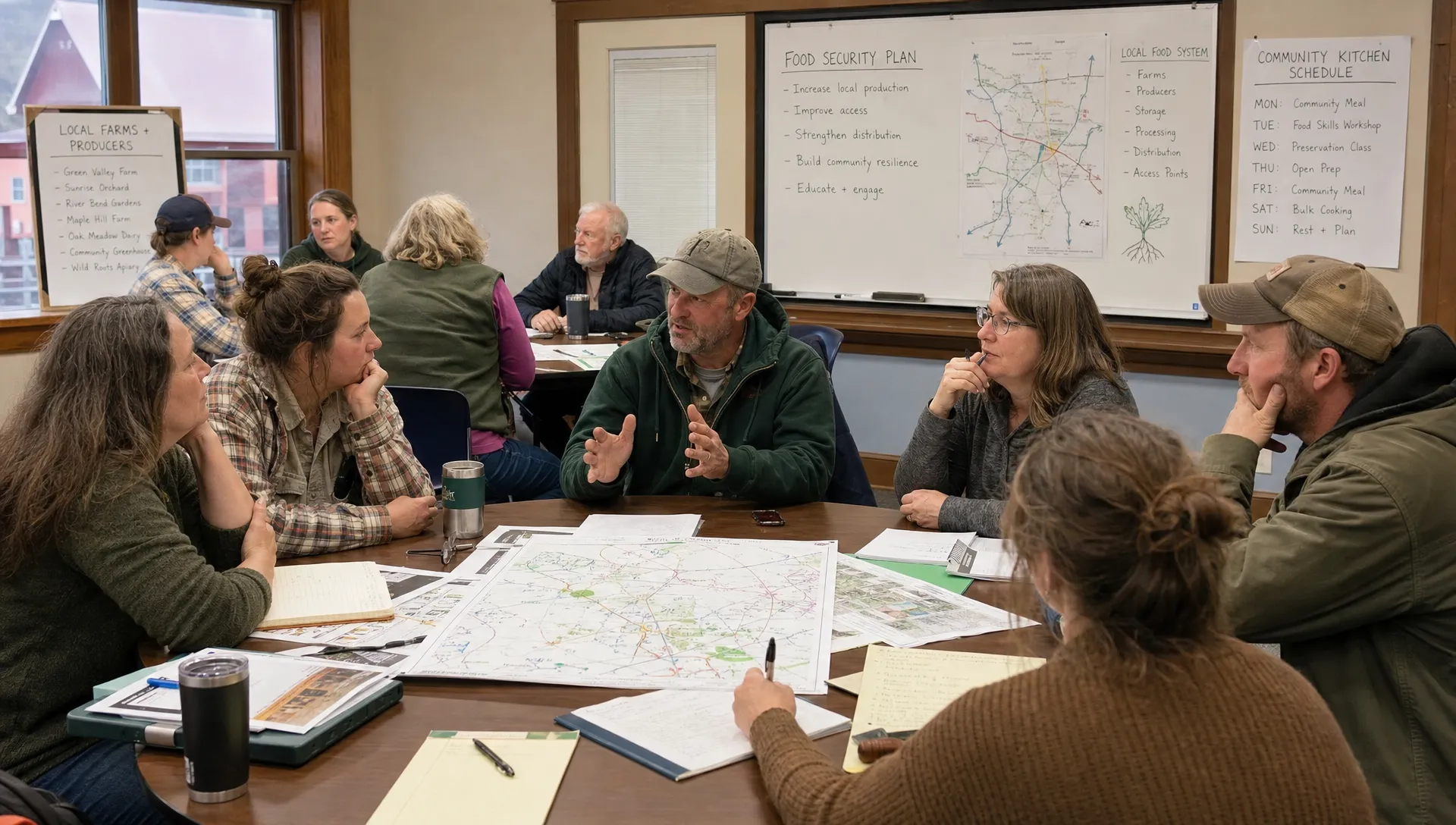
What Food Security Decisions Can Citizens Deliberate?
Not every question belongs in the same type of process. Technical staff should still calculate storage needs, inspect kitchens and manage contracts. The democratic question is where public values guide policy choices.
| Decision area | Why deliberation helps | Possible output |
|---|---|---|
| Emergency food reserves | Residents weigh cost against crisis readiness | Reserve targets and release rules |
| School meals | Families, students and staff balance nutrition, culture and budget | Meal standards and investment priorities |
| Local procurement | Farmers, buyers and taxpayers discuss value beyond lowest price | Procurement criteria and pilot programs |
| Food deserts | Communities identify access barriers that maps miss | Priority zones for markets, transport or mobile food services |
| Urban agriculture | Residents weigh land use, water, housing and food production | Zoning recommendations |
| Benefit access | Users explain administrative barriers | Simplified enrollment and outreach rules |
Food security planning overlaps with budget choices, land use, public health and climate adaptation. A city that has already used deliberation for budgeting can adapt many of the same practices. JustSocial’s model for deliberative democracy in budget decisions is especially relevant when food resilience funding must be allocated among competing needs.
Digital Tools Should Support Judgment, Not Replace It
Digital democracy can make food security planning more continuous, but it can also flatten complex human needs into misleading metrics. An online voting platform may help gather preferences, yet voting before learning can reproduce misinformation or short-term anger. The better sequence is evidence, discussion, recommendation, response and then ongoing monitoring.
This is close to the continuous input model JustSocial advocates. Residents could flag rising prices, report gaps in meal access, respond to policy options, follow committee recordings and see implementation data in one public place. The value is not novelty. The value is government transparency and citizen empowerment through tools that make public systems legible.
Strong guardrails are essential:
- Verified participation with privacy and anonymity protections where appropriate
- Public evidence libraries with plain-language summaries
- Offline participation for residents without reliable internet access
- Open publication of recommendations, official responses and implementation status
- Independent auditing for security, accessibility and bias
Technology can widen participation only if it is designed around people who are usually left out. If a food security platform mainly serves professionals with laptops, it will fail the people it claims to help.
The Five-Branch Lens for Food Security Governance
The JustSocial manifesto proposes a broader institutional imagination, including a more direct role for the people and a stronger public role for academia. Food security planning benefits from that lens because no single branch or profession can see the whole system.
The executive branch can implement food programs, manage procurement and coordinate emergency logistics. The legislative branch can authorize funding, set standards and require reporting. Courts can protect rights when eligibility rules or enforcement practices become unjust. The people can deliberate priorities continuously through structured civic participation. Academia can test claims, evaluate outcomes and educate the public.
This division of labor reduces two common failures. It prevents technocracy, where experts make value judgments without democratic legitimacy. It also prevents raw populism, where public anger overrides evidence, minority rights or operational reality. Food security needs both competence and consent.
For communities interested in permanent public input rather than one-time consultation, JustSocial’s article on deliberative democracy for continuous public input offers a wider governance frame that can be adapted to food systems.
Risks and How to Handle Them
Deliberative processes can fail. They can be captured by organized interests, ignored by officials, overloaded with jargon or designed so narrowly that nothing meaningful changes. Food security planning is especially vulnerable because many actors have financial, ideological or institutional stakes.
| Risk | Practical safeguard |
|---|---|
| Token participation | Give the assembly a formal mandate and require an official response |
| Capture by interest groups | Use balanced evidence, disclosure rules and independent facilitation |
| Exclusion of affected residents | Pay participants and recruit across income, geography and lived experience |
| Data without context | Combine indicators with testimony from households and frontline workers |
| Recommendations without implementation | Publish timelines, responsible agencies and progress updates |
| Privacy concerns | Separate identity verification from public preference data |
The goal is not to create a perfect process. The goal is to create a better public habit: decisions about shared survival should be made with the public, not merely announced to the public.
How a Local Government Can Start
A city, county or region does not need to redesign the entire food system in one cycle. It can start with a decision that is urgent, bounded and visible. School meals, emergency food reserves, public procurement or neighborhood access plans are good candidates because residents can understand the stakes and officials can act on the results.
A workable first cycle can follow a simple path:
- Choose one decision that will be made within six to nine months
- Commit publicly to answer every citizen recommendation
- Recruit a representative group of residents and stakeholders
- Prepare a balanced evidence pack reviewed by independent researchers
- Hold facilitated sessions with enough time for learning and revision
- Publish recommendations, dissenting views and implementation updates
This is how a political movement becomes practical. It does not only criticize distant institutions. It builds repeatable methods that help citizens, professionals and governments make hard choices together.
Frequently Asked Questions
How is deliberative democracy different from a public survey on food policy? A survey captures preferences quickly, but deliberative democracy gives participants time to learn, question evidence, hear other perspectives and produce informed recommendations. Both can be useful, but they serve different purposes.
Can deliberative democracy work during a food emergency? Yes, but the main design should happen before the emergency. Communities can deliberate reserve rules, priority groups, communication channels and accountability measures in advance so crisis decisions are faster and more trusted.
Should experts or citizens lead food security planning? Both are needed. Experts can explain constraints, risks and evidence. Citizens can judge tradeoffs, identify lived barriers and give democratic legitimacy to priorities. The strongest process gives each role clear authority.
Can digital tools make food security planning more inclusive? They can, if they are paired with privacy safeguards, offline access, transparent evidence and facilitation. Digital tools should support civic participation rather than replace public reasoning.
Toward a Food System People Can Govern
Food security is not only about preventing hunger after systems fail. It is about building public systems that listen before failure, adapt before crisis and treat residents as members of a shared political community.
That is why deliberative democracy belongs in food security planning. It gives citizens a real role in shaping priorities while giving officials better evidence of public values. It turns the food system from a background bureaucracy into a common civic project.
JustSocial exists to help move politics in that direction: more continuous, more transparent and more directly connected to the people who live with the results. If food is a basic condition of freedom, then planning for it should be one of democracy’s most serious tasks.





