
Internet access is no longer a luxury service sitting outside public life. It shapes education, work, health, speech, local business and access to government itself. That is why deliberative democracy for internet access decisions matters: communities need a structured way to decide not only where networks are built, but what values those networks should serve.
A city choosing between fiber expansion, public Wi-Fi, subsidies, municipal broadband or private partnerships is making a civic decision. Technical expertise is necessary, but it is not enough. Residents know where access fails, what families can afford, which public spaces need connectivity and what privacy risks they will not accept.
Why deliberative democracy belongs in internet access decisions
Internet access decisions combine engineering, economics and justice. A procurement team can evaluate vendor bids, but it cannot alone answer whether public money should prioritize rural coverage, low-income households, school connectivity, small businesses or network resilience during emergencies.
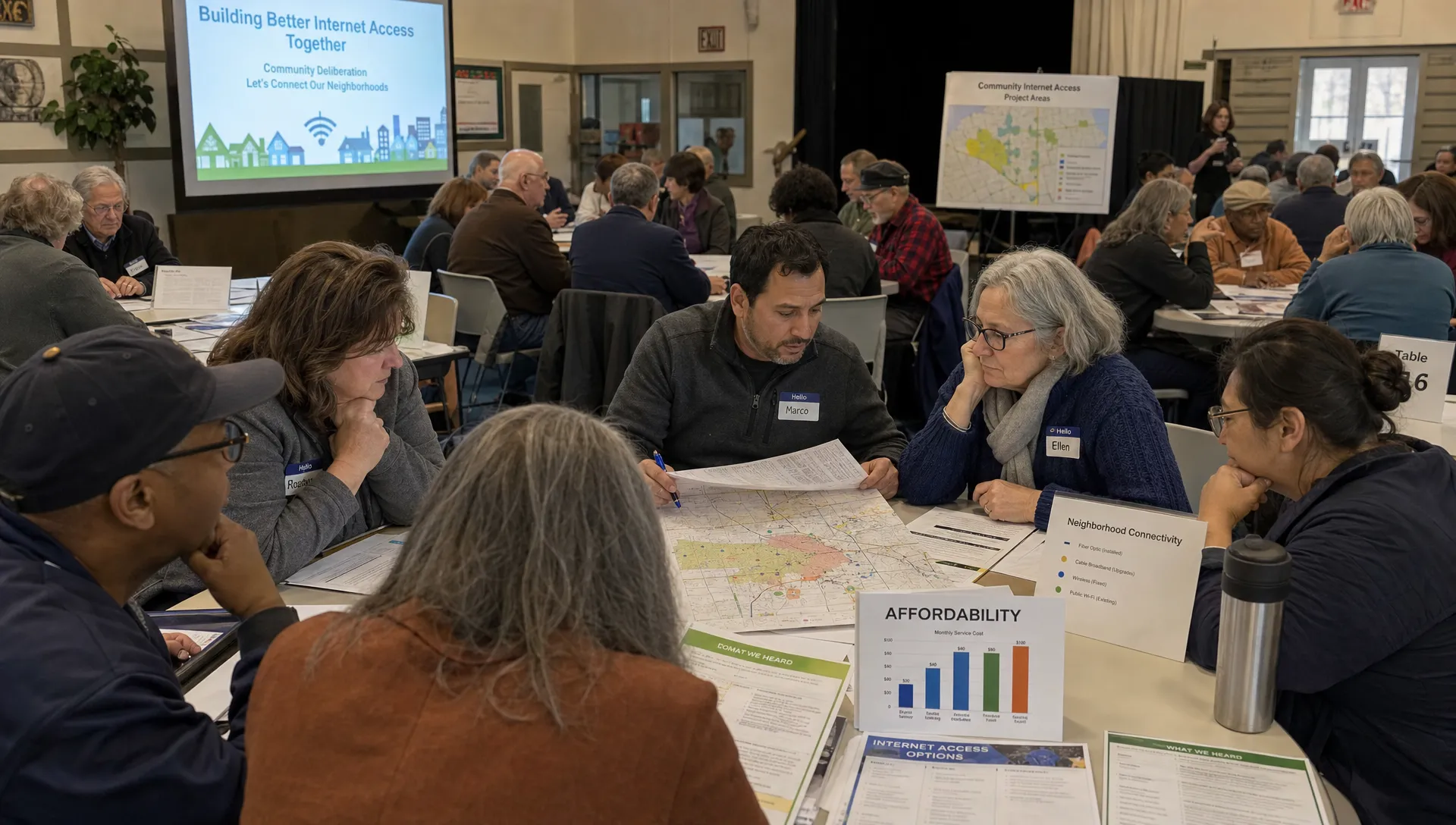
This is where deliberative democracy adds value. It creates a public process where ordinary citizens receive balanced information, question specialists, discuss tradeoffs and produce recommendations that decision-makers must answer in public. The point is not to turn every router placement into a referendum. The point is to make infrastructure choices more legitimate, better informed and harder to capture by narrow interests.
The global stakes are large. The International Telecommunication Union estimated in 2024 that about 2.6 billion people remained offline. Even in connected countries, gaps in affordability, device access, reliability and digital skills continue to shape who can participate fully in civic life.
For JustSocial, this connects directly to a broader democratic claim: people should not be reduced to voters and taxpayers who are heard only once every election cycle. The JustSocial manifesto argues for continuous public influence through technology, transparency and civic infrastructure. Internet access is one of the clearest places to begin because without access, digital democracy itself becomes unequal.
Internet access is not one decision
Public debate often treats internet access as a single question: should a community get faster broadband or not? In practice, the decision breaks into several policy layers, each with different consequences.
| Decision area | Public question | Why citizens should deliberate |
|---|---|---|
| Coverage | Which neighborhoods, villages or public buildings come first? | Maps can miss lived experience, especially in underserved areas. |
| Affordability | Should funds support construction, monthly bills, devices or training? | A fast network does not help families who cannot afford to use it. |
| Ownership | Should access rely on private providers, municipal networks, cooperatives or mixed models? | Ownership affects accountability, pricing and long-term control. |
| Public spaces | Where should libraries, schools, transit hubs and plazas offer access? | Residents know where connection gaps disrupt daily life. |
| Privacy and security | What data should networks collect and who can access it? | Connectivity should not become a quiet expansion of surveillance. |
| Resilience | How should networks perform during blackouts, disasters or conflict? | Emergency access is a public safety issue, not just a service feature. |
A deliberative democracy process helps communities see these layers together. It prevents the debate from shrinking into a contest between “more internet” and “less spending,” when the real question is what kind of connected public life people want.
From public comment to civic participation that changes the plan
Traditional public consultation often fails because it asks people to respond after the core plan has already been drafted. A notice is published, a meeting is held at an inconvenient hour and the same small group of residents attends. Written comments are collected, summarized and then quietly buried in an appendix.
Civic participation should work differently. Residents should enter early enough to shape the problem definition, not just react to a finished proposal. If a county assumes its biggest issue is last-mile rural deployment, but residents say the bigger barrier is monthly cost, then the plan should change before contracts are signed.
A stronger process begins with a clear decision mandate. For example: “How should the city allocate its next public connectivity budget across public Wi-Fi, household subsidies and neighborhood fiber expansion?” That question is specific enough for evidence, but open enough for public judgment.
Deliberative democracy also changes who gets heard. Instead of relying only on activists, lobbyists or residents with flexible schedules, organizers can recruit a representative panel by geography, age, income, disability status and current connection quality. Broader public input remains open, but the deliberative group has the time and support to work through evidence in depth.
The discursive democracy layer before formal decisions
Deliberation does not start in the meeting room. It starts in the public sphere, where people describe problems, argue about values and name harms that institutions may not yet see. That is the role of discursive democracy: open public discussion that shapes what a society notices before it decides.
For internet access, discursive democracy might include local journalists documenting dead zones, parents explaining homework barriers, small businesses comparing unreliable service, disability advocates identifying inaccessible digital services and students describing how school platforms assume constant connectivity.
This wider discourse should not be treated as a clean vote. Online conversations can be noisy, unequal and manipulated. Still, they contain signals that formal institutions need. A deliberative democracy process can gather these signals, verify them, organize them and bring them into a structured civic forum.
This is close to JustSocial’s idea of moving public life beyond isolated election moments. Public platforms should help government understand what people experience day to day, while still protecting independence, rights and evidence-based decision-making.
A practical deliberative democracy process for connectivity policy
A workable model does not need to be huge at first. Cities, school districts, public agencies and civic groups can begin with a limited pilot around one real internet access decision. JustSocial has already argued for small, trustworthy pilots in its guide to running deliberative democracy online, and connectivity policy is a strong use case because the outcomes are visible.
| Stage | What happens | Public output |
|---|---|---|
| Define the decision | Officials state the budget, legal limits, timeline and real choices available. | A plain-language mandate. |
| Build the evidence base | Independent briefings explain coverage data, costs, ownership models, privacy risks and equity gaps. | A balanced public briefing pack. |
| Recruit participants | A civic panel is selected to reflect the affected population, with accessibility support. | A visible participation profile. |
| Hear testimony | Residents, providers, technical experts and advocates answer questions. | Publicly archived evidence. |
| Deliberate tradeoffs | Participants discuss competing priorities with facilitation. | Draft recommendations. |
| Publish response | Government accepts, rejects or modifies recommendations with reasons. | An accountable decision record. |
| Review outcomes | Residents evaluate whether access, affordability and trust improved. | A public learning report. |
The last step is often forgotten, but it is crucial. If the chosen policy fails, the community should know why. Was the map wrong? Did a provider miss milestones? Did affordability improve on paper but not in household budgets? Continuous review turns one-time consultation into civic learning.
What citizens should deliberate, not just “approve”
The best internet access forums do not ask participants to rubber-stamp a technical plan. They ask citizens to weigh public values that engineers and procurement officers cannot settle alone.
Affordability is usually the first value. A household may be “served” under an availability map and still be effectively disconnected because the monthly cost is too high. Citizens should be able to debate whether public money is better spent lowering bills, building infrastructure or creating shared access points.
Equity is the second. Broadband expansion often follows market logic, which means wealthier or denser areas can be easier to serve first. A deliberative democracy process can ask whether public funding should correct those patterns by prioritizing communities that the market has neglected.
Privacy is the third. Public Wi-Fi, school networks and government-supported access programs can generate sensitive data about location, browsing patterns or identity. Connectivity policy should include clear limits on data collection, retention and sharing. Residents should not have to trade privacy for participation in modern life.
Finally, citizens should discuss democratic resilience. If public hearings, benefit applications, emergency alerts and schoolwork all move online, internet access becomes part of the civic floor beneath democracy. A community cannot claim equal civic participation if large groups cannot reliably connect.
Guardrails for legitimacy
A deliberative process can fail if it is performative, captured or too vague to influence real decisions. Internet access policy needs guardrails that make participation trustworthy.
First, the decision must be real. If the budget, vendor and location list are already locked, calling a public meeting “deliberative” only damages trust. Officials should specify which parts of the plan are open and which constraints cannot be changed.
Second, evidence must be balanced. Providers can explain costs and deployment limits, but their claims should be compared with public maps, independent technical review and resident testimony. In the United States, the FCC National Broadband Map is one example of public data that residents can inspect and challenge, though local experience often reveals gaps that maps miss.
Third, participation must be accessible. Meetings should support multiple languages, disability access, childcare needs, remote participation and compensation when possible. If only the already-connected can join the process, the result will reproduce the access divide it is meant to solve.
Fourth, government must answer publicly. Deliberative democracy does not require officials to accept every recommendation, but it does require reasons. A public response turns citizen work into part of the institutional record rather than symbolic participation.
How a political movement can turn access debates into public power
A political movement focused on continuous democracy should treat internet access as foundational. Without reliable access, the promise of online voting platforms, public transparency tools, digital consultations and continuous civic input becomes uneven from the start.
This is why connectivity decisions belong inside the larger project of public tech reform. JustSocial’s argument for deliberative democracy in public technology reform applies directly here: technology should not be imposed as a finished product from above. Citizens should help define the problem, understand the tools and shape the safeguards.
A movement can support this work in practical ways. It can help communities translate technical proposals into plain language, recruit residents who are usually left out, publish explainers, pressure officials to respond and build prototypes for more continuous input. It can also connect local access debates to a larger democratic vision: the public sector should use technology to hear citizens more precisely, not to manage them from a distance.
That is the deeper meaning of deliberative democracy for internet access decisions. The question is not only who gets broadband. The question is whether the infrastructure of the digital age will be governed with the people or merely sold to them.
Frequently Asked Questions
What does deliberative democracy mean for internet access decisions? It means citizens receive balanced information, question experts, discuss tradeoffs and make public recommendations before officials decide on broadband, public Wi-Fi, affordability or related connectivity policies.
How is this different from a normal public hearing? A normal hearing often gives residents a few minutes to react to an existing plan. A deliberative process gives a representative group time, evidence and facilitation so public judgment can shape the plan itself.
Can ordinary citizens understand technical broadband issues? Yes, if the process is designed well. Citizens do not need to become network engineers. They need clear explanations of options, costs, risks and consequences so they can weigh public priorities.
Should citizen recommendations be binding? Not always. For many internet access decisions, recommendations should guide officials and require a public response. In some cases, communities may choose binding votes, but deliberation should come before the vote.
Why does internet access matter for democracy? Digital access now affects education, government services, public debate, emergency information and civic participation. If access is unequal, democratic voice becomes unequal too.
Build the civic infrastructure behind digital democracy
Internet access decisions are public decisions about power, opportunity and voice. They deserve more than closed procurement meetings and late-stage comment periods.
If you believe technology should help citizens participate continuously in public life, explore JustSocial’s vision for continuous direct democracy at JustSocial.io. Read the manifesto, share the idea, volunteer if you can and help build a political movement that treats people as active partners in governing the digital age.





