
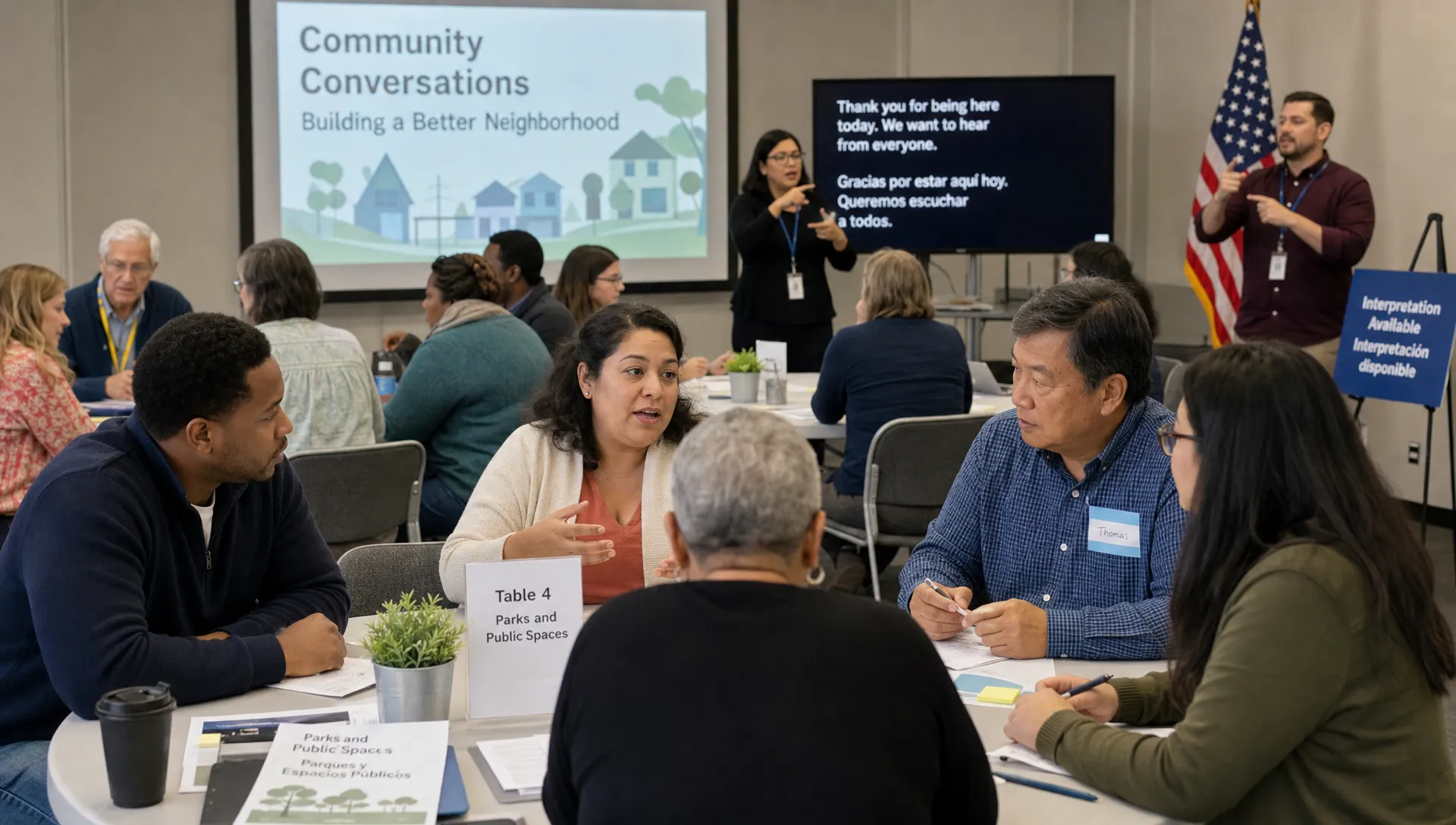
If a public discussion happens in only one language, it is not fully public. Deliberative democracy with interpreters and translation treats language access as part of democratic design, not as a courtesy added after the agenda, speakers and decisions are already set.
That distinction matters. Deliberation asks people to hear evidence, weigh tradeoffs, challenge claims, revise positions and explain why a decision can be justified to others. A citizen who understands only fragments of the process is present in the room but absent from the power of the room.
For a movement like JustSocial, which argues in its manifesto that citizens should no longer be reduced to voters, taxpayers and consumers, multilingual deliberation is not a side issue. A continuous democracy that wants to measure public opinion precisely must first make sure people can express that opinion in a language they can actually use.
Why Deliberative Democracy With Interpreters and Translation Matters
Deliberative democracy is built on a simple civic promise: people affected by a decision should have a meaningful chance to understand it, discuss it and influence it. That promise breaks when only fluent speakers of the dominant language can participate comfortably.
Language barriers do not affect everyone in the same way. New immigrants, Indigenous communities, linguistic minorities, refugees, Deaf citizens using sign languages and older residents who are more confident in a first language may all be formally invited into a process yet practically excluded from it.
This is not only unfair to participants. It also damages the quality of public decisions. If a housing assembly, school reform panel or local budget process mostly hears from one language group, the resulting recommendations will look more representative than they really are.
The OECD’s work on deliberative processes has emphasized that good deliberation depends on representativeness, information and time for reflection. Language access belongs inside all three. It affects who shows up, what they understand and whether they can speak without compressing complex experiences into simplified second-language answers.
Translation and Interpreting Are Not the Same
A serious language-access plan starts by separating translation from interpreting. Translation deals with written content: invitations, agendas, evidence briefs, consent forms, ballots, recommendations and public reports. Interpreting deals with spoken or signed communication in real time or near real time.
Both are necessary in deliberative democracy with interpreters and translation. Written translation helps people arrive prepared. Interpreting helps them participate once discussion begins. One cannot replace the other.
| Language need | What it covers | Democratic risk if missing |
|---|---|---|
| Written translation | Notices, background materials, surveys, reports and ballots | People arrive uninformed or never learn the process exists |
| Consecutive interpreting | A speaker pauses while the interpreter renders the message | Discussions take longer but can stay accurate and inclusive |
| Simultaneous interpreting | Interpretation happens while the speaker continues | Faster meetings require equipment, planning and skilled interpreters |
| Sign language interpreting | Signed access for Deaf participants | Deaf citizens are excluded from testimony and debate |
| Plain-language adaptation | Clear wording in every language | Jargon blocks understanding even when words are translated |
Machine translation may help with first drafts, but public deliberation cannot depend on unreviewed automated output. A mistranslated eligibility rule, safety concern or legal term can change what people believe they are deciding.
The Democratic Failures Language Access Prevents
Poor language access usually appears as a logistics problem, but it creates political distortions. Meetings run in one language tend to reward people who already know civic vocabulary, institutional habits and the unwritten rules of public meetings.
The first failure is recruitment bias. If invitations are not translated or distributed through trusted multilingual channels, organizers may conclude that certain communities are apathetic when those communities were never properly reached.
The second failure is agenda bias. If residents can only react to prewritten options in a second language, they are less likely to reframe the problem. That matters because many public conflicts are not only about yes or no decisions, but about what question the government should have asked in the first place.
The third failure is confidence bias. A participant may have deep local knowledge yet speak less often because they fear being misunderstood. The process then treats silence as consent.
JustSocial has already argued that civic participation for people with limited English must be designed into democratic systems from the start. Deliberative formats make that even more urgent because participation is not just a form submission. It is a live exchange of reasons.
Design Language Access Before People Enter the Room
The worst time to solve translation is five minutes before the meeting begins. By then, the agenda has already been shaped around the dominant language.
Organizers should begin with a language map of the affected community. This does not require intrusive data collection. It can combine census data, school language data, community organization input, voluntary registration questions and prior participation records.
The process should then provide translated recruitment materials, translated background briefs and multilingual points of contact before participants are asked to commit. If the topic is technical, interpreters and translators need glossaries in advance, not improvised explanations during the session.
A strong design also compensates for time. Interpreted discussion takes longer. If organizers refuse to extend the schedule, language-minority participants effectively receive less deliberation than everyone else.
A basic preparation checklist should include:
- Translated invitations and eligibility rules
- Plain-language summaries in every working language
- Professional interpreters or trained community interpreters for live sessions
- Bilingual facilitators where possible
- Clear instructions on turn-taking, confidentiality and interpreter use
- Translated final recommendations with time for review
These are not extras. They are the front-end architecture of equal civic participation.
What Interpreters Need During Deliberation
Interpreters are not political decision-makers in a deliberative process, but their work directly affects whether the process is fair. They need preparation, time, ethical clarity and respect from facilitators.
Before sessions begin, interpreters should receive the agenda, speaker list, technical vocabulary, community context and any rules on confidentiality. If the process involves trauma, policing, immigration, war, discrimination or health, interpreters also need support for emotionally difficult content.
During the session, facilitators should explain how interpretation will work. Participants need to know that they should speak in short segments, avoid side conversations and address each other directly rather than speaking to the interpreter as a substitute.
Interpreters also need the authority to ask for repetition, clarification or slower speech. If a process values speed over accuracy, it will produce false fluency: everyone appears to understand, but important meaning is lost.
This is especially important in divided societies. Tone, humor, religious references and historical terms can carry political weight. A literal translation may not communicate the social meaning of a phrase. Skilled interpreters help preserve meaning without turning themselves into advocates.
Technology Can Help, but Only With Human Accountability
JustSocial’s manifesto imagines democracy supported by public technology: civic platforms, community voting, public records, analytics and AI-assisted systems. This vision becomes stronger when language access is built into the technology layer rather than patched onto it.
A multilingual online voting platform or civic forum should allow residents to choose a language at the start, read the same evidence base and submit input without losing nuance. Public transparency tools should publish translated summaries, not only raw documents in the official language.
AI can help lower the cost of multilingual democracy. It can draft translations, summarize long meetings, generate glossary suggestions, caption video and help participants search public documents. Yet AI should not become the final authority on meaning. Human review is essential for legal terms, minority-language nuance, testimony and final recommendations.
The same principle applies to government analytics. If a city uses dashboards to understand public input, it should track whether some language groups are underrepresented, whether translated materials are being opened and whether certain groups drop out before final voting or recommendation stages.
Privacy must be central. Language identity can reveal ethnicity, immigration status, religion or minority status. Democratic technology should collect only what it needs, protect it carefully and explain why it is being collected.
From Discursive Democracy to Decisions People Can Trust
Deliberative democracy works best when it is connected to the wider public conversation. People do not arrive at a citizens’ assembly as blank slates. They bring narratives from families, media, social networks, religious communities, workplaces and neighborhood life.
That wider conversation is the domain of discursive democracy: the public contest over language, meaning, identity and legitimacy. If public language is inaccessible, distorted or available only to dominant groups, the formal deliberation will inherit those inequalities.
This is why JustSocial’s argument for discursive democracy through accessible public language connects directly to translation. Clear civic language is not the opposite of multilingualism. It is the foundation that makes translation more accurate and participation more equal.
A city can translate a 60-page technical report into five languages and still exclude people if the report is written in bureaucratic fog. Plain language, visual summaries and community review make translation useful rather than merely symbolic.
The goal is not to make every citizen agree. The goal is to make disagreement more honest. People should be able to say: I understood the issue, I heard other views, I had a chance to respond and the final decision explains how our input was considered.
A Practical Model for Multilingual Deliberation
A multilingual deliberative process should move through phases. Each phase has a language-access task and a democratic purpose.
| Phase | Language-access task | Democratic purpose |
|---|---|---|
| Recruitment | Translate invitations and use trusted community channels | Bring affected people into the process |
| Learning | Provide plain-language briefs in all working languages | Create a shared evidence base |
| Discussion | Use interpreters, bilingual facilitation and fair turn-taking | Let participants exchange reasons equally |
| Recommendation | Translate draft findings and allow multilingual feedback | Prevent errors before decisions are finalized |
| Public response | Publish the government response in every process language | Close the loop and support accountability |
This model can serve a neighborhood budget process, national citizens’ assembly, school district consultation or participatory democracy platform. The scale changes, but the democratic logic stays the same.
The model also fits JustSocial’s broader political movement. Continuous direct democracy cannot rely on one official language if the people are multilingual. A state that wants to hear its citizens continuously must build institutions that can listen continuously across languages.
What Governments and Movements Should Measure
Language access should be evaluated, not assumed. Governments, civic organizations and political movements should measure whether multilingual design actually improved participation.
Useful indicators include participation by preferred language, completion rates for translated surveys, attendance across language groups, speaking-time distribution, requests for clarification and participant understanding before and after deliberation.
Quality matters as much as quantity. Organizers should ask participants whether they felt able to express themselves, whether interpretation was accurate enough, whether translated materials arrived on time and whether the final report reflected their input.
Public reporting should be careful. Aggregated language-access data can improve transparency, but small minority communities should not be exposed through overly detailed breakdowns. The principle is simple: measure exclusion so it can be fixed, but do not turn vulnerable identity data into a public risk.
For a democracy tools ecosystem, these measurements could become standard civic infrastructure. They would help officials see not only what citizens think, but whose voices are missing from the picture.
Frequently Asked Questions
Why is translation important in deliberative democracy? Translation allows participants to understand invitations, evidence, options, ballots and final reports. Without it, many residents are asked to deliberate from an informational disadvantage.
Are interpreters enough for multilingual civic participation? No. Interpreters support live discussion, but participants also need translated written materials before and after the meeting. Strong language access uses both.
Can AI translation replace human interpreters? AI can help with drafts, captions and summaries, but human review is needed for public decisions, legal wording, sensitive testimony and culturally specific meaning.
Does multilingual deliberation slow down the process? It often requires more time, especially for interpreted discussion. That added time is part of the cost of equal participation, not an inefficiency to eliminate.
Building a Democracy That Can Hear Everyone
Deliberative democracy with interpreters and translation is not only about language services. It is about whether public power can hear the public as it really exists.
JustSocial’s vision of continuous direct democracy depends on that commitment. If people are asked to participate daily, locally and nationally, then democratic systems must be multilingual, transparent and designed for real human expression.
If this future matters to you, explore the JustSocial manifesto, share the idea with your community and help build civic tools that make participation possible for more people, in more languages, more often.





