A democracy can protect free speech and still fail at public reasoning. People can speak for hours at public hearings, argue for weeks online, and march by the thousands, only to hear the same empty response: “We listened.” But what was heard? Which claims were considered? Which evidence mattered? What changed? Who is responsible now?
That gap is where discursive democracy becomes practical. Discursive democracy is not just the right to speak in public. It is the civic architecture that makes public speech visible, contestable, organized, and connected to decisions. For JustSocial, this matters because continuous direct democracy cannot survive on noise, slogans, or viral outrage. It needs a public memory.
That public memory should be built through public receipts: short, inspectable records that show how civic speech moves from claim to evidence, from disagreement to decision, and from decision to follow-through.
What discursive democracy means in practice
Discursive democracy focuses on the public sphere: the space where citizens, journalists, movements, institutions, experts, and communities define problems, argue over values, challenge narratives, and shape what becomes politically possible.
It is related to deliberative democracy, but it is not the same thing. Deliberative democracy usually refers to structured forums that help people weigh evidence and produce decision-ready recommendations. Discursive democracy is broader. It includes the messy public conversation before formal deliberation begins: protests, community meetings, journalism, comment sections, town halls, petitions, neighborhood debates, and digital civic platforms.
In the tradition of thinkers such as Jürgen Habermas, democratic legitimacy depends not only on voting, but on the quality of public justification. The Stanford Encyclopedia of Philosophy’s overview of Habermas explains how communicative reason and public discourse became central to modern democratic theory. The practical lesson is simple: a public decision is stronger when citizens can inspect the reasons behind it.
Discursive democracy asks questions that elections alone cannot answer:
- Who had a real chance to speak?
- Which arguments were visible and which were ignored?
- Was evidence available in a form citizens could understand?
- Were minority concerns recorded before the majority moved on?
- Did officials explain why they accepted or rejected public input?
- Can anyone trace the path from public debate to public action?
Without answers, public discourse becomes emotional release. With answers, it becomes civic infrastructure.
The problem: public debate has no memory
Modern politics produces endless speech and very little traceability. A citizen posts a careful argument online, a parent gives testimony at a school meeting, a veteran speaks about public safety, a student raises a concern about mental health, a neighborhood group submits evidence about a road design. Then everything disappears into a meeting recording, a comment archive, a private inbox, or a social media feed.
This is not only inefficient. It is democratically dangerous.
When public debate has no memory, institutions can claim they listened without proving it. Movements can claim to represent “the people” without showing which people, which claims, or which disagreements. Opponents can misrepresent a process after the fact. Citizens burn out because participation feels like shouting into the void.
The JustSocial manifesto, The Face of Democracy, argues that citizens should not be reduced to voters, taxpayers, and consumers. It calls for continuous participation, transparent public systems, and technology that lets people weigh in on public affairs throughout the term, not only once every few years.
Public receipts are one practical step toward that vision. They turn civic speech into a record that citizens, officials, journalists, and movements can inspect.
What are public receipts?
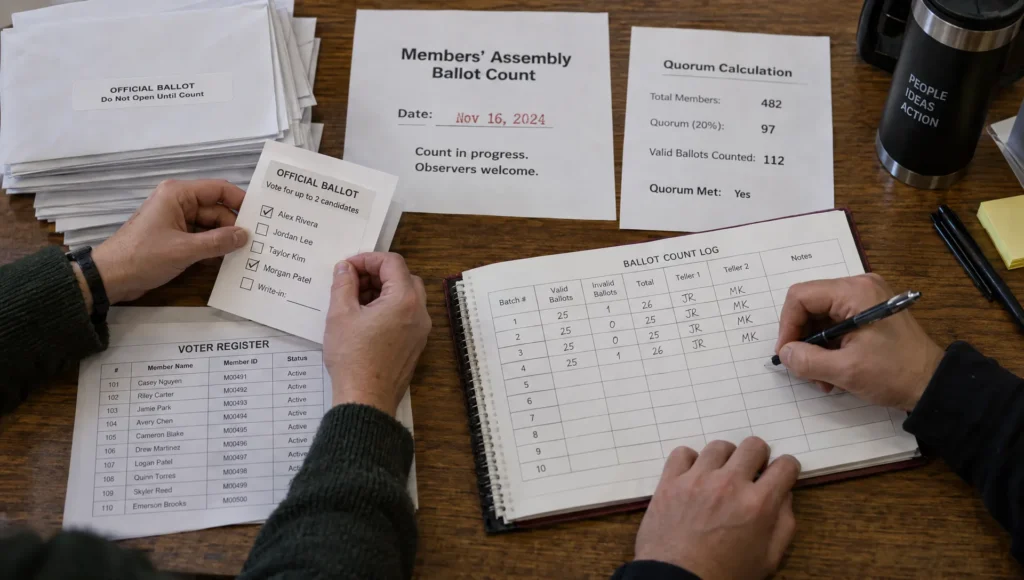
Public receipts are not financial receipts. They are democratic artifacts. A public receipt is a concise, public, durable record that proves a civic process happened and shows how input was handled.
A good public receipt answers seven basic questions: what decision was at stake, who could participate, what evidence was available, what citizens said, how input was synthesized, what decision-maker responded, and what happens next.
The goal is not to record everything forever. The goal is to make the democratic chain visible enough that citizens do not need blind trust.
| Discursive failure | Public receipt that helps | What it proves |
|---|---|---|
| “We listened” with no detail | Participation summary | Who participated and what themes emerged |
| Viral claims without evidence | Evidence index | Which sources were used and where uncertainty remains |
| Loud voices dominate | Structured synthesis | Minority views, repeated concerns, and dissent are visible |
| Officials ignore input | Response memo | Decision-makers explain what they accepted, rejected, or changed |
| Decisions disappear after approval | Implementation tracker | The public can see progress, delays, and responsibility |
| Movements make vague demands | Decision request record | The demand is tied to a specific owner, rule, and timeline |
Public receipts are the difference between “trust us” and “inspect the process.”
Why discursive democracy needs receipts
Discursive democracy values open public reasoning, but openness alone is not enough. In fact, unstructured openness can reward manipulation, repetition, and domination by the loudest voices. A comment thread with 5,000 posts may look democratic while hiding the most important information: the decision, the tradeoffs, the evidence, and the path to action.
Receipts solve a structural problem. They give public conversation a civic spine.
First, receipts make discourse cumulative. Citizens do not have to restart the same argument every week because the claims, evidence, and unresolved questions remain visible.
Second, receipts make disagreement safer. A minority group can see whether its concerns were recorded accurately, even if it did not win the final decision. This matters because democracy is not only majority rule. It is majority rule under conditions of dignity, rights, and public justification.
Third, receipts reduce manipulation. When a process publishes its rules, evidence, moderation actions, synthesis methods, and response obligations, it becomes harder for bad actors to distort what happened.
Fourth, receipts help representatives do their job. JustSocial’s manifesto does not argue that every public input should automatically become law. It argues that representatives should precisely measure and take public opinion into account. Public receipts create the bridge between citizen expression and representative responsibility.
A public receipt stack for discursive democracy
A serious discursive process does not need to begin with a complex platform. It can start with a small set of repeatable artifacts. The format can be a public webpage, shared folder, civic dashboard, newsletter archive, or platform module. The important point is that each receipt has a stable location, a clear owner, and an update rhythm.
| Receipt type | What it contains | When to publish it |
|---|---|---|
| Decision receipt | The real decision, owner, timeline, legal or institutional constraints, and participation promise | Before public input begins |
| Evidence receipt | Sources, data, expert notes, lived experience summaries, uncertainty notes, and open questions | Before and during public discussion |
| Participation receipt | Eligibility rules, outreach channels, participation counts, accessibility notes, and privacy protections | During the process |
| Synthesis receipt | Main claims, reasons, disagreements, minority concerns, and decision-ready questions | After public input closes |
| Handoff receipt | The package delivered to officials, committees, boards, journalists, or deliberative groups | When discourse moves toward action |
| Response receipt | The official or movement response explaining what changed, what did not, and why | After a decision or formal review |
| Follow-through receipt | Implementation steps, deadlines, responsible parties, delays, and outcome measures | Until the issue is closed or revised |
This stack is especially useful because it separates speech from proof. Citizens remain free to argue. Institutions remain free to decide. But the public can see whether the process was honest.
Receipts are not bureaucracy, they are anti-bureaucracy
A common objection is that receipts sound like more paperwork. That fear is understandable. Public systems already drown people in forms, portals, minutes, and procedural language.
But public receipts should do the opposite. They should reduce bureaucratic fog by translating process into citizen-readable proof.
A 200-page PDF hidden on a government website is not a useful receipt. A raw transcript with no synthesis is not enough. A dashboard with vanity metrics, such as total comments or total likes, is not democratic accountability.
A real receipt is short, structured, and connected to action. It says: here is the decision, here is what people raised, here is the evidence, here is the response, here is the next checkpoint.
That is why public receipts fit the JustSocial critique of industrial-era institutions. The manifesto argues that many public systems still operate through old social structures while modern technology has transformed private life. Receipts are a way to use technology not as decoration, but as public accountability infrastructure.
How public receipts protect free speech without controlling opinion
Discursive democracy must be careful. If a platform or institution tries to “improve discourse” by deciding which viewpoints are acceptable, it can become censorship or propaganda. Public receipts should not rank citizens by ideology or punish unpopular opinions. They should focus on process.
A process-based approach asks contributors to make claims legible without forcing agreement. For example, a civic platform can ask participants to separate claim, reason, evidence, and request. A public hearing can ask speakers to identify whether they are giving testimony, presenting data, proposing a change, or raising a rights concern. A movement can publish moderation receipts showing that rules were enforced based on harassment, spam, impersonation, or relevance, not political viewpoint.
This is where discursive democracy strengthens free speech. It does not replace the right to speak. It creates conditions where speech can be understood, answered, and remembered.
For high-risk issues, receipts should also protect privacy. Not every receipt should include names. Not every raw comment should be public. Vulnerable communities may need anonymized summaries, consent-based quoting, or privacy-preserving identity checks. The receipt should prove the process without exposing people to unnecessary harm.
From the Greek Polis to the modern public record
In the JustSocial manifesto, Yuval David Vered draws from the Greek Polis as a symbol of intense civic belonging. The Polis was not merely a state structure. It was a lived public world where citizens could feel the connection between communal life and political responsibility.
Modern societies cannot recreate the ancient Polis directly, and they should not recreate its exclusions. But they can recover one essential quality: public life should feel concrete. Citizens should be able to see where their voice went.
That is the deeper case for public receipts. They make the state less abstract. They make public action less remote. They help convert the feeling of civic helplessness into visible influence.
The manifesto’s idea of a future “Cosmopolis” depends on this shift. If democracy becomes continuous, digital, and participatory, it must also become inspectable. Otherwise, technology will only scale confusion.
Public receipts are how a modern democracy says: the people spoke here, the evidence was considered here, the disagreement remains here, the decision was made here, and the next accountability point is here.
What this looks like for movements, governments, and media
Public receipts are useful across civic life because discursive democracy does not happen in only one institution.
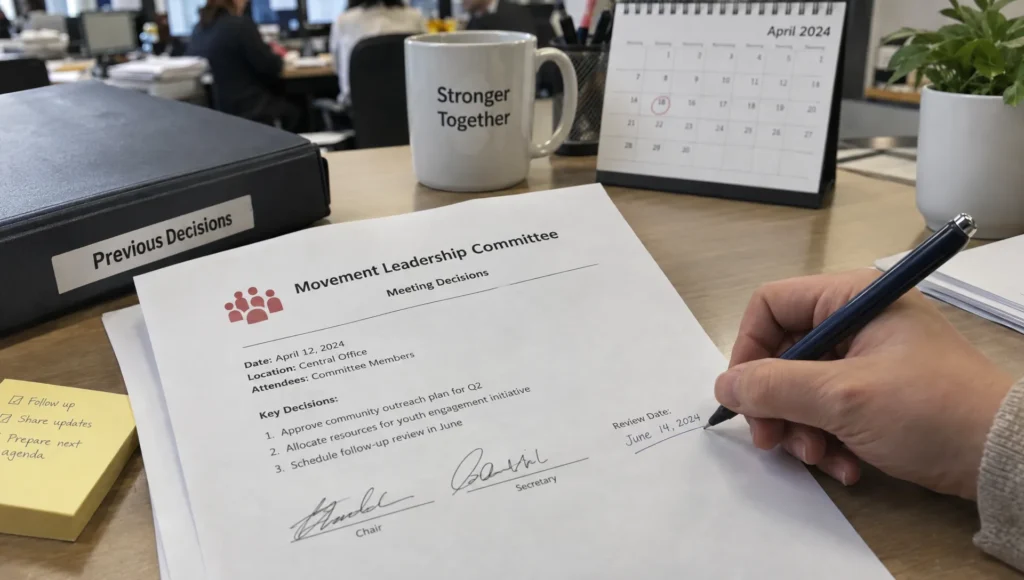
A political movement can publish receipts to prove it is not just harvesting attention. Its receipts might include meeting notes, funding summaries, internal decision rules, public demands, options memos, and progress trackers. For a deeper movement-specific approach, see JustSocial’s guide on building trust with public receipts.
A city council can publish receipts before and after public hearings. The pre-hearing receipt names the decision and evidence. The post-hearing receipt summarizes input and commits to a response. This turns public testimony from symbolic performance into a documented part of decision-making.
A newsroom can publish issue packs and synthesis notes when covering contested local decisions. Instead of treating public comments as engagement bait, journalists can help citizens see the decision, the evidence, the competing claims, and the official response.
A school community can use receipts to turn parent and student concerns into decision-grade input. For example, if a district is considering a phone policy, receipts can record the decision timeline, student testimony, teacher concerns, mental health evidence, proposed options, and the board’s response.
A civic technology platform can build receipts into the product experience. JustSocial’s manifesto sketches concepts such as TakeAction!, rParliament, rConcensus, public analytics, and a repository of state laws. Each of these ideas points toward the same principle: democracy needs tools that connect public voice to public records.
Minimum viable public receipts: start small
The strongest receipt system is the one people will actually maintain. A local group, campaign, or civic team can begin with four simple documents.
- Decision Note: A one-page explanation of the decision, owner, timeline, constraints, and public participation route.
- Evidence Shelf: A shared list of sources, data, lived experience, expert input, and known uncertainties.
- Synthesis Note: A short summary of claims, reasons, areas of agreement, disagreements, and unanswered questions.
- Response Tracker: A public table showing who received the input, what they said, what changed, and the next follow-up date.
These four receipts can change the character of participation. They move citizens from venting to documenting. They move officials from vague listening to answerable response. They move movements from attention to accountability.
Design principles for trustworthy receipts
Public receipts only work if people trust the way they are produced. A receipt can become propaganda if it hides dissent, manipulates categories, or records only convenient facts.
The following principles help keep receipts legitimate:
- Stable public access: Receipts should have durable links and clear version history.
- Plain language: Citizens should not need legal training to understand the record.
- Contestability: People should be able to challenge inaccurate summaries or missing evidence.
- Proportional transparency: Publish enough to verify the process while protecting privacy and safety.
- Decision linkage: Every receipt should connect to a real decision, not just general awareness.
- Minority visibility: Losing arguments and minority concerns should be recorded fairly.
- Follow-through: A process without implementation tracking is unfinished.
This is also why receipts should be designed before participation begins. If the rules are created after the outcome is known, the process will look rigged even when it is not.
The democratic value of being able to say “show the receipt”
In a healthier democracy, “show the receipt” should become a normal civic demand.
If a government says public input shaped a policy, show the receipt. If a movement says its members support a demand, show the receipt. If a platform says moderation was neutral, show the receipt. If an official says implementation is underway, show the receipt.
This demand is not cynical. It is the opposite. It allows citizens to participate without having to trust personalities, parties, slogans, or institutional branding.
The OECD’s work on deliberative citizen participation has emphasized the need to institutionalize citizen participation so it becomes more than a one-off exercise. Public receipts are one way to institutionalize discursive democracy. They let society learn from each process and improve the next one.
At a time when global democracy monitors such as V-Dem continue to warn about democratic backsliding, the answer cannot be only more messaging. It must be better democratic machinery.
Public receipts and the People’s Branch idea
JustSocial’s manifesto proposes adding the people as a new branch of government, not as a mob, but as a continuous, measured, safeguarded civic presence. Public receipts are a practical building block for that idea.
A People’s Branch cannot be only a voting app. It needs discourse records, evidence commons, deliberation outputs, response duties, implementation trackers, and privacy safeguards. It needs public analytics that are useful without becoming surveillance. It needs a culture where institutions are expected to justify decisions in public.
This is why discursive democracy matters. Before citizens can make better decisions together, they must be able to argue better together. Before public opinion can be measured responsibly, public speech must be structured enough to interpret. Before technology can empower citizens, it must create records citizens can inspect.
Public receipts are not the whole future of democracy. But they are one of the simplest ways to begin building it.
Frequently Asked Questions
What is discursive democracy? Discursive democracy is a model of democracy that emphasizes public reasoning, debate, framing, and justification. It focuses on how citizens and institutions form public meaning before, during, and after formal decisions.
How are public receipts different from meeting minutes? Meeting minutes usually record what happened in one meeting. Public receipts connect the full civic chain: decision, evidence, participation, synthesis, response, and follow-through. They are designed for accountability, not just administration.
Do public receipts require special technology? No. A public webpage, shared document, spreadsheet, or newsletter archive can work for a pilot. Technology helps when participation grows, but the core requirement is a clear process and a commitment to publish.
Can public receipts protect privacy? Yes. Good receipts use proportional transparency. They can summarize patterns, anonymize testimony, redact sensitive details, and separate identity verification from public display while still proving that the process was legitimate.
Why do political movements need public receipts? Movements ask people for trust, time, money, and public support. Receipts show how decisions are made, how input is used, how funds or volunteer energy are directed, and whether the movement practices the democracy it demands from government.
How do public receipts support continuous direct democracy? Continuous democracy requires ongoing participation, not isolated bursts of attention. Receipts create the public memory needed to connect daily civic input to decisions, responses, and implementation over time.
Help build a democracy that can prove it listened
JustSocial exists to move democracy beyond passive representation and toward continuous, transparent citizen power. Public receipts are one of the practical habits that can make that future believable.
If this vision speaks to you, read The Face of Democracy and explore how JustSocial connects discursive democracy, civic technology, public transparency, and the long-term idea of a People’s Branch. You can also go deeper into the relationship between public talk and structured decision-making in Discursive Democracy vs Deliberative Democracy.
Democracy should not ask citizens to shout and hope. It should show the receipt.