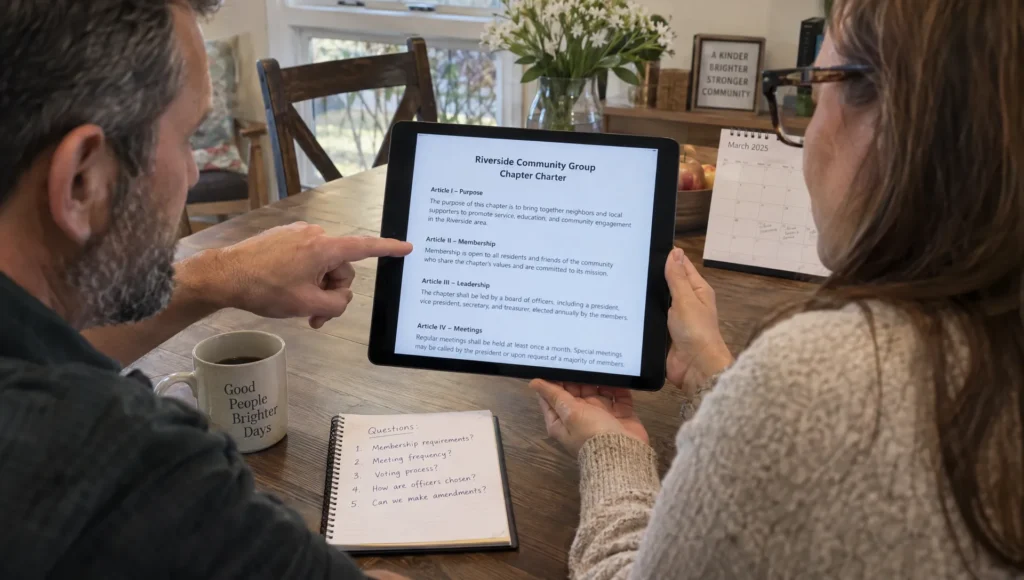
Debate is the heartbeat of democracy, but most public debate has a terrible memory. A town hall fills a room, a comment thread explodes, a protest captures attention, a committee livestream runs for three hours, and then the public record often collapses into a vague summary: people were concerned.
Discursive democracy offers a different standard. It does not ask citizens merely to speak louder. It asks public institutions, movements, journalists, and civic platforms to design debate so society can remember what was said, why it mattered, what evidence was offered, where disagreement remained, and how decision-makers responded.
That is the missing bridge between civic participation and real accountability. If public debate leaves no durable trace, power can absorb it, ignore it, or selectively quote it. If debate becomes public memory, citizens can return to it, learn from it, contest it, and use it to shape the next decision.
At JustSocial, this idea connects directly to the vision in The Face of Democracy: a society where people are not reduced to voters, taxpayers, and consumers, but become continuous participants in public life. Public memory is the infrastructure that makes that possible.
Why ordinary public debate disappears
Most democratic systems still treat debate as an event. A hearing happens. A campaign rally happens. A public comment period closes. A news cycle moves on. The formal institution may archive a video or PDF, but that is not the same as democratic memory.
An archive stores material. Public memory organizes meaning.
This distinction matters because political attention is short, but public decisions are long. Budgets, school policies, housing plans, national security laws, procurement decisions, and education reforms unfold over months or years. If citizens cannot see how earlier arguments shaped later actions, participation becomes performative. People speak, officials nod, and the institutional machine continues without a visible chain of reasoning.
The result is a public sphere with amnesia. The same claims are repeated without resolution. The same evidence is rediscovered. Minority concerns vanish after the meeting. Officials can say they listened without showing what they heard. Movements can mobilize anger but fail to preserve the knowledge their supporters generated.
Discursive democracy addresses this failure by turning speech into civic artifacts.
What public memory means in a democracy
Public memory is not a permanent record of every word every citizen says. That would create surveillance, overload, and fear. A healthy democratic memory is selective, structured, inspectable, and tied to decisions.
A useful public memory has four qualities:
- Traceable: Citizens can follow a claim from its first appearance through evidence, synthesis, official response, and implementation.
- Contestable: People can correct errors, add counter-evidence, and challenge how their views were summarized.
- Plural: Majority opinion is visible, but minority reasoning, dissent, and uncertainty are not erased.
- Actionable: The record connects to a decision owner, a timeline, and a duty to respond.
In other words, public memory is the difference between a society that shouts into the void and a society that learns in public.
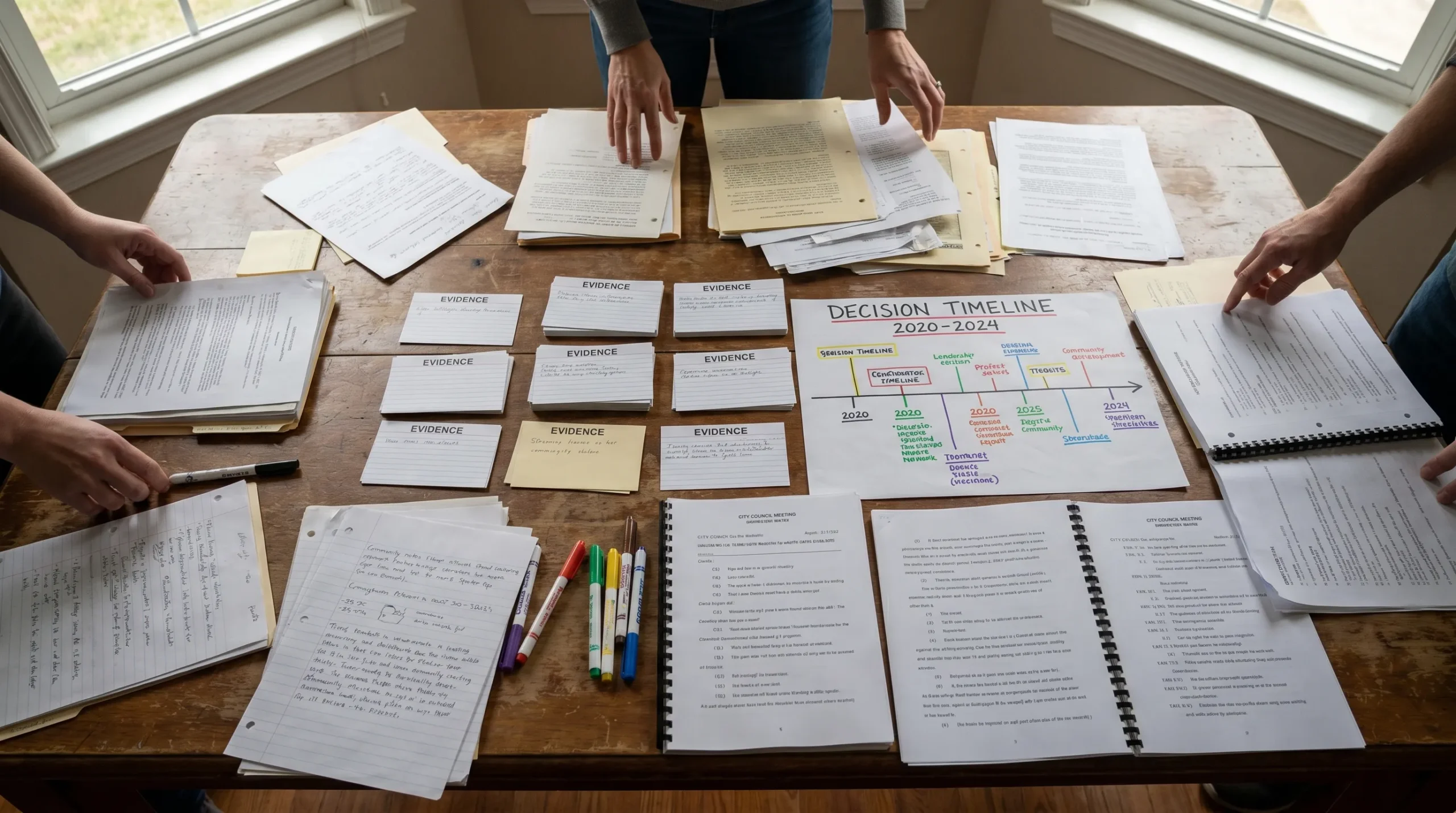
How discursive democracy turns debate into memory
Discursive democracy focuses on the quality and structure of public reasoning. It asks: who gets to speak, what formats make speech understandable, how are claims preserved, and how does public talk shape collective judgment?
That does not mean every debate must become formal or bureaucratic. It means democratic speech should leave usable traces. A chant, testimony, expert warning, personal story, data point, or objection can all matter, but each needs a pathway into shared memory.
| Debate element | Public memory artifact | Why it matters |
|---|---|---|
| A concern raised by a citizen | Claim card | Prevents the issue from being lost in volume |
| A source, statistic, or lived example | Evidence record | Lets others verify or challenge the basis of the claim |
| A disagreement between groups | Disagreement map | Shows what remains unresolved instead of hiding conflict |
| A proposed solution | Option note | Converts emotion into a decision-ready possibility |
| An official answer | Response memo | Makes accountability visible |
| A promised action | Implementation tracker | Lets citizens see whether words became results |
This is how debate becomes memory: not by recording everything, but by translating public speech into shared, reusable civic knowledge.
Step 1: Name the decision before opening debate
A debate without a decision target usually becomes a performance. People argue about values, personalities, history, and ideology, but no one knows what public action is actually on the table.
Discursive democracy begins by naming the decision. Is the city choosing between two street designs? Is a school district revising phone rules? Is a parliament committee considering amendments to a bill? Is a ministry deciding how to allocate public funding?
A clear decision statement should answer four questions: who decides, what can change, when the decision will be made, and how public input will be used. This creates the first layer of memory, because every later claim can be connected to a real public choice.
This also reflects a core JustSocial principle: civic participation should not be symbolic. Continuous direct democracy requires decision-connected participation, not endless expression detached from public authority.
Step 2: Convert speech into claim, reason, and request
Public debate often fails because statements arrive in incompatible forms. One person tells a story. Another attacks a party. Another cites data. Another makes a moral claim. Another asks for a specific amendment. All may be valid contributions, but without structure they are difficult to compare, synthesize, or answer.
A simple discursive format can help: claim, reason, request.
The claim says what the person believes. The reason explains why. The request states what the decision-maker should do next. This format does not eliminate emotion or identity. It gives them a path into public memory.
For example, instead of only saying that a public transit route change is unfair, a resident might say: the proposed route will harm elderly residents on the east side, because the new stop is too far from senior housing, so the agency should preserve one morning and one evening connection on the current route.
That statement can be remembered. It can be mapped, answered, compared, and revisited.
Step 3: Build an evidence commons
A democratic public memory needs more than opinions. It needs a shared place for sources, lived experience, uncertainty, and counterclaims. This is often called an evidence commons.
An evidence commons should not pretend to end disagreement. Its role is to keep disagreement honest. Citizens should be able to see which claims rely on official data, which rely on expert analysis, which rely on testimony, which remain uncertain, and which have been challenged.
This is especially important in 2026, when public debate is shaped by AI-generated content, misinformation, fragmented media, and declining trust in institutions. A public evidence layer gives communities a way to slow down viral claims without silencing legitimate dissent.
JustSocial’s manifesto imagines public technology that helps citizens take action, follow representative committees, participate in community ballots, and analyze public opinion. An evidence commons is part of that same democratic operating system: it makes public reasoning inspectable.
Step 4: Synthesize without erasing dissent
One of the hardest tasks in discursive democracy is synthesis. If a public process receives 10,000 comments, no official can answer each one individually in depth. But if the synthesis is vague, citizens lose trust.
A good synthesis should show the main claim clusters, the strongest evidence on each side, the affected groups, the unresolved disagreements, and the decision implications. It should also include minority reports where needed.
The goal is not artificial consensus. Real public memory must preserve conflict. When dissent is recorded fairly, losing sides can still inspect the process. They may disagree with the final decision, but they can see whether their arguments were understood, answered, or ignored.
This is where discursive democracy strengthens deliberative democracy. Discursive democracy captures the broad public conversation. Deliberative democracy can then take that memory into a smaller, structured process that weighs tradeoffs and creates decision-ready options.
Step 5: Require a public response
Public memory becomes politically powerful when decision-makers must respond to it.
A response memo should not merely thank citizens for participating. It should identify which claims influenced the decision, which were rejected, why they were rejected, what evidence was decisive, what tradeoffs were accepted, and what will happen next.
This creates a civic chain of custody:
| Stage | Memory question |
|---|---|
| Public debate | What did people say and why? |
| Synthesis | What patterns and disagreements emerged? |
| Decision | What was chosen and on what grounds? |
| Response | How did public input shape the choice? |
| Implementation | Did the decision actually happen? |
Without the response stage, participation can still be ignored. With it, citizens gain a record they can use in future meetings, elections, lawsuits, campaigns, and reforms.
Step 6: Track implementation over time
Democratic memory should not stop when a decision is announced. Many public failures happen after the press release: deadlines slip, budgets change, enforcement disappears, or officials quietly reinterpret the decision.
An implementation tracker turns memory into oversight. It records commitments, responsible offices, milestones, budget lines, changes, delays, and outcomes. This is where public debate becomes long-term civic power.
In JustSocial’s terms, this is one of the practical meanings of a People’s Branch: citizens do not only express preferences. They help preserve the record of public promises and check whether institutions kept them.
Why public memory matters for political movements
A political movement can win attention and still lose influence. This happens when it captures emotion but fails to preserve knowledge.
Discursive democracy gives movements a way to become more than campaign machines. A movement that builds public memory can show what its supporters are asking for, how those requests evolved, what evidence supports them, which tradeoffs were debated, and which institutions responded.
That matters for legitimacy. It also protects movements from becoming personality-driven. If the memory is public, inspectable, and distributed, the movement’s intelligence does not live only in the leader, the strategist, or the social media account. It lives in civic records that supporters can use and improve.
This aligns with Yuval D. Vered’s argument in the JustSocial manifesto that representatives should become closer to pipelines for gathering consensus and implementing public policy. Public memory is what makes that pipeline visible.
The technology layer: helpful, but not sovereign
Technology can dramatically improve democratic memory. Transcription can make hearings searchable. Tagging can connect testimony to bills or budget items. Analytics can identify recurring concerns. AI can help summarize large volumes of input. Version control can show how proposals changed over time.
But technology must serve democratic rules, not replace them.
For civic-tech teams working on shared synthesis, evidence review, and repeatable public workflows, tools such as TeamCopilot show why controlled, team-wide AI infrastructure can matter: organizations need approved skills, permissions, review processes, and secure environments when handling sensitive civic knowledge. In democracy, the point is not to let AI decide what the public means. The point is to help humans maintain a clearer, safer, more auditable memory of public reasoning.
Any AI-assisted democratic memory system should publish its rules. What was summarized? What was excluded? Who reviewed it? Can citizens appeal a summary? Are minority views preserved? Is private data protected? These questions are not technical details. They are legitimacy conditions.
The safeguards: memory without surveillance
Public memory can strengthen democracy, but only if designed with restraint. A system that records everything forever can chill participation, expose vulnerable groups, and become a tool for retaliation.
The right approach is proportional memory. High-stakes decisions need stronger traceability, but not every participant needs to be publicly identified. Public processes can verify eligibility privately while publishing anonymized or pseudonymous contributions. Sensitive testimony can be summarized with consent. Raw data can expire while public reasoning artifacts remain.
Democratic memory also needs governance. Moderation rules should focus on process, not viewpoint. Corrections should be possible. Conflicts of interest should be disclosed. Synthesis should be reviewable. Data access should be limited. Security should be treated as a civic obligation, not an afterthought.
A democracy that remembers must also know when and how to forget. Privacy, safety, and dignity are not obstacles to public memory. They are what make participation possible for people who cannot afford exposure.
A practical example: a transit route change
Imagine a city proposes changing a bus route. In the old model, residents complain at a hearing, the agency publishes a short summary, and the final route appears weeks later. Some people feel heard. Others feel ignored. No one can clearly trace why the decision changed or did not change.
In a discursive democracy model, the city starts with a decision page explaining the proposed change, the constraints, the timeline, and the decision owner. Residents submit claim-reason-request statements. The city builds an evidence commons with ridership data, accessibility maps, cost estimates, and public testimony. A synthesis groups concerns: elderly access, commute time, school routes, budget limits, and climate goals.
A small deliberative group then reviews the public memory and produces three options. The agency chooses one, publishes a response memo, and explains which public claims shaped the final route. Three months later, an implementation tracker shows whether travel times, accessibility complaints, and ridership changed.
That is not perfect democracy. It is learnable democracy. Citizens can inspect the record, challenge the synthesis, and improve the next process.
From the Polis to the Cosmopolis
The JustSocial manifesto draws inspiration from the Greek Polis, where political life was immediate, communal, and central to human meaning. The problem was scale. Ancient direct participation could not govern modern states with millions of citizens, complex institutions, and continuous policy demands.
Discursive democracy helps solve part of that scale problem. It does not require every citizen to deliberate on every detail. It creates a public memory system where many citizens can contribute to the shared record, smaller groups can deliberate with that record, decision-makers can respond to it, and everyone can inspect the outcome.
That is one path toward the Cosmopolis described in the manifesto: not a fantasy of constant voting, but a civic culture where public opinion, public reasoning, academic knowledge, representative action, and citizen oversight become connected.
How to start building public memory now
A community, newsroom, school, city council, or political movement does not need to wait for national reform. It can start with one decision and one public memory loop.
Start small:
- Pick one real decision with a known owner and timeline.
- Publish a simple decision page with the scope, constraints, and participation promise.
- Ask participants to use claim, reason, and request.
- Create a shared evidence list with sources, counterclaims, and uncertainty notes.
- Publish a weekly synthesis that preserves both major patterns and minority concerns.
- Ask the decision-maker for a response memo.
- Track what happens after the decision.
The first loop will be imperfect. That is fine. Democratic memory improves through use. The important shift is cultural: stop treating participation as a moment, and start treating it as a record citizens can build on.
Frequently Asked Questions
What is discursive democracy? Discursive democracy is a model of democratic life that focuses on the quality, openness, and structure of public debate. It asks how citizens form opinions, challenge claims, share reasons, and influence the public agenda before formal decisions are made.
How is discursive democracy different from deliberative democracy? Discursive democracy works in the broader public sphere, where many people shape meaning, visibility, and public arguments. Deliberative democracy is usually more structured and decision-focused, using balanced evidence and facilitation to produce considered judgments or recommendations.
Does public memory mean recording everything citizens say? No. Healthy public memory is selective and rights-protecting. It should preserve decision-relevant claims, evidence, disagreements, responses, and outcomes while minimizing unnecessary personal data and protecting vulnerable participants.
Can AI help create democratic public memory? Yes, but only as an assistant. AI can help transcribe, cluster, summarize, translate, and detect patterns, but humans must set the rules, review outputs, protect rights, and ensure that minority views are not erased.
How can a political movement use public memory? A movement can publish decision pages, evidence commons, synthesis notes, response requests, funding records, and implementation trackers. This turns supporter energy into durable civic knowledge and makes the movement more trustworthy.
Help build democracy that remembers
If democracy is going to become continuous, citizens need more than platforms for expression. We need institutions, habits, and tools that remember public reasoning and connect it to action.
That is the work JustSocial is committed to: building a political movement for continuous direct democracy, citizen empowerment, transparency, and civic technology that serves the public rather than replacing it.
Read the manifesto, share the idea, contribute your skills, or help build the next prototype. The future of democracy will not be created by louder debate alone. It will be created by public memory, public responsibility, and citizens who refuse to disappear between elections.