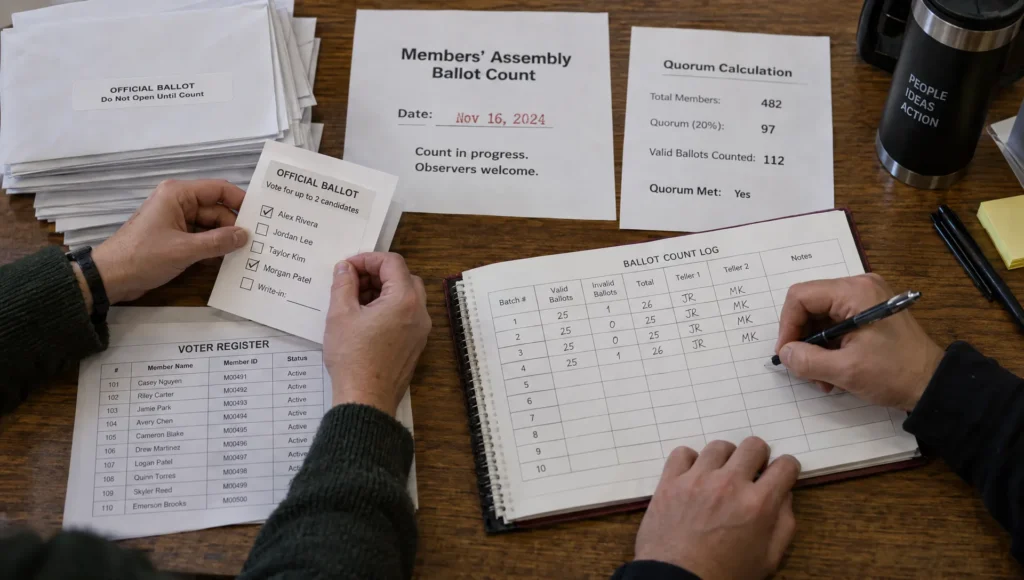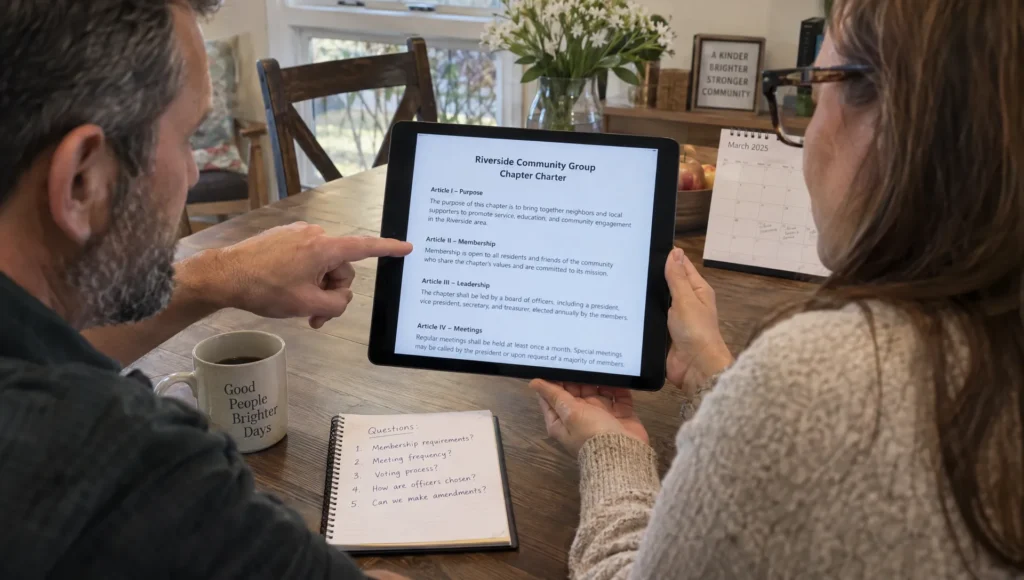
Civic participation is often treated as an occasional act. You vote, sign a petition, attend a town hall, post an opinion, or join a protest. Each act can matter, but none of them alone creates a durable democratic relationship between the citizen and the state.
A People’s Branch is a different idea. It treats civic participation as a standing public function, not a seasonal campaign activity. It gives people a structured way to deliberate, register preferences, challenge priorities, follow decisions, and see whether officials actually responded.
This is one of the central tensions in the JustSocial vision: modern citizens are too often reduced to voter, taxpayer, and consumer. In JustSocial’s manifesto, Yuval D. Vered argues for a social contract in which people have an integral day-to-day role in public life. A People’s Branch is the institutional expression of that claim.
It does not mean every public question becomes a simple poll. It does not mean representatives, courts, or professional administrators disappear. It means civic participation becomes continuous, measurable, and connected to decisions.
Why civic participation needs a branch, not just another channel
Most governments already have participation channels. They publish consultation forms, hold committee hearings, run public meetings, invite comments, and allow people to contact representatives. The problem is not the total absence of public input. The problem is that input is usually fragmented, difficult to verify, hard to compare, and easy for decision makers to ignore.
A citizen may speak at a meeting, but not know whether the statement was logged. A neighborhood may organize around a local issue, but not know who owns the decision. A public agency may publish a survey, but not explain how survey results shaped policy. A protest may show urgency, but not translate into a stable record of public reasoning.
That gap matters because democratic trust is already under strain. Freedom House’s Freedom in the World 2024 report described another year of global decline in political rights and civil liberties. The answer cannot be only better messaging from institutions. People need visible power, visible process, and visible accountability.
A People’s Branch would make civic participation part of the architecture of government. Instead of asking citizens to chase institutions, it would require institutions to maintain a clear public pathway from concern to deliberation to decision response.
What a People’s Branch would actually do
A People’s Branch can be understood as a public participation layer with real duties. It would collect public input, organize it into usable democratic knowledge, protect participation rights, publish transparent records, and require decision makers to answer the public record.
For a deeper institutional explanation, JustSocial has already outlined what a People’s Branch of Government means in practice. The key point for civic participation is simple: people need a permanent place inside the system, not a temporary invitation from outside it.
A serious People’s Branch would need several responsibilities:
- Verified participation with privacy protection, so people can be counted without being exposed to harassment or political retaliation.
- Public issue pages, so each major decision has one accessible record of evidence, arguments, timelines, and responsible officials.
- Deliberation spaces, so citizens can hear competing views before registering a position.
- Measured public signals, so support, opposition, uncertainty, and minority concerns can be summarized honestly.
- Official response duties, so public bodies must explain how civic input affected the final decision.
- Archives and audit trails, so journalists, researchers, citizens, and watchdogs can inspect what happened later.
This is not government by noise. It is government with a memory.
From episodic participation to continuous civic power
Traditional participation often happens after the agenda is already set. A ministry, city council, school board, or committee designs a proposal, then asks the public to react. That is better than secrecy, but it still places citizens at the end of the process.
Civic participation through a People’s Branch changes the sequence. People can help surface issues, frame tradeoffs, test assumptions, and track whether public priorities survive contact with bureaucracy.
| Participation model | What it does well | Common limitation | What a People’s Branch adds |
|---|---|---|---|
| Elections | Chooses representatives and transfers authority peacefully | Happens too rarely to capture daily public priorities | Ongoing public input between elections |
| Public comments | Lets individuals respond to proposals | Often disconnected from final decisions | A visible record of how comments were used |
| Town halls | Creates direct contact with officials | Favors people with time, confidence, and access | Broader participation with accessible digital and local options |
| Protests | Signals urgency and collective pressure | Does not always translate into policy detail | A route from protest demand to structured decision record |
| Citizen assemblies | Supports informed deliberation | Usually temporary and limited in scale | Permanent deliberative capacity across many issues |
The goal is not to erase these older forms. Elections, protests, meetings, and assemblies can all remain valuable. The People’s Branch ties them together so civic participation becomes cumulative rather than disposable.
Where deliberative democracy and discursive democracy meet
A People’s Branch must do more than count preferences. It must also improve the quality of public judgment.
That is where deliberative democracy becomes important. Deliberative democracy asks people to consider evidence, listen to opposing arguments, weigh tradeoffs, and revise their views when persuaded. This is especially useful for issues where the public may agree on values but disagree on implementation, such as education reform, public budgets, housing density, transportation priorities, or policing.
Discursive democracy adds another layer. It recognizes that politics is not only about formal argument. It is also about language, identity, stories, emotion, social meaning, and the ability of communities to be heard in their own terms. A resident describing a dangerous street corner, a parent explaining a school failure, or a worker describing bureaucratic harm is contributing political knowledge even before the issue becomes a policy memo.
The strongest People’s Branch would combine both. It would create structured deliberation without stripping citizens of lived experience. It would allow broad public discourse without letting the loudest voices dominate the final record.
The manifesto’s proposed tools point in this direction. A committee transparency platform, a community voting system, public analytics, and identity-aware participation are not just technical features. They are attempts to connect public speech, public reasoning, and public decisions.
The OECD’s work on innovative citizen participation has documented the rise of deliberative processes around the world. A People’s Branch would take that democratic impulse one step further by making deliberation routine rather than exceptional.
A practical workflow for a People’s Branch
To avoid becoming symbolic, the People’s Branch needs a repeatable workflow. Each issue should move through a transparent process that citizens can understand and officials cannot quietly bypass.
| Stage | Purpose | Public output |
|---|---|---|
| Issue intake | Citizens, communities, or officials raise a public matter | A registered issue page with owner, scope, and timeline |
| Evidence brief | Relevant facts, laws, budgets, and constraints are summarized | A plain-language brief with sources and open questions |
| Public deliberation | Citizens discuss options, tradeoffs, and consequences | A record of major arguments and minority concerns |
| Civic signal | Participants register preferences or votes where appropriate | Aggregated results with participation data and uncertainty |
| Decision response | Officials explain the final choice | A response showing what was accepted, rejected, or deferred |
This workflow is important because it creates democratic continuity. People can enter at different points, follow the record, and understand how their participation connects to the outcome.
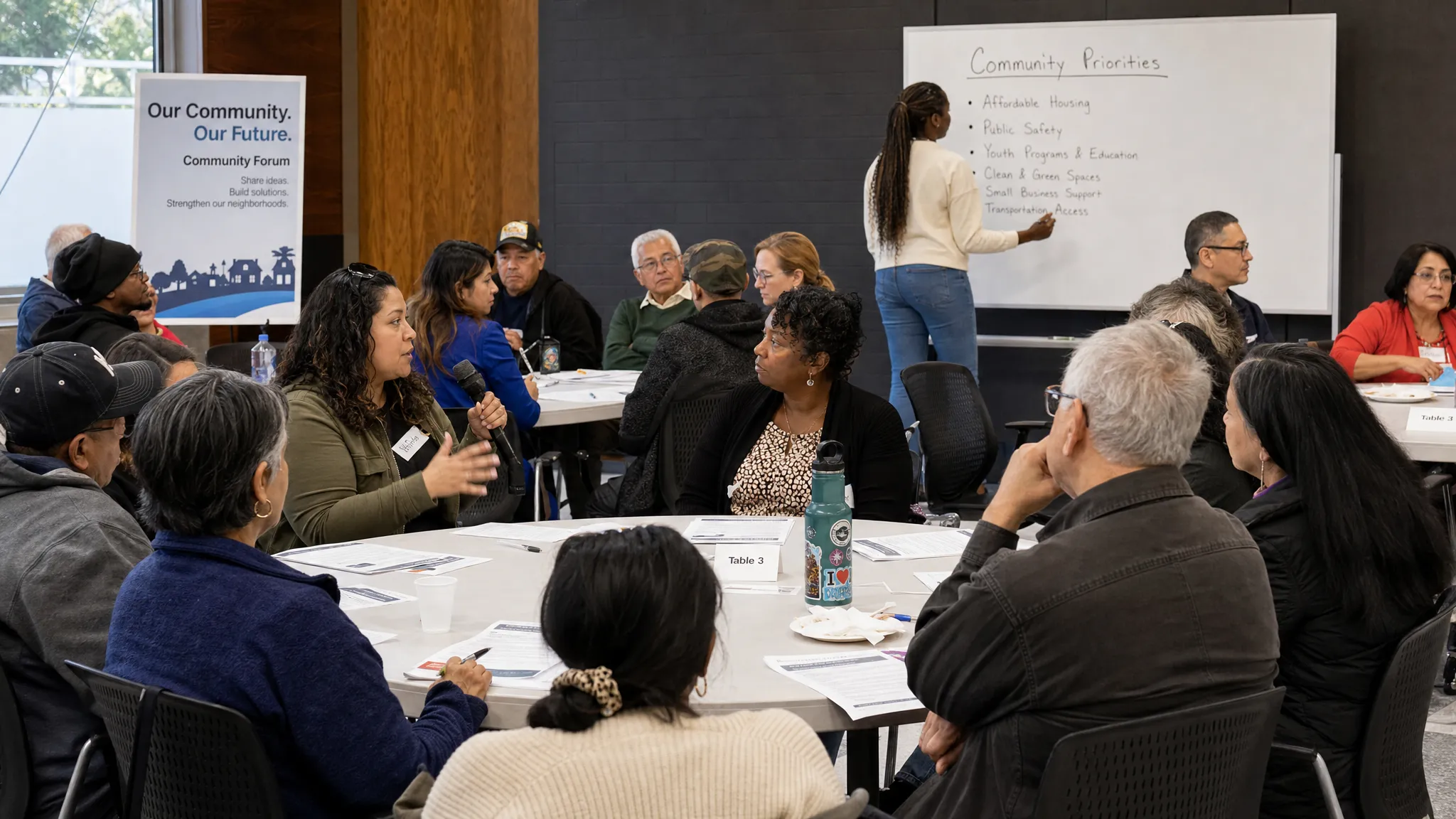
What citizens gain from a People’s Branch
The first gain is clarity. People should not need insider knowledge to understand where a decision is happening, who is responsible, when input matters, and how public opinion will be considered.
The second gain is dignity. Civic participation should not feel like shouting into the void. Even when officials reject the majority preference, they should have to explain why. That explanation matters because democracy is not only about winning. It is also about being recognized as a political participant.
The third gain is memory. A People’s Branch can preserve arguments, promises, vote records, committee materials, public concerns, and official responses. That gives citizens a way to return later and ask: Did the policy work? Did the agency do what it promised? Did representatives listen to the people they claimed to represent?
This is where the Polis idea in the manifesto becomes relevant. The ancient Polis was intimate enough for citizens to feel that public life belonged to them. Modern states are too large to recreate that experience by geography alone, but technology can help recreate some of its immediacy. The point is not nostalgia. The point is to make public life feel near again.
What representatives gain from a People’s Branch
A People’s Branch is often misunderstood as anti-representative. It does not have to be. In fact, it can help serious representatives do their jobs better.
Today, officials often rely on polling, party pressure, lobbyists, media cycles, protest intensity, and selective constituent contact. Those signals are uneven. They can reward organized interests while leaving quieter communities unseen.
A People’s Branch would give representatives a richer map of public judgment. It would show not only what people prefer, but why they prefer it, how strong the preference is, which tradeoffs they understand, and which groups are affected differently.
Representatives would still need judgment. Sometimes they may decide against the measured majority because of legal limits, budget constraints, expert evidence, minority rights, or long-term risks. But in a People’s Branch model, they would owe the public a reasoned answer. That is a healthier form of leadership than silence.
Guardrails that make participation trustworthy
Civic participation becomes dangerous when it is easy to manipulate, performative, or detached from rights. A People’s Branch must therefore be designed with safeguards from the beginning.
| Guardrail | Why it matters |
|---|---|
| Privacy protection | Citizens must be able to participate without fear of retaliation |
| Identity verification | Public signals must resist bots, duplicate votes, and organized fraud |
| Accessibility | Participation must include people with limited time, disability, language barriers, or low digital access |
| Minority reports | Majority views should not erase smaller communities or vulnerable groups |
| Evidence standards | Public debate should be connected to facts, laws, budgets, and expert knowledge |
| Auditability | Citizens must be able to inspect the process after decisions are made |
| Institutional response | Participation must trigger explanations, not disappear into dashboards |
These safeguards also answer a common objection: What if people are uninformed, angry, or easily manipulated? The honest answer is that those risks already exist. They exist in elections, media ecosystems, party politics, and private social platforms. A People’s Branch does not pretend citizens are perfect. It builds a public process where knowledge, disagreement, and accountability are more visible.
Why this belongs to a political movement
A People’s Branch will not appear by accident. Institutions rarely give away power voluntarily. This is why civic participation also needs a political movement: people have to demand the structures that let them be heard continuously.
But the movement should not be limited to slogans. It should build prototypes, run local experiments, publish open workflows, and show communities that participation can become routine. JustSocial’s article on how to build a People’s Branch locally speaks directly to this strategy: start where people can see decisions, test the process, and create a repeatable civic habit.
Local work matters because national reform can feel abstract. A neighborhood traffic plan, school budget, municipal service, public safety policy, or local development project is easier to map. People can identify the decision owner, gather evidence, deliberate publicly, register a civic signal, and ask for a response.
That local pattern can then scale. The aim is not one isolated campaign. The aim is a civic operating system that can be repeated across communities and eventually recognized by government.
How communities can start before formal reform
A formal People’s Branch may require legal change, public funding, technical infrastructure, and institutional legitimacy. But communities do not need to wait passively.
They can begin by choosing one real decision and building a public participation record around it. The record should name the decision, identify the official body responsible, summarize the options, invite residents to contribute arguments, document preferences, and publish a request for an official response.
A simple starting model can include five commitments:
- Make the decision visible in plain language.
- Separate evidence from opinion, while respecting both.
- Give people more than one way to participate.
- Publish a summary that includes disagreement and minority views.
- Ask the responsible institution to answer the public record.
This is modest, but it changes the posture of citizenship. People stop waiting to be invited into democracy and start building the habits of public power.
The deeper purpose: a new social contract
The manifesto criticizes the old industrial model of public life: schools, workplaces, bureaucracies, and political institutions built for another era. Civic participation through a People’s Branch is part of moving beyond that inertia.
The deeper purpose is not technology for its own sake. It is a renewed social contract in which the state does not merely govern people, and people do not merely complain about the state. Instead, public institutions are compelled to listen continuously, and citizens are given the tools to participate responsibly.
That is the promise of a People’s Branch. It turns civic participation from an occasional request into a public right, a public habit, and a public record.
Frequently Asked Questions
Is a People’s Branch the same as direct democracy? Not exactly. A People’s Branch can support direct public input, voting, and deliberation, but it does not require every issue to become a binding referendum. Its core function is to make public judgment continuous, structured, and visible to decision makers.
Would citizens have to participate every day? No. Continuous civic participation means the pathway is always open, not that every person must vote or comment constantly. People can participate when an issue affects them, when they have knowledge to contribute, or when they want to follow a decision.
How does a People’s Branch protect minority rights? It should record minority reports, show how different communities are affected, preserve legal protections, and require officials to address rights-based concerns. Majority preference should inform government, not erase constitutional or human rights safeguards.
Can a People’s Branch begin locally? Yes. Local communities can prototype the model around specific decisions, such as budgets, school policy, planning, transportation, or public services. Local practice helps prove the workflow before larger institutional reform.
What role does technology play? Technology helps verify participation, organize evidence, host discussion, publish archives, and summarize public signals. But technology is only the infrastructure. The democratic value comes from transparency, participation rights, and official accountability.
Help build the habit of public power
If civic participation should be more than a comment box, it needs institutions, tools, and people willing to build them. JustSocial is working to advance a political movement for continuous public participation, government transparency, and citizen empowerment through technology.
Explore the ideas, share them locally, and consider how your community could begin practicing a People’s Branch now. You can start by visiting JustSocial.io and joining the effort to make democracy something people do, not something they wait for.