A political movement is usually judged by its slogans, rallies, candidates, and election results. But a movement for continuous democracy has a harder task: it must design a new civic operating system, one that lets people participate before, during, and after elections without turning public life into permanent chaos.
That is why political movement design matters. Strategy asks how a movement wins attention and power. Design asks how the movement should function once people arrive. What do citizens do? How are disagreements handled? How does a post, petition, vote, or public meeting become a decision-ready signal? How does technology empower people without creating surveillance, manipulation, or noise?
The JustSocial manifesto frames this challenge as a shift away from industrial-era public systems, where citizens are reduced to voters, taxpayers, and consumers, toward a more active model of civic life. Its vision of a modern Cosmopolis is not simply more voting. It is a culture where citizens, representatives, public institutions, academia, and technology interact continuously.
In 2026, that design question is urgent. Freedom House has documented a long democratic recession, with public trust under pressure across many systems. If democratic reform movements want to do more than resist decline, they need institutions, habits, and tools that make civic participation normal, transparent, and consequential.
What political movement design means
Political movement design is the architecture of participation. It includes the roles people can play, the rules that guide debate, the channels where input is gathered, the safeguards that protect rights, and the process by which public opinion becomes public action.
For a movement built around continuous democracy, design starts with a simple premise: democracy should not be compressed into one anonymous act every few years. Elections remain important, but they should be surrounded by everyday forms of civic participation, discursive democracy, deliberative democracy, public transparency, and accountable implementation.
If you want the basic model in plain language, JustSocial has a helpful plain-English explanation of continuous democracy. The design challenge begins after that explanation: how do we build a movement that can actually practice it?
The answer is not to ask everyone to vote on everything every day. That would exhaust citizens and trivialize decision-making. The answer is to create civic pathways, so people can enter public life at different levels of time, knowledge, and responsibility. Some will react to an issue. Some will join a discussion. Some will study evidence. Some will help draft proposals. Some will vote. Some will monitor implementation.
A well-designed political movement makes all of these roles legitimate.
Start with a participation promise
Every movement makes an implicit promise. Traditional campaigns often promise representation: support us, and we will fight for you. Protest movements promise pressure: join us, and together we will force change. A continuous democracy movement must make a deeper promise: participate, and your voice will enter a visible civic process.
That promise needs to be specific. Citizens should know which issues are open for input, how proposals move forward, who reviews them, when deliberation begins, what data is public, and how officials or movement leaders must respond. Without that clarity, digital democracy becomes a suggestion box with better graphics.
A strong participation promise should answer five questions:
- What can citizens influence right now?
- How will public input be organized and protected?
- When does discussion become deliberation?
- How are decisions recorded, explained, and reviewed?
- What happens when leaders ignore a clear public signal?
This connects directly to the manifesto's criticism of the existing social contract. If citizens are asked to pay taxes, obey laws, and accept state decisions, then the state and its democratic movements owe them more than symbolic listening. They owe a process that can be inspected.
The democratic design stack
Continuous democracy is not one tool. It is a stack of democratic functions. Each layer has a purpose, an output, and a risk that must be managed.
| Design layer | Democratic function | Practical output | Risk to manage |
|---|---|---|---|
| Civic participation | Let people raise issues, react, and contribute lived experience | Petitions, issue submissions, local priorities, civic action | Noise, outrage cycles, unequal participation |
| Discursive democracy | Create open public conversation where arguments, stories, and objections circulate | Comment threads, public forums, community meetings, media responses | Harassment, manipulation, performative debate |
| Deliberative democracy | Help participants weigh evidence, trade-offs, and alternatives | Citizen panels, policy briefs, recommendations, proposal drafts | Elite capture, biased framing, low accessibility |
| Decision-making | Convert informed public will into mandates or guidance | Votes, participatory budgets, representative instructions, consensus records | Insecure voting, shallow majoritarianism, low trust |
| Transparency and review | Show what happened after the decision | Public records, implementation logs, audit trails, progress reports | Black-box governance, broken feedback loops |
Designing a political movement means deciding how these layers interact. A petition should not disappear after it trends. A heated public debate should not be mistaken for informed consensus. A deliberative panel should not become a private club of insiders. A vote should not be treated as the end of democracy, because implementation is where many promises die.
The manifesto's proposed tools point in this direction. A news action app would connect awareness to civic action. rParliament would make committees, documents, and recordings visible. rConcensus would let communities vote on recurring issues. A public analytics layer would help representatives, journalists, and citizens see civic signals. The important design insight is that these are not isolated apps. They are parts of a civic pipeline.
Discursive and deliberative democracy need each other
Discursive democracy is the broad, living conversation of the public. It includes disagreement, identity, emotion, testimony, humor, anger, and persuasion. It is where people discover that their private frustration is actually a shared civic problem.
Deliberative democracy is slower and more structured. It asks people to examine evidence, hear competing arguments, consider trade-offs, and produce recommendations that can survive scrutiny. The OECD has described a global rise in deliberative processes in its work on innovative citizen participation, especially citizen assemblies and panels.
A movement for continuous democracy needs both. Discursive spaces without deliberation become endless argument. Deliberation without broad discourse becomes technocratic and disconnected from public feeling. Good design creates movement between them.
For example, a citywide discussion about school transportation might begin with parents, students, teachers, and drivers sharing daily experiences. Those stories reveal recurring problems. The movement then organizes them into issue clusters. A deliberative group studies costs, safety data, equity concerns, and alternative routes. It drafts recommendations. The wider community reviews them. A vote or representative decision follows. After implementation, the public can see whether the change worked.
That is continuous democracy in practice: expression, organization, deliberation, decision, and review.
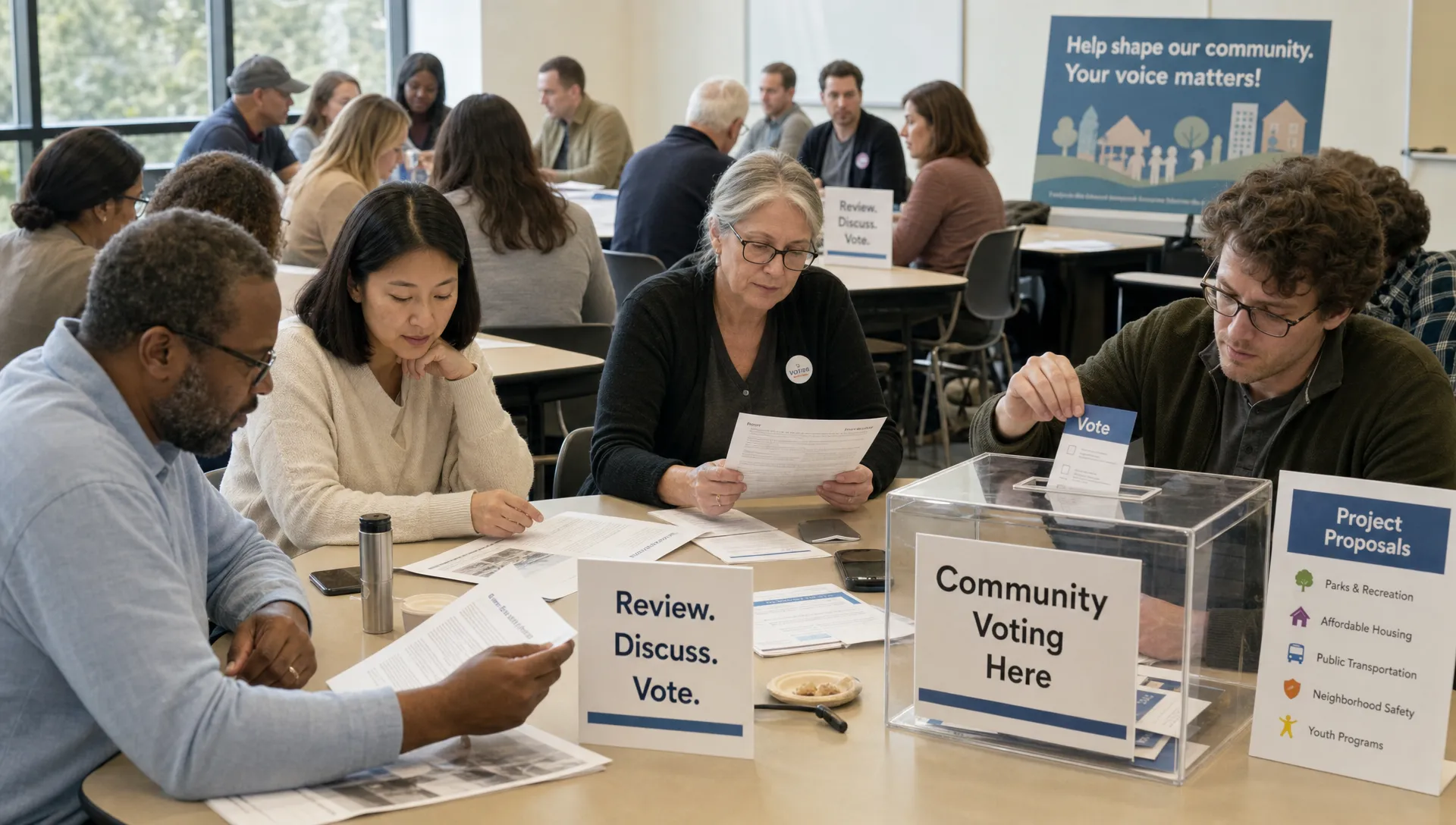
Design civic participation as a loop, not a campaign funnel
Most political campaigns use funnels. People see a message, sign up, donate, volunteer, vote, and then wait for the next election. That model can win campaigns, but it cannot sustain continuous democracy.
A continuous movement needs loops. Citizens should be able to return to the same issue after a decision, see what changed, challenge poor implementation, and reopen the conversation when conditions shift. The loop is: listen, organize, deliberate, decide, implement, audit, learn, and listen again.
This is also where local civic teams matter. A national platform may create visibility, but democratic trust is often built in smaller groups that can meet, research, moderate, summarize, and follow up. JustSocial has explored this operational challenge in its article on how to turn supporters into civic teams.
The design lesson is simple: do not build a movement where citizens are only an audience. Build one where citizens can become maintainers of public knowledge.
The technology should be civic, not merely digital
The manifesto argues that much of the required technology already exists: social platforms, cloud storage, analytics, AI language models, and possibly blockchain for confidentiality and verification. That is true in a practical sense. The hard part is not inventing every component from scratch. The hard part is using technology in a way that strengthens legitimacy.
An online voting platform alone is not continuous democracy. Nor is a social network, a dashboard, or a petition tool. The movement needs civic technology that respects democratic norms.
Good civic technology should be privacy-preserving, accessible, auditable, and understandable. Citizens should know when they are speaking publicly, when they are participating anonymously, how their input is counted, and who can see aggregated results. If identity is required to prevent fraud, the system should separate eligibility from public exposure as much as possible. If analytics are used, they should inform public reasoning rather than manipulate behavior.
This is especially important because the manifesto imagines willing and anonymous political identity, opinion clustering, and public analytics for officials and journalists. Those ideas can empower citizens only if the design prevents surveillance and coercion. Trust must be engineered into the system, not requested after the fact.
AI should follow the same rule. It can summarize arguments, translate civic materials, help draft policy comparisons, and support education. But it should not replace public judgment. In a democratic movement, AI is a civic assistant, not a sovereign.
Governance: the movement must prefigure the democracy it wants
A political movement for continuous democracy cannot demand transparency from government while operating through opaque internal power. Its own structure should model the norms it wants to spread.
That means published decision rules, clear stewardship roles, transparent moderation standards, and visible pathways for disagreement. It also means separating functions. The people who mobilize supporters should not be the only people who moderate debate. The people who write proposals should not be the only people who evaluate evidence. The people who build technology should not be the only people who decide its governance.
Here the manifesto's idea of additional democratic branches becomes useful as a design metaphor. The people are not merely a voting population. Academia is not merely a credentialing industry. In a continuous democracy model, the public supplies lived experience and legitimacy, while researchers, educators, and domain experts help test claims and improve proposals. Representatives still matter, but they become more like channels and implementers than distant rulers.
The movement should therefore create roles for civic facilitators, policy researchers, technologists, community organizers, legal reviewers, accessibility advocates, and public auditors. These roles do not need to become a bureaucracy. They need to make participation safer, clearer, and more useful.
Design for disagreement before it happens
Many democratic projects fail because they design for agreement and improvise when conflict appears. Continuous democracy must do the opposite. It should assume disagreement from the start.
That requires minority protections, anti-harassment rules, appeal processes, transparent moderation, and clear distinctions between popularity and legitimacy. A proposal with majority support may still violate rights. A minority objection may reveal a serious implementation risk. A loud online reaction may not represent the affected community.
Good movement design treats disagreement as civic material. It asks: What is the claim? What evidence supports it? Who is affected? What trade-off is being hidden? What would make this acceptable to more people? What cannot be compromised because it protects basic rights?
This is how a movement avoids becoming a digital mob. It does not suppress conflict. It gives conflict a democratic shape.
Measure what matters without surveilling citizens
Continuous democracy needs feedback, but not every measurement is healthy. A movement should measure the performance of the civic process more than the private psychology of participants.
Useful metrics include participation breadth, response time, issue diversity, deliberation quality, proposal completion, implementation progress, and trust signals. Dangerous metrics include manipulative engagement scoring, opaque influence rankings, and personal political profiling that citizens cannot inspect or challenge.
| Measurement area | Healthy question | Why it matters |
|---|---|---|
| Participation breadth | Are affected communities represented? | Prevents democracy from serving only the loudest participants |
| Deliberation quality | Did participants consider evidence and alternatives? | Separates informed judgment from reaction |
| Transparency | Can citizens trace input to outcome? | Builds trust in the process |
| Implementation | Did approved actions actually happen? | Prevents participation from becoming symbolic |
| Learning | Did the movement improve after feedback? | Keeps continuous democracy adaptive |
The goal is not to know everything about every citizen. The goal is to know whether the democratic process is working.
From Polis to Cosmopolis
One of the manifesto's most powerful references is the Greek Polis, where political life felt immediate and communal. The ancient Polis was not scalable to modern nation-states, and it excluded many people from citizenship. Yet it reminds us of something modern republics often lose: the feeling that public life is part of life itself.
Continuous democracy tries to recover that immediacy at modern scale. The Cosmopolis is not a nostalgic return to the city-state. It is a design challenge for digital democracy: how can a large society create meaningful civic proximity without sacrificing rights, privacy, expertise, or pluralism?
The answer will not come from one app, one leader, or one election cycle. It will come from political movement design that treats citizens as co-authors of public life. It will require civic participation that is easy to enter, discursive democracy that is open but moderated, deliberative democracy that is serious and inclusive, and public transparency that follows decisions all the way into implementation.
A movement designed this way does not merely campaign for democracy. It practices the future it wants to build.
Frequently Asked Questions
What is political movement design? Political movement design is the intentional structure of a movement's roles, rules, tools, rituals, and decision pathways. For continuous democracy, it focuses on turning civic participation into transparent public influence.
How is continuous democracy different from ordinary direct democracy? Ordinary direct democracy is often associated with referendums or ballot measures. Continuous democracy is broader. It includes agenda setting, public discussion, deliberation, voting, implementation tracking, and ongoing feedback.
Why do discursive democracy and deliberative democracy both matter? Discursive democracy opens space for public expression and disagreement. Deliberative democracy turns that energy into informed recommendations by adding evidence, facilitation, and trade-off analysis. One creates breadth, the other creates depth.
Can an online voting platform create continuous democracy by itself? No. Online voting can be one part of the system, but continuous democracy also needs identity safeguards, public deliberation, transparent records, implementation review, accessibility, and trust.
How can a political movement avoid becoming another bureaucracy? It should keep roles clear, publish decision rules, rotate responsibilities where possible, audit its own processes, and focus every structure on helping citizens understand, decide, and act.
Build the movement as civic infrastructure
If continuous democracy is the goal, the movement itself must become the first prototype. It should listen in public, deliberate with discipline, use technology carefully, and show citizens how their participation can move from voice to policy.
That is the real work of political movement design: not only winning attention, but building the civic infrastructure through which people can govern with greater continuity, dignity, and trust.