Transit planning is where democracy becomes physical. A bus route, rail extension, sidewalk connection, station design or fare change can decide who reaches work on time, who can get to a clinic and who is effectively cut off from public life.
Yet many transit decisions still follow a familiar pattern: agencies prepare technical options, consultants model demand, elected officials weigh costs and the public is invited to react late in the process. By then, the real choices are often already narrowed. Residents can speak, but they rarely deliberate.
Deliberative democracy offers a better path for fair transit planning because it treats riders, non-riders, workers, businesses and neighborhoods as participants in judgment, not only as sources of complaint. It asks people to examine evidence, listen to one another, weigh tradeoffs and help form recommendations that public agencies must answer in public.
Why Transit Planning Needs More Than Public Comment
Transit agencies work under real constraints. Budgets are limited, land is contested, ridership patterns change and every improvement has opportunity costs. A new bus lane may help thousands of riders but reduce parking for nearby merchants. A route redesign may improve frequency but remove a stop that elderly residents depend on. A fare policy may simplify the system but hurt low-income riders if exemptions are poorly designed.
Traditional public comment struggles with these tradeoffs. The loudest voices are not always the most affected. A three-minute speech at a hearing does not allow residents to compare alternatives. Online surveys can gather preferences, but they often miss people without time, language access or trust in government.
The JustSocial manifesto argues that many public systems are still shaped by industrial-era habits, where citizens are reduced to voters, taxpayers and consumers rather than treated as daily participants in public policy. Transit planning shows that problem clearly. People depend on a system every day, pay for it through taxes and fares, then are often asked to react only after the main design work is complete.
A deliberative approach changes the sequence. It brings the public into the reasoning stage, before maps harden and before agencies become defensive. JustSocial has explored the broader case for this kind of public reasoning in its article on how deliberative democracy improves public decisions. Transit is one of the clearest places to apply it because the effects are measurable, local and deeply unequal when done poorly.
What Fairness Means in Transit Planning
Fairness is not a slogan in transit. It has several practical meanings, and each one needs a process that can reveal blind spots.
| Fairness dimension | Transit planning question | Deliberative safeguard |
|---|---|---|
| Procedural fairness | Who gets to shape options before decisions are made? | Representative panels, multilingual outreach and early engagement |
| Distributional fairness | Who gains or loses access, time, safety and affordability? | Equity mapping, rider testimony and transparent impact analysis |
| Informational fairness | Can the public understand the constraints and evidence? | Plain-language briefs, open data and expert questioning |
| Geographic fairness | Are some neighborhoods repeatedly asked to absorb burdens? | Corridor-level and system-level review of past decisions |
| Accountability fairness | Did officials explain why they accepted or rejected public recommendations? | Written responses tied to each major recommendation |
A fair process does not guarantee unanimous support. Transit planning almost always involves conflict. But it can create decisions people can recognize as legitimate because the reasons are visible, the affected communities are present and the agency cannot hide behind technical language.
A Practical Deliberative Model for Transit Decisions
A city, transit authority or regional planning body does not need to replace every existing process to use deliberative democracy. It can add a structured deliberative layer to the decisions where fairness concerns are highest: major route redesigns, fare changes, new rail alignments, bus priority corridors, station closures, service cuts and long-range investment plans.
A strong model includes six steps:
- Define the real decision: State what is actually open for change, what is legally or financially fixed and when officials must decide.
- Select a representative civic panel: Recruit residents by lottery or targeted selection so riders, disabled residents, low-income households, youth, older adults, workers, businesses and affected neighborhoods are present.
- Prepare balanced evidence: Provide clear materials on costs, ridership, travel time, safety, climate effects, accessibility, land use and equity impacts.
- Let people question experts: Planners, drivers, disability advocates, business owners and community groups should answer questions in a moderated setting.
- Deliberate tradeoffs: Participants should compare options, amend them and explain which values guide their choices.
- Require an official response: The agency must publish how it used the recommendations, where it disagreed and why.
This is not government by focus group. The final legal authority may remain with elected officials or transit boards. The difference is that official discretion becomes disciplined by public reasoning. Decision-makers can still decide, but they must decide in view of a public record that is richer than a comment log.
Lived Evidence Belongs Beside Technical Evidence
Transit models are useful, but they are not complete. They can estimate travel demand, compare service frequency and project operating costs. They are weaker at capturing the dignity costs that riders experience: waiting alone at night, crossing a dangerous arterial, missing a medical appointment because a transfer failed or carrying groceries across a long gap in the network.
Deliberative democracy gives lived evidence a formal place. A wheelchair user can explain why a technically accessible route still fails because a curb cut is blocked. A night-shift worker can show why service frequency after 10 p.m. matters more than peak-hour optimization. A parent can describe how two transfers with a child turn a reasonable commute on paper into a daily burden.
This does not mean every personal story becomes policy. It means stories are tested alongside data. When repeated experiences reveal a pattern, the agency should treat that pattern as evidence. The deliberative process helps separate isolated inconvenience from systematic unfairness.
From Public Hearing to Continuous Civic Participation
Public hearings should not disappear. They should become part of a longer chain of civic participation. A hearing can be useful when it records arguments, lets officials hear directly from the public and forces agencies to answer objections. It becomes weak when it is the first meaningful opportunity for the public to speak.
Discursive democracy helps here. It focuses on how public speech becomes part of official reasoning. JustSocial has written about this in the context of improving public hearings through discursive democracy. For transit, the principle is simple: every major claim made by the public should be categorized, answered and connected to evidence or values.
Continuous direct democracy adds another layer. Riders should not have to wait years for an election or months for a hearing to say that a route is failing. Digital tools can collect ongoing input about delays, unsafe stops, overcrowding, accessibility problems and proposed changes. The goal is not to turn every bus stop into a referendum. The goal is to make public experience visible enough that agencies can see problems before they become crises.
The Technology Layer Must Be Trustworthy
Digital democracy in transit should be simple for the user and rigorous behind the scenes. People should be able to review proposals, compare options, submit comments, join deliberative panels, vote in advisory ballots and see how their input affected the outcome. For the agency, the platform should support identity protection, accessibility, translation, audit logs, cybersecurity, data minimization and reliable uptime.
Trust depends on technical competence. If residents believe a platform is insecure, manipulated or impossible to use, the democratic promise collapses. Even outside government, small and midsize organizations learn this through technology partners that emphasize security, uptime and long-term planning, such as dependable managed IT services. Public agencies need the same mindset when civic infrastructure becomes digital infrastructure.
A transit engagement platform should also separate identity from public expression where appropriate. A resident may need to verify that they live in a service area, but their political identity, disability status or travel patterns should not be exposed unnecessarily. Anonymity, verification and accountability can coexist if the system is designed carefully.
Handling the Hard Tradeoffs Openly
Transit planning becomes unfair when tradeoffs are hidden. Agencies may present a preferred option as if it were purely technical, but most transit choices involve values. Should a city prioritize maximum ridership or coverage for isolated neighborhoods? Should it invest in faster service on major corridors or preserve low-frequency routes for riders with few alternatives? Should it reduce fares or increase service hours?
Deliberative democracy does not remove conflict. It makes conflict usable.
| Transit tradeoff | Why it causes conflict | Deliberative question |
|---|---|---|
| Frequency versus coverage | Frequent service helps more riders, but coverage protects isolated areas | What minimum access should every neighborhood receive? |
| Speed versus curb access | Bus lanes improve reliability, but may reduce parking or loading space | Which uses of street space serve the strongest public need? |
| Fare simplicity versus targeted equity | Simple fares are easier to understand, but flat pricing can hurt poor riders | Who needs discounts, caps or exemptions to access the system? |
| Major capital projects versus daily service | Rail or rapid transit can transform a corridor, but daily bus service may suffer | What balance best improves access over the next decade? |
| Regional efficiency versus local disruption | Systemwide gains can impose burdens on specific blocks or communities | What mitigation is owed to the most affected people? |
When people deliberate with these choices in front of them, the discussion becomes more honest. Residents may still disagree, but they can see the real cost of each preference. That matters for legitimacy.
Academia Can Strengthen Transit Deliberation
The JustSocial manifesto proposes academia as a more independent public force, one that can help regulate public reasoning by raising standards of evidence and education. Transit planning would benefit from that role.
Universities, public policy schools and independent researchers can help design deliberative materials, audit equity analyses, review ridership models and evaluate outcomes after implementation. They can also translate technical findings into plain language, which is essential for fair participation. If only consultants and agencies understand the data, the public is not truly deliberating.
Academic involvement must remain transparent. Researchers should disclose methods, assumptions and funding. Their role is not to dictate policy. Their role is to make the evidence strong enough that citizens can judge it.
A Transit Deliberation Cycle in Practice
Consider a city redesigning a bus corridor that connects a low-income neighborhood, a hospital district, a university and a commercial center. The agency believes bus priority lanes could cut travel time, but merchants worry about parking, residents worry about stop consolidation and disability advocates worry about station design.
In a conventional process, the agency might release a proposal, hold a meeting, receive opposition and revise under pressure. In a deliberative process, the agency first publishes the decision frame: the corridor is unreliable, the budget is limited, the street width cannot grow and the board must choose among three design families within six months.
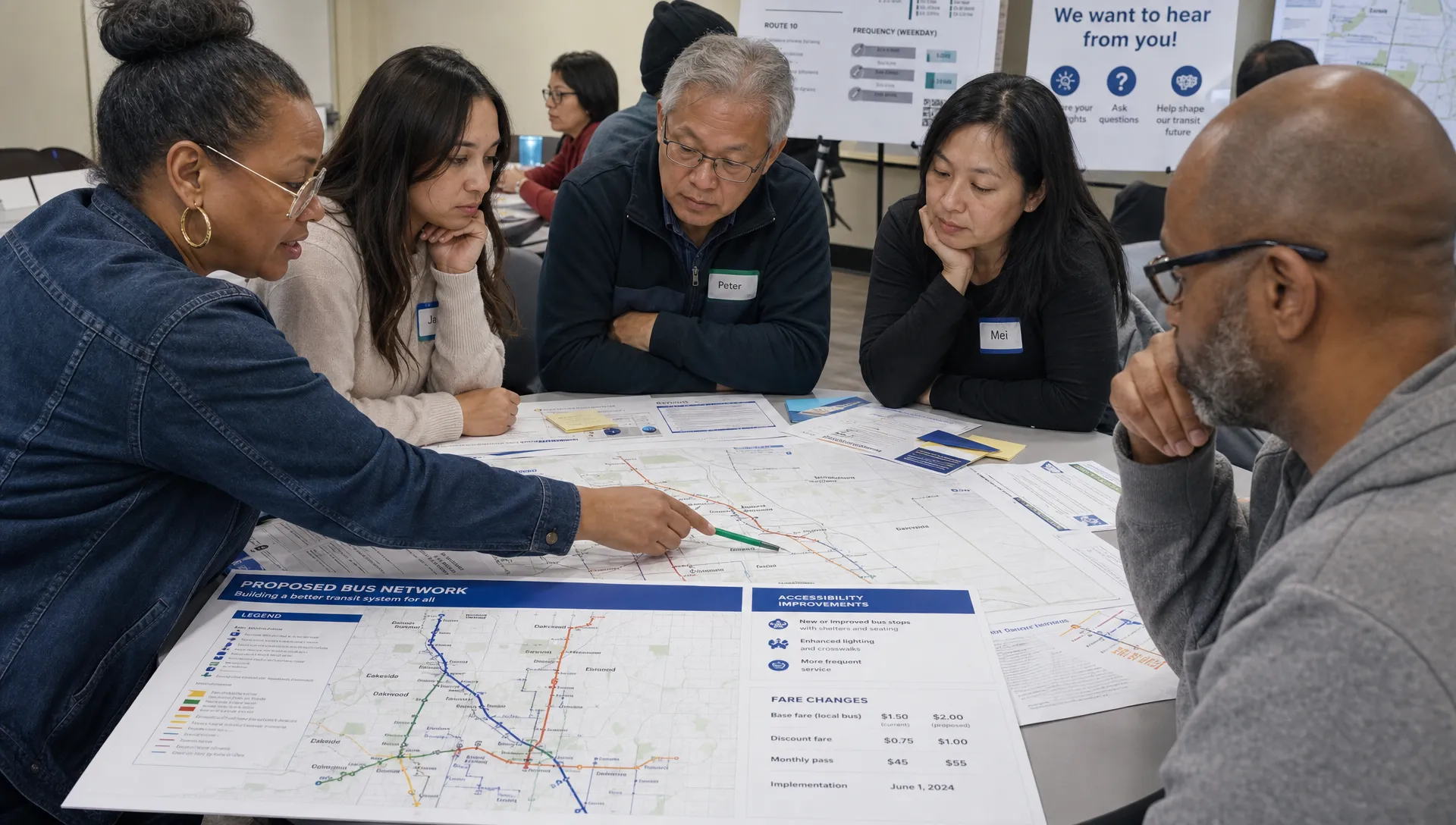
A representative panel then meets across several sessions. Members hear from planners, bus operators, merchants, riders, disability advocates, climate analysts and emergency services. They review maps showing travel time, crash history, expected ridership, sidewalk quality and impacts on curb uses. They question the assumptions. They deliberate in moderated groups, then produce recommendations.
The final report might support bus lanes on the most delayed segment, preserve accessible stops near medical facilities, create loading zones on side streets, require better lighting at consolidated stops and call for a one-year review after implementation. The transit board can still modify the plan, but it must publicly respond to each recommendation.
That process is slower at the beginning. It can be faster overall because it reduces late-stage backlash, litigation risk and public distrust. More importantly, it produces a plan that reflects both professional competence and civic judgment.
Measuring Whether the Process Was Fair
A deliberative transit process should be evaluated after the decision, not only praised at launch. Agencies should publish a short fairness report that tracks whether the process reached the right people, used evidence well and changed the final plan.
| Measure | What it reveals |
|---|---|
| Participation diversity | Whether affected groups were present, not only frequent meeting attendees |
| Evidence accessibility | Whether materials were understandable, translated and available in multiple formats |
| Recommendation response rate | Whether officials answered the public record rather than ignoring it |
| Equity impact | Whether travel time, affordability, safety and access improved for disadvantaged groups |
| Implementation follow-through | Whether promised mitigations and reviews actually happened |
| Trust change | Whether participants felt heard, even when they did not get every preferred outcome |
Ridership growth matters, but it is not the only sign of success. A transit plan can increase ridership while still shifting burdens onto people with less power. Fair planning asks who benefits, who pays, who was heard and whether the final decision can be defended in public.
Frequently Asked Questions
What is deliberative democracy in transit planning? Deliberative democracy in transit planning is a structured process where residents review evidence, question experts, discuss tradeoffs and produce recommendations before agencies make major transit decisions.
How is this different from a public hearing? A public hearing usually collects comments at a specific moment, often late in the process. Deliberation brings a representative group into the reasoning stage, where people can learn, compare options and influence the shape of the proposal.
Does deliberative democracy mean residents make the final transit decision? Not necessarily. Elected officials or transit boards may keep final authority, but they must respond to a stronger public record and explain how civic recommendations affected the decision.
Can digital tools make transit planning more democratic? Yes, if they are secure, accessible and transparent. Online voting platforms, civic engagement tools and public dashboards can support continuous participation, but they should not replace in-person outreach for communities that need it.
Why is fairness so difficult in transit planning? Transit decisions distribute time, money, safety and opportunity. Because riders and neighborhoods experience those impacts differently, fairness requires both technical analysis and direct civic participation.
Building Transit That Treats People as Citizens
Fair transit planning is not only about moving people efficiently. It is about whether public systems recognize people as members of a shared civic life. The spirit of the Polis that JustSocial points toward is not nostalgia for ancient city-states. It is a demand for immediacy, belonging and real influence in the systems that shape daily life.
Deliberative democracy can help transit agencies make better decisions because it connects data to lived experience, expert knowledge to public judgment and participation to accountability. For a political movement committed to continuous direct democracy, transit is a natural proving ground. If people can help govern the routes, streets and stations they rely on every day, the idea of citizen empowerment becomes practical rather than abstract.
The next fair transit plan should not begin with a finished map. It should begin with a public question, a transparent process and a commitment to listen before deciding.