A political movement earns trust when it can do more than describe a better democracy. It must show, in public, how people can move from frustration to structured influence. That is what civic tech pilots are for.
A civic tech pilot is not just a beta version of an app. It is a small, time-bound test of a democratic process: people identify a real issue, discuss it under clear rules, review evidence, produce decision-ready options, deliver them to the right institution, and track what happens next. The software matters, but the public process matters more.
This is closely aligned with JustSocial’s manifesto, The Face of Democracy, which argues that citizens should not be reduced to voters, taxpayers, and consumers. The manifesto’s deeper claim is that modern technology can help rebuild a living public sphere where people are heard continuously, where institutions measure public opinion seriously, and where participation becomes part of everyday governance rather than a ritual every few years.
For a political movement, the practical question is simple: how do you prove that vision without waiting for national reform? You start with pilots.
What makes a civic tech pilot different from campaign tech?
Most political technology is built for campaigns. It optimizes attention, persuasion, fundraising, volunteer mobilization, and turnout. Those are useful, but they do not necessarily improve democracy.
A civic tech pilot has a different purpose. It tests whether civic participation can become more transparent, structured, inclusive, and consequential. The success question is not, “How many people clicked?” It is, “Did public input become usable for a real decision, and can outsiders inspect the process?”
That difference changes everything. Campaign tech often rewards speed and emotional intensity. Civic tech must reward clarity, fairness, evidence, and follow-through. A campaign tool can vanish after election day. A civic pilot should leave behind public artifacts that a community, city council, school board, newsroom, or ministry can use again.
A strong pilot answers five basic questions:
- What real decision or public problem is this connected to?
- Who is invited to participate, and why?
- What rules make discussion fair and useful?
- What public records will prove what happened?
- What will decision-makers receive, and when must they respond?
If a movement cannot answer these questions, it is not yet building civic infrastructure. It is building engagement theater.
Start with a participation promise
Every pilot should begin with a short participation promise. This is the public contract between the political movement and participants. It tells people what the pilot can influence, what it cannot influence, how their input will be processed, and what receipts will be published.
The promise should be written in plain language. It should avoid vague phrases like “make your voice heard” unless it also explains how that voice will move through the process.
| Promise element | What to publish | Why it matters |
|---|---|---|
| Decision target | The issue, institution, owner, and timeline | Prevents symbolic participation disconnected from power |
| Participation role | Comment, proposal, deliberation, vote, oversight, or all of these | Helps people understand what they are being asked to do |
| Process rules | Moderation, evidence standards, facilitation, synthesis method | Builds procedural trust |
| Public receipts | Charter, issue pack, summaries, options memo, response log | Makes the pilot auditable |
| Privacy model | What data is collected, what is public, what is protected | Reduces fear and manipulation |
| Follow-through | Who receives the outputs and how updates will be tracked | Connects participation to action |
This echoes the manifesto’s idea that the state should measure and take public opinion seriously, while still allowing institutions to make independent decisions. A pilot should not promise that every participant will get their way. It should promise that public reasoning will be visible, organized, and delivered to the right place.
Choose a use case small enough to finish
Many civic tech pilots fail because they begin with a national-scale ambition and no realistic completion path. A political movement should choose a use case that is important enough to matter, but narrow enough to complete in 4 to 8 weeks.
Good pilots usually have three qualities. The issue is concrete, the affected community is reachable, and the decision owner can be identified. A local school policy, neighborhood safety problem, public meeting transparency project, small participatory budget, or committee-document archive is often better than a broad constitutional debate for a first test.
JustSocial’s manifesto sketches several product concepts that can inspire pilot design. A TakeAction-style pilot could connect news to structured civic action, such as petitions, representative emails, donations, volunteering, or public requests. An rParliament-style pilot could collect and organize committee recordings, documents, and votes so citizens can comment on specific public decisions. An rConsensus-style pilot could help a school, neighborhood, or association run recurring ballots and publish anonymized results with clear safeguards.
The point is not to build the full product at once. The point is to test one civic loop from beginning to end.
| Pilot type | Best first use | Minimum successful output |
|---|---|---|
| News-to-action pilot | Turn one public issue into coordinated civic action | A public action page, delivery log, and response tracker |
| Committee transparency pilot | Make one public committee easier to inspect | Searchable records, tagged clips, and a meeting summary |
| Community consensus pilot | Help one community decide between options | Participation rules, anonymized results, and a decision memo |
| Evidence commons pilot | Improve debate on a disputed issue | Claim cards, sources, uncertainty notes, and synthesis |
| Implementation tracker | Follow one promise after a decision | Status updates, responsible owners, and missed-deadline notes |
A movement gains credibility when it can say, “Here is one complete loop. Here are the records. Here is what changed. Here is what failed. Here is what we learned.”
Build the democratic workflow before the software
The fastest way to ruin a civic tech pilot is to start with the interface before designing the democratic workflow. Software can collect comments, count votes, and display charts. It cannot decide by itself what counts as fair participation.
A useful pilot should combine three layers.
First, discursive democracy helps the public conversation become legible. This is where people name problems, challenge assumptions, share lived experience, surface evidence, and expose disagreement. The goal is not immediate consensus. The goal is to make the public debate more structured and less chaotic.
Second, deliberative democracy turns public input into decision-ready judgment. A smaller, facilitated group reviews evidence, compares tradeoffs, hears different perspectives, and produces options that decision-makers can realistically consider.
Third, civic participation connects the process to power. It identifies the decision owner, sends the outputs, requests a response, and tracks implementation.
| Layer | Main question | Typical output |
|---|---|---|
| Discursive democracy | What are people saying, experiencing, and disputing? | Claim map, evidence shelf, public synthesis |
| Deliberative democracy | What options survive informed discussion? | Options memo with tradeoffs and minority views |
| Civic participation | How does this influence a real decision? | Decision request, response log, implementation tracker |
This structure keeps the pilot from becoming either a shouting forum or a closed expert committee. It gives public voice a place, gives careful reasoning a place, and gives accountability a place.
Design a minimum viable civic tech stack
A pilot does not need a complex platform on day one. It needs enough technology to make the process usable, transparent, and repeatable. In many cases, a movement can begin with forms, shared documents, spreadsheets, a simple website page, open-source tools, and moderated video calls. Custom software becomes necessary only after the process is clear.
A minimum viable civic tech stack usually includes an intake channel, an evidence repository, a structured discussion space, a deliberation workspace, a publishing page, and a tracker. The stack should also include a basic privacy and security plan, even for low-stakes pilots.
Do not treat hybrid participation as an afterthought. A civic lab is still a room as well as a platform: seating, microphones, childcare, signage, and modern lighting options can affect whether older residents, neurodivergent participants, parents, and evening-shift workers can participate comfortably.
The practical design principle is this: use the simplest tools that can still produce public receipts. If your platform looks impressive but cannot publish a clear issue pack, synthesis, options memo, and response tracker, it is not serving democracy yet.
Recruit for legitimacy, not just volume
A political movement naturally begins with supporters. A civic tech pilot cannot end there. If a pilot only includes people who already agree with the movement, it may be useful for internal strategy, but it will not prove public legitimacy.
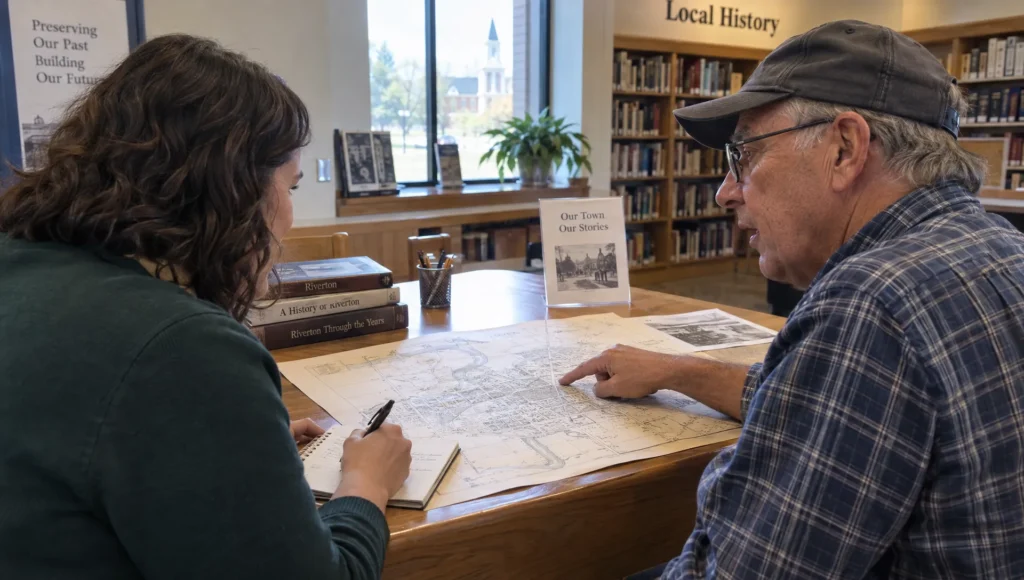
Recruitment should start with an affected-community map. Who is directly affected by the issue? Who is indirectly affected? Who has relevant expertise? Who usually gets excluded? Who is likely to disagree? Who will need accessibility support, translation, childcare, transportation, or offline options?
For a small pilot, perfect representativeness is unrealistic. But visible effort matters. Publish how participants were invited, what groups were missing, and what the movement did to reduce barriers. This is especially important when the movement claims to represent a new kind of public power.
Internal roles also matter. The manifesto’s call for developers, UX designers, product owners, product managers, project managers, and volunteers points to a deeper truth: civic technology is multidisciplinary. A credible pilot needs process people as much as technical people.
At minimum, assign these roles clearly: pilot lead, facilitation lead, outreach lead, evidence lead, technology lead, privacy and safety lead, and public liaison. One person can hold multiple roles in a tiny pilot, but the responsibilities should still be named.
Publish public artifacts from the beginning
Public artifacts are the difference between “trust us” and “inspect us.” They are the records that let outsiders understand what happened without being inside the room.
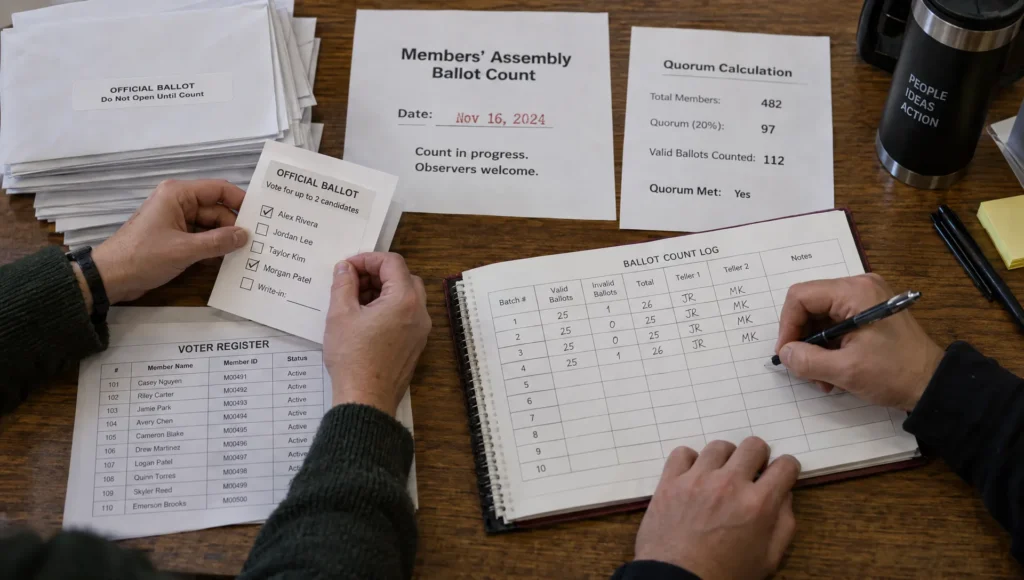
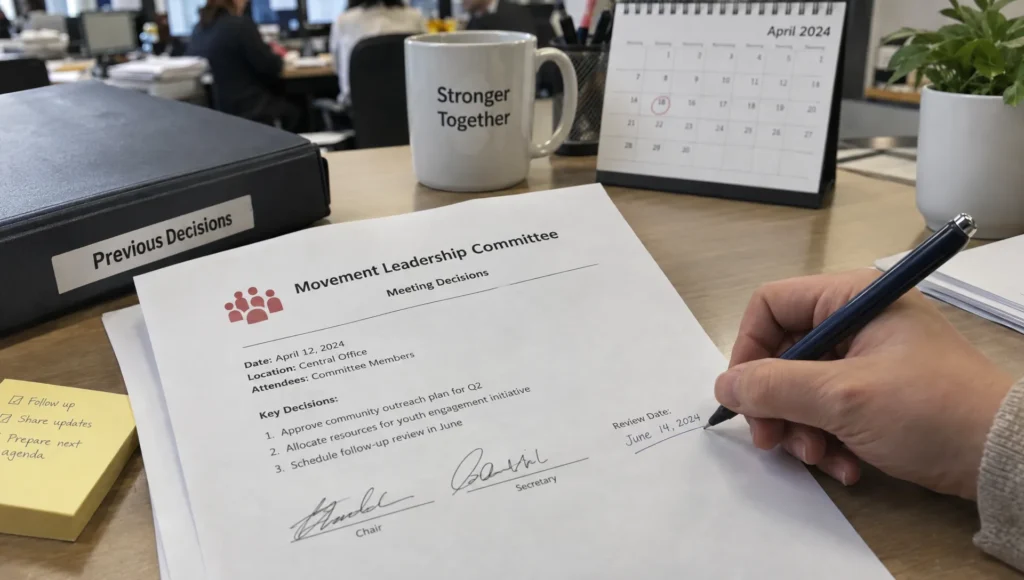
A movement should publish artifacts before, during, and after the pilot. Before the pilot, publish the charter, participation promise, decision target, rules, timeline, privacy note, and issue pack. During the pilot, publish synthesis notes, evidence updates, moderation summaries, and attendance or participation summaries where privacy allows. After the pilot, publish the options memo, delivery proof, response log, implementation tracker, and retrospective.
This is not bureaucracy for its own sake. It is how a movement models the public transparency it wants institutions to adopt.
The JustSocial manifesto criticizes public systems that operate through inertia, bureaucracy, and distance from citizens. Public artifacts are a practical antidote. They make the process visible. They make promises checkable. They allow supporters, critics, journalists, academics, and decision-makers to evaluate the pilot on evidence rather than personality.
Protect the pilot from capture and manipulation
Any civic process can be captured. A loud faction can dominate discussion. A technical team can control the agenda. A funder can shape priorities. A moderator can suppress dissent. A platform can amplify outrage. A bot network can distort apparent public opinion.
The answer is not paranoia. The answer is threat modeling.
Before launching, name the most likely risks for your specific pilot. A school policy pilot may face retaliation concerns for students or parents. A neighborhood pilot may face intimidation or organized brigading. A voting pilot may face eligibility disputes. A transparency pilot may face legal or privacy constraints around documents.
Then match safeguards to the stakes. Low-stakes idea gathering can allow lighter identity checks. A formal community ballot needs stronger eligibility rules. Sensitive testimony may require anonymous or pseudonymous participation. Public deliberation may require process-based moderation, where rules govern relevance, evidence, safety, and format rather than viewpoint.
Be careful with AI. AI can help summarize large volumes of input, translate text, detect duplicate submissions, and draft plain-language materials. It should not become the final judge of what the public thinks. If AI is used, publish where it was used, how humans reviewed it, and how participants can challenge summaries.
Run the pilot in 8 weeks
A first pilot should be short enough to maintain momentum and long enough to produce credible outputs. Eight weeks is often a realistic rhythm for a movement that relies on volunteers and part-time contributors.
| Week | Main activity | Public artifact |
|---|---|---|
| 1 | Select one issue and identify the decision owner | Pilot charter and participation promise |
| 2 | Build the issue pack and recruitment map | Issue pack, outreach plan, accessibility note |
| 3 | Open structured public intake | Claim form, evidence shelf, moderation rules |
| 4 | Synthesize input and map disagreements | Public synthesis and disagreement map |
| 5 | Convene a deliberative working group | Agenda, facilitation rules, participant summary |
| 6 | Draft options and tradeoffs | Options memo with minority notes |
| 7 | Deliver outputs to decision owner | Delivery receipt and response request |
| 8 | Publish results and next steps | Response log, implementation tracker, retrospective |
The key is to finish the loop. Many civic projects get stuck in input collection because collecting more comments feels like progress. It is not enough. The movement must synthesize, deliberate, deliver, and track.
Measure whether the pilot mattered
A civic tech pilot should not be judged by vanity metrics alone. Signups, impressions, and comments can help diagnose reach, but they do not prove democratic value.
Better metrics examine inclusion, discourse quality, deliberation quality, decision linkage, and follow-through.
| Metric category | What to track | What it reveals |
|---|---|---|
| Reach and inclusion | Participation by neighborhood, age range, language, role, or affected group where appropriate | Whether the pilot reached beyond insiders |
| Discursive quality | Percentage of claims with reasons or evidence, number of surfaced disagreements | Whether public talk became more usable |
| Deliberative quality | Options compared, tradeoffs named, minority views included | Whether the process produced informed judgment |
| Decision linkage | Decision owner identified, response requested, response received | Whether participation connected to power |
| Follow-through | Implementation updates, deadlines met, changes explained | Whether the process continued after attention faded |
| Learning | Documented failures, design changes, reusable templates | Whether the pilot can improve and scale |
Publish a short evaluation even if the pilot fails. Especially if it fails. A movement that hides failure trains people to distrust it. A movement that learns in public builds institutional seriousness.
Turn a pilot into a civic institution
A pilot is not the destination. It is a proof point. The strategic goal is to turn repeated pilots into a standing civic capacity.
This is where JustSocial’s broader vision becomes important. The manifesto proposes a people-centered branch of public life, supported by technology, public analytics, and an academic role in producing knowledge and oversight. A local pilot can model that structure in miniature.
The People’s Branch idea can begin as a recurring civic team that maintains issue dockets, runs structured public intake, convenes deliberative groups, publishes decision packs, and tracks official responses. The Academic Branch idea can begin as a partnership with researchers, teachers, students, or independent experts who help create evidence briefs, uncertainty notes, evaluation plans, and plain-language explainers.
Over time, the movement can approach institutions with something stronger than slogans. It can bring a working model, public data, templates, governance rules, and a record of community use. That is how a political movement becomes a builder of democratic infrastructure.
For governments, schools, nonprofits, and civic organizations, the offer becomes practical: start with one decision, one community, one transparent loop, and one published tracker. Then repeat.
Common mistakes to avoid
The most common mistake is building too much software before proving the process. A beautiful platform cannot rescue a vague participation promise.
Another mistake is confusing openness with legitimacy. A comment box open to everyone may still be dominated by the loudest, fastest, most organized, or most digitally connected participants. Inclusion requires design.
A third mistake is overpromising power. If the pilot is advisory, say so. If the movement cannot force a city council or ministry to respond, say that too. People can tolerate limited influence when the limits are honest. They lose trust when symbolic power is sold as real power.
A fourth mistake is ignoring maintenance. Civic tech pilots create obligations: answer questions, protect data, publish updates, correct errors, and continue the tracker after the launch excitement fades.
Finally, movements should avoid treating disagreement as a branding problem. In discursive democracy, disagreement is data. In deliberative democracy, disagreement is material for better options. In civic participation, disagreement must be carried honestly to decision-makers, not edited out to preserve a clean narrative.
FAQ
Can a political movement run a civic tech pilot without government permission? Yes. A movement can run public intake, evidence gathering, deliberation, transparency tracking, and decision-pack delivery independently. However, it should be honest about whether the pilot has formal authority or is advisory.
Should the first pilot include online voting? Usually not as the main feature. Voting can be useful, but early pilots often gain more legitimacy by proving the full process: issue framing, public discussion, evidence review, deliberation, delivery, and follow-through. If voting is used, match identity and security safeguards to the stakes.
How many participants are enough for a first pilot? The better question is whether the right affected groups were invited and whether the process produced usable outputs. A focused pilot with 30 thoughtful participants and strong public artifacts may be more valuable than a vague survey with thousands of responses.
What is the role of deliberative democracy in a civic tech pilot? Deliberative democracy helps convert public input into informed options. It slows the process enough for evidence, tradeoffs, and minority concerns to be considered before recommendations are delivered to decision-makers.
How does discursive democracy fit into the pilot? Discursive democracy improves the wider public conversation before formal deliberation begins. It helps people state claims clearly, provide reasons, challenge assumptions, and make disagreement visible without turning every debate into a popularity contest.
What should a movement publish after the pilot? At minimum, publish the participation promise, issue pack, synthesis, options memo, delivery receipt, response log, implementation tracker, and retrospective. These records make the pilot inspectable and reusable.
Build the first loop, then invite the public to inspect it
A political movement that wants to reform democracy should model the democracy it demands. That means building small, transparent, repeatable civic tech pilots that turn civic participation into public reasoning, public records, and public accountability.
If this vision resonates with you, start with JustSocial’s manifesto, The Face of Democracy. Then choose a contribution lane: organize a local pilot, help design the process, support accessibility, review evidence, build civic technology, volunteer technical skills, or help publish the receipts that make participation trustworthy.
The future of democracy will not be built by one app, one election, or one leader. It will be built through visible loops of participation that people can use, question, improve, and repeat.