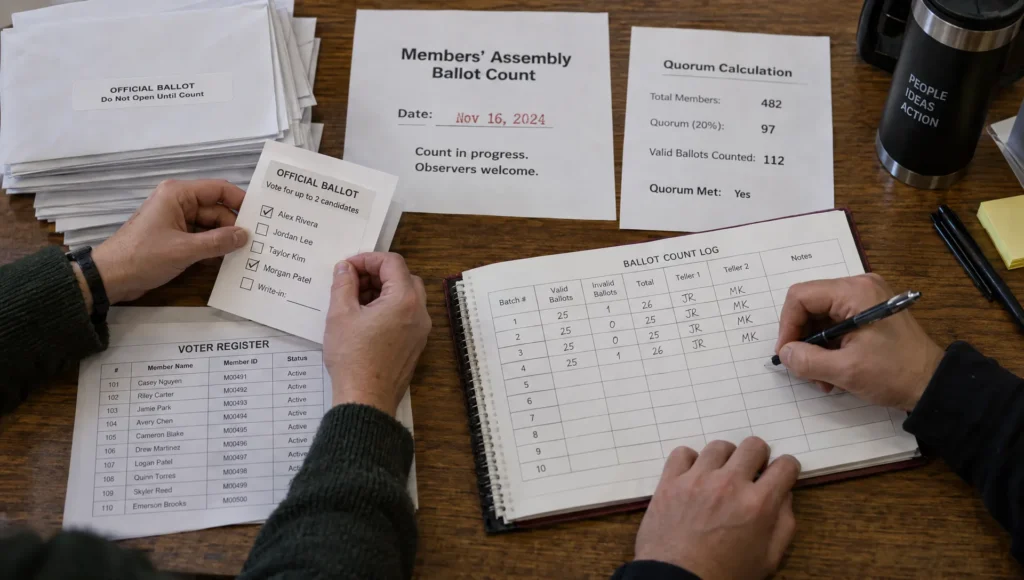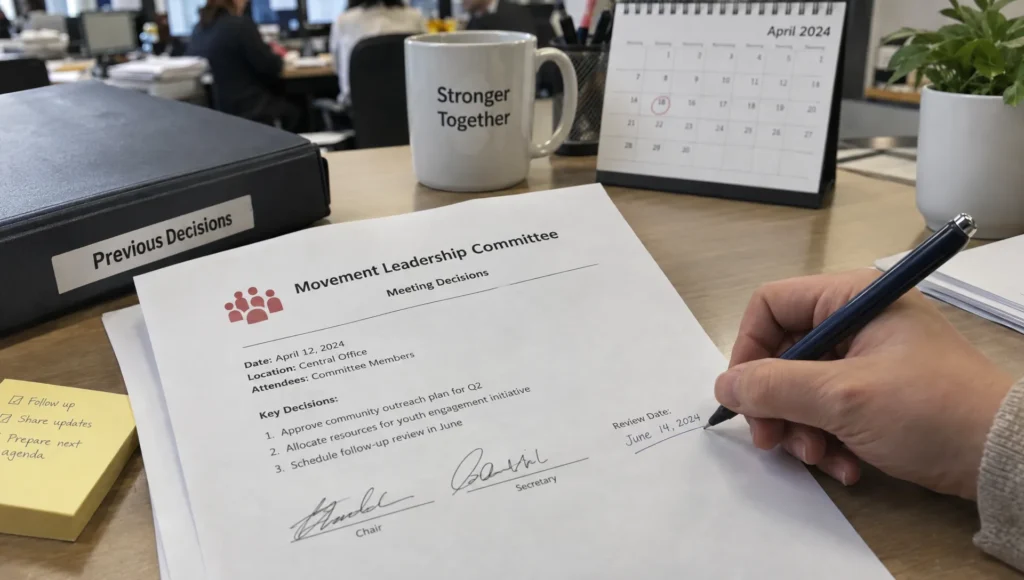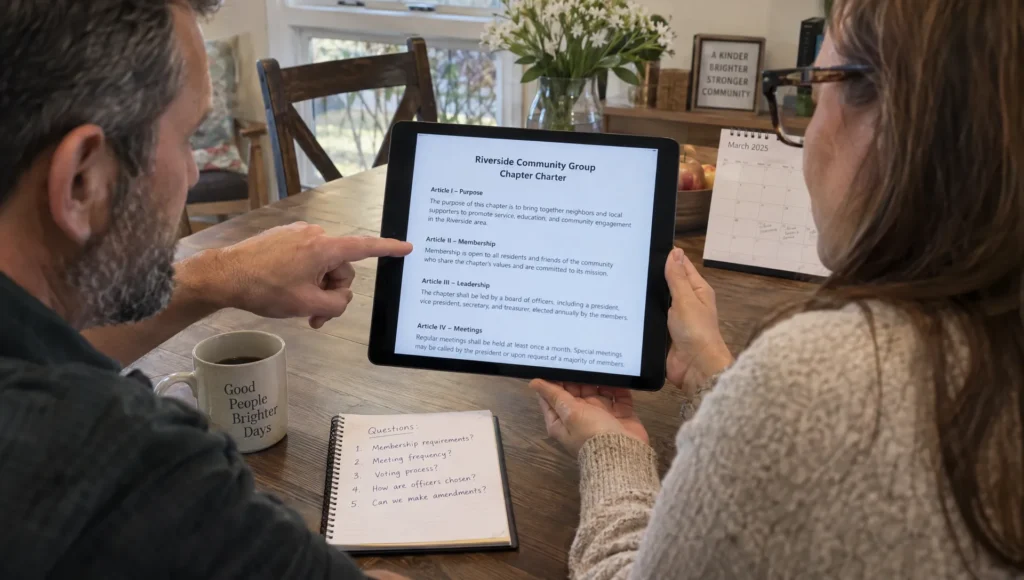
A political movement does not lose trust only when money is stolen. It loses trust when supporters cannot tell who funds it, what the money buys, who benefits from spending decisions, and whether donors quietly receive more influence than ordinary citizens.
That is why political movement funding is not just an administrative task. It is a democratic design problem. If a movement claims to expand civic participation, strengthen deliberative democracy, or build a more transparent public life, its own finances must demonstrate those values before it asks governments to adopt them.
This is especially true for a movement like JustSocial. In The Face of Democracy, Yuval D. Vered argues that modern democracy should move beyond the old pattern of citizens acting mainly as voters, taxpayers, and consumers. The manifesto calls for continuous direct democracy, technology-enabled participation, and public institutions that listen more consistently to the people. Funding should follow the same logic: supporters should not be treated as passive donors, but as participants in a transparent civic project.
Why funding is part of democratic legitimacy
Political money creates a legitimacy test. People may support the mission, agree with the policy goals, and still hesitate if the funding model looks opaque. In a low-trust environment, the question is not only, 'Do I agree with this political movement?' It is also, 'Can I verify that this movement behaves according to its own principles?'
In 2026, this question is sharper than ever. AI-generated persuasion, dark money networks, micro-targeted ads, and influencer-style politics make it easier for groups to look larger, cleaner, or more grassroots than they really are. A movement can be visible without being accountable. It can sound democratic while operating like a closed brand.
Trustworthy funding reverses that pattern. It makes the movement inspectable. It helps supporters understand the difference between a serious civic institution in formation and a personality-driven campaign with a payment link.
Think of the standard people increasingly expect even outside politics: buyers trust a vendor more when inventory, condition checks, pricing, and delivery terms are visible before purchase, as with companies that publish transparent pricing and condition inspection for physical goods. A political movement should be at least as inspectable with the money it asks citizens to contribute.
The basic funding promise every movement should publish
Before asking for donations, investment, purchases, or volunteer labor, a political movement should publish a simple funding promise. This is not a legal filing and it should not replace compliance obligations. It is a public-facing commitment that tells supporters how money will be accepted, governed, spent, and reported.
A credible funding promise should answer five questions clearly: what the movement is raising money for, what kinds of money it will accept, what it will refuse, who approves major spending, and what public receipts supporters can expect.
| Funding question | What supporters need to know | Public artifact to publish |
|---|---|---|
| Purpose | The mission, near-term priorities, and why funding is needed now | Funding statement or campaign brief |
| Sources | Whether money comes from small donors, major donors, grants, sales, services, or investment | Income category summary |
| Boundaries | Donations, conditions, or relationships the movement will not accept | Donation acceptance policy |
| Authority | Who can approve spending and what requires review | Spending authority rules |
| Receipts | How the movement will prove what happened after money was received | Monthly or quarterly transparency report |
This matters because vague fundraising language invites suspicion. 'Support democracy' is emotionally powerful, but it is not enough. A supporter should be able to see whether their contribution helps fund civic technology, public education, translation, legal compliance, organizing, accessibility work, research, or operations.
The JustSocial manifesto is unusually candid about the early-stage reality of movement building: limited capital, a founder-led beginning, a need for volunteers, and a call for people to help spread the idea. That kind of honesty is a strength if it becomes a habit. The next step is turning honesty into a repeatable transparency system.
Ethical funding sources for a political movement
No single funding source is perfect. Small donations are democratic but often unstable. Major gifts can accelerate work but may create influence concerns. Grants can support professional capacity but may distort priorities. Product sales can create independence but may shift focus toward marketing. Volunteer labor can build community but can also hide the true cost of operations.
The goal is not purity. The goal is a funding mix that is transparent, resilient, and aligned with the movement's democratic mission.
A healthy political movement can combine several sources while publishing the rules for each:
- Small recurring contributions that reduce dependence on a few wealthy supporters.
- Larger donations with clear disclosure thresholds, conflict checks, and no hidden policy control.
- Educational products, publications, or events that spread the mission while creating modest revenue.
- Grants or institutional support when the funder does not control civic outputs or political positions.
- Volunteer contributions, tracked respectfully so unpaid labor is visible and not exploited.
- B2G or advisory work when separated from internal movement governance and disclosed properly.
For JustSocial, this distinction is important because the movement sits at the intersection of civic reform, technology, public participation, and government-facing solutions. If a funder supports a prototype, platform, campaign, or policy initiative, the public should know whether that funder receives any special governance rights. A donor should not be able to purchase the rules of participation.
Use discursive democracy to shape funding priorities
Discursive democracy is about the quality of public conversation: how claims are made, how evidence is shared, how disagreements are mapped, and how people understand what is actually at stake. Applied to funding, it means supporters should have a structured way to discuss priorities before budgets become fixed.
Most movements treat funding as an internal leadership matter and messaging as the public layer. That creates a gap. Supporters are asked to mobilize around goals they did not help clarify. Over time, this can produce cynicism, especially when spending decisions appear to follow media attention rather than civic importance.
A movement can use discursive democracy by opening a structured funding discussion around questions like these:
- Which public problem should the movement prioritize in the next quarter?
- What work is most urgent: civic education, software prototypes, local organizing, research, or transparency infrastructure?
- Which communities are currently underrepresented in the movement's spending?
- What risks would make supporters withdraw trust?
- What evidence should guide the next funding decision?
These questions should not be dumped into chaotic comment threads. The movement should collect claims, reasons, evidence, objections, and proposals in a format that can be summarized. The result is not a mob vote. It is a public map of priorities and concerns.
This connects directly to JustSocial's broader idea of a People’s Branch: citizens should be heard continuously and legibly, not only at election time. A movement can model that branch internally by letting supporters shape the agenda around money.

Use deliberative democracy for major budget choices
Discursive democracy helps surface concerns. Deliberative democracy helps turn those concerns into reasoned options. For funding, that means a political movement should not decide every major budget choice behind closed doors and then publish a polished explanation afterward.
Instead, for significant spending decisions, the movement can convene a small deliberative budget group. The group should review evidence, compare options, consider tradeoffs, and produce a short recommendation. The leadership may still make the final decision, especially in an early-stage movement, but it should respond publicly to the recommendation.
For example, imagine a movement has enough money to fund only one of three priorities: a local civic participation pilot, a public transparency dashboard, or a series of educational workshops. A deliberative process would ask participants to compare the options using shared criteria such as mission alignment, urgency, cost, reach, feasibility, and long-term capacity.
| Budget option | Key question | Evidence needed | Possible public output |
|---|---|---|---|
| Civic participation pilot | Can this create real decision-linked public input? | Local decision calendar, partner readiness, accessibility needs | Pilot charter and evaluation plan |
| Transparency dashboard | Will this make the movement more inspectable? | Data sources, maintenance cost, privacy risks | Public receipt dashboard |
| Educational workshops | Will this expand civic capacity? | Audience need, curriculum, facilitator availability | Workshop plan and learning report |
This process does not need to be expensive. A small movement can start with a two-hour online session, a simple issue pack, and a published options memo. What matters is the discipline: people see the tradeoffs, the reasoning, and the final response.
That is the deeper point of JustSocial's manifesto. Technology should not merely amplify political noise. It should help create civic systems where people can reason together, influence priorities, and inspect outcomes.
What financial transparency should include
Transparency is not the same as publishing everything. A responsible movement protects personal privacy, legal compliance, security, and vulnerable supporters. But it should publish enough for outsiders to understand the flow of money and the integrity of decisions.
A practical transparency stack can be simple at first.
| Transparency artifact | What it shows | Suggested cadence |
|---|---|---|
| Income summary | Money received by category, such as small donations, major donations, sales, grants, or services | Monthly or quarterly |
| Expense summary | Spending by mission category, such as technology, education, organizing, operations, legal, or research | Monthly or quarterly |
| Major expense memo | Why a large cost was approved and how it connects to the mission | For expenses above a published threshold |
| Conflict register | Relevant financial, vendor, employment, or governance conflicts | Updated when needed |
| Restricted funds note | Money that can only be used for a defined purpose | Quarterly |
| Volunteer contribution log | Hours and roles contributed, without exposing private personal data | Monthly or quarterly |
| Impact receipt | What was produced with the funding | After each project milestone |
This is the funding version of public receipts. A receipt is not a slogan. It is a compact record that lets people verify what happened. If a movement raises money for a prototype, the receipt might be a product brief, accessibility review, test report, or public demo note. If it raises money for education, the receipt might be curriculum materials, attendance summaries, feedback, and follow-up actions.
The key is to connect money to outcomes without pretending every outcome is immediate. Movement building includes invisible work: legal setup, translation, moderation, security, administration, and relationship building. These costs are legitimate. They become suspicious only when hidden.
Guardrails that protect trust
A political movement should treat money as a source of risk as well as capacity. The more serious the mission, the more disciplined the guardrails should be.
First, there should be a donor influence rule. Donors can support the movement, but they should not receive secret control over policy positions, participant selection, platform rules, or public priorities. If a donor funds a specific project, that restriction should be disclosed in general terms.
Second, there should be a conflict-of-interest process. Movement leaders, vendors, contractors, advisors, and major funders may have overlapping relationships. Not every overlap is corruption, but undisclosed overlaps corrode trust. A short conflict register is often enough for early-stage work.
Third, there should be privacy-by-design. Publishing donor names may be legally required in some contexts and harmful in others. A movement should comply with relevant law while protecting small supporters from harassment or retaliation where possible. Transparency should expose power, not endanger ordinary participants.
Fourth, there should be a separation between fundraising and deliberation. People who give more money should not get more voice in deliberative democracy processes. A supporter who gives a small amount, volunteers time, or contributes lived experience may be just as important to the movement's judgment as a major donor.
Finally, there should be a compliance baseline. Political finance rules vary by country, state, and activity type. A civic nonprofit, political party, campaign committee, company, and social movement may face different obligations. This article is not legal advice. Any serious movement should get qualified guidance before raising or spending funds at scale.
Red flags supporters should watch for
Supporters should not need blind faith. They should be able to evaluate a movement's funding culture before contributing.
Be careful when a political movement asks for money but refuses to publish even a basic budget. Be careful when leaders claim that transparency is impossible because opponents might use it against them. Some details may need protection, but total opacity is not a safeguard. It is a power structure.
Other warning signs include fundraising around emergencies with no follow-up receipts, major donors who appear to receive special access, public language about democracy paired with internal decision-making that excludes supporters, and claims that all money goes directly to the cause while operational workers remain unpaid or invisible.
A movement does not need to be perfect to deserve support. But it should be learning in public. It should admit constraints, publish corrections, and improve its transparency over time.
A 30-day starter plan for transparent movement funding
A small political movement can begin without complex software. The first goal is to create minimum viable trust.
- Week 1: Publish the funding promise: State what you are raising for, what you will not accept, who approves spending, and when supporters will receive updates.
- Week 2: Create the first budget map: List expected income categories, planned spending categories, and the top three unfunded needs.
- Week 3: Run a discursive funding session: Invite supporters to submit claims, reasons, concerns, and priorities in a structured format.
- Week 4: Publish a decision memo: Explain what you heard, what you decided, what remains unresolved, and when the next financial receipt will be published.
This cycle can be repeated monthly. Over time, the movement can add more formal deliberative democracy practices, independent review, audited statements, public dashboards, and participatory budgeting for specific funds.
The point is not to create bureaucracy for its own sake. The point is to build the civic muscle that the movement wants society to adopt. If JustSocial argues that government should precisely measure public opinion, publish public records, and empower citizens through technology, then movement funding is a natural place to practice those norms.
Funding as a prototype of the society you want
Every political movement faces a temptation: win first, become transparent later. The problem is that political habits harden early. If money is handled through informal trust, personal loyalty, and closed decision-making at the beginning, it is unlikely to become democratic after the movement gains power.
Funding should be treated as a prototype of the future social contract. In the old contract, citizens often pay taxes and receive distant decisions from institutions they barely understand. In a better contract, people can see priorities, weigh in, inspect reasoning, and track results.
That does not mean every supporter votes on every invoice. It means the movement creates a transparent relationship between resources, decisions, and public value.
For JustSocial, this is not a side issue. The manifesto imagines a society where the people are not reduced to occasional voters and passive consumers. A transparent funding model helps prove that the movement means it. It says: if you support this work, you are not merely giving money to a brand. You are helping build a civic institution that should remain answerable to the people who make it possible.
Frequently Asked Questions
What is the best funding model for a political movement? The best model is usually mixed: small recurring contributions for independence, transparent larger support for capacity, mission-aligned educational or product revenue, and volunteer labor that is acknowledged rather than hidden. The right mix depends on legal structure, country, scale, and goals.
Should every donor be publicly named? Not always. Disclosure rules depend on law and activity type, and privacy risks are real. A trustworthy movement should comply with legal requirements, disclose concentrated power and conflicts, and protect ordinary supporters where appropriate.
How can deliberative democracy improve movement funding? Deliberative democracy helps supporters compare budget options using evidence and tradeoffs rather than impulse or internal politics. It can produce recommendations that leadership must answer publicly, even if leadership keeps final responsibility.
What is the difference between transparency and performative transparency? Real transparency lets outsiders verify decisions, money flows, conflicts, and outcomes. Performative transparency publishes polished updates without enough detail to inspect whether promises were kept.
Can an early-stage movement be transparent without expensive tools? Yes. A simple public funding promise, budget map, decision memo, and quarterly receipt report can build meaningful trust before advanced platforms or audits are possible.
Help build funding practices worthy of democracy
Political movement funding should not imitate the closed habits of the systems it wants to reform. It should model civic participation, public reasoning, and accountability from the start.
If the JustSocial vision resonates with you, read the manifesto, share it with people who care about democracy reform, and consider how you can contribute skills, time, resources, or constructive critique. A movement for continuous direct democracy must be funded by people who expect transparency, practice participation, and insist that trust be earned in public.