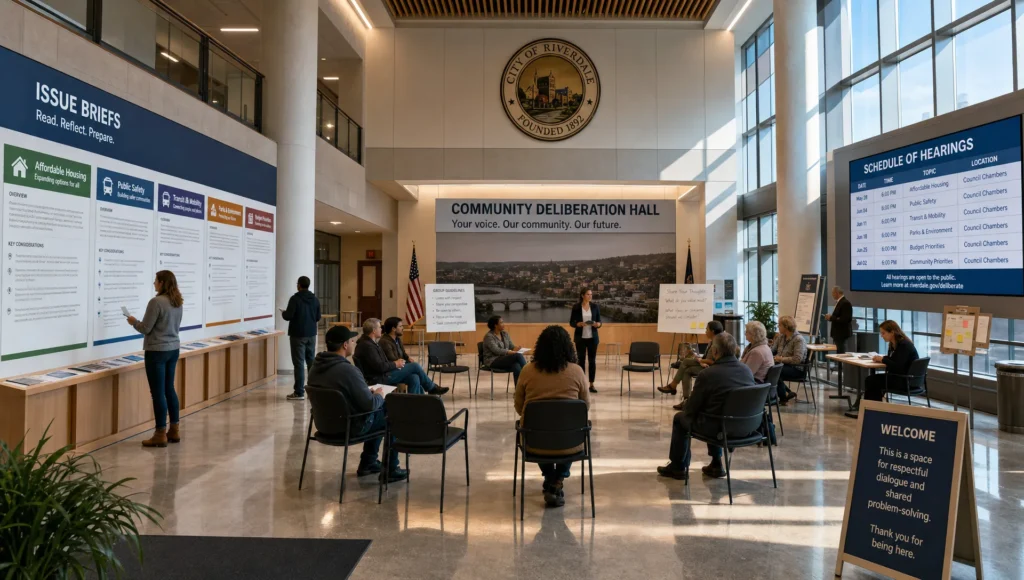
If party politics has started to feel like a permanent shouting match, you are not alone. Many people still care deeply about public life, but they feel exhausted by party branding, campaign slogans, loyalty tests, and the sense that ordinary citizens disappear between elections.
That exhaustion can become apathy. But it can also become something more useful: civic participation that is issue-first, transparent, and connected to real decisions.
You do not have to become a party loyalist to influence your school, city, workplace, neighborhood, or national institutions. You can practice politics in a different way, one that starts with public problems, brings people into structured discussion, asks decision-makers for visible answers, and tracks whether anything actually changes.
That is close to the core argument of JustSocial’s manifesto, The Face of Democracy: democracy should not reduce people to voters, taxpayers, and consumers. It should give citizens continuous, meaningful ways to be heard and to shape public life.

Why party politics feels so draining
Party politics has a purpose. Parties organize candidates, form governments, create platforms, and compete for power. In representative systems, they are difficult to avoid.
But parties also compress people. A person with complex views about housing, education, public safety, public technology, religion, taxes, and civil rights is often treated as a single partisan identity. Once that happens, public discussion becomes less about solving problems and more about proving loyalty.
There are several reasons this burns people out.
First, campaigns reward conflict. Election cycles need clear enemies, repeatable slogans, and emotional urgency. Governing, by contrast, requires evidence, tradeoffs, implementation, budgets, and accountability. The habits that win attention are not always the habits that solve problems.
Second, party systems often make citizens feel replaceable. You may vote every few years, receive fundraising messages, watch elected officials negotiate behind closed doors, and then be asked to repeat the cycle. The feedback loop is weak.
Third, modern public trust is fragile. Pew Research Center’s long-running public trust data shows that trust in the U.S. federal government has remained near historic lows for years. This is not only an American issue. Across many democracies, citizens increasingly feel that institutions do not listen well, explain decisions clearly, or respond consistently.
The answer is not to pretend parties do not matter. The answer is to stop treating party politics as the only form of politics.
Civic participation is politics without the party uniform
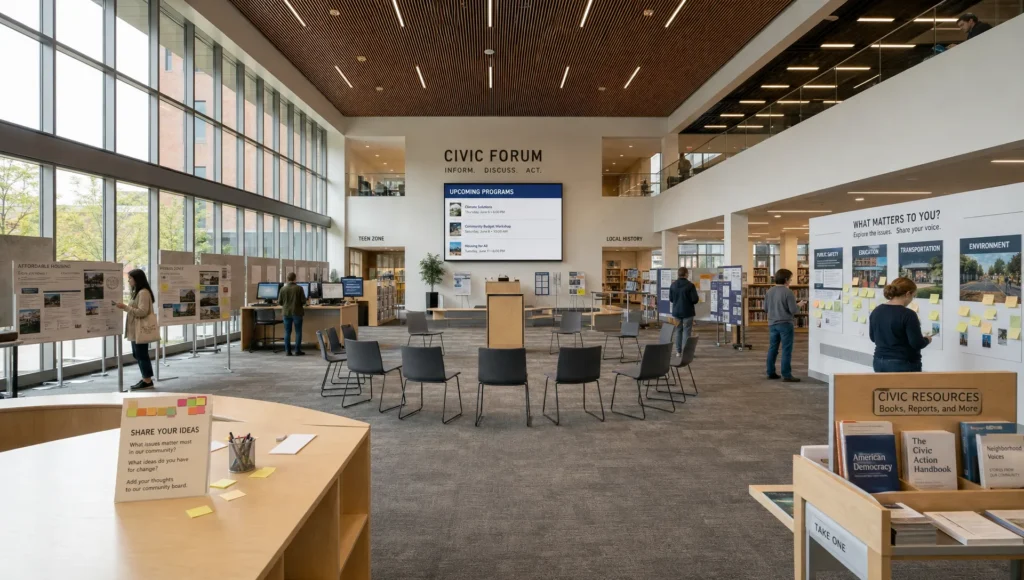
Civic participation means taking part in public life in ways that can influence decisions, priorities, accountability, and community problem-solving. Voting is one form of participation, but it is not the whole story.
For people tired of party politics, the most useful distinction is this:
Party politics asks, “Which team should govern?” Civic participation asks, “What decision is being made, who is affected, what evidence matters, and how will the public know whether officials responded?”
That shift changes the work. Instead of arguing forever about identity, you focus on decisions.
| Party-centered politics | Decision-centered civic participation |
|---|---|
| Starts with party identity | Starts with a public problem |
| Measures attention, turnout, and loyalty | Measures influence, transparency, and follow-through |
| Rewards message discipline | Rewards clear evidence and usable proposals |
| Often peaks during elections | Continues between elections |
| Treats citizens as supporters | Treats citizens as participants and watchdogs |
This is not “anti-party.” Parties can still run candidates, pass laws, and govern. But civic participation gives citizens more than a spectator role. It creates a way to act before, during, and after party competition.
Start with the decision, not the ideology
The fastest way to escape partisan exhaustion is to stop beginning with a grand political label. Start with one decision.
A decision is specific. It has an owner, a timeline, a process, and consequences. Examples include a city budget vote, a school district phone policy, a public transport route change, a zoning decision, a police oversight procedure, or a procurement contract for public technology.
A useful civic question sounds like this:
“What decision is being made, by whom, by when, under what rules, and where can the public input be seen?”
That question cuts through noise. It forces participation to become practical.
If you are tired of partisan debate, choose an issue where real people have a shared stake even if they disagree politically. Street safety, school quality, public service delays, open data, accessibility, emergency preparedness, and local budgeting often create space for cross-partisan civic work.
A simple first step is to write a one-page Decision Note:
- Decision owner: Name the council, agency, committee, school board, ministry, or department responsible.
- Decision window: Identify the next meeting, consultation deadline, budget cycle, or vote.
- Public impact: Explain who is affected and how.
- Evidence: Add two or three reliable sources, local examples, or public records.
- Request: Ask for a specific action, explanation, meeting agenda item, or published response.
- Receipt: Ask what public record will show how input was considered.
This approach is less glamorous than partisan outrage, but it is much harder to dismiss.
Use discursive democracy to make public debate usable
People often leave party politics because public debate feels poisoned. But silence does not fix the public sphere. We need better rules for disagreement.
This is where discursive democracy matters. Discursive democracy focuses on the quality of public conversation: how issues are framed, whose voices are heard, what evidence is shared, and whether disagreement becomes legible instead of chaotic.
For a citizen group, neighborhood forum, school community, or movement chapter, discursive democracy can be very practical. It means setting process boundaries before the argument begins.
A healthier discussion format can ask each participant to separate four things:
- Claim: What do you believe is happening?
- Reason: Why do you believe it?
- Evidence: What experience, data, document, or testimony supports it?
- Request: What should a decision-maker do next?
This does not eliminate disagreement. It makes disagreement useful.
For example, consider a dispute over a city’s plan to remove parking spaces for a bus lane. Party-style debate may quickly become “anti-car” versus “anti-transit.” Discursive participation asks better questions: Who uses this street? What is the current delay? How many businesses rely on curb access? What safety data exists? What alternatives were considered? What tradeoffs are decision-makers willing to publish?
The goal is not to force consensus. The goal is to create a public record that a deliberative group or decision-maker can actually use.
Use deliberative democracy when the issue has tradeoffs
Some civic issues are not solved by collecting opinions. They require structured judgment.
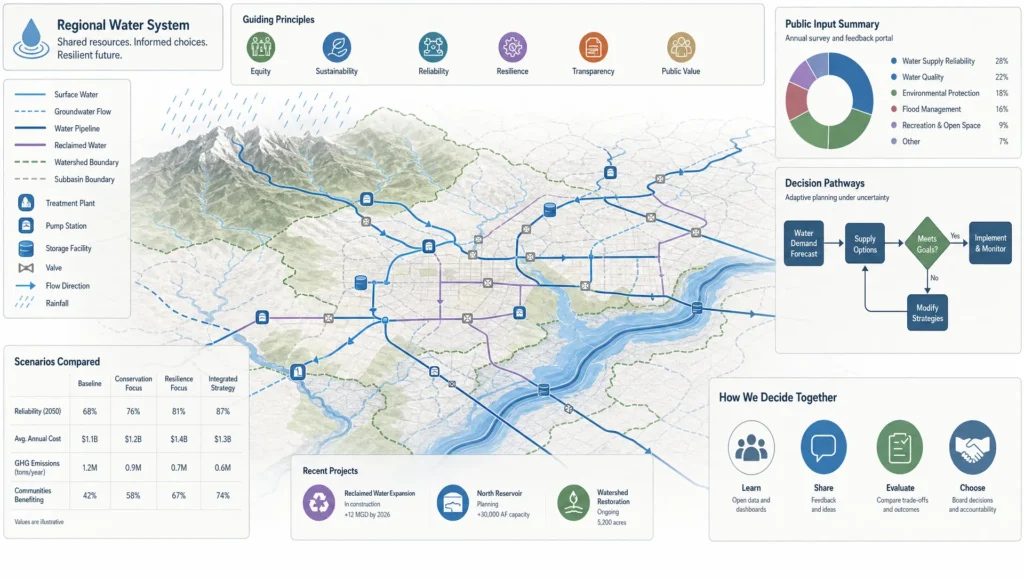
That is where deliberative democracy comes in. Deliberative democracy brings people into a fair, informed process where they review evidence, hear from affected groups, discuss tradeoffs, and produce recommendations or options.
This is especially useful when the issue involves competing values, limited budgets, technical complexity, or unequal impacts. Housing, education reform, climate adaptation, public safety, and health policy all benefit from deliberation because they cannot be reduced to a simple slogan.
A small deliberative process does not need to be complicated. It can involve a diverse group of residents, a shared evidence packet, a facilitator, clear rules, and a short options memo at the end.
A strong options memo usually includes:
- The decision question being answered
- The main options considered
- The strongest argument for each option
- The strongest concern about each option
- Expected costs, risks, and implementation needs
- Points of agreement and disagreement
- A clear request for an official response
This is the opposite of performative politics. It tells decision-makers, “We did the civic work. Here is the public reasoning. Now show us how you will respond.”
JustSocial’s broader vision of continuous direct democracy depends on this distinction. Technology can help gather input, organize evidence, and publish outputs, but legitimate democracy still requires reasoning, safeguards, and visible follow-through.
Ask for public receipts
People tired of party politics often say, “No one listens anyway.” Sometimes that is true. But the solution is not only louder speech. It is a stronger demand for proof.
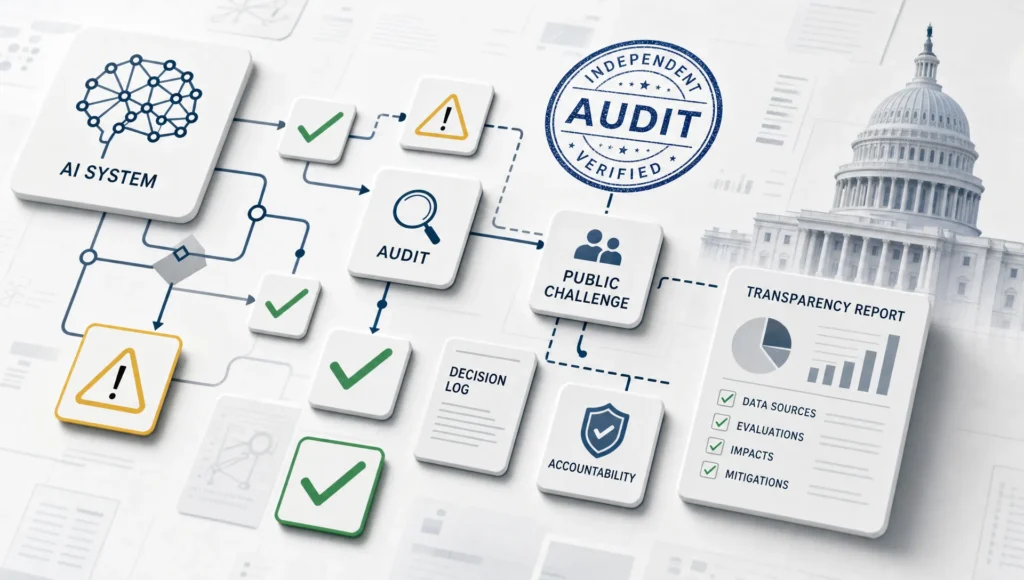
A public receipt is a visible artifact showing what happened in a decision process. It can be an agenda, minutes, a response memo, a vote record, a decision rationale, a dataset, a budget line, or an implementation tracker.
Receipts matter because they reduce the amount of trust citizens must place in personalities. You do not have to believe a politician’s speech if the process produces inspectable records.
When contacting an official or institution, include a receipt request:
“Please publish the decision rationale, including which public inputs were considered, which were rejected, and why.”
Or:
“Please add this issue to the public agenda and identify the timeline, decision owner, and criteria for evaluating options.”
Or:
“If the proposal is approved, please publish an implementation tracker with deadlines, responsible staff, and progress updates.”
This connects directly to the JustSocial manifesto’s critique of citizens being heard only through elections or noisy media attention. Continuous democracy needs a memory. Public receipts create that memory.
Build a civic lane that parties cannot easily capture
If you are trying to participate outside party politics, you need guardrails. Otherwise, every civic effort can be pulled back into partisan identity.
The goal is not to ban party members. That would be unrealistic and often undemocratic. The goal is to make the process stronger than the faction.
Here are five useful guardrails:
| Risk | Guardrail |
|---|---|
| A group becomes a campaign tool | Publish a participation promise and decision scope |
| Loud voices dominate | Use structured speaking time and written input |
| Evidence becomes selective | Maintain a shared evidence shelf with sources and counterclaims |
| Officials give vague answers | Ask for written rationales and implementation trackers |
| People burn out | Work on one decision at a time and rotate roles |
These guardrails help citizens cooperate across differences without pretending differences do not exist.
A conservative parent, a progressive teacher, a politically independent student, and a nonpartisan local business owner may disagree on national politics. But they can still deliberate about a school safety policy, a curriculum transparency process, or a mental health budget if the process is clear, respectful, and tied to a real decision.
This is civic participation as a discipline, not a mood.
What one issue-first civic sprint can look like
Here is a realistic example.
A group of residents is frustrated by repeated pedestrian accidents near a school. Party politics could turn the issue into a fight about cars, policing, climate, urbanism, or municipal incompetence. Civic participation starts smaller and sharper.
The group identifies the decision owner: the city transportation department and the relevant council committee. It finds the decision window: the next quarterly street safety review. It builds a short evidence file: crash reports, photos, parent testimony, school arrival patterns, and examples of similar interventions in nearby cities.
Then it runs a discursive session. Residents submit claims, reasons, evidence, and requests. The group maps areas of agreement and disagreement. Some want speed bumps. Some want a crossing guard. Some worry about traffic spillover. Some ask for better lighting.
Next, a smaller deliberative team creates three options: quick paint and signage, a temporary protected crossing pilot, and a full street redesign proposal. Each option includes cost range, timeline, benefits, risks, and what would need to be measured.
Finally, the group sends the options memo to officials and asks for a public response. If officials act, the group tracks implementation. If officials refuse, the group publishes the refusal and asks why.
No one had to join a party. No one had to pretend the issue was apolitical. The group practiced politics by making a public decision more visible, reasoned, and accountable.
How this connects to JustSocial’s political movement
JustSocial is a political movement, but not in the narrow sense of telling people to become loyal soldiers in a party machine. Its manifesto argues for a deeper reform: a modern democracy where citizens can participate continuously, public institutions become more transparent, and technology helps people shape decisions rather than merely react to them.
Several ideas from the manifesto are especially relevant for people tired of party politics.
First, the manifesto argues that the current social contract is too thin. Citizens are expected to study in systems they barely shape, pay taxes into institutions they barely understand, and vote occasionally for representatives who often do not listen consistently. Civic participation is the practical beginning of a thicker social contract.
Second, the manifesto proposes a stronger role for “the people” as an ongoing democratic branch. Whether formalized in law or piloted locally, this idea points toward standing participation systems: public issue dockets, structured deliberation, transparent analytics, and visible decision records.
Third, the manifesto emphasizes technology, but not as a magic substitute for democracy. Concepts such as TakeAction!, rParliament, and rConcensus are described as ways to connect news, public records, community voting, and civic action. The deeper principle is that digital tools should help citizens organize attention into influence.
Fourth, the manifesto’s reflection on the Greek Polis is not nostalgia for exclusionary ancient politics. The lesson is intimacy and meaning. People should feel that public life is not remote, abstract, and owned by professionals. A modern democracy must scale that sense of belonging without sacrificing rights, inclusion, or safeguards.
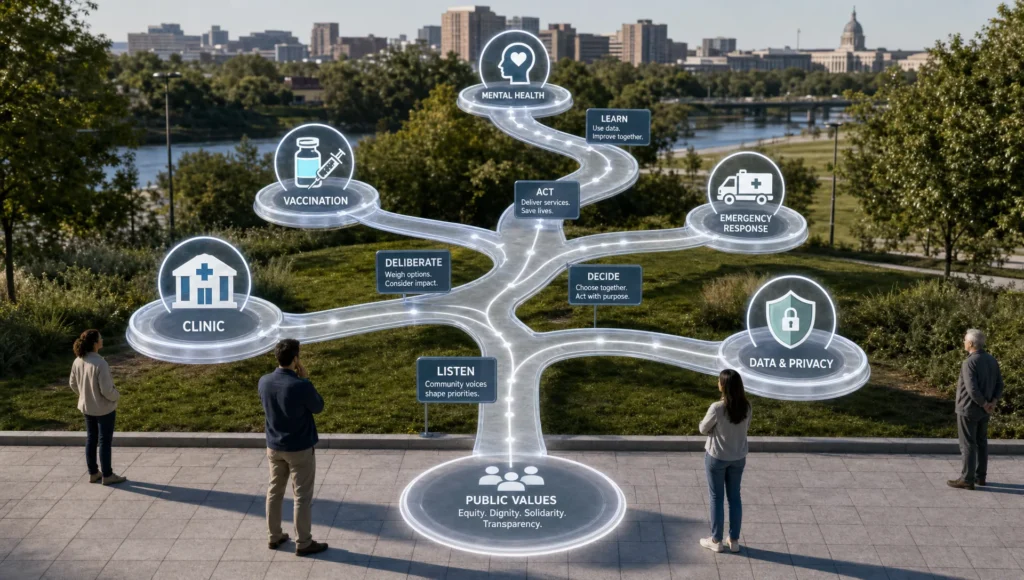
That is the path from party fatigue to democratic renewal: not withdrawal, but better participation infrastructure.
A first step for this week
If you want to begin without joining a party, choose one public decision and write one Decision Note.
Keep it short. Keep it factual. Keep it attached to a real decision-maker. Send it to the relevant office, publish it where your community can see it, and ask for a receipt.
Use this template:
We are asking about [specific decision]. The decision owner appears to be [person, office, committee, agency]. The decision window is [date or process]. The affected public includes [groups]. The key evidence we found is [sources or observations]. Our request is [specific action]. Please publish [agenda item, response memo, rationale, tracker, or timeline] so the public can see how this input is handled.
That single note will not fix democracy. But it changes your role. You are no longer only reacting to politics. You are producing civic evidence, civic pressure, and civic memory.
Frequently Asked Questions
Can civic participation really be nonpartisan? It can be nonpartisan in process, even when the issue has political meaning. The key is to focus on decisions, evidence, public reasoning, and accountability rather than party loyalty.
Does this mean parties do not matter? No. Parties still compete for office and pass laws. Civic participation complements elections by giving citizens ways to influence agenda-setting, deliberation, implementation, and oversight between elections.
What if officials ignore citizen input? Ask for public receipts, publish the lack of response, build a broader coalition, attend the next decision meeting, and keep a response log. If ignored repeatedly, that record becomes evidence for stronger public pressure or electoral accountability.
How do I avoid being used by partisan groups? Work with transparent rules. Publish the decision scope, evidence sources, funding or affiliations where relevant, meeting notes, and output documents. A process that can be inspected is harder to capture.
Is online civic participation safe? It depends on the design. Safe digital participation needs privacy protection, accessibility, moderation rules, identity controls appropriate to the stakes, and public audit records. Technology should support democratic legitimacy, not replace it.
Help build democracy beyond party fatigue
If you are tired of party politics, do not mistake exhaustion for powerlessness. The next democratic step is to build civic participation that is continuous, transparent, and decision-connected.
JustSocial exists to advance that shift: from occasional voting to continuous direct democracy, from vague public anger to structured civic action, and from closed institutions to public receipts.
Read The Face of Democracy, explore the work at JustSocial.io, and consider contributing as a citizen, organizer, technologist, educator, volunteer, or supporter. The future of democracy will not be built by parties alone. It will be built by people who decide to participate even when party politics has failed to inspire them.