Trust in public life is not repaired by a better slogan. It is rebuilt when people repeatedly experience something concrete: I can understand the decision, I can speak into it, I can see how evidence was weighed, and I can check whether promises were kept.
That experience is the practical promise of civic participation. Not participation as a ceremonial town hall. Not participation as a comment box that disappears into an inbox. Real participation means citizens have visible, recurring, and accountable ways to shape the public decisions that affect their schools, neighborhoods, budgets, rights, and future.
The trust problem is not abstract. Pew Research Center's long-running public trust tracker shows that trust in the U.S. federal government has hovered near historic lows for years, with about two-in-ten Americans saying in 2024 that they trust the government in Washington to do what is right just about always or most of the time. The challenge is global as well. The OECD 2024 Survey on Drivers of Trust in Public Institutions reported that, on average across surveyed countries, only 39% of people had high or moderately high trust in their national government.
But low trust does not mean people no longer care. Often, it means the opposite. People care deeply, but they do not believe public life has a meaningful place for them.
The trust crisis is partly a participation crisis
Modern public life often treats people as spectators. Citizens vote, pay taxes, consume news, complain online, and occasionally attend a meeting after the real decision has already been shaped. Between elections, many experience government as a distant system of procedures, forms, party negotiations, bureaucratic delays, and public statements.
This is exactly the condition JustSocial's manifesto, The Face of Democracy, challenges. It argues that industrial-era institutions still shape education, work, and politics even though society now has the technology and civic knowledge to build more continuous forms of democratic participation. Its critique is sharp: citizens are too often reduced to voters, taxpayers, and private consumers rather than treated as active members of public life.
The loss of trust follows from that reduction. When people cannot see the path from public concern to public decision, suspicion fills the gap.
| Trust problem | What citizens experience | Civic participation response |
|---|---|---|
| Distance | Decisions feel remote and already decided | Bring participation earlier into agenda-setting and policy design |
| Opacity | People cannot see why choices were made | Publish evidence, tradeoffs, rationales, and implementation updates |
| Capture | Organized insiders appear to dominate | Open structured channels for broader, documented public input |
| Polarization | Debate becomes identity warfare | Use discursive democracy to clarify claims, reasons, and disagreements |
| Complexity | Issues feel too technical for ordinary people | Use deliberative democracy with accessible evidence and expert support |
| Broken promises | Input disappears after meetings | Track responses, commitments, deadlines, and outcomes publicly |
This is why rebuilding trust requires more than electing different leaders. It requires changing the public experience of democracy.
Civic participation rebuilds trust through repeated proof
Trust grows when people can verify a process, not when they are asked to have faith in it. Civic participation can provide that verification through four mechanisms: visibility, reasoning, consequence, and memory.
1. Visibility: people need to see the real decision
Public frustration often begins with a basic question: who is actually deciding this?
A city may hold a listening session about transit, but the budget line may already be fixed. A school may ask parents for feedback on phone policy, but the legal constraints and decision timeline may be unclear. A national ministry may invite comments on a reform, but citizens may not know whether their input affects language, implementation, or only public relations.
Civic participation rebuilds trust when every process begins with a clear decision statement. The public should know the decision owner, the decision window, what is open to change, what is legally fixed, and what kind of input will matter.
This sounds simple, but it changes the emotional contract. Citizens stop feeling like they are shouting into fog. Officials stop receiving unfocused anger and start receiving usable public judgment.
2. Reasoning: conflict becomes less threatening when it is structured
Democratic trust does not require agreement. In pluralistic societies, disagreement is normal and healthy. What destroys trust is the feeling that disagreement is pointless, manipulated, or contemptuous.
This is where discursive democracy matters. Discursive democracy focuses on the quality of public conversation: how claims are made, how evidence is shared, how people respond to each other, how identity and experience enter the conversation, and how disagreement becomes visible without becoming chaos.
A healthier public discussion asks citizens to move from pure reaction to reasoned contribution. Instead of only saying, I oppose this plan, a participant is invited to state the claim, give the reason, name the evidence or lived experience, and identify the decision request.
That format does not make everyone polite or moderate. It makes public disagreement usable. It gives institutions, journalists, movements, and neighbors a way to understand what people mean and where conflicts actually sit.
3. Consequence: participation must connect to action
Nothing destroys civic trust faster than participation theater. If citizens spend hours giving testimony and no one can later show what changed, the process teaches cynicism.
Meaningful civic participation must create a visible bridge between public input and official response. Decision-makers do not have to obey every majority impulse, and they must still protect rights, facts, budgets, and minority interests. But they should have to explain how public input was considered.
A trustworthy process publishes a response memo after participation. It can say which proposals were accepted, which were rejected, which were modified, and why. It can also name the next step, the responsible office, and the timeline.
The point is not to guarantee that every citizen wins. The point is to make losing understandable. People can accept disagreement more easily than contempt. They can accept a hard tradeoff more easily than silence.
4. Memory: public life needs records people can inspect
Trust needs memory. If every public meeting, consultation, promise, and reform disappears into archives no ordinary person can navigate, public life resets into confusion again and again.
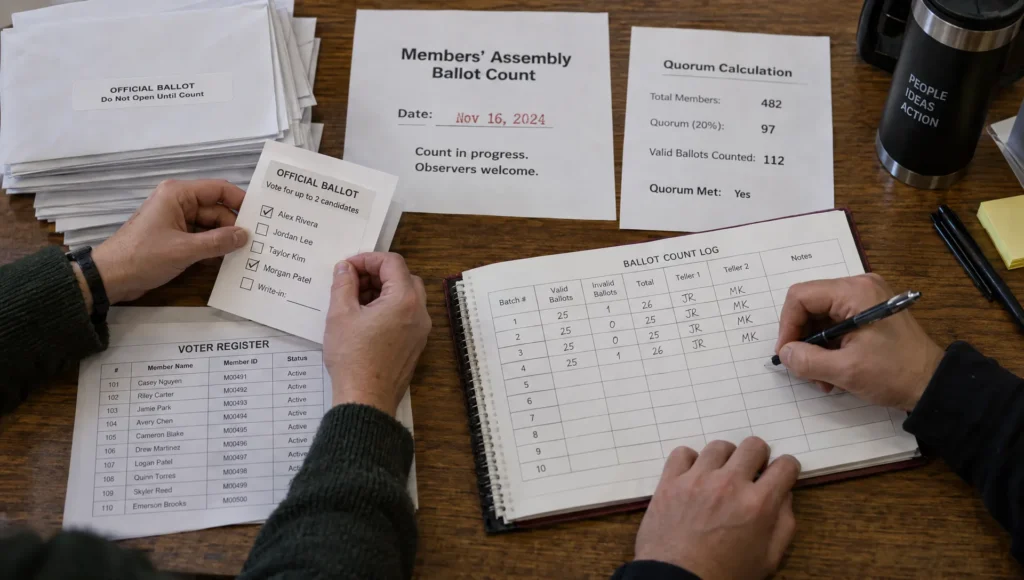
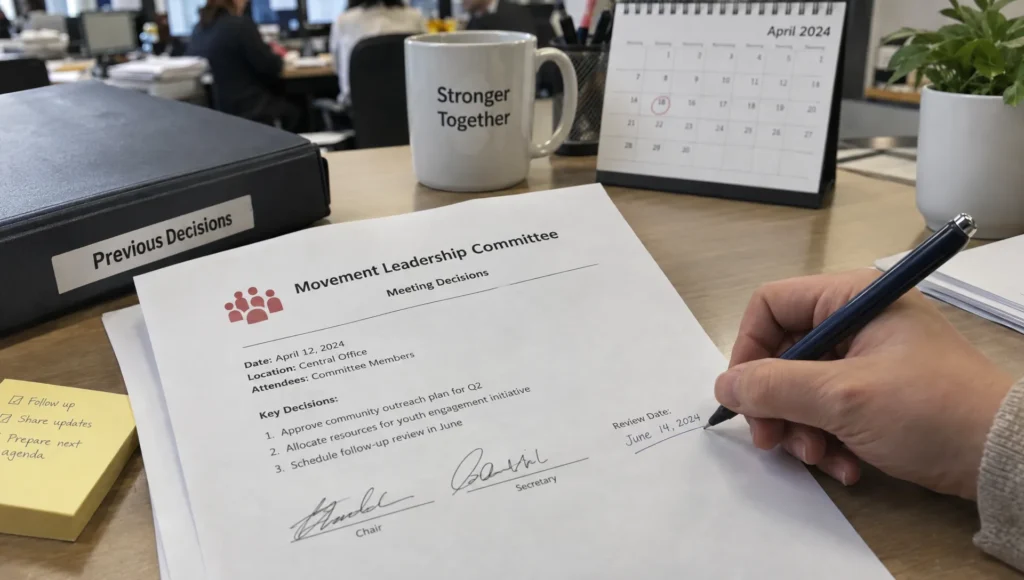
Civic participation should leave behind public artifacts: issue packs, evidence indexes, meeting notes, synthesis reports, options memos, decision rationales, and implementation trackers. These records are not bureaucracy for its own sake. They are civic memory.
They let newcomers catch up. They help journalists report accurately. They allow minority positions to remain visible. They make it harder for officials or movements to rewrite history. They also teach citizens how decisions are made, which is one of the deepest forms of civic education.
A practical trust loop for public life
Civic participation rebuilds trust when it becomes a loop, not an event. A local council, school district, ministry, public agency, nonprofit, or political movement can start with a simple structure:
- Name the decision: Publish the decision owner, scope, constraints, timeline, and what public input can influence.
- Build a shared evidence base: Create an issue pack with data, legal constraints, budget facts, lived-experience summaries, and uncertainty notes.
- Open discursive input: Invite broad public contributions in a structured format that captures claims, reasons, evidence, and requests.
- Run deliberative work: Convene a smaller, diverse group to weigh tradeoffs and produce decision-ready options.
- Require a public response: Ask the decision-maker to explain what was adopted, rejected, delayed, or changed.
- Track implementation: Publish progress, deadlines, responsible offices, obstacles, and outcomes.
This loop is modest enough to pilot locally and strong enough to scale. It also reflects a core theme of JustSocial's manifesto: democracy should not be a once-every-few-years ritual. It should become a continuous civic capacity.
Why deliberative democracy is essential for trust
Broad participation is necessary, but not sufficient. If thousands of people comment on a complex issue without shared evidence, fair facilitation, or synthesis, public input can become noise. Worse, the loudest or most organized voices can dominate.
Deliberative democracy addresses this problem by creating structured spaces where citizens study evidence, hear different perspectives, question experts, discuss tradeoffs, and produce reasoned recommendations. It does not replace elections or constitutional safeguards. It improves the quality of public judgment before decisions are made.
Deliberation is especially important for issues where values and facts collide: housing, education reform, climate adaptation, policing, emergency powers, digital privacy, taxation, and public spending. These are not problems that can be solved by a quick poll alone. They require citizens to confront costs, alternatives, uncertainties, and competing needs.
Trust grows when people see that ordinary citizens can reason together under fair conditions. It challenges the cynical assumption that the public is too ignorant or emotional to be heard. The manifesto makes a similar argument in a more radical institutional language: if representatives can be flawed, uninformed, lazy, or captured, then citizens should not be dismissed as unworthy of participation. The answer is not to silence the public. The answer is to design better public processes.
The People’s Branch as a trust-building idea
One of the most important ideas in The Face of Democracy is the proposal for a new branch of government centered on the people. In the manifesto, this People’s Branch is not simply mob rule or permanent referendum. It is a standing civic layer through which citizens can express identity, opinion, priorities, and public judgment in ways that institutions can measure, protect, and consider.
That idea matters because trust in public life depends on whether citizens feel like members of the state rather than subjects of it.
The manifesto connects this to the ancient Greek Polis, where public life felt immediate and membership was part of the meaning of being a citizen. The modern state cannot simply recreate the small city-state. But with careful technology, civic education, transparent processes, and institutional safeguards, it can recover some of that immediacy at scale.
That is the deeper trust argument. People do not only distrust government because services fail. They distrust it because it feels remote from their agency. Civic participation narrows that distance.
Technology can support trust, but only if it is governed
Digital tools can make civic participation more continuous, inclusive, and visible. They can help collect public input, summarize recurring concerns, track implementation, translate materials, support accessibility, and publish decision records. The manifesto sketches product concepts in this direction, including tools for civic action, parliamentary transparency, community voting, public analytics, and open legal repositories.
But technology does not automatically create trust. A badly governed platform can amplify manipulation, expose vulnerable participants, privilege high-attention voices, or turn participation into data extraction.
Trustworthy civic technology needs clear rules before code. It needs privacy protections, accessibility, independent oversight, audit trails, appeal processes, and human responsibility for final decisions. It also needs integrity checks for public records and financial flows.
That last point is often overlooked. Public trust is damaged not only by bad debates, but also by fraud, tampered records, and unverifiable claims. In areas like procurement, grants, reimbursements, and public claims, institutions can learn from tools such as AI-based invoice and receipt fraud detection, which use forensic analysis to identify manipulated or AI-generated documents. In democratic settings, similar integrity thinking must be paired with due process, transparency, and human review so verification supports trust rather than becoming surveillance.
The principle is simple: technology should make public life more inspectable, not more mysterious.
A political movement must practice the trust it demands
If a political movement wants to rebuild trust, it cannot only criticize institutions. It must model a better civic culture in its own operations.
That means publishing its participation rules. It means showing how supporters can influence priorities. It means separating open public debate from structured deliberation. It means tracking promises, funding, decisions, volunteer roles, and internal disagreements with enough transparency for people to judge the movement fairly.
This is particularly important for movements that seek democratic reform. A movement that demands transparency from government but hides its own decision-making teaches the wrong lesson. A movement that speaks about citizen empowerment but only broadcasts from the top repeats the same political pattern it claims to oppose.
JustSocial's mission is strongest when understood this way: not only as a set of civic technologies, but as a movement to make participation habitual, auditable, and consequential. The goal is to build the public muscle needed for continuous direct democracy, one trustworthy loop at a time.
What citizens can do now
Rebuilding trust in public life does not require waiting for national reform. Citizens can start where decisions are close enough to see: a school board, neighborhood plan, city budget, public transit route, local safety policy, housing proposal, or community service.
The first move is to stop asking only, what do I think? and start asking, where is the decision? Find the meeting, docket, consultation, committee, budget line, or official responsible for the issue. Then make participation concrete.
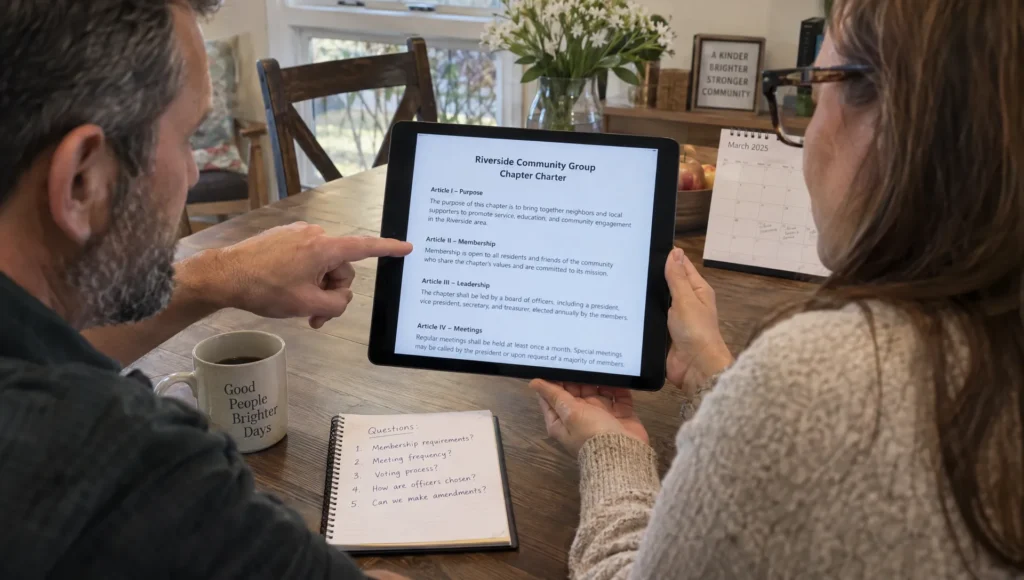
Write a one-page decision note. Name the problem, the decision owner, the evidence, the affected groups, and the specific request. Ask for a public response. If others care, invite them to add reasons and evidence rather than only signatures. If the issue is complex, convene a small deliberative session and produce options rather than demands alone. After the decision, track what happened.
This is not glamorous. It is not always viral. But it is how trust becomes practical. Public life improves when citizens create records, ask better questions, and insist on visible follow-through.
Frequently Asked Questions
What is civic participation in public life? Civic participation is the active involvement of citizens in shaping, monitoring, and improving public decisions. It includes public input, deliberation, oversight, organizing, evidence-building, and follow-up, not only voting.
Can civic participation rebuild trust if people are deeply polarized? Yes, if it is structured well. Polarization becomes worse when people only perform identity conflict. Discursive democracy and deliberative democracy help by clarifying claims, evidence, tradeoffs, and decision requests.
Does this replace elected representatives? No. Civic participation should complement representation by giving officials better public judgment, clearer priorities, and stronger accountability between elections. Rights, courts, expertise, and constitutional limits still matter.
What role should technology play? Technology should support access, transparency, evidence organization, secure participation, and implementation tracking. It should not replace human judgment, hide decision rules, or turn citizens into data points without accountability.
How can a community start rebuilding trust quickly? Start with one real decision. Publish the decision scope, gather structured input, create a shared evidence base, produce options, ask the decision-maker for a public response, and track implementation.
Help build a more trustworthy public life
Trust will not return because citizens are told to calm down or believe harder. It will return when public life becomes visible, participatory, and accountable enough to deserve trust.
If this vision resonates with you, read JustSocial's manifesto, The Face of Democracy, and explore how the movement is working toward continuous direct democracy through civic tools, public transparency, and citizen empowerment. You can also visit JustSocial.io to learn how to contribute, volunteer, support prototypes, or help turn democratic trust into democratic infrastructure.