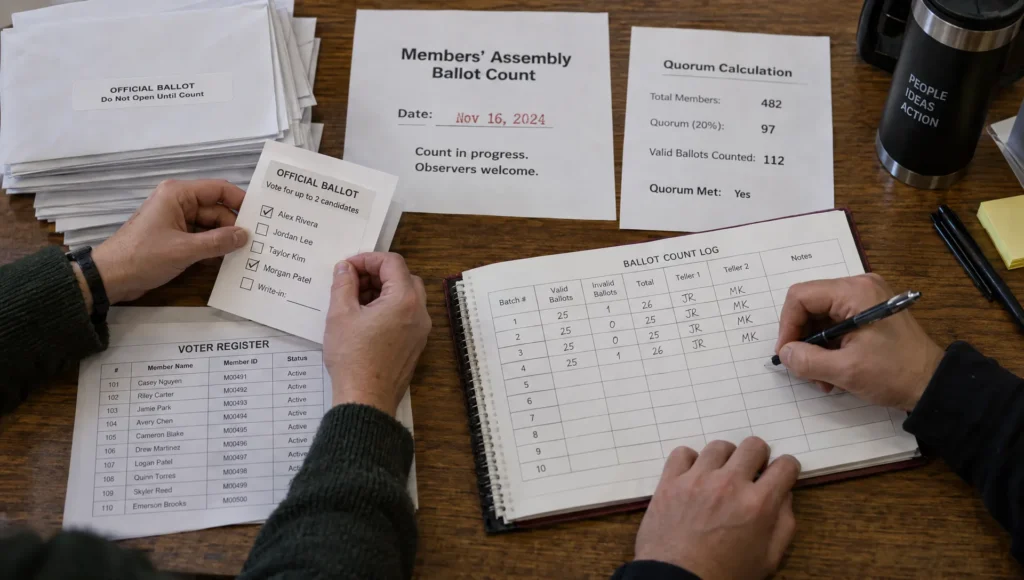
AI can make public participation faster, broader, and more legible. It can translate testimony, summarize thousands of comments, detect recurring concerns, and help officials find the evidence they should have read before a meeting. But deliberative democracy and AI raise a harder question than efficiency: what parts of democratic judgment should never be automated?
The answer matters because deliberation is not only a workflow. It is a civic act. People listen, change their minds, defend values, weigh tradeoffs, and accept responsibility for decisions that affect real lives. AI can support that process, but it cannot become the source of legitimacy.
This is close to the argument at the heart of JustSocial’s manifesto, The Face of Democracy. The manifesto calls for modern technology to be absorbed into public life faster, but not so citizens can be replaced. The point is the opposite: technology should help people be heard continuously, transparently, and meaningfully.
So the practical standard should be simple: AI may serve deliberation, but humans must own democracy.
Why AI Is So Tempting for Deliberative Democracy
Deliberative democracy depends on time, information, and attention. Those are exactly the areas where modern public institutions often fail.
A city receives 8,000 public comments on a housing plan. A national committee publishes hundreds of pages of budget material that most citizens cannot realistically read. A school district hears parents, teachers, students, and administrators talk past one another because every group arrives with different facts. A political movement wants to include thousands of supporters, but only the loudest voices dominate meetings.
AI appears to offer relief. It can sort large volumes of input, group similar arguments, simplify technical text, translate between languages, and draft summaries. In a public sector still shaped by industrial-era bureaucracy, these capabilities are not trivial. Other regulated industries already use AI to reduce repetitive administrative work, such as AI-powered insurance automation for underwriting and claims, and governments can learn from that operational shift.
But democratic institutions are not only administrative machines. They are legitimacy systems. A claims process can be automated when the rules, data, and accountability model are clear. Public judgment is different. In democracy, the process must not only produce an answer. It must produce an answer people can inspect, contest, and live with.
That is why AI in deliberative democracy should be treated as democratic infrastructure, not as a shortcut around civic participation.
Deliberation Is Not Just Information Processing
A common mistake is to imagine deliberative democracy as a better meeting format: collect opinions, summarize them, find consensus, publish recommendations. That description is useful, but incomplete.
Deliberation is also a moral and social process. It asks citizens to do something difficult: move from private preference to public reasoning. Instead of saying only “I want this,” participants are asked to explain “this is what I think we should do together, and here is why others could reasonably accept it.”
That human movement cannot be generated by a model. AI can imitate reasons, but it cannot experience obligation to neighbors. It can simulate empathy, but it cannot take civic responsibility. It can summarize disagreement, but it cannot be one of the people who must carry the consequences.
This does not make AI useless. It makes role definition essential.
| Democratic function | AI can help with | What must stay human |
|---|---|---|
| Understanding input | Clustering comments, detecting themes, translating language | Deciding which experiences and harms deserve attention |
| Evidence work | Summarizing reports, flagging claims, linking sources | Judging uncertainty, credibility, and acceptable risk |
| Discussion support | Drafting agendas, prompts, and neutral summaries | Facilitating trust, dignity, and conflict in real time |
| Option design | Comparing tradeoffs and drafting option memos | Choosing values, priorities, and compromises |
| Decision linkage | Tracking promises, timelines, and implementation | Authorizing decisions and accepting accountability |
The table shows the central rule: AI is appropriate where the task is clerical, analytical, or accessibility-related. It becomes dangerous when it starts performing moral, political, or authoritative judgment.
What Should Stay Human?
The boundary is not “AI versus no AI.” The boundary is between assistance and authority. In deliberative democracy, at least five functions should stay human.
1. Framing the Public Question
The way a question is framed often determines the range of acceptable answers. “Should we increase enforcement?” is not the same as “How should we improve safety while protecting civil rights?” “Should schools ban phones?” is not the same as “How should schools balance attention, safety, mental health, and learning?”
AI can help detect vague wording or summarize alternative framings. But humans must decide the final question because framing is an act of power. It defines whose pain is visible, which tradeoffs matter, and which solutions are considered legitimate.
For a JustSocial-style People’s Branch, this means every deliberative process should publish a human-approved Decision Statement. AI may assist the draft, but a named human body, committee, civic team, or public institution must own the final wording.
2. Lived Experience and Testimony
No model can replace the citizen who says, “This policy changed my life in this specific way.” Lived experience is not merely data. It is a form of democratic evidence, especially for communities that are often undercounted, misunderstood, or harmed by formal systems.
AI can make testimony more accessible by transcribing speech, translating languages, or helping participants organize their thoughts. But it should not flatten testimony into sentiment scores and call that democracy.
Discursive democracy matters here. Before a structured deliberation begins, people need spaces where public meaning is formed: stories, claims, fears, identities, and disagreements. AI can help keep those spaces readable, but humans must decide what those stories mean politically.
3. Moral Tradeoffs
Public decisions often involve tradeoffs that cannot be solved by optimization.
How much privacy should be sacrificed for public safety? How much budget should go to urgent services versus long-term prevention? When does efficiency become exclusion? How should a community weigh majority preference against minority protection?
AI can map options and consequences. It can help participants see who benefits, who pays, and where uncertainty remains. But it cannot decide what is just. Moral judgment belongs to people because legitimacy comes from human beings reasoning together under shared conditions.
This is where JustSocial’s proposed Academic Branch is relevant. Expertise should inform public reasoning without replacing it. Academics, researchers, and technical experts can clarify evidence, uncertainty, and likely consequences. AI can support their work. But the democratic decision still belongs to the public and its accountable institutions.
4. Recognition, Trust, and Conflict
Deliberation is not only about better arguments. It is also about recognition: people seeing that others are real participants in a shared political life.
A good facilitator can notice fear in a room, slow down a dominant speaker, invite a quiet participant in, and name a conflict without humiliating anyone. AI can suggest facilitation prompts, but it cannot carry the relational burden of public trust.
This is especially important in divided societies. People may not trust institutions, parties, media, or one another. A purely automated process can easily feel like another black box. Human facilitation, transparent rules, and public receipts help convert suspicion into inspectable process.
5. Authorization and Accountability
The final decision must be made by humans who can be challenged, voted out, replaced, appealed, or publicly criticized. This is not a technical detail. It is the foundation of democratic responsibility.
If an AI system recommends a policy and officials rubber-stamp it, accountability becomes blurred. Was the decision made by the model, the vendor, the dataset, the procurement team, or the elected body? Democracies cannot afford that confusion.
Every AI-supported deliberative process should end with a human public rationale: what was decided, who decided it, what evidence was used, which public input mattered, what objections remain, and how implementation will be tracked.
Where AI Belongs: The Democratic Support Layer
AI is most useful when it strengthens human participation without pretending to be the participant. In practice, that means using AI as a support layer across the civic lifecycle.
AI can help create plain-language versions of complex documents. It can translate between languages. It can produce first-draft summaries of hearings, provided the raw record remains available. It can help identify repeated concerns across thousands of submissions. It can detect missing stakeholder groups and prompt organizers to improve outreach. It can support accessibility for people with disabilities. It can compare whether official responses actually address public recommendations.
These are powerful uses because they reduce the cost of meaningful civic participation. A citizen should not need a law degree, a free afternoon, and a personal connection to understand what government is deciding.
The OECD has documented the growth of citizens’ assemblies and other deliberative processes in its work on the deliberative wave. As these processes scale, the administrative burden will grow. AI can help, if it is governed by transparency, auditability, privacy, and human review.
The goal is not to make deliberation frictionless. Some friction is democratic. People should have to give reasons, consider evidence, and face disagreement. The goal is to remove the wrong friction: inaccessible documents, bureaucratic opacity, language barriers, missing records, and processes that produce no response.
Where AI Does Not Belong: Red Lines for Civic Legitimacy
AI should not decide what citizens believe. It should not secretly rank political content to manipulate attention. It should not generate fake grassroots participation. It should not replace public officials in giving reasons. It should not produce “consensus” by averaging away moral disagreement.
A simple red, yellow, green framework can help public institutions and political movements set boundaries.
| Use of AI | Risk level | Democratic rule |
|---|---|---|
| Translation, transcription, accessibility support | Low | Allowed with quality checks and privacy protections |
| Summarizing public input | Medium | Allowed only with raw records, human review, and correction rights |
| Clustering arguments or detecting themes | Medium | Allowed only if methods are disclosed and minority views are preserved |
| Drafting policy options | Medium | Allowed as a draft, never as final judgment |
| Moderating civic spaces | High | AI may flag issues, but humans must decide enforcement and appeals |
| Ranking political content for persuasion | High | Prohibit opaque personalization in official civic processes |
| Casting votes or making final recommendations as an “AI citizen” | Extreme | Prohibit |
| Creating synthetic supporters, comments, or testimony | Extreme | Prohibit and disclose violations publicly |
This framework aligns with the broader direction of AI governance. The NIST AI Risk Management Framework emphasizes validity, reliability, safety, security, transparency, accountability, and fairness. Democratic systems need all of that, plus one more requirement: legitimacy through human public reasoning.
Discursive Democracy Needs Special Protection From AI
Deliberative democracy usually refers to structured processes: assemblies, panels, working groups, facilitated forums, and decision-ready recommendations. Discursive democracy is broader. It includes the public conversation that shapes what people think is possible, urgent, shameful, fair, or dangerous.
AI can improve this public conversation, but it can also poison it.
The risk is not only misinformation. It is synthetic scale. A small group can use AI to flood comment sections, generate thousands of variations of the same talking point, imitate local voices, or create the illusion of majority sentiment. If institutions treat volume as legitimacy, AI turns participation into a numbers game that organized manipulators can win.
The fix is process design. Discursive spaces should ask for claims, reasons, evidence, affected groups, and decision requests. They should preserve anonymity when needed, but protect against mass impersonation. They should publish moderation receipts, synthesis notes, and handoff rules showing how public discourse moves into deliberation.
In other words, AI should not be allowed to make public debate louder without making it more accountable.
A Human-Centered AI Workflow for Deliberation
A healthy AI-supported deliberative process can be built around a clear sequence. The sequence matters because it keeps AI in a support role and humans in authority.
- Publish the human decision: A public body, civic team, or movement names the actual decision, timeline, constraints, and decision owner.
- Open discursive intake: Citizens submit claims, stories, evidence, and questions in structured formats that remain publicly inspectable.
- Use AI for sensemaking: AI clusters themes, translates input, identifies recurring concerns, and flags missing perspectives, with human review.
- Build an evidence commons: Human editors and experts verify sources, mark uncertainty, and publish competing interpretations.
- Convene human deliberation: A diverse group weighs tradeoffs, hears testimony, questions experts, and produces options.
- Draft with assistance, approve by people: AI may help format an Options Memo, but participants and facilitators validate the reasoning.
- Require a human response: Officials or movement leaders publish what they accept, reject, or modify, with reasons.
- Track implementation: A public tracker shows deadlines, progress, delays, and outcomes.
This is the kind of process that turns AI from a threat into a civic tool. It also reflects JustSocial’s broader theory: continuous democracy needs infrastructure, public records, and repeated loops of participation, not isolated moments of outrage.
Why “Human in the Loop” Is Not Enough
Many AI governance proposals rely on the phrase “human in the loop.” In democratic contexts, that phrase is too weak.
A human can be “in the loop” while still being overwhelmed, underinformed, pressured to approve machine outputs, or unable to challenge the system. If an official sees an AI-generated summary of 10,000 comments and has no access to the raw input, no time to inspect the model’s assumptions, and no obligation to publish corrections, the human is decorative.
Democracy needs a stronger standard: human in command, citizen in authority, machine under audit.
That means humans do not merely supervise AI outputs. They define the purpose, rules, appeal channels, evidence standards, privacy limits, and public accountability model. Citizens must be able to see how AI was used and challenge errors that affect the democratic record.
What Political Movements Should Do Now
A political movement that wants to use AI responsibly should not wait for perfect regulation. It can model the democratic norms it wants governments to adopt.
The first step is an AI Use Charter. This should be short, public, and specific. It should say where AI is used, where it is prohibited, who reviews outputs, how errors are corrected, what data is collected, and how participants can appeal.
For a movement like JustSocial, this is not just operational hygiene. It is political philosophy in practice. If the movement argues that the state should be transparent, participatory, and accountable, the movement itself must publish receipts. If it argues for civic technology, it must show that technology can be governed by humans rather than quietly governing them.
A credible movement AI charter should include these commitments:
- AI-generated summaries are labeled and linked to source material.
- Final deliberative outputs are approved by human participants or accountable organizers.
- Raw civic input is preserved when privacy and safety allow.
- Minority reports and dissenting views are not erased by automated clustering.
- AI is not used to impersonate supporters, manufacture consensus, or microtarget manipulative political messages.
- Participants can request corrections to summaries that misrepresent their input.
- Sensitive identity data is minimized, protected, and never used for hidden persuasion.
These rules are not anti-technology. They are pro-democracy. They allow civic participation to scale without turning citizens into raw material for automated politics.
The Manifesto Connection: AI as Clerk, Not Sovereign
In The Face of Democracy, Yuval D. Vered argues that public institutions are still shaped by the relics of the Industrial Revolution while modern technology has transformed almost every other part of life. He calls for tools like civic social platforms, public analytics, open committee records, community voting systems, and AI-supported education.
The most important point is not that every public function should be digitized. It is that technology should help restore political agency to the people.
The manifesto’s education section offers a useful analogy. AI may help deliver knowledge, answer questions, and support learning, but the human teacher remains essential as the emotional and social guide of the classroom. Democracy needs a similar division of labor. AI can help with information, translation, memory, and analysis. Humans must remain responsible for care, conflict, legitimacy, values, and judgment.
That is the right model for deliberative democracy and AI: the machine as clerk, translator, librarian, analyst, and tracker. The citizen as speaker, listener, judge, neighbor, and sovereign participant.
Frequently Asked Questions
Can AI moderate deliberative democracy? AI can help flag abusive language, duplicate submissions, or off-topic content, but final moderation decisions should remain human, appealable, and publicly documented. In civic spaces, moderation is a legitimacy function, not just a content-management task.
Should AI write policy recommendations? AI may draft formats, compare options, or help simplify language. The recommendations themselves should be reviewed, revised, and approved by human participants who understand the evidence, tradeoffs, and consequences.
Can AI represent citizens who are too busy to participate? AI should not become a political proxy that votes or deliberates on behalf of citizens. It can help citizens understand issues, prepare comments, or track decisions, but representation and authorization must remain human.
How can discursive democracy protect itself from AI manipulation? Discursive processes should use structured contribution formats, personhood or eligibility safeguards where appropriate, transparent moderation, public evidence records, and synthesis notes that preserve minority views rather than rewarding raw volume.
What is the safest first use of AI in civic participation? Start with low-risk support functions: transcription, translation, accessibility, document simplification, agenda drafting, and implementation tracking. Avoid opaque ranking, automated persuasion, and final decision-making.
Build the Future Without Automating the People Out of It
The democratic challenge of AI is not whether public institutions should use powerful tools. They already will. The challenge is whether those tools will strengthen civic participation or quietly replace it.
Deliberative democracy gives us a practical answer. Use AI to reduce bureaucratic friction, widen access, preserve memory, and make public reasoning easier to inspect. But keep the human parts human: testimony, moral judgment, conflict, accountability, and consent.
That is the future JustSocial is working toward: a political movement for continuous, transparent, technology-enabled democracy where the people are not treated as data points, but as the living source of legitimacy.
If that vision speaks to you, read The Face of Democracy, share it, and consider contributing your skills as a developer, designer, product thinker, educator, organizer, or citizen willing to help build democratic infrastructure that keeps people at the center.