Renters often feel local policy changes after the decision has already been made. Civic participation changes that timeline. It gives tenants a way to spot proposals early, organize evidence, speak in public forums, push for safeguards and keep pressure on officials after the hearing ends.
For homeowners, local policy is often framed as property value, parking or neighborhood character. For renters, the same policy can decide whether a family can renew a lease, whether a student can stay near campus, whether an elderly resident can remain close to medical care or whether a worker can keep commuting without losing half a paycheck. The stakes are practical, immediate and deeply political.
JustSocial’s manifesto argues that modern citizens are too often reduced to voters, taxpayers and consumers. Renters experience that reduction sharply because local systems frequently treat them as temporary, even when they are the people most affected by zoning, transit, redevelopment, inspection rules and rental regulations. A healthier democratic culture would hear renters continuously, not only during elections or after displacement begins.
Why Civic Participation Matters for Renters
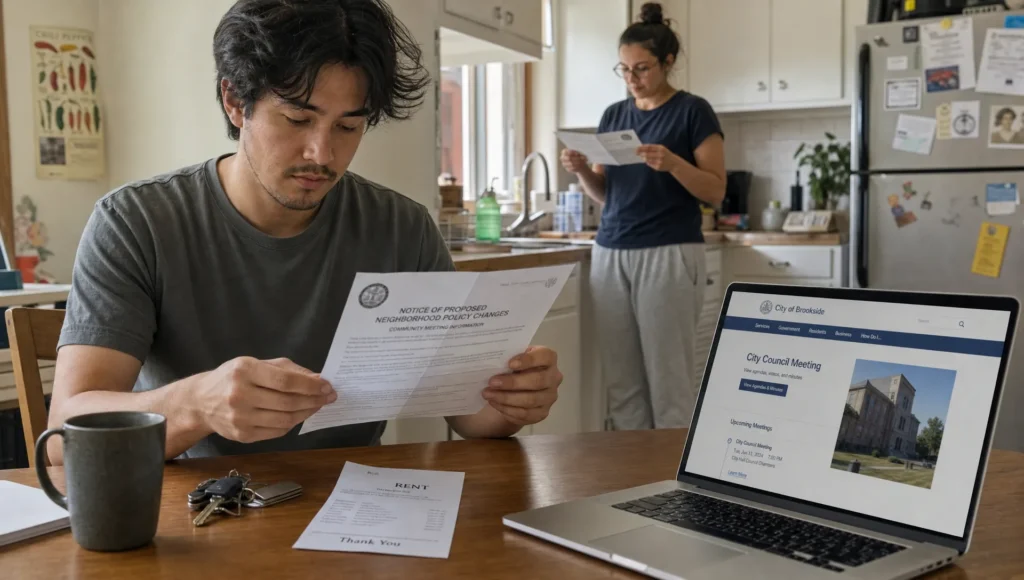
Local policy changes rarely arrive with dramatic headlines. They may appear as a zoning notice on a lamppost, a planning commission agenda item, a new short-term rental rule, a public housing redevelopment plan, a transit route change or a budget decision that cuts tenant legal aid. By the time many renters hear about them, the official comment period may be closing.
Civic participation matters because renters usually face three disadvantages in local politics. They have less time, less institutional knowledge and less perceived legitimacy than property owners who are already familiar with city hall. A homeowner association may know which council member to call. A tenant may not even know which department owns the issue.
This is not a problem of intelligence or motivation. It is a design problem. Local government often asks residents to navigate scattered websites, legal language, weekday hearings and unclear decision paths. A renter-friendly democracy would make the path visible, understandable and repeatable.
JustSocial’s idea of continuous direct democracy speaks directly to this gap. Citizens should not have to wait four years to express how public decisions affect their lives. For renters, the democratic question is simple: can the people most exposed to a policy change influence it before it becomes an eviction notice, a rent spike or a broken commute?
The Local Policies Renters Should Watch First
Not every city agenda item deserves the same level of attention. Renters can avoid burnout by focusing on decisions that are likely to affect housing stability, monthly costs, mobility and neighborhood access.
| Local policy area | Why it matters to renters | What to ask before responding |
|---|---|---|
| Zoning and land use | Can increase housing supply or trigger displacement | Will this create affordable units, reduce them or change tenant protections? |
| Rent rules and fees | Directly affects monthly housing costs | Who is covered, who is excluded and how will enforcement work? |
| Redevelopment plans | Can improve buildings or remove existing residents | Is there a right to return, relocation support or phased construction? |
| Short-term rental regulation | Can shift units away from long-term tenants | How many homes are being used commercially and where? |
| Transit and parking changes | Affects commuting costs and access to work | Were renters without cars included in the consultation? |
| Code enforcement | Can protect tenants or become a pretext for displacement | Are repairs paired with anti-retaliation protections? |
This table is a starting point, not a complete map. The key is to translate policy language into lived consequences. “Upzoning,” “overlay district,” “capital improvement pass-through” or “corridor plan” may sound technical, but each can reshape who gets to remain in a community.
From Complaint to Evidence
A renter saying “this will hurt us” may be dismissed as emotional. A renter group showing patterns, documents and testimony is harder to ignore. Civic participation becomes more effective when it turns private frustration into public evidence.
Start by collecting what tenants already know. How many residents received notices? How many are month-to-month? How many rely on a bus route under review? How many seniors, disabled residents, students or families with children would be affected? Personal stories matter, but patterns turn those stories into policy-relevant facts.
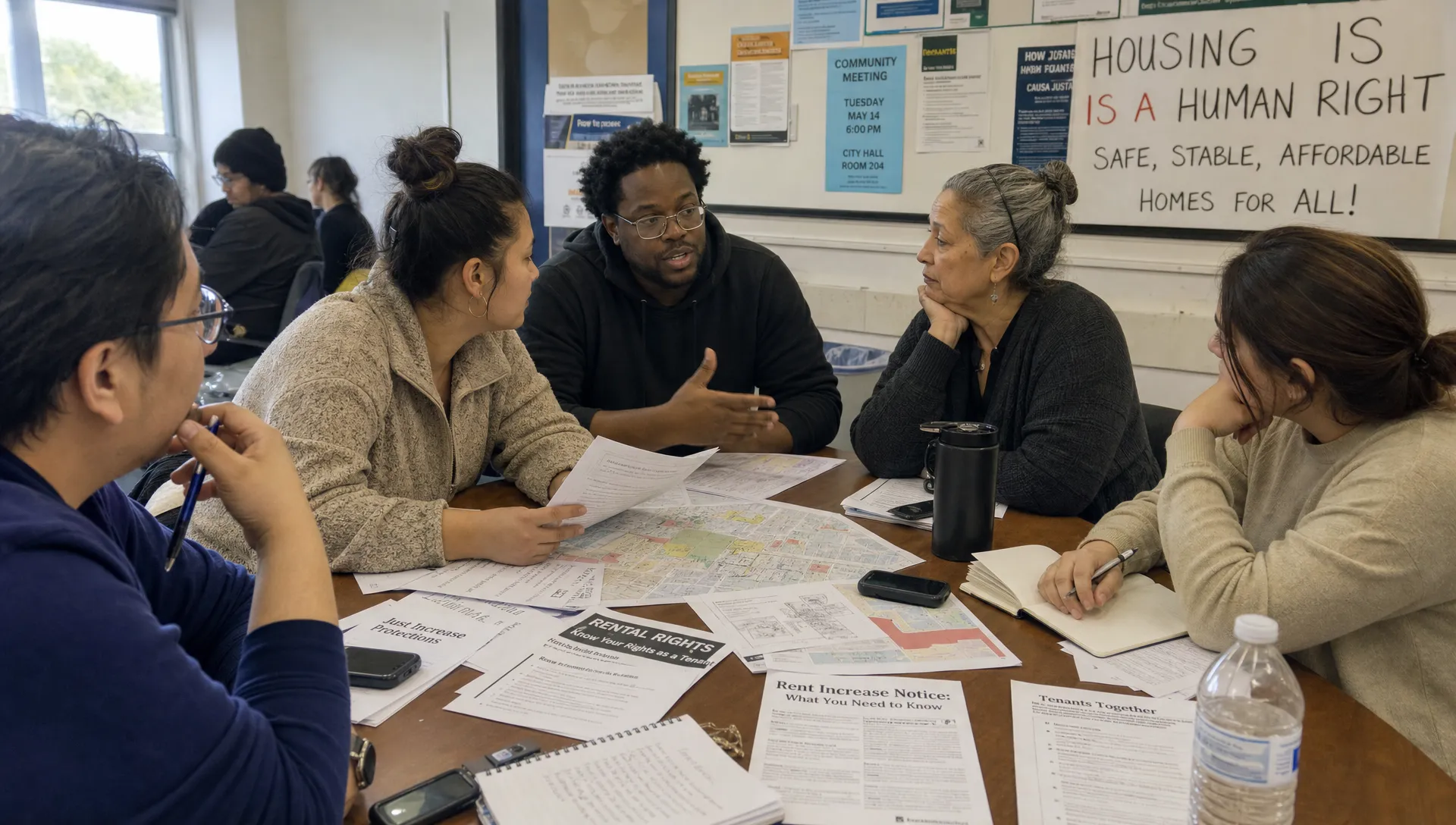
Evidence does not need to be perfect to be useful. A simple tenant survey, screenshots of rent increases, photos of neglected repairs, maps of affected buildings or a timeline of landlord communications can help officials understand the real-world impact of a proposal. If the city is considering redevelopment, residents can ask for displacement modeling, affordability requirements and written guarantees rather than vague promises.
This is where JustSocial’s emphasis on public transparency becomes practical. Public documents, committee recordings, agendas, votes and implementation reports should be accessible to the people affected by them. A renter should not need legal training to understand whether a city decision threatens their home.
Use Discursive Democracy Before the Hearing
Discursive democracy is the everyday layer of democratic life: conversation, explanation, argument, listening and public meaning-making. For renters, it happens in building chats, neighborhood groups, tenant meetings, local media comments, school communities, faith spaces and online forums.
A public hearing is usually too late to begin persuasion. By then, positions may be hardened. Discursive democracy helps renters shape the narrative earlier. Instead of allowing the issue to be framed as “tenants versus development” or “renters versus homeowners,” residents can explain the actual question: what local policy protects both community stability and future housing opportunity?
Good discursive work avoids slogans that only speak to people who already agree. It names tradeoffs honestly. More housing may be needed, but not through avoidable displacement. Building repairs may be necessary, but not as an excuse for retaliation. Transit reform may improve the city, but not if it disconnects low-income renters from work.
For readers building a broader local strategy, JustSocial’s guide to local reform without party loyalty is useful because renter issues often cut across party identity. A tenant may disagree with a neighbor on national politics but still share concerns about lease security, safe buildings and transparent planning.
Use Deliberative Democracy When the Issue Is Complex
Some renter policy fights are too complicated for a shouting match at a council meeting. Redevelopment, rent stabilization, affordable housing mandates and zoning changes involve tradeoffs. Deliberative democracy can help because it gives residents time, balanced information and structured discussion before recommendations are made.
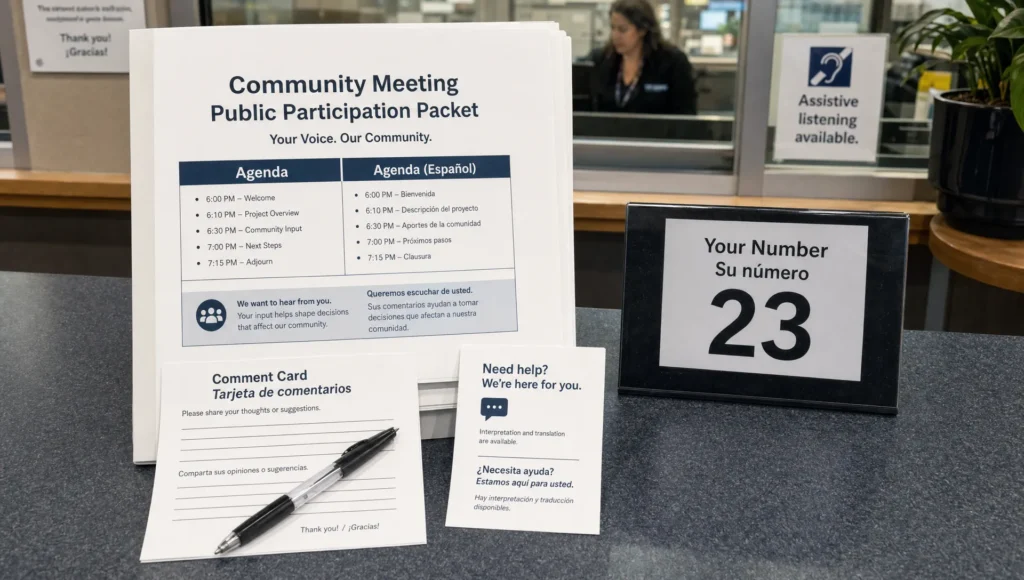
In a deliberative process, renters should not be decorative participants. They should be part of the design. That means meetings at accessible hours, childcare where possible, translation, plain-language materials and compensation for time when budgets allow. It also means including renters from the specific buildings or neighborhoods affected, not only professional advocates.
A strong deliberative process should produce decision-ready options. For example, a tenant group responding to redevelopment might propose several conditions: a right to return, temporary relocation assistance, rent limits after renovation, independent tenant counseling and a public dashboard tracking commitments. The goal is not only to be heard. The goal is to shape what officials can actually vote on.
JustSocial has written more deeply about deliberative democracy for housing policy deadlocks, a useful framework when a city is stuck between affordability, supply, neighborhood opposition and tenant protection. Renters should insist that “complexity” is not a reason to exclude them. It is a reason to deliberate better.
A Practical Civic Participation Plan for Renters
Renters do not need to become full-time activists to have influence. They need a repeatable process that turns limited time into focused pressure.
- Identify the decision owner: Find out whether the issue sits with city council, the planning commission, a housing department, a transit authority, a school board or a redevelopment agency.
- Track the timeline: Write down hearing dates, comment deadlines, committee votes and expected implementation dates.
- Name the demand: Replace broad opposition with specific asks, such as relocation support, anti-retaliation language, affordability requirements or tenant seats on oversight committees.
- Divide the work: One person tracks agendas, one gathers stories, one contacts reporters, one speaks at meetings and one follows up with officials.
- Document every commitment: Save emails, meeting notes, public statements and revised policy language.
This form of civic participation is powerful because it does not depend on one charismatic leader. It creates a structure any renter group can reuse. If one person moves away, the work continues.
For people starting from zero, a basic participation framework is often enough. JustSocial’s article on practical ways to get involved now can help renters choose manageable commitments instead of burning out in the first week.
Protect Renters From Retaliation and Burnout
Renters may hesitate to speak because the risk feels personal. A homeowner can criticize a zoning change without wondering whether their landlord will refuse repairs or decline renewal. Tenants may fear rent hikes, harassment, informal blacklisting or social pressure inside the building.
A serious participation strategy must include safeguards. Anonymous surveys can help gather information before people speak publicly. Tenant unions or community organizations can act as intermediaries. Public comments can be submitted by groups rather than only individuals. Legal aid organizations, where available, can clarify anti-retaliation protections.
Emotional sustainability also matters. Local policy fights can stretch for months. Residents should rotate roles, keep meetings short, celebrate small wins and avoid turning every conversation into crisis mode. Rest is not separate from democratic work. It helps people stay capable of judgment, patience and courage.
If organizing stress is becoming physical, take recovery seriously. A walk, a quiet meal, a day away from the group chat or even a professional relaxation massage in central Valencia through Relax VLC can be part of staying grounded enough to keep participating well.
What Local Governments Should Change
Renters can organize more effectively, but responsibility should not fall only on residents. Local governments should redesign participation so affected people are not forced to fight through confusion.
First, every major housing-related proposal should include a renter impact note written in plain language. It should explain who may face higher costs, relocation, commute changes or service disruptions. Second, meeting access should reflect renter reality: evening options, remote participation, multilingual materials and clear summaries after each vote.
Third, cities should maintain public records that are easy to search. JustSocial’s manifesto imagines public systems where documents, recordings and civic input are visible and connected. Applied locally, that means renters could see the full path from proposal to committee discussion to vote to implementation.
Fourth, participation should be continuous. A single hearing cannot capture the changing effects of policy. Cities need follow-up surveys, public dashboards, tenant advisory groups and open channels for reporting unintended consequences. Civic participation should not end when officials cast their votes.
How a Political Movement Can Support Renters Without Speaking Over Them
A political movement can help renters by building tools, training participants and demanding transparent systems. It should not replace tenant voices with branding or ideology. The people facing displacement or instability must remain the authors of their demands.
JustSocial’s manifesto points toward a model where representatives become more like pipelines for public consensus than distant rulers. For renter policy, that means elected officials should gather lived experience, test proposals in public, explain disagreements and show how tenant input changed the final decision.
A movement can also connect renters across buildings and cities. One neighborhood fighting a redevelopment plan may learn from another that already negotiated right-to-return language. One tenant group may share a survey template. Another may explain how to get committee recordings or force a clearer public timeline.
The deeper goal is cultural. Renters should not have to prove they belong before they are heard. They are residents, workers, parents, students, caregivers, neighbors and citizens. A democratic city treats them as political participants, not temporary occupants.
Frequently Asked Questions
What is the first step for renters facing a local policy change? Identify the exact decision, the public body responsible for it and the deadline for input. Then gather a small group of affected renters to define one or two specific demands.
How can renters participate if they cannot attend city meetings? They can submit written comments, join remote sessions when available, send group letters, contact local reporters, meet officials during office hours or ask a trusted organization to present tenant evidence.
What is the difference between discursive democracy and deliberative democracy? Discursive democracy is the broad public conversation that shapes how people understand an issue. Deliberative democracy is a more structured process where participants review evidence, discuss tradeoffs and produce recommendations.
Can renters influence policy without joining a political party? Yes. Many local housing issues are practical rather than partisan. Renters can organize around specific outcomes such as affordability, repairs, relocation support, transit access and transparent enforcement.
How can tenants reduce the risk of retaliation? They can act collectively, use anonymous surveys, document landlord communications, work through tenant associations or legal aid groups and learn local anti-retaliation rules before speaking publicly.
From Being Managed to Being Heard
Renters are often managed by policy rather than invited to shape it. That is the democratic failure this work must correct. Civic participation gives renters a path from private anxiety to public influence, especially when it is continuous, evidence-based and protected by transparent institutions.
JustSocial exists to promote a politics where citizens are not reduced to occasional voters or passive consumers of government decisions. If local policy is about homes, streets, schools, transport and community life, then renters must be part of making it. The future of democracy will not be built only in national campaigns. It will be built in city agendas, tenant meetings, committee rooms and the everyday courage to say: we live here, so we must be heard here.