Every political movement eventually faces the same temptation: recruit faster, post louder, fundraise harder, and turn visibility into scale as quickly as possible. The problem is that scale does not create trust. Scale reveals whether trust was already built.
A movement without infrastructure may look strong when attention is high, but it often becomes fragile the moment real decisions, internal disagreements, media scrutiny, donor pressure, or government negotiations appear. People join with hope, then leave when they cannot see how their time, voice, or money changes anything.
Political movement infrastructure is the answer to that failure. It is the system that turns public energy into civic participation, civic participation into decision-ready proposals, and proposals into public pressure that institutions can understand, answer, and adopt.
That idea sits at the center of JustSocial’s manifesto, The Face of Democracy: democracy should not be reduced to one vote every few years. It should become a continuous, transparent, technology-supported public practice. But a movement that demands better democratic institutions must first model those practices internally.

What Political Movement Infrastructure Actually Means
Political movement infrastructure is not just a website, a mailing list, a social media account, or a donation page. Those are tools. Infrastructure is the repeatable operating system behind them.
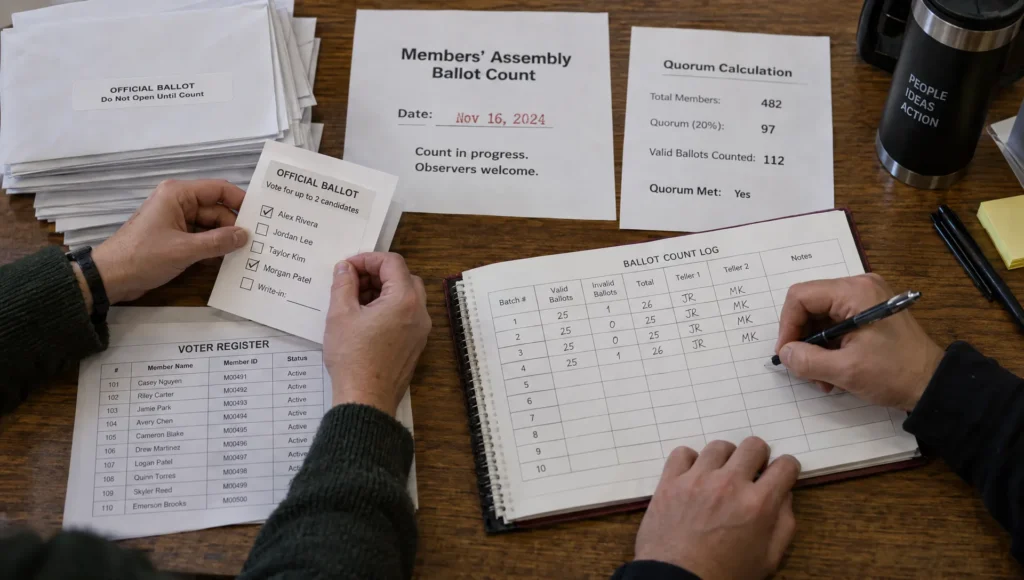
It includes the rules for how people participate, the roles that turn supporters into contributors, the records that prove what happened, the deliberation methods that handle disagreement, the technology that makes participation accessible, and the public receipts that make trust inspectable.
A healthy movement can answer basic questions clearly:
- What can supporters influence?
- How are priorities chosen?
- Who has authority to speak or decide?
- How are disagreements handled?
- What records are published?
- How does public input reach real decision-makers?
- How are money, data, and identity protected?
Without those answers, scale becomes a risk. With those answers, scale becomes capacity.
This is especially important for democratic reform movements. If the mission is continuous direct democracy, discursive democracy, deliberative democracy, or deeper civic participation, then the movement cannot operate like a personality cult or a private campaign machine. It must practice the democratic culture it wants society to adopt.
Why Scaling Before Building Breaks Movements
Movements usually do not fail because people do not care. They fail because care is not converted into usable civic power.
People sign petitions, join groups, attend protests, share posts, and donate small amounts. Then they wait. If nothing happens, or if decisions are made behind closed doors, they learn the wrong lesson: participation does not matter.
That is devastating for democracy. Freedom House has repeatedly warned that global freedom has been under pressure in recent years, with democratic institutions weakened by conflict, manipulation, and distrust. In that environment, movements cannot ask citizens for blind faith. They need verifiable processes.
The table below shows how scale-first movements typically break, and what infrastructure prevents the damage.
| Scale-first symptom | Root cause | Infrastructure fix |
|---|---|---|
| Many followers, little influence | No link to real decisions | Decision maps, named decision owners, response requests |
| Internal faction fights | No rules for disagreement | Discursive democracy rules and moderation receipts |
| Burned-out volunteers | No repeatable roles or cadence | Small civic teams with weekly operating rhythms |
| Claims of capture or corruption | No public records | Funding transparency, meeting notes, decision logs |
| Viral misinformation | No shared evidence layer | Evidence Commons and claim tracking |
| Government ignores the movement | Demands are too vague | Options memos, draft policies, implementation trackers |
| Supporters disengage | No proof their work matters | Public receipts and visible follow-through |
The lesson is simple: a political movement should not measure readiness by audience size alone. It should measure readiness by whether it can absorb more people without becoming less trustworthy.
The Seven Layers of Movement Infrastructure
A strong movement does not need to build everything at once. But it does need a coherent stack. The following seven layers create a practical foundation before aggressive scaling.
1. A participation promise
A participation promise is a plain-language commitment that tells people what their participation can do.
It should not say, “Join us and change everything.” That sounds inspiring, but it is too vague. A stronger promise says something like: “Supporters can propose local issues, help build evidence packs, join deliberation groups, vote on movement priorities, and inspect how leadership responds.”
The promise should also name limits. Not every question can be decided by an open vote. Legal, safety, financial, and privacy constraints matter. Honest boundaries increase legitimacy because people know the rules before investing their time.
For a deeper movement-starting framework, JustSocial’s guide on how to start a political movement without a party machine expands this idea into a full participation-first strategy.
2. A discursive democracy layer
Discursive democracy is the public conversation layer. It is where people frame problems, challenge assumptions, share stories, contest language, and surface neglected experiences.
Most movements already have discourse, but it is often chaotic. It happens in comment sections, group chats, interviews, and protest slogans. The infrastructure question is whether that discourse becomes useful.
A movement should create simple rules for public debate. Contributions should be encouraged to include a claim, a reason, a source when available, and a request. Moderation should focus on process, not viewpoint. People should be able to disagree sharply without being drowned out, doxxed, or reduced to tribal labels.
This is where movements move beyond attention. Discursive democracy turns scattered speech into a map of public reasoning.
3. A deliberative democracy layer
Deliberative democracy is different from open discussion. It is structured, time-bound, evidence-informed work that helps people produce decision-ready options.
The OECD’s work on deliberative citizen participation has shown how citizens’ assemblies, panels, and similar processes can help institutions handle complex public issues when designed with care. The key is not just talking. The key is fair recruitment, balanced information, facilitation, output quality, and a visible link to decisions.
For a political movement, deliberation can be small at first. Ten to twenty people can review an issue pack, hear competing views, identify tradeoffs, and produce an options memo. That memo can then be shared publicly, challenged, improved, and delivered to the relevant institution.
This matters because movements that only mobilize anger often struggle to govern. Deliberation trains the movement to make choices.
4. Decision linkage
Civic participation becomes powerful when it is connected to a real decision.
A decision link has four parts: the decision owner, the decision window, the decision rule, and the duty to respond. If a city council, school board, agency, party committee, or ministry controls the decision, the movement should name that body. If the decision will be made on a specific date, the movement should work backward from that date. If the process requires public comment, a hearing, a budget vote, or a committee recommendation, the movement should design participation around that rule.
Without decision linkage, participation becomes expression. Expression matters, but it is not enough. JustSocial’s broader vision of continuous direct democracy depends on citizens having routine, legible paths into public decisions, not just louder megaphones.
5. Public receipts
Public receipts are the records that let outsiders verify what happened. They are not propaganda summaries. They are inspectable artifacts.
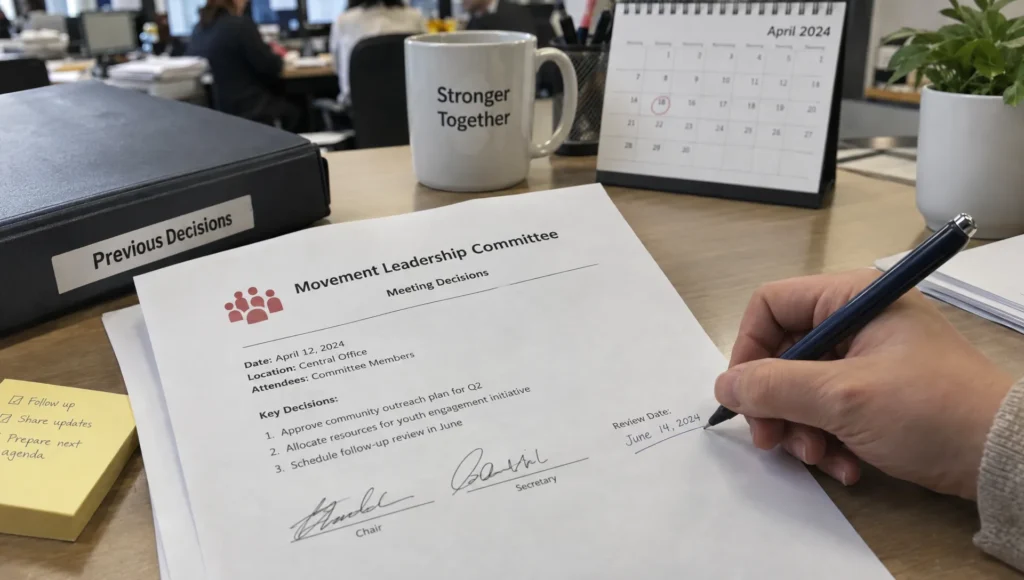
A receipt can be a meeting note, an agenda, a funding summary, a decision memo, an evidence index, a dissent note, a leadership vote, or an implementation tracker. The point is to reduce the amount of trust people must donate blindly.
JustSocial has argued for this approach in detail in Political Movement Strategy: Build Trust With Public Receipts. For movements, receipts are not administrative clutter. They are democratic proof.
A movement that publishes receipts says: “You do not have to believe our slogans. You can inspect our process.”
6. Civic teams and operating cadence
Movements often treat volunteers as a crowd to activate when needed. Infrastructure treats them as civic teams with repeatable roles.
A small civic team might include a facilitator, researcher, outreach lead, records keeper, institutional liaison, and accessibility reviewer. The same person can hold more than one role at the beginning. What matters is that the work is named.
The cadence should be sustainable. A weekly 60-minute rhythm can produce more long-term power than occasional bursts of heroic effort. For example, one week can identify a public decision, the next can gather evidence, the next can run a deliberation circle, and the next can publish and deliver a decision pack.
This approach turns supporters into builders. It also prevents the common failure where everything depends on one charismatic founder or one exhausted organizer. The related JustSocial article on turning supporters into civic teams offers a practical operating model for this layer.
7. Technology with governance
Technology can help movements scale civic participation, but only if the governance comes first.
A platform can collect input, map opinions, verify eligibility, publish documents, host deliberation, and track implementation. But technology cannot decide what is legitimate by itself. A voting tool without fair questions can manipulate. Analytics without privacy rules can become surveillance. AI summaries without human review can distort minority views.
The JustSocial manifesto proposes concepts such as TakeAction!, rParliament, rConcensus, public analytics, and a more accessible legal knowledge infrastructure. These are not merely app ideas. They point toward a larger claim: democracy needs modern infrastructure, but that infrastructure must be transparent, rights-respecting, and accountable.
A movement should therefore start with low-risk tools and clear governance rules. Publish documents. Track decisions. Use accessible forms. Protect personal data. Separate public identity from eligibility verification when possible. Use AI as an assistant for summarization or translation, not as a final authority.
A 90-Day Build-Before-Scale Roadmap
A movement does not need national reach to begin acting like a civic institution. It can build a minimum viable infrastructure in 90 days.
| Time period | Build focus | Public output | Success signal |
|---|---|---|---|
| Days 1 to 30 | Define the participation promise, issue scope, roles, and transparency rules | Movement charter, role map, first public receipt page | People understand how to contribute and what is off-limits |
| Days 31 to 60 | Create the discursive layer and evidence process | Issue pack, evidence index, discourse rules, moderation log | Public discussion becomes more specific and less chaotic |
| Days 61 to 90 | Run one deliberative cycle tied to a real decision | Options memo, dissent note, delivery record, response request | A decision-maker can respond to concrete proposals |
| After 90 days | Repeat, improve, and then scale recruitment | Implementation tracker, monthly learning note, updated charter | The movement can show a full loop from input to follow-through |
The most important principle is to complete one full loop before expanding aggressively. A full loop means people can see the path from concern, to discussion, to deliberation, to action, to response, to follow-through.
That loop is the smallest version of the democratic future JustSocial describes: citizens not as passive voters or consumers, but as continuous participants in public life.
Readiness Scorecard: Are You Ready to Scale?
Before launching a major recruitment push, a political movement should test whether its infrastructure can handle more people. The following scorecard is intentionally practical.
| Infrastructure area | Ready to scale if | Not ready if |
|---|---|---|
| Participation promise | Supporters know what they can influence | Participation is mostly symbolic or undefined |
| Governance | Roles, authority, and escalation paths are documented | Decisions depend on private chats or personal loyalty |
| Discursive democracy | Debate rules make claims, evidence, and requests visible | The loudest voices dominate every conversation |
| Deliberative democracy | The movement can produce options memos on real issues | The movement only produces slogans or petitions |
| Transparency | Receipts are published on a predictable schedule | Records appear only during controversy |
| Funding | Donor influence rules and expense summaries exist | Supporters cannot tell who funds what |
| Technology | Tools are accessible, privacy-aware, and auditable | The movement chases platforms before defining rules |
| Institutional linkage | Outputs are delivered to named decision owners | Campaigns end at awareness or outrage |
If a movement scores poorly, that is not a failure. It is useful evidence. The right response is not to stop. The right response is to build.
How This Connects to the JustSocial Manifesto
JustSocial’s manifesto argues that many public institutions still operate like relics of the Industrial Revolution: centralized, slow, bureaucratic, and poorly adapted to modern technology. It also argues that citizens are too often reduced to three roles: voter, taxpayer, and consumer.
Political movement infrastructure is one way to break that pattern before formal institutional reform arrives.
The manifesto’s idea of a “People’s Branch” points toward a standing civic capacity where public opinion, identity, deliberation, and participation are not occasional events. They are part of everyday governance. A movement can prototype that culture locally by building transparent issue dockets, evidence commons, deliberative groups, public receipts, and implementation trackers.
The manifesto’s proposed role for academia also matters. Movements should not treat expertise as a weapon to silence citizens. They should treat expertise as a public service: evidence summaries, uncertainty notes, tradeoff memos, and evaluation plans that citizens can inspect and contest.
The same applies to technology. The manifesto imagines public digital tools that allow citizens to weigh in continuously, follow representatives, organize action, vote in communities, and understand law and policy. But the deeper point is not that every problem needs an app. The deeper point is that democracy itself needs infrastructure worthy of the digital age.
Movements should build the smallest credible version of that infrastructure now.
The Metrics That Matter Before Growth
Most movements track easy numbers: followers, impressions, email signups, event attendance, and donations. Those numbers are not useless, but they do not prove civic power.
A democratic movement should also track whether participation is becoming more inclusive, reasoned, decision-linked, and consequential.
| Metric category | What to track | Why it matters |
|---|---|---|
| Inclusion | Who participates, who is missing, what barriers appear | Scale without inclusion creates distorted legitimacy |
| Discursive quality | Claims with reasons, evidence references, respectful rebuttals | Better public reasoning improves later decisions |
| Deliberative output | Issue packs completed, options memos produced, dissent captured | The movement becomes capable of governing tradeoffs |
| Decision linkage | Outputs delivered to named institutions, responses received | Participation must reach power to matter |
| Transparency | Receipts published on time, records corrected, changes logged | Trust grows when process is inspectable |
| Retention | Volunteers returning, roles rotating, burnout signals | Infrastructure should make participation sustainable |
| Implementation | Promises tracked, partial wins recorded, failures explained | Movements build credibility by following through |
These metrics help a movement avoid vanity growth. They also prepare the movement for government partnerships, civic technology pilots, public campaigns, and long-term democratic reform.
Common Mistakes to Avoid
Confusing audience growth with power
An audience can amplify a message, but power comes from organized capacity. If supporters cannot produce research, testimony, deliberation, pressure, funding, and follow-up, the movement remains dependent on attention cycles.
Treating technology as legitimacy
A platform does not make a process democratic. Legitimacy comes from clear rules, inclusion, privacy, transparency, contestability, and follow-through. Technology should make those commitments easier to inspect.
Avoiding internal conflict
Movements often fear disagreement because it looks messy. But hidden conflict is more dangerous than visible conflict. Discursive democracy gives people a way to disagree without destroying the movement. Deliberative democracy gives them a way to turn disagreement into choices.
Publishing only victories
If a movement publishes only wins, supporters eventually suspect manipulation. Real trust requires learning in public. Publish mistakes, dissent, unanswered letters, failed meetings, and revised assumptions. Public honesty is infrastructure.
Scaling before completing one loop
A movement that has never completed a participation loop should be careful about recruiting thousands of people into it. First prove the loop. Then invite more people into a process that already works.
Frequently Asked Questions
What is political movement infrastructure? Political movement infrastructure is the set of rules, roles, tools, records, and habits that turn supporters into organized civic participants. It includes governance, deliberation, transparency, technology, funding practices, and decision follow-through.
How is movement infrastructure different from campaign infrastructure? Campaign infrastructure is usually built to win an election, raise money, persuade voters, and manage communications. Movement infrastructure is broader. It builds long-term civic capacity, public reasoning, participation loops, and accountability systems that can operate before, during, and after elections.
Can a small political movement use deliberative democracy? Yes. Deliberative democracy does not need to start with a national citizens’ assembly. A small movement can begin with a structured working group, a shared issue pack, fair facilitation, and an options memo tied to a real decision.
Isn’t too much infrastructure just bureaucracy? It can be if the process becomes self-serving. Good infrastructure should reduce confusion, not create paperwork for its own sake. The test is whether it helps people participate, verify decisions, and sustain action with less personal trust required.
What technology should a movement build first? Start with simple, auditable tools: a public document library, issue tracker, evidence index, meeting notes, contribution forms, and implementation tracker. More advanced tools like voting platforms, identity systems, analytics, or AI support should come after governance rules are clear.
How do we know when we are ready to scale? You are ready to scale when new participants can join without needing private explanations, when public receipts show how decisions are made, when teams can repeat the participation loop, and when the movement can deliver decision-ready outputs to real institutions.
Build the System Before You Ask People to Trust It
The future of democracy will not be built by attention alone. It will be built by movements that can prove, in public, that participation matters.
That is why political movement infrastructure must come before scale. Build the participation promise. Build the discursive layer. Build deliberative capacity. Publish receipts. Protect privacy. Track decisions. Train civic teams. Complete one loop, then another, then another.
This is how a movement becomes more than a brand. It becomes a prototype of the democratic society it wants to create.
If that is the future you want to help build, start with JustSocial’s manifesto, The Face of Democracy, and explore the practical work already being developed across civic participation, public transparency, and continuous direct democracy. You can also learn how the People’s Branch idea works in practice through People’s Branch of Government: What It Means in Practice.
Build before you scale. Then scale what is worth trusting.