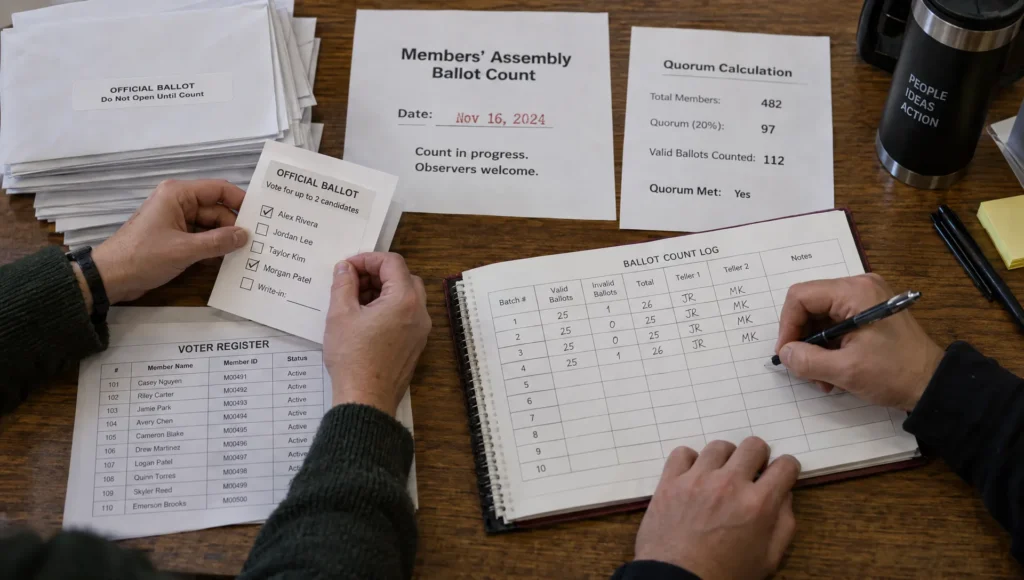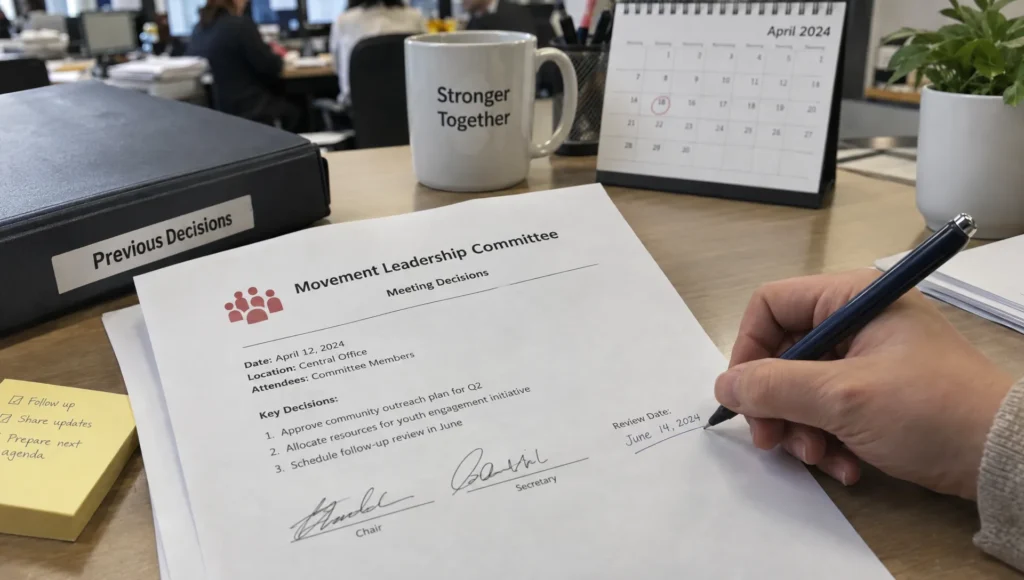
Starting a political movement used to mean finding a party sponsor, getting invited into closed rooms, and learning the “machine” rules: who gets access, who gets funding, and who gets to define what’s realistic.
In 2026, that path is both less necessary and less trustworthy. People are more connected, more informed (and misinformed), and more frustrated by institutions that only invite public input when it is convenient. If your goal is to build a movement that stays accountable to citizens, the alternative to a party machine is not “just go viral.”
The alternative is to build civic participation infrastructure: a repeatable way for people to surface issues (discursive democracy), reason together (deliberative democracy), and translate that work into public outcomes.
JustSocial’s manifesto, The Face of Democracy, argues that modern politics is still running on industrial-era structures while society has moved on. Whether you agree with every claim or not, the practical insight is hard to ignore: if participation is rare, anonymous, and disconnected from decisions, citizens get reduced to spectators. A movement worth joining reverses that.
What a party machine gives you (and what you must replace)
Party organizations provide capabilities, not magic. If you want to start a political movement without that machinery, you need substitutes that are more transparent and less captive to insiders.
| Party machine function | What it looks like in practice | Movement alternative that scales without insiders |
| Narrative discipline | Message testing, talking points, media relationships | Public, testable claims tied to real decisions and tradeoffs |
| Membership and identity | Party cards, local branches, internal hierarchies | Community cohorts, local chapters, open participation rules |
| Fundraising | Donor networks, bundled contributions | Small recurring donations with public budgets and receipts |
| Candidate pipeline | Primaries, party lists, gatekeeping | Leadership emergence through demonstrated civic work and trust |
| Policy production | Staffers, internal committees | Deliberative outputs, evidence commons, decision-ready memos |
| Legitimacy signals | Brand, history, endorsements | Transparency, procedural fairness, and measurable follow-through |
A party machine centralizes these functions. A modern movement can distribute them, but only if you treat civic participation as an operating system, not a one-off campaign.
Step 1: Define a “participation promise” (the movement’s real product)
Most new movements start with slogans. Movements that endure start with a clear promise about how people will influence outcomes.
A useful participation promise answers:
- Who can participate (and how eligibility is determined).
- What issues are in scope.
- When participation matters (decision windows).
- How input will be handled (rules for deliberation and synthesis).
- What receipts the movement will publish so outsiders can audit sincerity.
This idea aligns with the manifesto’s central frustration: people are asked to participate infrequently, then ignored between elections. A movement that replaces the party machine must do the opposite: create a stable channel where participation is routine and legible.
If you want a concrete cadence, adapt a weekly loop like JustSocial’s “Decision Note” habit from Active Civic Engagement: A Simple Weekly Action Plan, but make it communal, not individual.
Step 2: Build the discursive layer (discursive democracy) to surface real problems
Discursive democracy is the messy, living public sphere: stories, arguments, memes, lived experience, moral claims, and competing frames. You cannot skip it. If you do, your movement becomes an echo chamber with polished policy and no legitimacy.
But you also cannot confuse discourse with decision-making. Discourse is how issues emerge. It is not how you reliably produce decision-grade guidance.
A movement without a party machine should deliberately design its discursive layer around two goals:
- Representation of lived reality, especially from people who are usually ignored.
- Traceability, so outsiders can see how the movement formed its agenda.
Practical ways to do this without turning into a shouting match:
- Run structured “listening drops” (online and offline) where contributions must include a concrete problem statement and a who/where affected field.
- Publish an evolving public docket of issues, including minority frames, not just the majority narrative.
- Separate mobilization content from reasoning spaces so outrage does not dominate deliberation.
JustSocial’s manifesto describes a future where citizens can continuously register what they think and believe, and where institutions actually measure public opinion rather than pretending elections are enough. Whether your movement is local or national, the same design principle applies: treat discourse as an input stream that must be organized, not exploited.

Step 3: Add a deliberative layer (deliberative democracy) that produces decision-ready outputs
If discursive democracy helps your movement hear society, deliberative democracy helps your movement think.
Deliberation is not “a debate.” It is a structured process that:
- uses a shared evidence base,
- forces tradeoffs into the open,
- protects equal speaking conditions,
- and produces outputs that a decision-maker could actually use.
James Fishkin’s deliberative polling tradition is one influential example, and JustSocial has a practical explainer here: James Fishkin and Deliberative Democracy, Explained.
For a movement, the key is not which school of deliberation you cite. The key is that your movement can repeatedly produce three things:
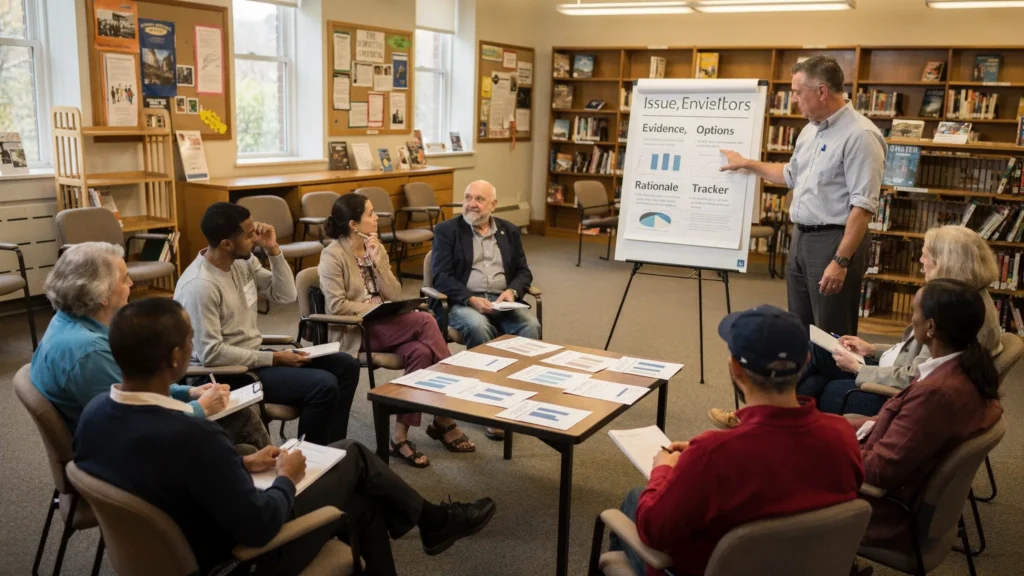
- An Issue Pack (what is being decided, by whom, by when, and with what constraints).
- An Evidence Commons (sources, data, affected stakeholders, and uncertainty).
- Decision-grade options (2 to 5 choices with pros, cons, costs, and risks).
Here is a simple comparison you can use internally to keep your process honest:
| Dimension | Discursive democracy | Deliberative democracy |
| Primary output | Voice, framing, legitimacy signals | Reasons, options, considered judgment |
| Strength | Inclusion of diverse expression | Higher quality decisions and tradeoff clarity |
| Main risk | Noise, polarization, domination | Technocracy, exclusion, over-structuring |
| What to publish | Docket, themes, minority frames | Evidence set, deliberation rules, rationale |
If you want a template for running a credible online pilot, use Deliberative Democracy Online: A Pilot Template as a starting point.
Step 4: Publish “receipts” so trust does not depend on charisma
A party machine often substitutes brand for transparency. A movement should do the reverse.
Receipts are public artifacts that show:
- what you heard,
- what you considered,
- what you decided to prioritize,
- and what happened next.
At minimum, publish:
- Decision Link: decision owner, decision window, decision rule, and duty-to-respond.
- Summary of deliberation: what claims won, what claims lost, and why.
- Rationale memo: the movement’s recommended option with explicit tradeoffs.
- Implementation tracker: if an institution acted, what changed, and what did not.
This is also where a movement can borrow a strong instinct from JustSocial’s broader work: participation must be auditable, otherwise it becomes “engagement theater.” See Civic Participation That Actually Changes Decisions.
Step 5: Organize like a civic institution, not a campaign
Campaigns optimize for attention spikes. Civic institutions optimize for continuity.
A movement without a party machine needs lightweight structure that is clear enough to coordinate, and open enough to avoid gatekeeping. The manifesto’s critique of bloated, job-creating political bureaucracy is relevant here: you want professional execution, not insider patronage.
A practical operating model is a small set of standing “lanes,” with clear outputs:
- Participation lane: runs intakes, listening, and chapter onboarding.
- Deliberation lane: facilitators, evidence librarians, synthesis writers.
- Accountability lane: tracks decisions, publishes receipts, measures follow-through.
- Comms lane: translates outputs to the public without distorting them.
- Operations lane: compliance, finances, tooling, and volunteer care.
This is not about corporate aesthetics. It is about protecting the movement from two predictable failures: chaos, and capture.
Step 6: Defend legitimacy (anti-manipulation, inclusion, and moderation)
If you build participation, you will attract manipulation. Not because your movement is special, but because public influence is valuable.
Two safeguards matter early:
- Anti-astroturfing discipline: publish rules, design friction, and pre-commit to enforcement transparency. JustSocial’s checklist in How to Prevent Astroturfing in Digital Participation is a strong starting point.
- Process-first moderation: enforce contribution formats and civility rules without policing ideology. See How to Moderate Political Deliberation Without Censorship.
In parallel, inclusion is not optional. If participation systematically excludes busy people, people with disabilities, people with limited digital access, or people with low civic confidence, your movement will accidentally rebuild the same elite politics it claims to oppose.
Step 7: Fund and govern transparently (so you do not become what you fight)
A movement without a party machine still needs money, basic governance, and legal compliance. The difference is that you can design these with fewer hidden incentives.
Start by deciding what your movement is, legally and operationally:
- A volunteer network with minimal funds.
- A nonprofit or advocacy organization.
- A civic-tech initiative building tools.
- A hybrid, where one entity builds infrastructure and another does advocacy.
If your movement will operate internationally, or you need a clean corporate structure for governance and compliance in a specific jurisdiction, get expert help early. For example, teams building operations in the UAE often use partner-led firms that focus on transparent governance and setup, such as Alldren’s company formation and governance services.
Whatever structure you choose, publish a basic financial transparency page: budget categories, decision rules for spending, and conflict-of-interest disclosures.
Step 8: Scale through repeatable civic participation loops, not personality
The easiest movement to build is a fan club. The hardest is an organization that keeps working when nobody is trending.
To scale without a party machine:
- Replicate the same discursive to deliberative to accountability loop in local chapters.
- Train facilitators and synthesis writers, because deliberation quality does not scale automatically.
- Keep decision linkage local whenever possible (schools, municipalities, agencies), because wins teach.
- Measure what matters: participation retention, decision follow-through, and trust indicators, not just follower counts.
This approach reflects the manifesto’s “Cosmopolis” ambition in a practical way: culture changes when people repeatedly experience meaningful influence, not when they read another manifesto and go back to being spectators.
Where JustSocial fits (and how to borrow the method even if you disagree)
JustSocial is explicit about its direction: upgrade democracy by making civic participation continuous, structured, and transparent, supported by modern technology and new institutional thinking. The manifesto also proposes expanding governance beyond the classic three branches, adding a people’s branch and an academic branch to strengthen accountability and civic learning.
Even if your movement has different constitutional goals, you can adopt the method:
- Treat participation as infrastructure.
- Separate discourse from deliberation.
- Publish receipts.
- Build legitimacy through process, not proximity to power.
That is how you start a political movement without waiting for a party machine to let you in.
Frequently Asked Questions
Do I need to start a political party to start a political movement? No. A political movement can build civic participation capacity, influence agendas, and change policy without running candidates. If you later decide to enter electoral politics, you will do it with clearer legitimacy and a stronger base.
What’s the difference between discursive democracy and deliberative democracy in practice? Discursive democracy is the open public sphere where issues and frames emerge. Deliberative democracy is a structured process that turns those inputs into evidence-informed options and reasons that can guide decisions.
How do we keep our movement from becoming another elite club? Design for inclusion early: multiple participation channels, plain-language materials, transparent moderation rules, and published receipts that show how input shaped outputs. Measure who participates and who drops out, then fix the causes.
How do we prevent manipulation in online civic participation? Start with a threat model, separate mobilization from deliberation, publish decision rules, and use proportional identity and integrity controls based on the stakes. Build oversight and appeals into the system from day one.
What should we publish publicly to earn trust? At minimum: an issue docket, deliberation rules, evidence sources, a written rationale for recommendations, and an implementation tracker that shows what changed after your work.
Join the work: build participation that outlasts the news cycle
If you want a movement that is more than content and more than elections, start where legitimacy begins: with civic participation that produces public receipts.
Read JustSocial’s manifesto to see the full vision, then choose a contribution lane that fits your skills. If you can help build, facilitate, research, design, or pressure-test participation systems, explore JustSocial at JustSocial.io and get involved through the project’s contribution pathways and prototypes.