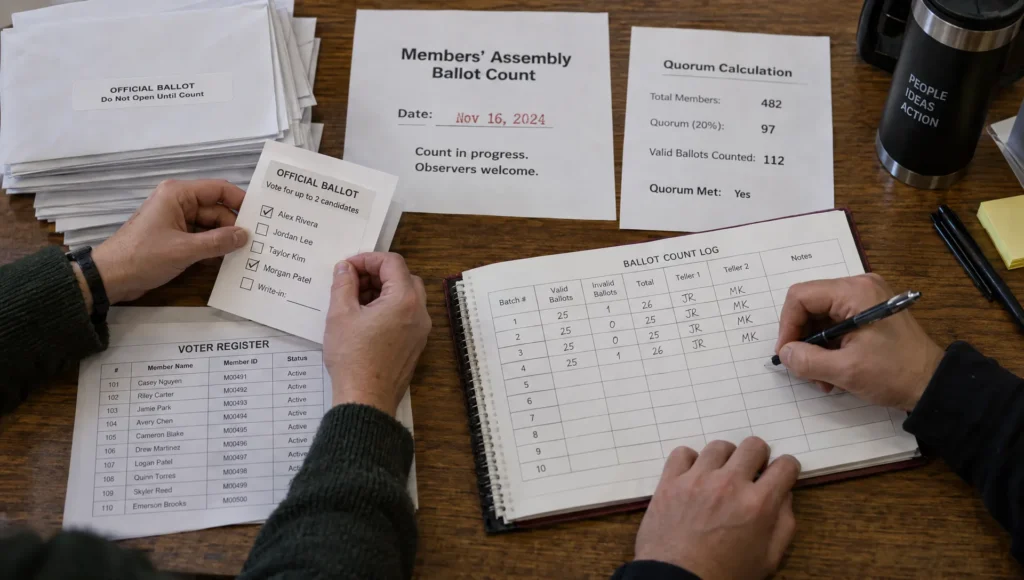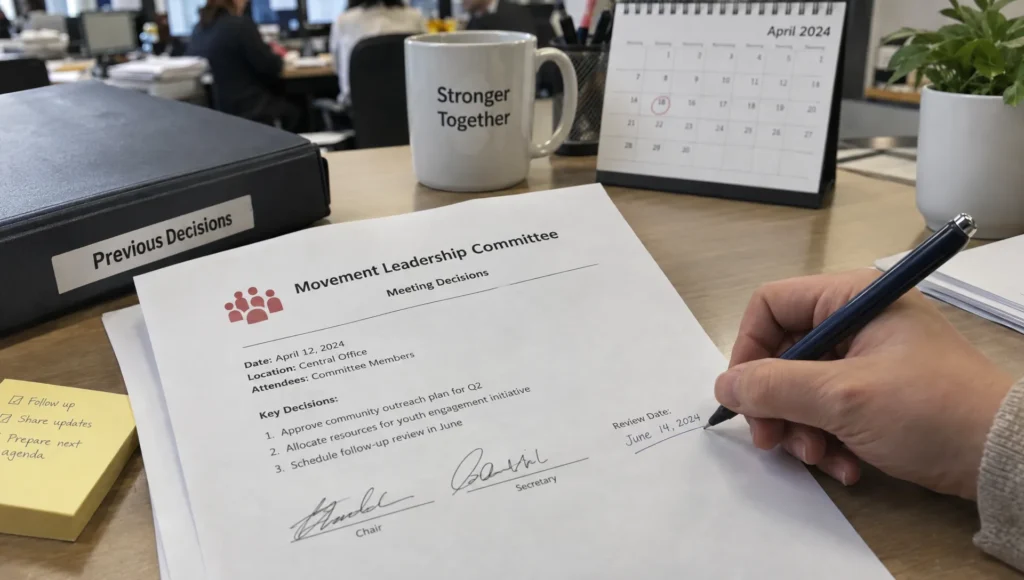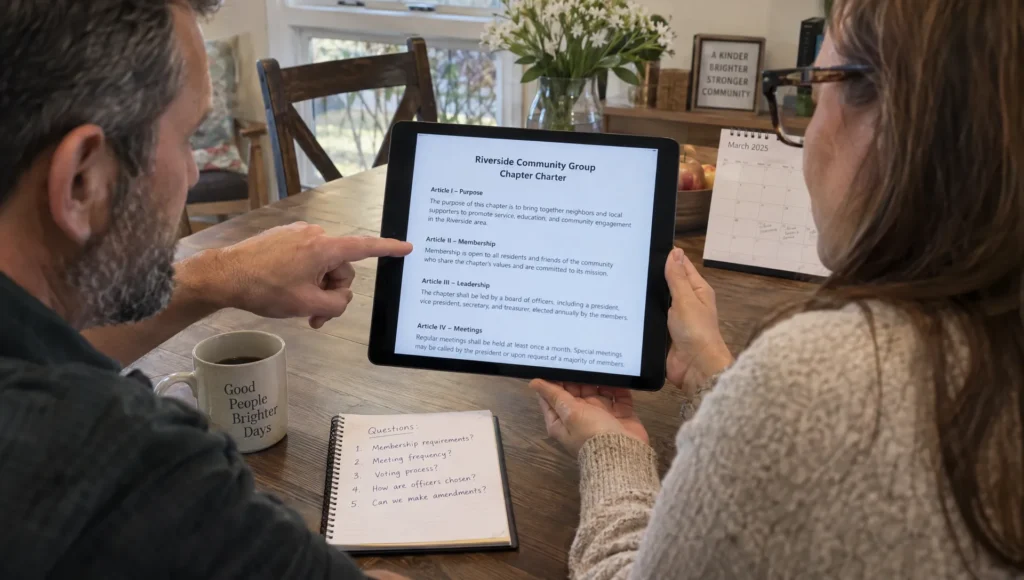
Local reform often starts before ideology enters the room. A dangerous crosswalk, a school policy that does not work, a confusing permit process, a public budget nobody understands, or a neglected park can bring neighbors together who would never vote for the same national candidate.
Then the party labels arrive.
Someone asks which side you are on. A local issue gets absorbed into a national culture war. Residents who agree on the problem stop talking because they do not want to be seen helping “the other team.” The reform loses its practical center.
That is exactly where civic participation for local reform without party loyalty becomes powerful. It does not ask people to be apolitical. It asks them to be loyal to the decision, the evidence, the community, and the follow-through before they are loyal to a faction.
Why party loyalty is a weak tool for local reform
Political parties can organize volunteers, simplify choices, and compete for power. They are not useless, and in many systems they remain a necessary part of representative democracy. But local reform often needs a different operating logic.
Most local problems are not born inside party platforms. Traffic safety, school schedules, public records, neighborhood planning, sanitation, procurement, library hours, housing rules, and local transparency do not fit neatly into left-versus-right identity boxes. They involve tradeoffs, budgets, residents with lived experience, and decision-makers who need usable input.
Many local races and boards in the United States are formally nonpartisan, although party networks can still shape endorsements, fundraising, and turnout. That mixed reality creates a strange tension: local government is close enough for citizens to influence, but party identity can still distort how people listen.
JustSocial’s manifesto, The Face of Democracy, argues that modern citizens are too often reduced to voters, taxpayers, and consumers. Local reform is where that reduction can be challenged first. Instead of waiting years to express one general preference at the ballot box, citizens can practice continuous influence around concrete public decisions.
The question is not “Which party owns this issue?” The better question is “What decision is being made, who has authority, what evidence matters, and how will the public know whether its input changed anything?”
Be loyal to the decision, not the faction
Decision loyalty means organizing around the public choice itself. It is a discipline that keeps a reform effort focused, inspectable, and harder to capture.
A decision-loyal group commits to a few simple behaviors:
- Name the specific decision and the person or body responsible for it.
- Publish the evidence, uncertainty, and tradeoffs in plain language.
- Invite residents across political identities to contribute structured input.
- Convert complaints into comparable options.
- Ask officials for a written response or public rationale.
- Track implementation after the vote, policy change, or administrative action.
This approach fits the spirit of deliberative democracy because it values reasoned judgment, not just volume. It also fits discursive democracy because it improves the quality of public conversation before decisions are made. Most importantly, it turns civic participation into a repeatable practice rather than a one-time protest or campaign slogan.
| Party-first participation | Reform-first civic participation |
|---|---|
| Starts with identity and loyalty | Starts with a local decision and public need |
| Measures success by wins for the team | Measures success by transparent changes and follow-through |
| Uses talking points to mobilize supporters | Uses evidence, testimony, and options to inform decisions |
| Treats disagreement as threat | Treats disagreement as material for better design |
| Often disappears after election season | Continues through implementation and oversight |
No party loyalty does not mean no values. It means your values are expressed through a process that neighbors can inspect, challenge, and join without surrendering their political independence.
Build a local reform process parties can support but cannot own
The practical goal is not to ban party members from participating. That would be unrealistic and undemocratic. The goal is to design the process so no party, donor, influencer, or personality becomes the gatekeeper of public voice.
A strong local reform process separates three layers:
Discursive democracy creates space for broad public framing. Residents explain what they see, what they fear, what they value, and what outcomes would count as improvement.
Deliberative democracy turns that raw input into structured options. A smaller group studies evidence, compares tradeoffs, and produces decision-ready recommendations.
Civic participation links those recommendations to official power. The group delivers the work to a council, board, agency, committee, or administrator and asks for a response that the public can verify.
This is a local version of the People’s Branch idea in the JustSocial manifesto: citizens do not replace every institution, but they become a standing source of measured, structured, and visible public judgment.

The five-part local reform stack
If you want local reform without party loyalty, do not begin with branding. Begin with infrastructure. The following stack can be used by a neighborhood group, parent coalition, student group, civic association, or local political movement that wants to stay independent.
| Layer | Core question | Public output | How it protects independence |
|---|---|---|---|
| Decision map | What decision is actually being made? | One-page Decision Note | Keeps the effort from drifting into vague outrage |
| Discourse rules | How will people speak and be heard? | Participation rules and meeting format | Prevents loud factions from dominating the process |
| Evidence commons | What do we know, and what is uncertain? | Shared evidence folder or issue pack | Reduces dependence on party talking points |
| Deliberation | What options are realistic? | Options Memo with tradeoffs | Converts disagreement into comparable choices |
| Follow-through | What did officials do with the input? | Response log and implementation tracker | Makes influence visible after the meeting ends |
The OECD Guidelines for Citizen Participation Processes emphasize clarity of purpose, accountability, inclusion, and transparency. Those principles matter even more when a group is trying to maintain independence from party machinery.
A 30-day local reform sprint without party loyalty
You do not need a party office, a major donor, or a large staff to begin. You need one decision, a small team, and a public record of your work.
| Timeframe | Goal | Artifact to publish | Success signal |
|---|---|---|---|
| Days 1-3 | Choose one local decision | Decision Note | You can name the decision owner, timeline, and authority |
| Days 4-7 | Gather basic evidence | Issue Pack | Residents can understand the problem without insider knowledge |
| Days 8-14 | Run structured public input | Claim-reason-request summary | Input is organized by reasons and requests, not party identity |
| Days 15-21 | Deliberate on options | Options Memo | At least two realistic options are compared with tradeoffs |
| Days 22-26 | Deliver to decision-maker | Public submission and receipt request | Officials acknowledge the request or place it in a process |
| Days 27-30 | Track response | Response log | The community can see what happened next |
This sprint is small by design. A local reform effort earns legitimacy by completing loops, not by announcing a grand movement before it can show results.
If the issue is a school policy, the decision owner might be a principal, superintendent, school board, or district committee. If the issue is a street, the owner might be a transportation department, city engineer, planning commission, or council member. If the issue is a public budget, the owner might be a finance committee, agency director, or elected board.
The first victory is not always policy change. Sometimes the first victory is forcing the system to become legible: who decides, when, by what rule, and with what evidence.
Rules that keep reform independent
Nonpartisan work can still be captured. A party can quietly dominate the room. A donor can set the agenda. A charismatic organizer can become impossible to question. A social media account can turn a practical reform into a loyalty test.
Independence requires rules before the conflict becomes personal.
- Open participation: Invite residents regardless of party affiliation, and make clear that no party membership is required.
- No hidden endorsements: If parties, elected officials, unions, businesses, or advocacy groups support the effort, disclose it publicly.
- Transparent funding: Publish basic income and expense summaries for the reform campaign, especially if money is used for ads, events, printing, or tools.
- Conflict disclosure: Ask organizers and speakers to disclose direct financial, professional, or political interests in the outcome.
- Role separation: Separate facilitation, evidence review, communications, and decision drafting so one faction cannot control the whole process.
- Minority reports: Let serious dissent be recorded when consensus is not possible.
- No permanent gatekeepers: Rotate meeting roles and make documents accessible to people who were not in the room.
These rules do not make a process perfect. They make it contestable. That is the real standard for trust in local civic participation: people do not have to trust the organizers blindly because they can inspect the process.
What to say when people demand a party label
A reform-first approach will confuse some people. They may assume every public issue is secretly partisan. They may ask whether you are “really” working for one side.
Prepare answers that are clear, calm, and process-focused.
| Challenge | Reform-first answer |
|---|---|
| “Which party is behind this?” | “No party owns the process. We publish our evidence, funding, meeting notes, and requests so anyone can inspect them.” |
| “Are you left or right?” | “Residents involved may be left, right, or neither. The reform is tied to a specific local decision and measurable outcomes.” |
| “Why not just elect better people?” | “Elections matter, but this decision is happening now. We want public input before, during, and after the decision.” |
| “Is this just activism?” | “It is civic participation with a decision owner, evidence, options, and follow-through.” |
| “Who gave you authority?” | “No one gave us binding authority. We are producing public judgment and asking official decision-makers to respond.” |
That last answer is important. A local reform group should not pretend to be the government. Its strength comes from making public reasoning visible enough that government cannot easily ignore it.
Use official channels without becoming a party machine
Local reform needs contact with institutions. Avoiding parties does not mean avoiding power. It means approaching power with public artifacts instead of private loyalty.
Useful channels include public comment periods, school board meetings, city council hearings, advisory committees, budget workshops, planning processes, public records requests, agency office hours, and direct meetings with decision-makers. The point is not to attend everything. The point is to enter the right channel with the right output.
A vague complaint is easy to dismiss. A decision-ready request is harder to ignore.
For example, instead of saying, “The city does not care about pedestrian safety,” a reform group might submit: “By the June transportation committee meeting, we ask the city engineer to evaluate three crosswalk options at this intersection, publish cost and safety tradeoffs, and explain which option will be selected or why no action will be taken.”
That request does not require party loyalty. It requires clarity.
For more on linking public input to official action, JustSocial’s guide on civic participation that actually changes decisions expands this decision-linked approach.
The manifesto connection: local repair as the first step toward continuous democracy
In The Face of Democracy, Yuval D. Vered argues that modern public systems still carry the inertia of industrial-era institutions. People are asked to move through schools, agencies, elections, and bureaucracies as if society has not been transformed by modern technology, networks, and data.
The manifesto’s answer is not simply “more apps.” It is a deeper shift: citizens should have ongoing ways to weigh in, organize, deliberate, and hold public systems accountable. Technology should help the public sector listen more precisely, publish more transparently, and act more intelligently.
Local reform without party loyalty is a practical entry point into that larger vision.
The Greek Polis, discussed in the manifesto through Charles Wayper, was powerful because citizens experienced political life as immediate and concrete. Modern cities and states are much larger, so we cannot simply recreate ancient assemblies. But we can rebuild the feeling that public life is not remote. A neighborhood safety sprint, a school policy deliberation, or a transparent budget process is a small act of modern Polis-building.
This is also where JustSocial’s technology-forward ideas become relevant. The manifesto proposes concepts such as TakeAction!, rParliament, rConcensus, public analytics, and transparent repositories of law and public information. Whether built by JustSocial, governments, civic groups, or aligned initiatives, the principle is the same: digital democracy tools should help citizens produce evidence, express preferences, deliberate, and track what institutions do next.
The local version can begin with simple tools: shared documents, meeting notes, public trackers, accessible summaries, and clear response logs. More advanced civic technology should come later, once the governance rules are clear.
Common pitfalls to avoid
Local reform without party loyalty can fail if independence becomes vague, anti-political, or performative. The goal is not to float above politics. The goal is to practice politics in a way that is more accountable than factional loyalty.
| Pitfall | Why it fails | Better practice |
|---|---|---|
| “We are nonpartisan” with no proof | People suspect hidden influence | Publish funding, roles, evidence, and meeting notes |
| Trying to solve every issue | The group burns out and loses focus | Pick one decision and complete one full loop |
| Avoiding disagreement | Hard tradeoffs stay hidden | Use structured deliberation and minority reports |
| Chasing attention | Visibility replaces influence | Track official responses and implementation |
| Depending on one organizer | The effort becomes personality-driven | Rotate roles and document the process |
| Treating technology as the solution | Platforms can amplify chaos | Define rules first, then choose tools |
A political movement that wants to outgrow party loyalty must become more disciplined than the parties it criticizes. It must show its work.
Frequently Asked Questions
Can local reform really be nonpartisan? It can be nonpartisan in process, even if participants have political beliefs. The key is to keep the reform tied to a specific decision, publish the rules, disclose interests, and prevent any party from controlling access or messaging.
Is refusing party loyalty the same as being politically neutral? No. You can have strong values and still refuse factional obedience. Reform-first civic participation asks people to defend their values through evidence, deliberation, transparent requests, and follow-through.
What if a party supports the reform? Accepting support is not automatically a problem. Hidden control is the problem. Disclose support, keep decision-making rules open, invite disagreement, and make sure public outputs are not rewritten into party propaganda.
What if officials ignore the group? Publish the request, the evidence, and the lack of response. Then use official channels again, recruit more residents, ask process questions at meetings, and track the silence as part of the public record. Accountability often begins with making non-response visible.
Does this approach replace elections? No. Elections still matter for choosing representatives and setting broad authority. Continuous civic participation fills the gap between elections by helping residents influence concrete decisions as they happen.
Can digital tools help local reform stay independent? Yes, if they are used for transparency, accessibility, evidence organization, structured input, and implementation tracking. They can also harm the process if they reward outrage, hide moderation rules, or turn participation into vanity metrics.
Build local power without surrendering your independence
If you want better public decisions but do not want to become a party loyalist, start locally. Choose one decision. Build a public record. Invite people who disagree. Produce options. Ask for a response. Track what happens.
That is civic participation as democratic infrastructure.
JustSocial exists to advance continuous direct democracy, citizen empowerment, transparency, and technology-driven participation. If this approach speaks to you, read The Face of Democracy, explore JustSocial.io, and consider how you can contribute as a citizen, organizer, educator, technologist, researcher, volunteer, or supporter.
The future of democracy will not be built only by parties. It will be built by people who learn how to act together without surrendering their judgment.