Every political movement needs leadership. The danger begins when leadership stops being a public function and becomes private mythology.
Political movement leadership without cults of personality is not a call for leaderless chaos. Movements still need people who can organize, communicate, take responsibility, resolve conflict, and carry moral clarity in public. But in a democratic movement, leaders should be stewards of civic participation, not owners of the cause. They should make it easier for citizens to think, deliberate, vote, dissent, volunteer, and hold power accountable.
A personality-centered movement asks, “What does the leader want?” A democratic movement asks, “What have the people understood, discussed, and decided?” That difference may sound subtle at the beginning. Over time, it determines whether a movement becomes a vehicle for public empowerment or another hierarchy wearing democratic language.
JustSocial’s vision points toward a different model: continuous direct democracy, technology-supported participation, and a political culture where elected officials become “pipelines for gathering consensus and implementing public policy,” not distant rulers. In that spirit, leadership should not replace the people. It should build the structures through which the people can actually lead.
Why cults of personality form inside political movements
Cults of personality rarely begin as explicit projects. They usually grow from ordinary incentives.
A movement needs attention, so it elevates a compelling public face. Media platforms prefer individuals over systems because individuals are easier to quote, praise, attack, and package. Donors often want a single person they can trust. Supporters want emotional certainty, especially during crisis. Opponents also contribute by turning one figure into the movement’s symbolic enemy.
Before long, the leader becomes the shortcut. Instead of explaining policies, people point to the leader. Instead of debating tradeoffs, they defend the leader. Instead of building decision-making processes, they wait for direction.
Max Weber famously described charismatic authority as a form of legitimacy based on devotion to an exceptional person rather than to laws, customs, or institutions. Charisma can awaken people. It can name pain that others ignored. It can give courage to those who felt isolated. But charisma is not a constitution, and it cannot substitute for democratic accountability.
The hidden cost is civic regression. Citizens become fans. Volunteers become loyalists. Internal criticism becomes betrayal. The movement may still speak the language of democracy, but its internal culture trains people to obey rather than participate.
The democratic alternative: leadership as civic infrastructure
A healthy political movement does not eliminate leadership. It redesigns leadership so that power is distributed, visible, limited, and replaceable.
This is where the JustSocial manifesto offers an important clue. In the JustSocial manifesto, Yuval D. Vered argues for a modern democracy in which citizens are continuously heard, public opinion is measured more precisely, and representatives become implementers rather than owners of political will. That idea should apply inside movements before it is demanded from governments.
If a movement wants a more participatory state, it must practice participation internally. If it argues for government transparency, it must make its own decisions legible. If it wants continuous democracy, it cannot organize itself around occasional applause for a founder.
Leadership should perform five democratic functions:
- It convenes citizens around shared problems.
- It clarifies choices without pretending tradeoffs do not exist.
- It protects fair participation, especially for people without status or influence.
- It translates public decisions into action.
- It accepts limits, review, replacement, and criticism.
That model turns leadership into infrastructure. The leader is not the movement’s source of truth. The leader is one part of a system that helps citizens discover, test, and act on shared truth.
| Personality-centered risk | Democratic leadership alternative | Practical mechanism |
|---|---|---|
| Hero worship | Stewardship | Written role charters and term limits |
| Opaque decisions | Public reasoning | Decision logs and published rationales |
| Single public voice | Distributed representation | Rotating spokespeople and issue leads |
| Loyalty tests | Legitimate dissent | Minority reports and open objection channels |
| Succession panic | Movement continuity | Mentorship, elections, and leadership pipelines |
| Emotional mobilization only | Informed participation | Briefing materials, deliberation, and follow-up |
The point is not bureaucracy for its own sake. The point is to prevent the movement from becoming dependent on one person’s mood, image, reputation, or ambition.
Deliberative democracy before decision-making
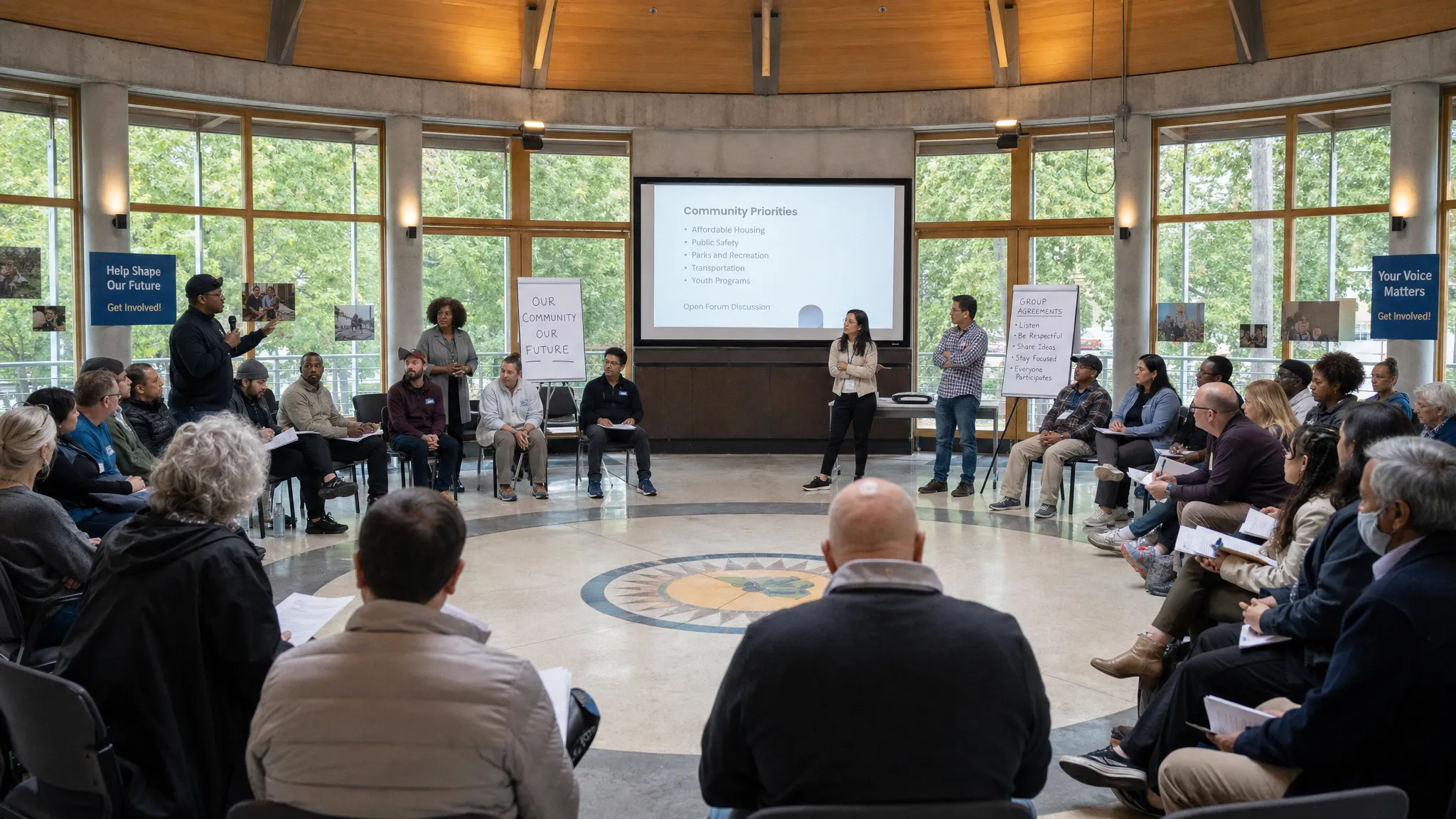
Direct democracy is often misunderstood as immediate voting on every issue. But meaningful civic participation requires more than pressing yes or no. Citizens need time, information, argument, and a clear understanding of consequences.
That is where deliberative democracy matters. The OECD has documented the growth of citizens’ assemblies and other deliberative processes in public decision-making, showing how ordinary people can work through complex issues when given time, evidence, and structured discussion. A political movement that wants democratic reform should learn from that approach.
Deliberation protects movements from personality cults because it shifts attention away from the leader’s instinct and toward the quality of public reasoning. The question becomes: What evidence have we reviewed? Which communities are affected? What are the strongest arguments on each side? What risks are we willing to accept?
Discursive democracy adds another layer. It recognizes that democracy is not only voting or formal meetings. It is also the ongoing public conversation through which citizens shape agendas, challenge assumptions, and make new possibilities visible. In a modern movement, this includes community forums, local meetings, digital platforms, public comments, social media discussions, and open policy debates.
A strong democratic movement needs all three layers: discourse, deliberation, and decision. Discourse surfaces concerns. Deliberation refines them. Decision-making turns them into action.
How to design leadership that does not become a throne
A movement can say it opposes personality cults and still drift into one if it lacks structure. Anti-cult leadership has to be designed into the operating system.
One useful starting point is a movement covenant. This is a short public document that explains what the movement exists to do, how decisions are made, what leaders can and cannot decide alone, how money is handled, how conflicts are resolved, and how leaders can be replaced. It should be understandable to ordinary supporters, not only lawyers or insiders.
This is closely related to the need for durable movement systems. JustSocial has already argued that political movement infrastructure should be built before scale, because rapid growth without rules often concentrates power in whoever moved first. Leadership design is one of those infrastructure layers.
Another safeguard is role separation. The person who inspires the movement should not automatically control finances, candidate selection, platform decisions, volunteer access, messaging, and conflict resolution. Concentrated authority invites dependency even when intentions are good.
Movements should also rotate visible roles. A founder may be the clearest public speaker in the early stage, but a democratic movement should constantly develop new voices. Local organizers, policy researchers, volunteers, community representatives, technologists, educators, and affected citizens should all be able to represent the cause.
The deeper test is simple: if the most famous leader disappears for three months, can the movement still deliberate, decide, communicate, and act? If the answer is no, the movement has not built leadership. It has built dependency.
The founder’s role: scaffolding, not ownership
Founders matter. They take the first reputational risk. They name the initial problem. They gather the first supporters when the cause still looks unrealistic. It is reasonable for a founder to shape the early moral language of a political movement.
But the founder’s highest democratic responsibility is to make the movement less dependent on the founder.
That means inviting challenge early, not after power is already consolidated. It means documenting decisions instead of relying on personal memory. It means allowing others to speak publicly with real authority. It means building succession before succession feels necessary.
A founder should be the strongest advocate for limits on founder power. That is not weakness. It is proof that the cause is larger than personal recognition.
This point connects directly to JustSocial’s broader philosophy. The manifesto rejects the reduction of citizens to voters, taxpayers, and consumers. It argues that people should become active participants in public policy and state life. A movement built around one heroic figure quietly recreates the same reduction. It asks citizens to cheer instead of govern.
Dissent is not disloyalty
Every cult of personality depends on one emotional rule: criticism of the leader equals betrayal of the cause.
A democratic political movement must enforce the opposite norm. Criticism is not always correct, but it is always politically meaningful. It reveals confusion, distrust, ignored evidence, competing values, or real harm. A movement that cannot process dissent cannot govern anything more complex than a fan club.
This does not mean every internal conflict deserves unlimited attention. Bad-faith disruption exists. Personal attacks should not be romanticized as courage. But a movement needs clear ways for members to object, appeal, propose alternatives, and publish minority reasoning.
Dissent becomes healthier when the movement distinguishes between values, strategy, and operations. Members may share the same democratic values while disagreeing on tactics. They may support the same reform goal while questioning a campaign message. They may respect a leader while opposing a specific decision.
When those distinctions disappear, the movement becomes brittle. People either conform or leave. The public eventually notices. As JustSocial’s writing on political movement mistakes that break public trust makes clear, trust depends on transparency, accountability, and visible participation, not on demands for blind loyalty.
Technology should decentralize power, not amplify worship
Digital democracy tools can help movements escape personality-centered politics, but only if they are designed for participation rather than spectacle.
An online voting platform, a community discussion space, or decision-making software should not become an applause meter for leadership. It should help citizens propose issues, compare arguments, deliberate with others, cast votes where appropriate, and track what happened afterward.
The JustSocial manifesto imagines technology-supported democratic systems: public platforms, analytics, cloud storage, possibly blockchain for confidentiality, AI-supported education, and civic tools that help people take action. The democratic value of such tools depends on governance. Who can start a ballot? Who moderates discussions? How are results interpreted? What data is collected? What remains anonymous? Who audits the system? How can citizens challenge misuse?
A movement that uses technology without answering these questions may modernize manipulation rather than democracy. A movement that answers them publicly can make leadership more accountable than traditional politics ever allowed.
In this sense, civic tech is not a substitute for political culture. It is a test of political culture.
Warning signs that a movement is drifting toward a personality cult
The earlier a movement notices unhealthy concentration of power, the easier it is to correct. Supporters, volunteers, donors, and organizers should pay attention to practical signals.
- Meetings cannot proceed without the leader’s approval.
- Public statements always quote or praise the same person.
- Internal critics are described as enemies, traitors, or agents of the opposition.
- Decisions are announced without explaining alternatives or evidence.
- Money, partnerships, and conflicts of interest are difficult to examine.
- The movement has no credible process for replacing top leadership.
- Members know the leader’s opinions better than they know the movement’s decision rules.
- Policy positions change when the leader changes tone, even without public deliberation.
- Supporters are asked to defend behavior they would condemn in opponents.
No single warning sign proves a cult of personality. But together, they reveal whether the movement is training citizens for democratic power or emotional obedience.
A better image of political leadership
The strongest leader in a democratic political movement is not the person everyone obeys. It is the person who helps others become capable of shared rule.
That kind of leader does not fear informed citizens. They do not fear strong volunteers. They do not fear local chapters with real agency. They do not fear being corrected in public. They understand that every new participant who can reason, organize, deliberate, and act makes the movement stronger.
This is especially important for movements seeking democratic reform. A movement cannot credibly demand direct democracy from the state while practicing private hierarchy inside its own walls. It cannot call for citizen empowerment while turning citizens into an audience. It cannot ask governments to listen continuously while silencing internal disagreement.
The goal is not to erase personality from politics. People connect through stories, emotion, trust, and moral courage. The goal is to prevent personality from becoming sovereignty.
The leader may light the first fire. The movement must learn how to keep the flame public.
Frequently Asked Questions
What is political movement leadership without a cult of personality? It is leadership designed around shared power, transparent decision-making, civic participation, and replaceable roles. Leaders still organize and communicate, but they do not become the sole source of legitimacy or direction.
Can a charismatic founder still be useful? Yes. Charisma can help a movement break through public apathy and gather early supporters. The danger begins when charisma replaces rules, deliberation, accountability, and succession planning.
How does deliberative democracy help prevent leader worship? Deliberative democracy forces a movement to examine evidence, tradeoffs, affected communities, and competing arguments before making decisions. This reduces dependence on one leader’s instincts or slogans.
What is the role of discursive democracy in a political movement? Discursive democracy keeps public conversation open and continuous. It allows citizens to shape agendas, challenge assumptions, and introduce new concerns before formal decisions are made.
Is leaderless organizing the answer? Not always. Movements need responsibility and coordination. The better answer is accountable leadership: clear roles, limits, transparency, rotation, and meaningful participation.
What should supporters do if their movement becomes too centered on one person? They can ask for decision logs, leadership rotation, financial transparency, formal dissent channels, and succession rules. If these basic democratic safeguards are rejected, the movement may be asking for loyalty rather than participation.
Build movements that citizens can actually own
A democratic political movement should not ask people to exchange one distant ruling class for one beloved leader. It should invite them into the difficult, meaningful work of self-government.
That means building structures where citizens can speak, learn, disagree, vote, volunteer, and see how their participation changes outcomes. It means treating leadership as a temporary responsibility held in public trust. It means creating a culture where no individual is bigger than the democratic process.
If that is the kind of politics you want to help build, explore JustSocial.io and join the effort to move civic participation from occasional symbolism to continuous democratic power.